

Quick Overview: Asking the right questions to hire developers can save you from costly mistakes and mismatched teams. This guide covers 10 essential questions to hire dedicated developers, covering experience, communication, engagement models and technical fit before you sign any contract.
Hiring the wrong developer is expensive. It can delay your launch, blow your budget, and leave you with code that no one wants to touch. That’s why the questions you ask to hire developers during the hiring process matter so much. Asking the right questions helps you identify talented, reliable developers early. The wrong questions or no questions at all leave you guessing.
This blog walks you through the top questions to hire developers, whether you are hiring one freelancer, building a dedicated team, or a software development outsourcing company you’re working with. There’s also a bonus section with questions for software engineer interviews, a comparison of hiring models, and answers to common hiring concerns.
Let’s start with a short answer: before you hire dedicated developers, ask about their experience with your tech stack, their past projects, how they communicate, how they test their code, their pricing model, and their contract terms. These six areas cover almost every risk you will face when hiring developers.
Let’s go through each one in detail.
Why Asking the Right Questions to Hire Developers Matters
People are at the heart of every software project. A good developer will take a rough idea and build it into a working product. A poor hire can turn a simple project into a long, costly mess. This principle is true whether you are scaling an enterprise team or hiring dedicated developers for a startup.
When you ask good questions to hire developers, three things happen. It has technical ability. It shows how a person reacts under pressure. Additionally, it indicates whether the candidate will align with your team culture and communication style. The model offers more flexibility, and many businesses today prefer to hire dedicated developers rather than build a full in-house team from scratch. Skipping this step is one of the most common and costly hiring mistakes a business can make.
The Real Cost of a Bad Hiring Decision
A bad developer hire rarely appears on day one. It shows up weeks later, in the form of missed deadlines, buggy code, or a project that needs to be rebuilt from scratch. Many of these problems trace back to common hiring mistakes businesses make when they rush the process. Rehiring, retraining, and rewriting code costs far more than spending extra time on questions to hire developers upfront.
Dedicated Developers vs. Freelancers vs. In-House Teams
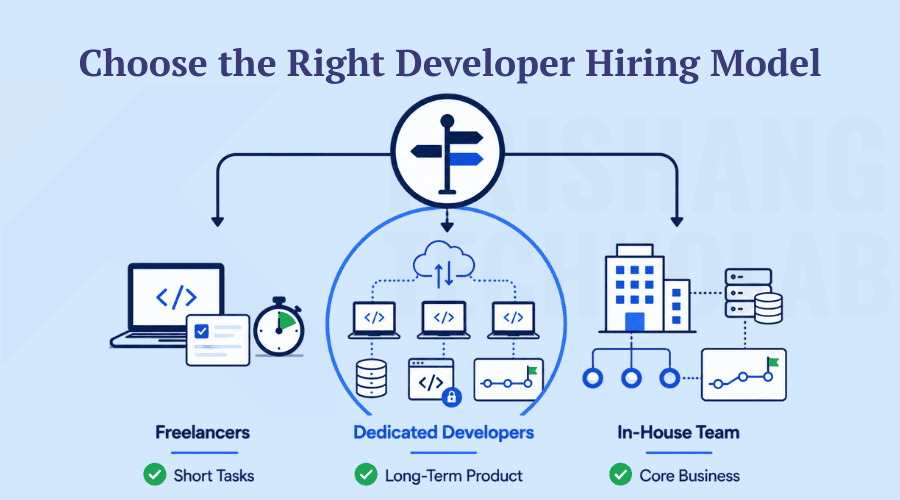
Not every project requires the same hiring model. Here’s a simple side-by-side comparison to help you decide.
| Hiring Model | Best For | Cost | Control |
| Dedicated Developers | Long-term projects, ongoing product work | Medium, predictable | High |
| Freelancers | Short tasks, one-off fixes | Low to medium, variable | Low to medium |
| In-House Team | Core, long-term products | High | Highest |
If you want steady progress without the overhead of a full in-house team, understanding the trade-offs between dedicated developers and freelancers will allow you to select developers that can work as an extension of your business.
The Complete Checklist of Questions to Hire Developers
Here’s the basic checklist. Below are some questions with the short direct answer first, followed by more detail so you know exactly what to listen for.
1. What Is Your Experience With Our Required Tech Stack?
Direct answer: Ask the developer to walk you through real projects that used your exact stack, not just a list of skills on a resume.
Technology moves fast. A developer who lists ten languages on their profile may only have profound experience in one or two. Specific examples of projects built using your stated frameworks, languages, and tools. If your project is in Node.js or PHP, ask when they last used it and what kind of project it was. This is one of the most relevant questions to hire developers because a skills mismatch here causes problems later in the project, not at the beginning.
2. Can You Show Examples of Relevant Past Projects?
Direct answer: A strong portfolio should include projects similar in size, industry, or complexity to yours, with clear outcomes.
What you’ve done in the past says so much more than any answer you could provide in an interview. Request to see live products, case studies or code samples. Check out similar projects in scope to what you are planning. Full-stack developers should be able to show work across both front-end and back-end layers for a broader skill set. This is the heart of learning how to vet software developers properly.
3. What Is Your Communication and Collaboration Process?
Direct answer: Ask which tools they use, how often they update you and how they handle time zone differences.
Good code is of no use if updates are unclear or delayed. Inquire about their communication preferences, whether it be Slack, Zoom, or project management tools like Jira, and Trello. Ask about how often they update their status and how well they work with different time zones. The question becomes even more important if you’re thinking of hiring remote developers, because once a project is underway, it’s harder to fix communication gaps.
4. How Do You Manage Projects and Track Progress?
Direct answer: Look for a clear process involving sprints, milestones and regular reporting, not vague promises of “we’ll keep you updated.”
If a developer is unable to articulate their work tracking methods, they will likely be difficult to manage once the project begins. Ask them if they’re Agile or Scrum, how they break a project into sprints, and what their reporting looks like in practice. Some developers may simply say they will “keep you posted” without providing any further information. An idea alone isn’t a process; you need defined steps and details to put it into practice. Weekly check-ins. Sprint boards: you can look at yourself. A status report you can expect every Friday. The more specific the answer, the less likely you are to be chasing updates two months later.
5. What Quality Assurance Practices Do You Follow?
Direct answer: Ask about their testing types, code review habits and how they catch bugs before launch.
Nobody wants to find out about a broken checkout flow after the product is live. Ask whether they run unit tests, integration tests, and user acceptance testing, or if testing is something they do “when there’s time.” Ask if someone else reviews their code before it gets merged, since a second pair of eyes catches problems the original developer misses. This holds true whether you bring on Node.js developers or a team working in a totally different stack. If a developer treats QA as a real step, not an afterthought, they tend to hand you software that actually works when you need it to.
6. How Do You Handle Tight Deadlines or Scope Changes?
Direct answer: A good developer explains their process for prioritizing tasks, and communicating delays early, not hiding them until the deadline.
Projects seldom proceed as planned. Ask the developer how they handle pressure, changing requirements or unforeseen roadblocks. Ask for a clear, organized response instead of vague reassurances. This question will separate the developers that panic under pressure from those that can adapt.
7. Can You Provide Client References or Testimonials?
Direct answer: Ask for at least two references you can actually contact, not just written testimonials on a website.
References confirm what a portfolio cannot: how the developer behaves on a real project. If you have worked with PHP developers or any other specialized team, ask past clients about communication, reliability and whether the final product met expectations. This is one of the simplest questions to hire developers that people skip, even though it takes only a few extra minutes to check.
8. What Is Your Pricing and Engagement Model?
Direct answer: Confirm whether pricing is hourly, fixed-price, or a monthly dedicated developer hiring model and what exactly is included.
There are no universal pricing models and choosing the wrong one for your project is where budgets spiral. You can think of it fast like this:
| Engagement Model | How It Works | Best For |
| Hourly | Pay per hour worked | Small or unclear-scope tasks |
| Fixed-Price | One agreed price for defined scope | Well-defined, short projects |
| Dedicated Monthly | Fixed monthly fee for a dedicated developer or team | Long-term, ongoing projects |
Clarify upfront what is included, such as project management, testing, and support after launch. This matters whether you engage a single developer, or a full software development outsourcing partner. Surprise costs are one of the biggest complaints businesses have after they hire dedicated developers without a clear contract.
9. Will You Sign an NDA and Assign IP Rights?
Direct answer: Always confirm in writing that the developer will sign a non-disclosure agreement, and transfer full intellectual property rights to you.
This one’s non-negotiable, and honestly it should be the easiest question on this list to get a “yes” to. Before you start any work, ensure that the developer or outsourcing company will sign a non-disclosure agreement and put in writing that the code will be your property once you have paid for it. Skip this one, and you’re inviting ownership disputes down the road, which is a headache no one needs after a project’s already shipped.
10. What Happens If a Developer Underperforms or Leaves the Project?
Direct answer: Ask about their backup, and replacement policy so a single person leaving does not stall your entire project.
Even skilled developers may leave a project for reasons like illness, other commitments, or performance issues. Ask what backup process is in use. A reputable agency or a specialized developer hiring agency should have a replacement plan and proper knowledge transfer so your project does not lose momentum.
Bonus: Questions for Software Engineer Technical Screening
Beyond vendor-level questions to hire developers, you also need strong questions for software engineer technical interviews when evaluating software developers directly. This section helps you dig deeper into individual skill and mindset.
Technical Questions to Ask During the Interview
Ask them to describe a recent project, how they arrived at their decisions and why they did what they did. Ask them how they would debug a slow application or structure code to scale. Answers here separate people who’ve actually done the work from people who’ve memorized the right words to say.
Behavioral and Problem-Solving Questions
Ask about a time they disagreed with a teammate over a technical call and how it got resolved. Ask how they figure out what to work on first when everything feels urgent at once. The best engineers can talk through their thinking calmly, even when the situation they’re describing wasn’t calm at all.
Red Flags to Watch For in Answers
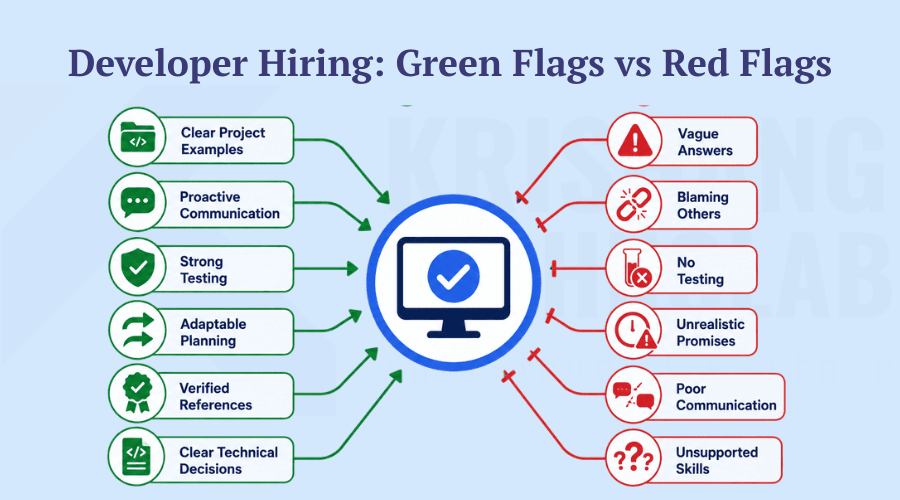
Beware of vague answers that don’t have real examples behind them. Beware of candidates who blame everyone else for every failed project. And be suspicious if they seem to have trouble explaining elementary concepts in the precise field where they say they excel. These are often indicators of the resume saying more than the person can actually back up.
How to Hire Dedicated Developers the Smart Way
Once you have your list of questions to hire developers ready, the next step is to find the right hiring partner. Following the steps involved in hiring a dedicated development team can help you pre-vet the talent and spend less time screening and more time building, which can simplify this process.
What Should a Vetting Process Include
A strong vetting process includes technical tests, live coding exercises and interviews designed to assess both skill and communication. As with other IT staff augmentation services agencies, Krishang Technolab generally conducts multiple rounds of interviews before presenting candidates to a client.
Choosing Between Freelancers, Agencies, and Offshore Teams
Freelancers can do small tasks if you want speed and low commitment. When you need reliability, structure and long-term support, the offshore development center is usually the safer choice.
Many businesses now look to hire developers in India for cost efficiency without sacrificing skill since the region has a large pool of experienced engineers across web, mobile, and full-stack development.
Some companies with longer-term needs that go beyond a single project will look at a global capability center instead, which gives them a dedicated permanent extension to their business.
For businesses that prefer to keep hiring closer to home, it’s also possible to hire dedicated developers USA through an agency that handles vetting and onboarding on your behalf, without the added complexity of managing an entirely offshore setup.
If you need a custom software development agency to guide you from planning to launch, Krishang Technolab offers dedicated developers, full-stack teams and staff augmentation support built around your project needs.
Common Mistakes to Avoid When You Hire Dedicated Developers
Many businesses rush the hiring process and skip the questions to hire developers that matter most. Some common mistakes include hiring based on price alone, skipping reference checks, not clarifying IP ownership and failing to test communication before the project starts. Avoiding these mistakes early on, especially when you are planning to hire dedicated developers for a long-term engagement, can save you considerable time and cost later on.
Conclusion
Asking the right questions is the first step toward choosing the right development partner. The questions to hire developers covered in this guide, from tech stack experience to contracts to backup plans, offer a clear, actionable checklist that you can apply to any hiring decision.
If you are looking to hire dedicated programmers or full-stack developers or explore a dedicated developer hiring model for a long-term project, taking the time to ask these questions to hire developers protects your budget, your timeline and your final product.
If you are ready to hire dedicated developers who already have the skill and reliability you need, then finding out more about the variety of software development services offered by Krishang Technolab can help you build the right team for your project.
Frequently Asked Questions
What are the most important questions to hire developers?
The most important things include tech stack experience, examples of previous projects, communication process, quality assurance habits, and contract terms like NDAs and IP rights. If you can answer these five, you’ve covered most of the risk in a hiring decision.
What questions should I ask a software engineer before hiring?
Ask about a recent project they worked on, hands-on. Ask how they would go about debugging or scaling an application, and how they deal with disagreements or priorities shifting. What they say back to you tells you more than any line on a resume.
How much does it cost to hire dedicated developers?
It depends on the model you pick. Hourly rates are best for small or ill-defined jobs; fixed pricing is good for short, well-defined projects; and a dedicated monthly arrangement is best for long-term, ongoing work.
What is the difference between hiring a freelancer and a dedicated developer?
Freelancers tend to work on smaller, more independent jobs with less daily oversight. Dedicated developers working as part of your team on a continuous basis tend to mean more consistency and tighter alignment with your project.
How long does it take to hire a dedicated developer team?
Go through a pre-vetted agency and you could have a team in place within one to two weeks. Source and interview candidates on your own, and that timeline can stretch into months.
Found this post helpful? Don't forget to share it with your network!



)