
Quick Overview: Dedicated developer hiring shouldn’t be a gamble. This guide breaks down exactly how to evaluate technical skills, portfolios, and communication before you commit plus real red flags to watch for and a practical checklist, so your dedicated developer hiring decision is backed by evidence, not guesswork.
Hiring the right developer can make or break a software project. Whether you’re building a new application, improving an existing platform, or growing your development team, the right technical hire helps you move faster without sacrificing quality, which is precisely why dedicated developer hiring deserves a real process rather than a gut call.
For many businesses, hiring a dedicated developer is the practical middle ground; you get specialized skills without the overhead of building out a full in-house team. But finding the right person takes more than skimming resumes and comparing hourly rates. If you’re a startup weighing this route for the first time, it’s worth reading up on hiring dedicated developers before you commit to a model.
Whether you want to hire a dedicated developer, you’ll need to look past the surface: technical expertise, relevant experience, communication, problem-solving ability, availability, and how well they’ll actually fit your project.
This guide walks you through how to evaluate a dedicated developer before hiring, covering everything dedicated developer hiring actually requires and what to look for as you compare candidates. For a broader look at the process itself, our guide on how to hire dedicated developers is a useful companion read.
1. Start by Defining Your Project Requirements
But before you start hunting for a dedicated developer, you have to know what your project wants.
This sounds obvious, but skipping it is the most common mistake. A clear picture of your requirements makes it far easier to spot candidates with the right technical background. Begin with the basic goals, scope, timeline, budget, tech stack, and what the role will actually be responsible for.
Maybe you need a frontend developer who knows React inside out. Maybe it’s a backend specialist in Node.js. Or maybe you need someone full-stack who can move between application development and database work without missing a beat, in which case it’s worth checking what to look for when you hire a full-stack developer specifically.
You’ll also want to think through how this person fits into your team. Are they working solo, collaborating closely with your internal developers, or owning a specific feature end to end? Businesses in locations such as Seattle and California often need to carefully consider these factors, particularly when the intention is to hire remote developers located outside their timezone.
The clearer your requirements going in, the easier the rest of this process becomes and the smoother dedicated developer hiring turns out to be overall.
Read About: Hire Dedicated Developers for Startups
2. Evaluate Their Technical Expertise
Technical expertise is usually the first thing people check when they want to hire a dedicated software developer and for good reason.
However, a lengthy list of programming languages on a resume doesn’t provide much insight. But what matters is how you have used those skills on real projects.
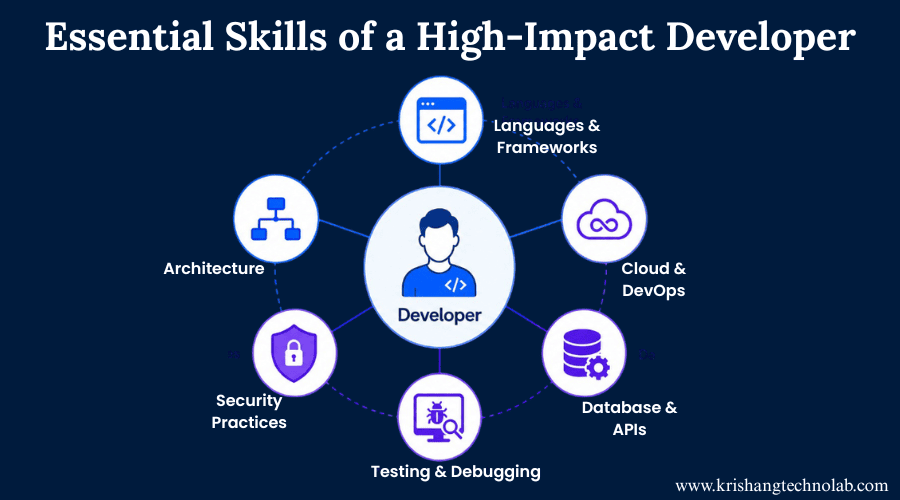
Verify their experience with the particular technologies your project needs: frontend and backend frameworks, databases, APIs, cloud platforms, DevOps tools, testing frameworks, security practices, and whatever is relevant to you.
Don’t ask in the interview if they know a technology. Get them to talk you through how they have used it:
Please share your experience working on a project with React. What challenges did you come up against and how did you deal with state management and performance?
That kind of question reveals a lot more than a simple yes/no about whether someone “knows React.”
Before you hire dedicated developers, it’s also worth digging into how they think about software architecture, debugging, testing, version control, performance optimization, and secure coding, not just whether they can write functioning code.
3. Review Relevant Development Experience
When you hire a dedicated developer, don’t just weigh the years of experience.
Relevant experience often matters more than raw tenure. Say you’re building an e-commerce application. A developer who understands payment gateways, inventory systems, customer accounts, APIs, and scalable databases is probably going to do better than someone with more years in the business but no experience in that area.
Ask them about the projects they worked on and what they were really responsible for. Were they handling architecture and deployment, or just writing code for a small piece of a much bigger system?
If you’re looking to hire a dedicated developer in Australia, for instance, try to find candidates whose past work lines up closely with your own technical and business needs.
It’s also worth asking about the toughest technical problem they’ve had to solve. How they answer tells you a lot about how they think through problems and land on practical solutions.
4. Analyze Their Portfolio Carefully
A portfolio is one of the best windows into a developer’s real experience, but don’t judge it on visuals alone.
When you’re reviewing dedicated developers for hire, pick a few projects that are close to what you actually need and ask the candidate to walk you through their part in it.
Find out:
- What was their specific role?
- Which technologies did they use?
- What problems did they have?
- And how did they solve them?
- What part of the project did they personally build?
If you’re considering a dedicated developer in Seattle, for example, ask them to explain how they tackled performance, APIs, authentication, scalability, or integrations on a past project.
It’s also worth figuring out the difference between projects they built solo versus ones where they were one of many people on a large team.
A strong portfolio shows more than finished screens; it shows practical skill, sound technical judgement, and the ability to actually solve business problems.
5. Test Their Problem-Solving Ability
Writing code is only part of the job. Being able to think through a problem and land on a workable solution matters just as much.
Real projects rarely go exactly to plan: bugs show up, requirements shift, performance dips, integrations break, and technical limitations get in the way.
Give candidates a realistic scenario tied to your project and see how they’d approach it.
For example: “An API that was fast is now quite a bit slower after a new feature was delivered. How would you go about investigating it?”
You’re not looking for one “correct” answer here. You’re paying attention to how they think.
Do they ask clarifying questions first? Are they considering DB queries, logs, infrastructure, recent code changes, and third-party services? Can they walk you through the steps they would take to trace the root cause?
If you hire a dedicated developer, a good sign of someone who can handle challenges on their own is a structured approach to problem solving.
6. Conduct a Practical Coding Assessment
A practical assessment tells you whether someone’s claimed skills actually hold up.
It doesn’t need to be elaborate; a bug fix, a small feature, an API endpoint, or a review of existing code all work fine.
Don’t just check whether they finish the task. See how they achieve code quality, code readability, code maintainability, error handling, testing, and security. See how well they can justify their choices.
It’s also worth noticing whether they ask insightful questions before diving in. Developers who start coding before understanding the requirements tend to make more mistakes down the line, not fewer.
For anything substantial, consider a paid trial project instead of asking for hours of free work. It’s fairer to the candidate, and it gives both sides a much more realistic sense of what working together would actually look like. This single step alone tends to separate serious, dedicated developer hiring from guesswork.
7. Ask Experience-Based Interview Questions
A good interview is more than simply asking textbook technical questions.
The experience-based questions will give you an idea of how a person has actually dealt with real situations, not what they know in theory.
Try questions like:
- “Tell us about the most difficult technical problem you’ve solved.”
- “What was the biggest challenge on your last project?”
- “Walk us through a production issue you had to fix.”
- “Have you ever disagreed with a technical decision? How did you handle it?”
- “If you rebuilt one of your past projects today, what would you do differently?”
Look for answers that are specific and have real examples, not just vague generalities.
“Good candidates should be able to describe what happened, what they did, how they did it and what they learned from it.”
This type of question is particularly beneficial when you have a handful of candidates to choose from and are trying to find out which dedicated developer for hire is actually the best fit for your project.
8. Assess Communication Skills
Technical skill alone won’t carry a long-term working relationship.
Once you hire a dedicated developer, that person will likely be talking regularly with project managers, designers, other developers, stakeholders, and sometimes customers directly.
Weak communication leads to misunderstandings, delays, duplicated effort, and costs that creep up quietly over time.
Pay attention to whether the developer can explain technical ideas clearly, understand what you’re actually asking for, give useful progress updates, and flag problems early rather than after they’ve already caused damage.
This is especially true for remote and international teams. For example, a company in the USA that is working with developers in India needs strong communication habits to keep everyone truly aligned, not just technically connected.
In the interview, see if they are actually listening and asking questions that show they understand your project. Someone who takes the time to get your requirements right before the contract starts is far more likely to keep communicating well afterward.
9. Consider Team and Cultural Fit
A dedicated developer might be part of your team for months, sometimes years. That’s long enough that fit matters just as much as raw skill.
How does the candidate respond to feedback? How do they deal with disagreement? And how do they take ownership and adapt when requirements change under them?
You might ask:
“How would you handle a disagreement with another developer over a technical approach?”
Or:
“What would you do if the project requirements changed right before an important deadline?”
Their answers say a lot about how they’ll collaborate, how flexible they actually are, and how much ownership they take for their own work.
You’re not trying to find a clone of your existing team. You want somebody who is adaptable, gets along with others, and really owns their deliverables.
10. Confirm Availability and Time Zone Compatibility
Availability needs to be nailed down before you hire dedicated developers, not discovered after the contract’s already signed.
Get clear on how many hours they can actually dedicate to your project and whether they’re juggling other clients at the same time.
Time zones matter too, though a difference in hours doesn’t automatically doom collaboration; you just need enough overlap for the meetings and discussions that actually count.
A company in California hiring a dedicated developer in India, for instance, needs to work out overlapping hours that cover updates, meetings, and anything urgent that comes up.
It’s worth agreeing early on communication channels, response times, meeting schedules, holidays, and what happens if something urgent lands outside normal hours. Establishing these expectations up front will save you a lot of friction later.
Do you Know: Why 68% of Startups Hire Dedicated Development Team
11. Evaluate Security Awareness
Security deserves real attention before you hire a dedicated software developer, especially if they’ll have access to source code, customer data, databases, or cloud infrastructure.
Ask how they approach secure development, authentication, authorization, data protection, access control, dependency management, security testing, and all of it.
You’ll also want confidentiality and intellectual property terms spelled out clearly in your agreement.
A developer worth hiring understands that security isn’t something you bolt on at the end. It should be part of how they build, from the first line of code through deployment.
12. Consider a Paid Trial Project
If you’ve narrowed things down to a few strong candidates and still aren’t sure who to pick, a small paid trial project can settle it.
A trial shows you how someone actually works in a realistic setting before you’re locked into anything longer-term.
Keep it on topic and relevant. A small feature, a bug fix of an existing bug, or a proof of concept related to your actual needs is fine.
Don’t just judge the final output at the trial. Observe how well they understand requirements, how they communicate progress, how they respond to feedback, how they manage their time, and how they handle the unexpected.
This approach is especially useful if you’re trying to hire an offshore dedicated developer, since it gives you real evidence of how they’ll actually work with your team, not just how they interview.
13. Compare Overall Value, Not Just Cost
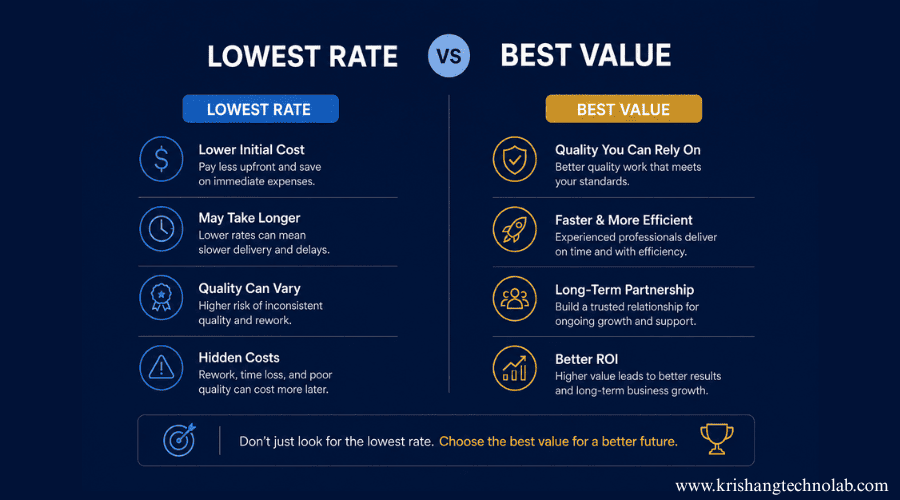
Cost matters, obviously, but the lowest hourly rate rarely equals the best value.
A cheaper developer may require more supervision, take longer to get tasks done, or leave you with code that will be challenging to maintain in the future.
Someone with more experience might cost more per hour but move faster, solve problems on their own, and produce software that holds up better over time.
If you’re comparing dedicated developer services in the UK, weigh the full picture rather than anchoring on hourly rates alone. This ties closely into the broader decision many businesses face when they compare outsourcing against other engagement models before committing to one.
Factor in technical expertise, productivity, communication, reliability, experience, and what long-term maintenance is likely to cost you.
Instead of asking, “Which developer is the cheapest?” ask, “Which developer is most likely to deliver what we actually need, within our budget?”
Read More About: Cost to Hire Dedicated Developers in India
14. Use a Simple Dedicated Developer Hiring Checklist
Once you’re comparing several candidates, it’s easy to lose track of details from interviews and assessments. A simple checklist keeps dedicated developer hiring consistent across everyone you evaluate.
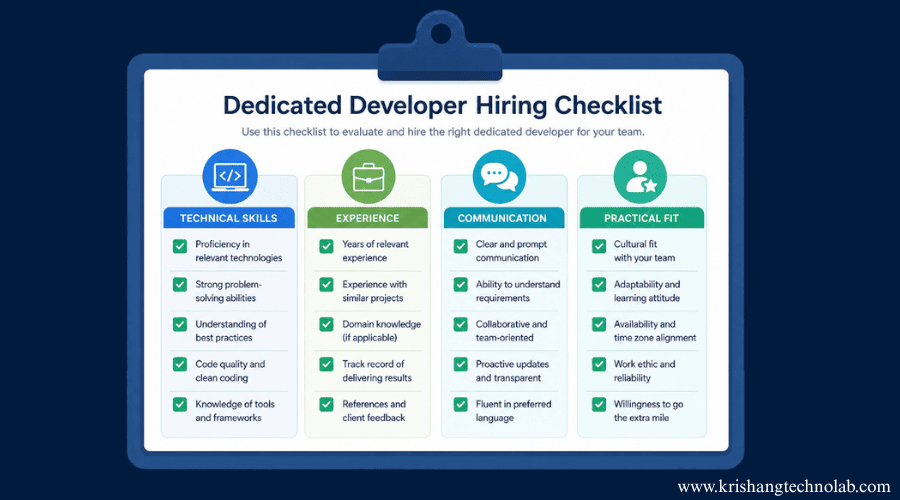
Technical Skills
- Relevant technical expertise
- Experience with required technologies
- Strong coding ability
- Testing and debugging knowledge
- Security awareness
Experience
- Relevant previous projects
- Similar industry experience
- Strong portfolio
- Verifiable references
- Clear understanding of their role in previous projects
Communication and Collaboration
- Clear communication
- Good responsiveness
- Understands project requirements
- Accepts constructive feedback
- Works effectively with teams
Practical Fit
- Suitable availability
- Compatible working hours
- Budget alignment
- Successful trial project
- Clear contract and engagement terms
Applying the same criteria to every candidate keeps the process objective and stops first impressions from carrying too much weight.
15. Watch for Hiring Red Flags
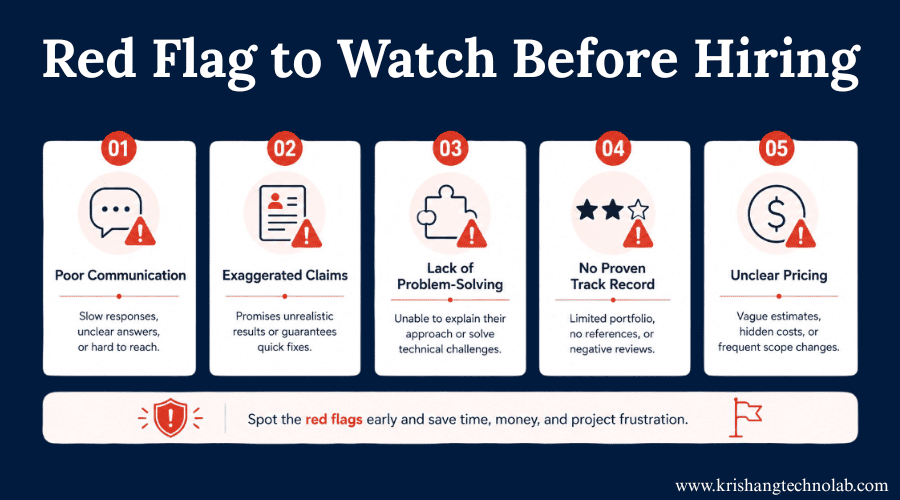
Even a candidate who looks great on paper may have red flags that are worth pausing to consider.
Beware of people who can’t give a clear explanation of previous projects or who are vague about what they actually did.
An impressive-looking portfolio doesn’t mean much if the candidate can’t explain how the work got done or what they personally contributed.
Communication issues are another major flag. If someone misses meetings, responds painfully slowly, or never asks questions about your project during the hiring process itself, it’s worth asking whether that pattern will continue once they’re hired.
Other things to watch for: unrealistic promises, experience you can’t verify, pushback on technical assessments, vague answers about availability, or a conversation that keeps circling back to price above everything else.
One red flag alone isn’t necessarily a dealbreaker. A pattern of several usually is, and spotting that pattern early is a core part of responsible, dedicated developer hiring.
16. Make Your Final Hiring Decision
After the interviews, portfolio reviews, technical assessments, and trial projects are done, weigh each candidate against the requirements you set out at the start.
Don’t let one strong (or weak) factor dominate the decision.
A technically brilliant developer can still be a bad hire if they can’t communicate well, aren’t available when you need them, or clash with how your team already works.
Look at the whole picture:
Technical expertise + relevant experience + problem-solving + communication + reliability + availability + overall value
If a candidate does well across all of these and performs well in a practical assessment, you can go ahead with real confidence.
If you’re trying to hire dedicated developers in India, or anywhere else, a structured evaluation process makes it much easier to compare candidates fairly.
Conclusion
The ability to evaluate a dedicated developer before hiring can save your business a lot of time, money, and frustration down the line. When done right, hiring developers is not a gamble; it’s a repeatable process.
The best hiring decision doesn’t come from a resume, an hourly rate, or an impressive list of technologies alone. You have to weigh practical experience, technical expertise, problem-solving, communication skills, dependability, availability, and fit into your team.
First, know what you need for your project. Review portfolios and experience. Do practical assessments and ask interview questions based on experience. Emphasize communication & collaboration.
If you’re still undecided between candidates, a small paid trial project often becomes the tipping point before you make a long-term commitment.
Whether you want to hire a dedicated developer, hire dedicated software developers, build a dedicated development team, or work with an offshore developer, a structured evaluation process will help you find the right technical partner.
At the end of the day, the goal isn’t just to find a developer for hire; it’s to find a dedicated professional who understands your business goals, communicates well, solves problems independently, and consistently delivers quality software.
Found this post helpful? Don't forget to share it with your network!