
Quick Overview: Startups need dedicated developers for startups who move fast without the overhead of full-time hiring. This guide covers engagement models, cost expectations and how to vet the right team, helping founders scale product development quickly while staying lean on budget and headcount.
Building a startup is challenging, so hiring issues shouldn’t hinder your progress. For many early-stage founders, hire dedicated developers for startups is one of the biggest challenges when building a reliable team and turning an idea into reality. You need people who can move fast, adapt to change and write clean code, all while you’re watching every dollar of runway.
This blog takes you through all the information you need: when to hire dedicated developers, how the dedicated developer hiring model works, how much it costs, and how to avoid the mistakes most first-time founders make. At the end, you’ll have a clear roadmap for hiring dedicated developers for startups the right way.
What Does It Mean to Hire Dedicated Developers for Startups?
When you hire dedicated developers for startups, you’re hiring a developer or team of developers who work solely on your project, usually via a software development agency, and not juggling multiple clients simultaneously. Unlike freelancers who often juggle multiple projects, a dedicated development team for startups is fully invested in your product, timeline and goals.
This hiring model is built by Krishang Technolab and similar agencies for this very need. It gives founders the essential foundation they need in the early stages: clear priorities, steady execution, and the ability to move quickly. Your remote dedicated developers learn your users, your codebase, and your product vision and this context builds up over time instead of resetting with every new hire. If you want to see what a dedicated developer team looks like before making a decision, you can review how a dedicated developer team is structured.
Industry data backs this up. Recent developer survey data shows the global developer population continues to climb year over year, giving startups a much larger and more accessible talent pool than they had even five years ago. That number gives startups a much larger and more accessible talent pool than they had five years ago, let alone ten. This means that the challenge today is not to find developers; it’s finding the right dedicated developers for your startup’s specific needs.
Dedicated Developers vs. Freelancers vs. In-House Team
| Factor | Dedicated Developers | Freelancers | In-House Team |
| Commitment level | Full-time, project-focused | Part-time, multi-client | Full-time, permanent |
| Cost structure | Fixed monthly/hourly | Per-task or hourly | Salary + benefits + overhead |
| Onboarding speed | Fast (agency-managed) | Fast but inconsistent | Slow (recruiting takes weeks) |
| Best for | Long-term or evolving products | Small, one-off tasks | Mature, funded companies |
| Scalability | High | Low | Low to moderate |
If you’re comparing options, this table alone answers the most common question founders ask: Should I hire dedicated developers, freelancers or build in-house from day one? For most early-stage startups, the dedicated development team for startups has the best cost control vs. commitment, a classical dedicated team vs in-house team trade-off.
When Should Startups Hire Dedicated Developers?
Not every startup needs to hire dedicated developers on day one. Knowing when the timing is right can save you money and prevent hiring mistakes.
Your Project Will Run Longer Than a Few Months
If you’re building something big, an app, a SaaS platform, or a marketplace, and it’s going to take six months or more, then hiring dedicated developers for startups makes a lot more sense than piecing together freelancers. A dedicated team is involved in the project from planning to launch and beyond. At this point, some founders think about software outsourcing for startups to compare it with the creation of a dedicated in-house-style team.
Your Product Requirements Keep Changing
With startups, it’s seldom a straight line. User feedback changes priorities, and your roadmap changes with it. A dedicated development team for startups is built to absorb that kind of change, since they’re already embedded in your product instead of working from a fixed freelance brief.
Your In-House Team Is Stretched Thin
Your existing team is already busy with other work and just another opportunity comes up. Hiring dedicated developers allows you to take the opportunity without overloading your existing team or delaying other priorities.
You Need to Scale Quickly After Funding
After a funding round many startups need to quickly ramp up their engineering capacity. Choosing to hire remote developers lets you add skilled hands in weeks, not months, which is nearly impossible with traditional in-house recruiting.
Founders who want closer time-zone overlap and easier in-person coordination during this scaling phase often look at hiring dedicated developers in USA as a starting point before deciding whether to expand offshore.
You’re Working with a Tight Budget
A dedicated developer hiring model usually comes with predictable dedicated development team pricing on a monthly or hourly basis. That predictability helps you plan cash flow carefully, which matters enormously when every dollar of runway counts.
Benefits of Hiring Dedicated Developers for Startups
Founders who choose to hire dedicated developers for startups typically see these advantages:
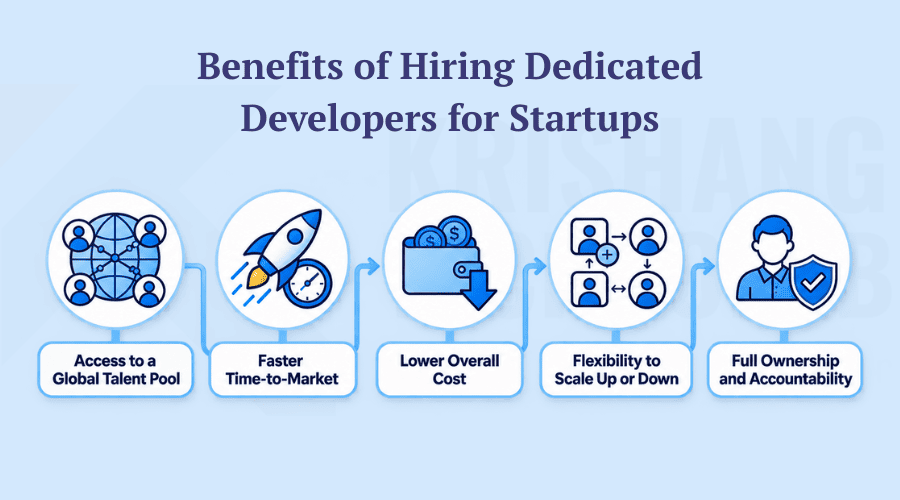
Access to a Global Talent Pool
You can hire dedicated developers with the exact stack experience that your project needs, be it React, Node.js, Python, Flutter or whatever else it takes, including custom software development for startups based on your particular product, instead of going with the local talent that you may find.
Faster Time-to-Market
Teams are assembled and ready to go, shaving weeks or months off of the traditional hiring timeline. Startups that take a more structured approach to MVP development services, with a dedicated team, such as the process outlined for building a startup MVP, tend to release faster than those who hire ad hoc.
Lower Overall Cost
Hiring dedicated developers allows you to avoid the additional costs of full-time employment, including payroll taxes, benefits, equipment, and office space, while still receiving dedicated attention on your project.
Flexibility to Scale Up or Down
As your product grows, you can add more remote dedicated developers to the team. When priorities shift, you can scale down without the complications of layoffs from a truly scalable development team.
Full Ownership and Accountability
A dedicated developer hiring model assigns one team to own the outcomes and generally produces better communication and fewer dropped tasks than putting together multiple freelancers.
Dedicated Team vs. Fixed Price vs. Time & Material: Which Hiring Model Fits Your Startup?
Picking the right developers is important, but picking the right engagement model is equally important. Here’s a comparison of the three most common options.
| Model | Best For | Cost Structure | Flexibility |
| Dedicated Team | Long-term, evolving products | Fixed monthly rate per developer | High scope can change anytime |
| Fixed Price | Small, well-defined projects | One agreed total price | Low scope is locked in |
| Time & Material | Projects with uncertain scope | Pay for actual hours worked | Moderate, flexible, but variable cost |
The dedicated team model offers the best balance between predictability and adaptability for most startups that are creating a product expected to change after launch. Some teams also compare the model to an offshore development center setup where offshore dedicated developers for startups work as an extension of the founding team at a lower overhead. Fixed price works well for a simple landing page or MVP with clearly defined features, while time, and material suit short-term or experimental work where scope isn’t fully known yet.
Step-by-Step Process to Hire Dedicated Developers for Your Startup
Here’s a practical, step-by-step process many startups follow to hire developers for startup projects without wasting time, or budget.
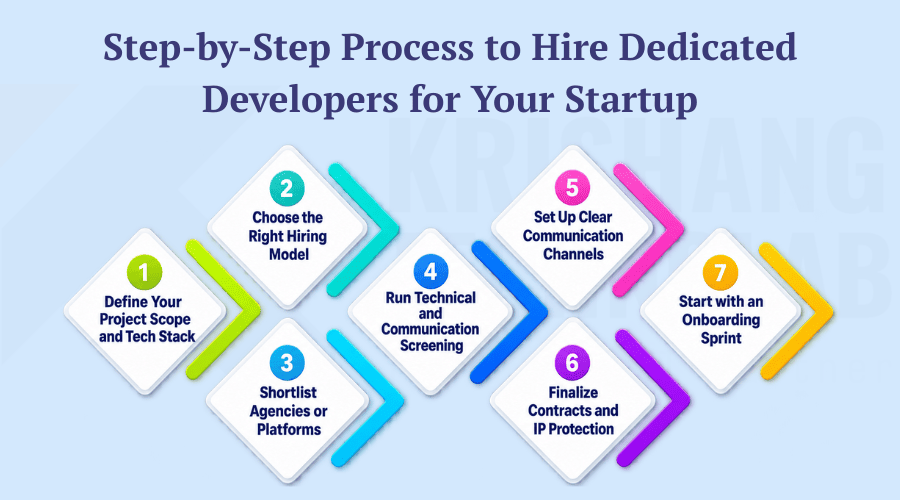
1. Define Your Project Scope and Tech Stack
Before you hire, write down what you are building, what technologies it requires and what “done” looks like for the first milestone. A well-defined scope attracts better-qualified applicants and avoids scope creep down the road.
2. Choose the Right Hiring Model
Not all projects call for every kind of engagement. Starting with the comparison above, decide if a dedicated team, fixed-price contract or time-and-material setup makes the most sense for what you’re building. A fixed-price model is great when requirements are cast in stone and a dedicated team is great for a project that will evolve as you learn more about your users.
3. Shortlist Agencies or Platforms
Start your search for software development agencies, staff augmentation companies, and freelance platforms like LinkedIn, Upwork, and GitHub. Before you contact anyone, look at portfolios, read what clients say and look at case studies. If your project needs more coverage, some agencies also offer full-stack developer hiring so that one team can do both frontend and backend work without needing to coordinate two separate vendors.
4. Run Technical and Communication Screening
Coding tests, technical interviews and short paid trial tasks check if a developer can really do the work. But that’s not all. Also observe how they communicate during this stage. A remote developer will slow your team down if they can’t explain their thinking clearly, regardless of how strong their code is.
5. Check Past Work and References
Even when you’re in a hurry, don’t skip this one. Ask for references from real past clients and actually look at finished projects. Interviews are easy to prepare for, but a messy or abandoned past project is much harder to fake your way out of. This step identifies problems that may not arise during discussions.
6. Set Up Clear Communication Channels
Set up your check-in cadence, joint project boards, and reporting expectations before day one – not after the fact. Slack, Trello, Zoom; whatever your toolkit, the point is keeping a dedicated team truly aligned with your goals instead of guessing at priorities.
7. Finalize Contracts and IP Protection
Before you do any work, make sure your contracts state intellectual property ownership, confidentiality terms and service-level expectations in plain English. It is important not to rush through this step or rely solely on a template. This ambiguity can become an expensive problem months later.
8. Start with an Onboarding Sprint
Start with a small experimental sprint, instead of jumping straight into the whole project. This really gives you a feel for whether the team understands your product and can deliver at the speed and quality that you really need before you have invested a lot of time or money in the engagement.
Also Read About: How to Hire a Dedicated Development Team?
How Much Does It Cost to Hire Dedicated Developers for a Startup?
Cost is often the deciding factor for early-stage founders. Your rate will depend a lot on the location you live in, your experience and mode of engagement.
| Region | Hourly Rate Range | Full-Time Monthly Range | Strategic Startup Fit |
| United States / Canada | $70 – $130+ | $12,000 – $20,000+ | Best for strict regulatory needs or direct in-person coordination. |
| Western Europe | $60 – $110 | $10,000 – $18,000 | Strong engineering culture; limited daily overlap with US teams. |
| Latin America (LATAM) | $30 – $60 | $5,000 – $9,500 | Top choice for US startups due to real-time time zone overlap. |
| Eastern Europe (CEE) | $35 – $70 | $6,000 – $10,000 | Exceptional math/technical backgrounds; 2 – 4 hours of US overlap. |
| South / Southeast Asia | $15 – $50 | $3,000 – $8,500 | Lowest cost; ideal for highly-specified tasks using async workflows. |
Founders looking at local talent, like those looking at developer rates in the USA, typically combine that research with offshore quotes to come up with a realistic budget.
Seniority matters a lot too. Typically, junior developers will charge between $20 and $35 an hour; mid-level developers, $35 to $60; and senior developers with five or more years of experience, $60 to $100+, depending on the region. A more detailed cost breakdown for dedicated developers can help you plan a realistic monthly budget before you commit.
Instead of hiring developers one by one, you can often get project management, quality assurance, and backup coverage included in the rate by hiring dedicated developers from an agency. It’s easy to overlook these things when comparing raw hourly numbers. Agencies such as Krishang Technolab typically bundle these services into their dedicated development team pricing, so founders get more predictability without extra hidden costs.
Skills and Qualities to Look for When You Hire Dedicated Developers
Strong technical skills may help a developer land a role, but long-term value comes from reliability, collaboration, and a willingness to grow. The best dedicated developers for startups have the right mix of real engineering ability and the attitude needed in a fast-paced environment.
- A solid command of the relevant languages and frameworks; think React developers who can build genuinely interactive frontends, or Node.js developers who handle backend logic and APIs without constant oversight
- Strong problem-solving instincts, which matter even more when you hire Python developers for startup work involving data-heavy features
- Communication that’s clear and proactive, especially when your team is spread across time zones
- A genuine comfort with ambiguity and shifting priorities, because startup roadmaps rarely stay still
- The ability to pick up new technologies quickly when the project demands it
- Reliable time management and delivery that doesn’t require chasing
- Actual interest in what you’re building, not just a paycheck at the end of the sprint
Startups building anything complex will often find that they need to hire mobile app developers or hire MERN stack developers in addition to their core web team. Have a clear idea of what stack combinations your roadmap requires before you start screening so you’re not making that call in the middle of a search.
Common Mistakes Startups Make When Hiring Developers
Pitfalls of hiring developers for startup projects, even for experienced founders:
- Writing a vague project brief: Mismatched expectations, and wasted time in interviews due to unclear requirements. Clearly define the scope, stack, and timeline from the outset.
- Choosing the cheapest option: The lowest hourly rate is often accompanied by hidden costs, rework, missed deadlines or poor communication. It’s not just about the price.
- Skipping a trial period: A short paid trial task says much more about a developer’s real ability than any interview.
- Ignoring IP and NDA protection: Startups often skip intellectual property clauses and sign contracts in a rush, a sure way to serious legal risk later.
- Underinvesting in communication tools: The most talented developers may get out of sync with your product goals without structured check-ins and shared documentation.
Also Read About: What Common Mistakes Should You Avoid When Hiring Developers?
Avoiding these mistakes can often determine whether the engagement proceeds smoothly or requires an expensive restart a few months later.
Final Thoughts:
Learning how to hire dedicated developers for startups comes down to timing, process, and picking the right engagement model for where your product is today. Define your scope well, choose a hiring model that matches the shape of your project and screen carefully before you commit. If done right, your dedicated developers will be one of your startup’s best assets, not just a budget line item. Agencies such as Krishang Technolab work with founders through exactly this process, helping them move from a vague idea to a fully staffed, dedicated development team for startups.
If you’re ready to see how this can work for your product, you can start here: hire dedicated developers for your startup.
Frequently Asked Questions
What is the dedicated developer hiring model?
This is an engagement model where a developer or a team works only on your project for a fixed monthly or hourly fee rather than working on multiple clients at a time like a regular freelancer.
How much does it cost to hire a dedicated developer for a startup?
Costs range from $18 to $18-$150 per hour depending on region and experience, with most startups paying $35-$65 for a solid mid-level developer.
How is a dedicated team different from staff augmentation?
All project delivery and results are the responsibility of a dedicated team. IT staffing augmentation services provide individual developers to complement your existing team and management structure.
How long does it take to onboard a dedicated developer?
Most agencies can onboard a vetted dedicated developer within one to two weeks versus one to three months for a typical in-house hire.
Is it better to hire dedicated developers or freelancers for a startup?
Freelancers can do an impressive job on short, well-defined tasks. For better consistency, accountability and long-term value, hire programmers dedicated to your product and embedded in it if you want a product that’s always being developed.
How do I choose the right agency to hire dedicated developers from?
Before committing, check their portfolio, client reviews, technical assessment process and communication style and always start with a smaller trial engagement if possible.
Found this post helpful? Don't forget to share it with your network!