Quick Overview: Headless Shopify vs Traditional Shopify comes down to speed versus flexibility. Traditional Shopify suits lean teams needing fast, affordable setup, while headless commerce delivers scalability, personalization, and omnichannel reach for enterprise brands ready to invest in custom development.
Headless Shopify vs Traditional Shopify – deciding between the two affects your store’s speed, cost, and future growth path. Every eCommerce brand eventually asks this question. However, the right answer depends on your revenue, your team, and your customer channels.
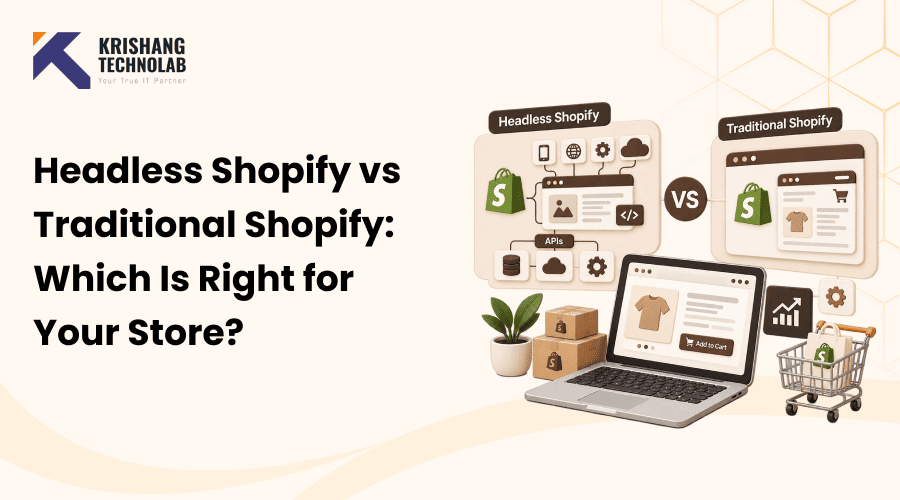
With traditional Shopify, your front end and back end are still closely integrated through Liquid templates. This coupled commerce model drives themes, checkout and the admin panel at the same time. In the meantime, Headless Shopify uses the Shopify Storefront API to decouple the shopfront from the commerce engine. Instead, developers build custom experiences with React or Hydrogen.
Both models address real business problems, but at different growth stages. Shopify’s classic is for smaller teams looking for speed and simplicity. However, if you are an enterprise brand seeking scalability, personalisation, and broader omnichannel coverage, headless Shopify is the ideal choice. Choosing between Headless Shopify vs Traditional Shopify ultimately comes down to where your business stands today.
This guide makes the difference between Headless and Traditional Shopify easy to understand. You’ll learn what each architecture actually does and how each affects performance and SEO. On top of that, you will see when traditional setups still win and when headless commerce delivers a stronger ROI.
We’ll also look at market trends, real brand results, and a hybrid approach to consider. By the end, you’ll have a clear framework for Shopify development in 2026, helping you choose between headless Shopify and traditional Shopify with confidence. This guide breaks the Traditional vs Headless Shopify debate down into a decision you can actually act on.
What Is Traditional Shopify?
Headless Shopify decouples the customer-facing storefront from the commerce backend, giving brands true headless storefronts to build on. Rather than one codebase, the two sides communicate through the Headless API — specifically, the Shopify Storefront API. This separation leaves the design and user experience up to the developers, making it a core offering within modern Shopify development services.
This monolithic approach to Shopify development company keeps setup simple, and Shopify handles hosting, security, and uptime automatically. Marketers launch sales or update pages without developer help. Consequently, traditional Shopify remains the fastest, most cost-effective route to market for growing ecommerce development company brands.
What Is Headless Shopify?
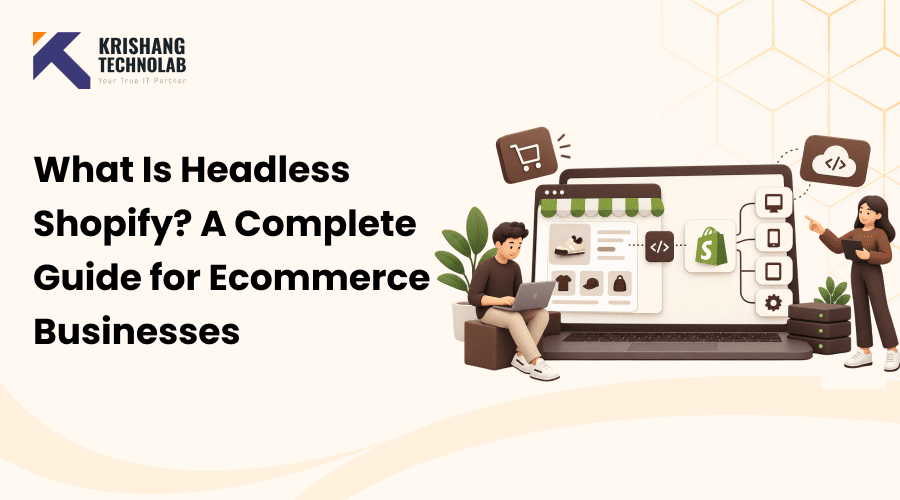
Headless Shopify decouples the customer-facing storefront from the commerce backend. Rather than one codebase, the two sides communicate through the Storefront API. This separation leaves the design and user experience up to the developers.
Most teams build the front end in React, Next.js or Shopify’s own Hydrogen framework, and going headless with Next.js has become an especially popular choice for performance-focused builds. Meanwhile, Shopify is still handling inventory, orders, payments and customer accounts behind the scenes.
An API-driven architecture enables the same backend to power a website, a mobile app, and a progressive web app (PWA) at the same time. Brands get flexibility, but also more technical responsibility. Shopify headless commerce, therefore, suits teams with dedicated engineering resources.
Market Trends: Why Brands Are Moving Toward Headless Commerce
The shift to headless architecture is a real change in enterprise commerce, not a trend. Here are five market signals to watch, from growth forecasts to adoption rates to platform migration to enterprise demand to Shopify’s own infrastructure spending.
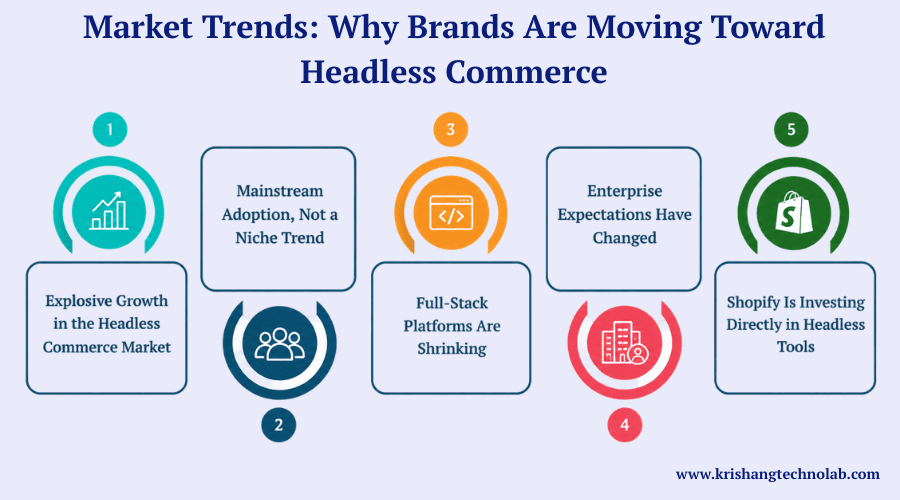
1. Explosive Growth in the Headless Commerce Market
The global headless commerce market was valued near $1.74 billion in 2025. Analysts predicted it would reach USD 7.16 billion by 2032 with a CAGR of around 22.4%. That growth rate is well above the overall growth of U.S. retail e-commerce sales data across the globe.
2. Mainstream Adoption, Not a Niche Trend
No longer is headless design only for workers working in the background for big companies. A majority of companies report they are already transitioning to headless commerce, or actively planning the move within the next twelve months.
3. Full-Stack Platforms Are Shrinking
Around 29% of companies still run purely monolithic commerce platforms today. But 91% of those brands say they are moving to blended or modular SaaS commerce, which is a clear industry-wide directional shift.
4. Enterprise Expectations Have Changed
Brands today manage regional shopfronts, use AI to personalise experiences, and refresh content in real time across multiple markets at once. This changed headless commerce from a niche conversation for developers to a growth strategy conversation for executives, with leading Shopify development companies now positioning headless as a core part of enterprise strategy.
5. Shopify Is Investing Directly in Headless Tools
With its acquisition of Remix, Shopify has made developer tooling better for headless builds. Its new Agentic Shopfronts also connect headless stores to AI-powered shopping experiences, which further lowers the technical barrier to entry.
Headless Shopify vs Traditional Shopify — Head-to-Head Comparison
Both architectures solve different problems well. Traditional Shopify is about speed and simplicity. Headless Shopify is about flexibility and scale. In short, when weighing traditional Shopify vs Headless Shopify, the table below compares both across the factors that matter most for growing brands.
| Factor | Traditional Shopify | Headless Shopify |
| Architecture | Coupled/Monolithic | Decoupled via APIs |
| Storefront | Liquid themes (Dawn, Impulse) | Custom-built with React/Hydrogen |
| Setup Time | Days to weeks | 4–7 months |
| Initial Cost | 29–2,000/month + apps | 25,000–150,000+ |
| Dev Requirement | Low, marketers self-manage | High, dedicated React developers |
| Page Speed | Good, with optimization | Excellent, edge-native delivery |
| Core Web Vitals | Can slow with app stacking | Consistently strong at scale |
| SEO | Handled natively | Requires deliberate SSR setup |
| Omnichannel | Limited | Native across all channels |
| Personalization | Basic | Advanced, AI-driven options |
| Scalability | Reliable within theme limits | Composable, independent scaling |
| Best For | SMBs, lean teams, fast launch | Enterprise, multi-brand, omnichannel |
When Traditional Shopify Is the Right Call
Many brands still choose Traditional Shopify because it is not dying — for many fast-growing companies, it remains the more strategic choice. Use the criteria below to find out if your business fits this category, based on revenue, team structure and product complexity.
- Your annual revenue sits below $5 million, and you are still finding product-market fit.
- Your marketing team needs independence without relying on developers for daily updates.
- Your products are already compatible with the standard eCommerce patterns that are already accommodated in the Shopify theme library.
- You lack dedicated front-end developers in-house or on retainer.
- Speed to market matters more right now than deep customization.
When Headless Shopify Delivers Better ROI
Companies often Choose Headless Shopify once they outgrow the traditional architecture. Below are indicators of a strong return on investment, especially for brands scaling across channels, regions, or multiple customer touchpoints simultaneously.
- You consistently generate over $5 million in annual revenue and scale across channels.
- Page performance limitations are measurably costing you conversions.
- You sell across a website, mobile app, and additional digital touchpoints at once.
- You operate multiple brands or regional storefronts with distinct requirements.
- AI-driven personalization and omnichannel data integration drive your growth strategy.
Accenture says brands that go “headless” with their commerce can expect to see about a 30% boost in revenue. This gain is driven by improved product experiences and increased personalisation.
Real-World Example: Sennheiser’s Headless Shopify Plus Migration
Sennheiser moves to Headless Shopify Plus architecture across 25 markets. Post-switch, the brand converted 4.5% more people. That’s a big dent to the bottom line for a business that size. Faster load times and localized storefronts across regions likely drove much of that lift.
This case study captures the Shopify headless commerce and traditional Shopify trade-off in action. When a brand gets to a certain size, the performance gains can start to compound quickly. Therefore, enterprise teams often consider Website Migration service as a growth investment, not a cost center.
Hybrid Approach: Combining Traditional and Headless
Many enterprise teams no longer choose one architecture exclusively. Rather they combine the two models to obtain the best of both. Headless handles high impact pages, while traditional Shopify handles checkout and account functions, and a skilled Shopify development agency typically manages this split to keep both sides working smoothly.
This hybrid architecture approach reaps the performance benefits of a full headless setup without the full cost of going fully headless. It therefore provides a plausible middle ground for brands that are uncertain as to where they sit on the threshold. Isolated pages let teams test the benefits of headless with Shopify developers before committing to a full rebuild.
How to Decide Between Headless Shopify vs Traditional Shopify: A Framework for Your Business
Making the right call requires more than following market trends. The five factors below create a repeatable decision framework for your organization, covering revenue, technical bandwidth, budget, channel complexity, and hybrid options worth testing first. This framework applies whether you’re weighing Headless Shopify vs Traditional Shopify for a new build or an existing store.
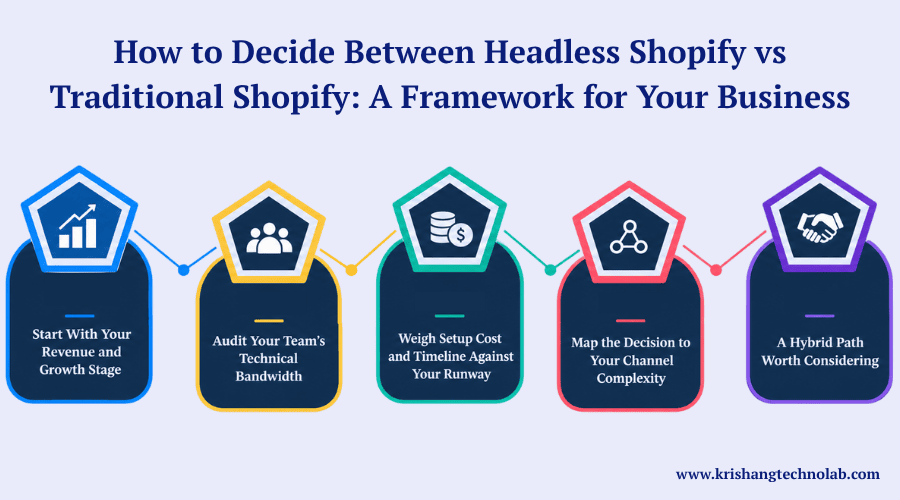
1. Start With Your Revenue and Growth Stage
Headless commerce readiness is often determined by revenue level. For companies with less than $5 million in annual revenue, speed to market is generally more important than flexibility. If your channel continues to grow, then past that point the headless architecture starts to pay for itself.
2. Audit Your Team’s Technical Bandwidth
Traditional Shopify lets marketers manage content directly. But, Headless Shopify needs dedicated React developers to maintain it in the future. If you don’t have that sort of bandwidth in-house, be sure to factor in the hiring or outsourcing costs, before you sign up — whether that means choosing to hire Shopify developers in-house or partnering with one of the established Shopify development agencies.
3. Weigh Setup Cost and Timeline Against Your Runway
Traditional Shopify typically has a Shopify website development cost of $29 to $2,000 monthly and launches within weeks. The Hidden Costs of Going Headless can push a build to $25,000 to $150,000 and stretch the timeline to several months. Now compare that timeline to how fast your business needs to be launched.
4. Map the Decision to Your Channel Complexity
Shopify’s traditional theme ecosystem is well suited to brands with a single shopfront and standard product catalogue. If a brand has multiple channels of selling, they’ll get more value out of an API-first structure. This avoids duplicated work on separate front ends.
5. A Hybrid Path Worth Considering
You can try the benefits of headless on a few pages with a hybrid setup from the start. This reduces risk and enhances performance where it really counts. That’s a common approach for many enterprise teams, before committing fully to one or the other.
Conclusion: Headless Shopify vs Traditional Shopify
The Headless Shopify vs Traditional Shopify decision has no universal answer. Traditional Shopify remains a proven, low-overhead platform for lean teams moving quickly. It’s great for brands that are still trying to find product-market fit or don’t have dedicated developers.
With Headless Shopify you get the real-world benefits of performance, personalisation and omnichannel reach. But these benefits only justify the expense when your business is large and technically resourced enough to support them. On your final choice, consider setup cost, development time and team bandwidth. Weighing Headless Shopify vs Traditional Shopify this way keeps the decision grounded in your actual business needs.
The biggest mistake brands make is choosing architecture on future aspirations rather than present reality. Compare your decision to where your business really is today instead. No matter which approach you take – traditional Shopify, headless Shopify or hybrid – your architecture should be right for your growth stage.
In the end, this decision dictates the speed, agility and growth potential of your store. Look at revenue, technical resources and channel complexity before committing. That clarity will guide you toward the architecture that fits your business best.
FAQs on Headless Shopify vs Traditional Shopify
Is Headless Shopify worth the investment for small businesses?
Not usually. Traditional Shopify tends to make more sense on a tight budget. Headless Shopify development eats into ongoing engineering resources, so it fits brands with steady revenue and a technical team already on staff, not startups still testing the waters — unless they’re ready to hire Shopify experts to bridge that gap early.
What is the average headless Shopify development time?
Budget four to seven months for a full build, sometimes longer depending on integrations. Traditional Shopify skips most of that wait entirely. Pre-built themes get you live in days, while custom engineering from scratch simply takes longer — a timeline that varies significantly depending on the Shopify development service you choose.
Does headless Shopify improve SEO or hurt it?
It depends on execution. Get server-side rendering right, and SEO can actually improve. Skip that step, though, and search engines may struggle to crawl your pages properly. Traditional Shopify sidesteps this issue since indexing works through built-in metadata by default.
Can I build a PWA with headless Shopify?
You can Sure. The Shopify Storefront API is designed for progressive web app (PWA) development, delivering app-like speed and offline functionality as you go. That’s not something your average Shopify theme is going to give you.
What frameworks work best for headless Shopify commerce?
Most teams reach for React, Next.js, or Vue.js when building headless Shopify commerce projects. Another good option is Shopify’s own Hydrogen framework, particularly with Oxygen hosting which makes deployment easier and faster.
How does content velocity differ between headless and traditional Shopify?
Marketing teams publish exponentially faster on headless, even sometimes 4x faster once the setup is dialled in. Traditional Shopify still makes edits in theme edits, which decreases content velocity when running high-frequency campaigns.
Is Shopify Plus required for headless Shopify?
Not really, but the thing is that most enterprise headless Shopify development projects are run on it anyway. At that scale, Shopify Plus is hard to skip with its advanced API access, higher rate limits, and better multi-region support.
What is composable commerce and how does it relate to headless Shopify?
Think of it as mixing best-of-breed tools instead of locking into one rigid platform. Headless Shopify supports this naturally. Its decoupled architecture lets you update search, personalization, and checkout components independently, without touching everything else.
Can traditional Shopify stores migrate to headless without downtime?
Most of the time, yes, if it’s done right. Phased transfer methods allow brands to gradually shift from traditional Shopify to Shopify headless commerce. Operating both systems for a short period during the transition will help to prevent disruption to checkout and live orders.
Does headless Shopify eliminate vendor lock-in risk?
Partly see Decoupling the frontend from Shopify’s backend does help reduce vendor lock-in to an extent. But Shopify is still in charge of the checkout and the business logic. That reliance sticks around regardless.
Found this post helpful? Don't forget to share it with your network!