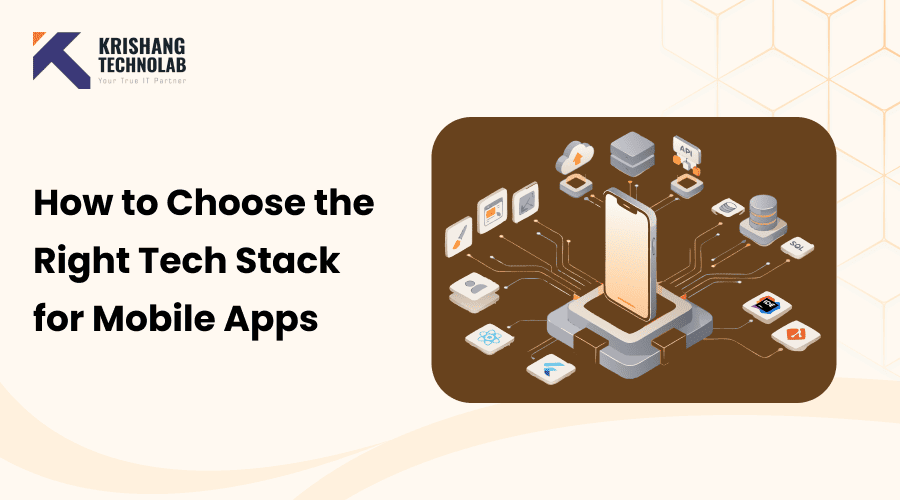
Quick Overview: Choosing the right tech stack for mobile app development is critical to building scalable, secure and high-performing applications. This blog talks about both frontend and backend technologies. It shows how to choose a tech stack for mobile app projects based on platform, business goals, development cost, team expertise, and long-term scalability requirements.
Choosing the right tech stack for mobile app development is one of the most crucial decisions for any business, startup, or entrepreneur. Your choice will directly influence the speed, scalability, security, development cost and future success of your app.
Today, companies want mobile apps that are fast, secure and scalable. Perhaps you are developing an Android app, an iOS app or a cross-platform solution. Anyway, choosing the best mobile app tech stack can help shorten development time. It also makes things better for the person as a whole.
In this blog, you will discover everything about choosing the right technology stack for mobile app development. This is front-end frameworks, back-end technologies and databases. You will also explore the important factors to consider before jumping into your project.
What is a Tech Stack for Mobile Apps?
The tech stack is the set of technologies used to develop and operate a mobile app. It consists of front-end tools, back-end frameworks, databases, APIs and hosting services. It also links all components of the system. This leads to smooth running of the app. It further enhances the overall performance.
The common tech stack for mobile app development is:
- Frontend technologies
- Backend frameworks
- Databases
- APIs
- Cloud hosting
- DevOps tools
For instance, Android apps use Kotlin. Flutter or React Native also create cross-platform apps. You can make backends with Node.js, Django, ASP.NET Core, Laravel or Firebase. This allows developers to have more freedom in their tool choice. That means they can pair tools with project needs.
Therefore, the ideal mobile development tech stack is one that facilitates the creation of scalable, secure, and easy-to-maintain apps.
Also Read About: What’s In For Mobile App Development Trends?
Different Tech Stack for Mobile App Development
Understanding a tech stack for mobile apps helps you know its core layers. A good mobile app development tech stack takes care of UI, data flow, APIs, security and scalability. It also improves app performance across all platforms.
A complete mobile app technology stack is mainly divided into two parts:
- Front-End
- Backend
The frontend is the user interaction and design. The backend is all about data, APIs, authentication and server-side logic. Also, both work together for smooth and scalable applications.
Choosing the right mobile development tech stack can boost performance and cut costs. It also helps in the long-term growth of mobile applications. This will help companies to create better and more stable apps.
1. Front-End Tech Stack for Mobile Apps
A mobile application’s exposed frontend is its user interface. They are about layout, design, navigation, animations and user interactions. A good frontend increases user engagement. It also offers a smooth experience on Android and iOS devices.
The frontend also influences app responsiveness, loading speed, visual appearance, and usability. It provides insights into real-time user behavior while using the app. Thus, clarity of design and strong performance increase user satisfaction. Therefore, choosing the right tools is very important, including the best front-end frameworks for mobile development.
That’s why companies are very careful when deciding on the best frontend technologies for their mobile app tech stack.
For frontend mobile app development, there are two main approaches:
- Native Stack
- Cross-Platform Stack
The right frontend technology depends on project requirements, budget, scalability goals, and target audience.
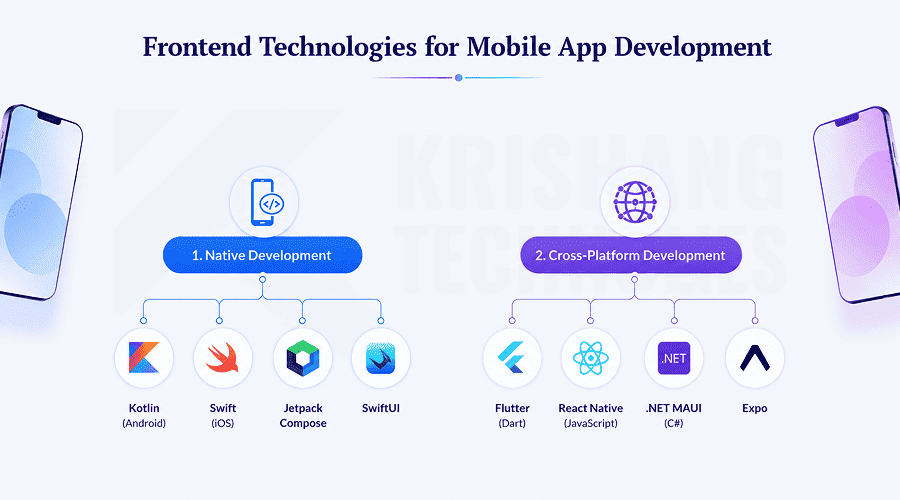
Native Stack
A native stack is developed specifically for a single platform such as Android or iOS. It also allows for smoother animations. It allows for more hardware integration.
They use native development to create banking apps, gaming apps, healthcare platforms, and enterprise solutions. They select it for high optimization. It’s also like it for its decent reliability.
The following table shows the most common native front-end technologies used in modern mobile development stacks:
| Technology | Platform | Main Language | Best For |
| Kotlin | Android | Kotlin | Native Android apps |
| Swift | iOS | Swift | Native iPhone & iPad apps |
| Jetpack Compose | Android | Kotlin | Modern Android UI |
| SwiftUI | iOS | Swift | Interactive iOS interfaces |
1. Kotlin
Kotlin is a hot technology in the modern Android app tech stack. It helps developers to build secure Android applications. It also helps them to build scalable applications. They improves performance. It also accelerates development.
Best For:
- High-performance native Android apps
- Scalable enterprise mobile solutions
- Feature-rich e-commerce applications
- Secure Android development practices
- Custom Android UI/UX solutions
- Robust mobile app architecture design
2. Swift
Swift is a powerful programming language of the modern iOS app tech stack. It helps developers to build fast iPhone apps. They also help them build secure applications. It improves performance. It improves user experience as well.
Best For:
- High-performance native iOS apps
- Seamless Apple ecosystem applications
- Premium-grade mobile applications
- Optimized high-performance iPhone apps
- Custom iOS UI/UX development
- Secure Apple platform solutions
Cross-Platform Stack
Cross-platform frameworks help app developers. They work for Android and iPhone. They have one code base. It takes less time. It also lowers cost. So users get the same experience on both platforms.
Many startups work with cross-platform frameworks. Many businesses use them as well. Development is rapid. And easy to do. This approach allows companies to deploy apps fast. Also, the teams can manage projects easily. This approach is why cross-platform development has become a major pillar of mobile app strategy.
The popular frameworks for cross-platform mobile app development are:
| Framework | Language | Best Use Case |
| Flutter | Dart | High-performance cross-platform apps |
| React Native | JavaScript | Startup and social apps |
| .NET MAUI | C# | Enterprise mobile apps |
| Ionic | JavaScript | Hybrid mobile apps |
1. Flutter with Dart
Flutter is a popular cross-platform framework used in modern mobile app development tech stack solutions. It also provides fluid animations. Clean user interfaces. That’s why many startups opt for Flutter. Also, the developers can use a single codebase. It is compatible with Android and iOS. This speeds up development. It also reduces the effort. Therefore, teams save time and cost. Many businesses rely on Flutter App Development Services to build scalable and high-quality mobile applications efficiently.
Best For:
- Cross-platform apps
- Fast development
- Smooth UI animations
- Startup mobile apps
2. React Native with JavaScript
React Native builds apps for iOS and Android. It has one codebase. That saves time. It also saves labor. It allows companies to move faster. Also has fast updates. It came with a flexible design. That’s why it’s used by many startups and e-commerce companies. Developers can also reuse codes. It is cross-platform compatible. This makes it easier to maintain. This results in faster app deployments by teams. Because of these advantages, many companies choose to hire react native developers to build and scale their applications efficiently.
Best For:
- Startup apps
- Social media apps
- E-commerce platforms
- Fast app deployment
3. NET MAUI with C#
.NET MAUI is a Microsoft framework. This framework is for mobile apps. It’s built for enterprise use. It also integrates with Microsoft tools. Companies that use Microsoft systems prefer it. In addition, it supports large apps. It also supports scalable applications. This enables teams to easily manage complex projects. So it’s an excellent choice for enterprise applications.
Best For:
- Enterprise applications
- Microsoft ecosystem projects
- Secure business apps
- Scalable mobile platforms for growth-ready apps
2. Backend Tech Stack for Mobile Apps
Every mobile app has a backend. It’s running on the server. It drives the main logic of the application. It also deals with databases, APIs, authentication, notifications, and cloud services. And it, in turn, guarantees smooth and stable app performance.
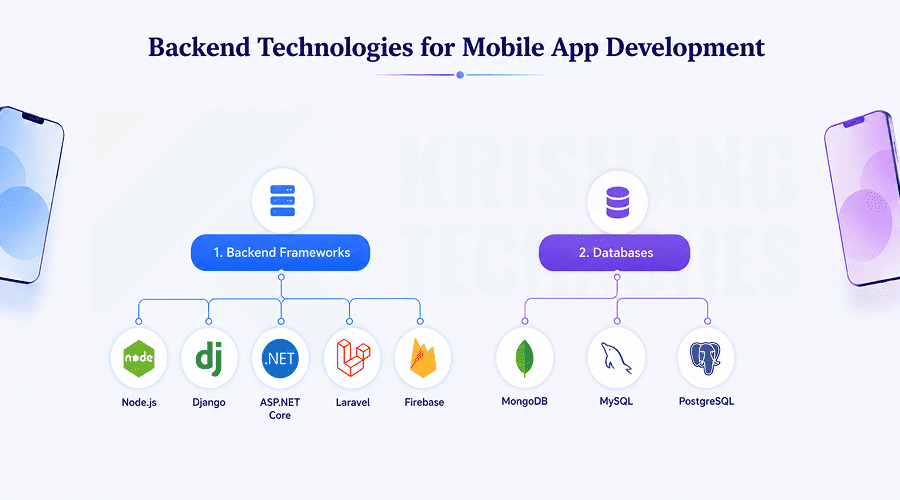
Most mobile apps today rely on a strong backend. Backend that makes you go fast. It also enhances security. Scalability is supported as user demand increases. Backends are a must for apps to not be slow. They may also fall under heavy traffic. Apps can, in some cases, even lose data or have security issues.
The backend links the frontend to the database. It transfers data between the two systems. It is fast and secure. Moreover, it provides correct communication between the services. So the app is functioning properly for the users.
That is why developers carefully choose the best backend frameworks for mobile app development.
Below are some of the most widely used backend technologies for mobile app development:
| Backend Technology | Main Language | Best For |
| Node.js | JavaScript | Real-time apps and APIs |
| Django | Python | AI and data-driven apps |
| ASP.NET | Core C# | Large enterprise applications |
| Laravel | PHP | Business and startup apps |
| Firebase | Cloud Platform | MVPs and real-time apps |
1. Node.js
Node.js is a quick backend technology. Also, it scales very well. It is very widely used in modern mobile app development tech stacks. So good for real-time mobile apps.
It also easily handles high traffic. The data processing is also rapid. The platform also supports scalable APIs.
Best For:
- Real-time chat applications
- High-quality streaming apps
- Low-latency real-time systems
- Scalable and secure APIs
Also Read About: Which is Better for Your Business NodeJS vs Python Backend Frameworks?
2. Django
Django is a secure framework for Python. It also supports applications that are data-hungry and scalable. Also, this framework is popular in AI and enterprise mobile apps.
It also helps us build safe systems. Also, it provides a clean project structure. Therefore, development accelerates. When comparing Django vs Laravel, both frameworks also help developers build secure and well-structured applications.
Best For:
- AI-powered intelligent applications
- Modern healthcare mobile solutions
- Secure fintech platform development
- Robust and secure backend systems
3. ASP.NET Core
Microsoft’s backend framework is called ASP.NET Core. It is also used for enterprise mobile applications. Additionally, the framework offers high security and robust performance.
It is also used in big systems. Furthermore, it offers stable performance. It also manages complex enterprise workloads.
Best For:
- Enterprise-grade mobile applications
- Secure banking application solutions
- Advanced healthcare digital platforms
- Scalable cloud-based systems
4. Laravel
Laravel is a PHP framework. It also supports fast development. They also provide simple backend management. It is often used in startup projects.
It also speeds development. In addition, backend tasks are simplified. This results in a significant reduction of development effort.
Best For:
- Scalable startup mobile applications
- Feature-rich e-commerce solutions
- Custom business application development
- Cost-effective software development services
5. Firebase
Firebase is a cloud-based backend platform for Google. Moreover, it simplifies backend development. In addition, it supports real-time features.
Also, developers use it for fast development. Furthermore, server management is removed. Therefore, it becomes easier to use. It also supports real-time updates and authentication.
Best For:
- Rapid MVP product development
- Scalable startup mobile applications
- High-speed real-time applications
- Secure push notifications and authentication systems
How to Choose the Front-End Tech Stack for Your Mobile App?
Choosing the right frontend for your tech stack for mobile app development relies on the type of app you are developing. It also depends on performance requirements and business objectives. Moreover, the frontend is a key part of the mobile app development tech stack. It affects user experience. It also affects speed and engagement.
First, clearly understand your app. In fact, a mobile app technology stack for a gaming app is very different from a fintech app. It’s also different from just a content-based app. So choose according to your app objectives.
- If your app needs high performance, hardware access, and smooth animations → choose native development.
- If your app is content-driven or needs fast development → choose cross-platform development. In addition, cross-platform tools reduce cost. They also reduce development time.
| Approach | Technologies | Best Use Case | Key Benefit |
| Native Android | Kotlin, Java | Android-only apps | Best performance & hardware access |
| Native iOS | Swift | Apple ecosystem apps | Smooth UX & high security |
| Cross-Platform | Flutter, React Native, .NET MAUI | Android + iOS apps | Faster development & lower cost |
1. Native Android App Development
Native Android development is an integral part of the Android app tech stack. Besides, it is the best for high-performance apps. It also enables deep device integration. Also, it provides strong security for apps.
Native Android development should be your choice when your mobile development stack needs advanced features. For example, apps may require GPS tracking. Camera processing or real-time performance may be required as well. Native development is the better choice in this case.
Advantages of Native Android Development:
- Delivers fast and optimized app performance
- Enables complete access to device hardware features
- Provides advanced security and data protection
- Ensures smooth and responsive user experience
- Supports seamless integration with Android features
Kotlin is the most preferred language in the modern Android development tech stack now. Developers do write most new projects in Kotlin. They have taken the place of Java in many modern apps.
| Feature | Java | Kotlin |
| Syntax | Verbose | Clean and simple |
| Performance | Good | Better and optimized |
| Safety | Less safe | Null-safe design |
| Async Support | Manual | Built-in coroutines |
| Modern Development | Limited | Limited Fully modern |
Kotlin is highly popular in the modern tech stack for developing Android apps. It also helps to reduce app crashes. It also helps increase developer productivity. So that’s good news for new apps hire android developers. However, legacy systems are still being developed in Java.
Development Tools (Android Stack)
A strong mobile app technology stack for Android includes key tools. Moreover, these tools improve speed and quality.
- Android Studio – The main IDE for Android development
- ADB (Android Debug Bridge) – Used for testing and debugging
- Jetpack Compose – Modern toolkit for building native Android interfaces
Jetpack Compose is a popular tool in the modern mobile app development tech stack. It also reduces the boilerplate code. It is also improving the UI performance.
2. Native iOS App Development
The iOS app tech stack contains native iOS development. Apple app developers utilize it. It is good for secure applications.
When to Choose Native iOS:
Choose native iOS for iPhone and iPad apps. It is also good for banking apps and health care apps. It also supports advanced UI features. This provides users with a better app experience.
Swift is the primary language in the modern tech stack for iOS app development. Apple is using Swift for new projects. And so many developers are using Swift rather than Objective-C. Because of this demand and specialization, many companies prefer to hire iOS developers to build secure and high-performance iOS applications.
Objective-C vs Swift (iOS Tech Stack)
| Feature | Objective-C | Swift |
| Syntax | Complex | Clean and modern |
| Type Safety | Weak | Strong typing |
| Performance | Slower | Faster execution |
| Debugging | Difficult | Easy and efficient |
| Adoption | Legacy apps | Modern apps |
Swift is a popular language for the modern iOS developer tech stack. It speeds up the app. And it improves code quality. And coding is simple. That’s why developers are using Swift in new iOS apps.
Development Tools (iOS Stack)
These are the tools that form a strong mobile app development tech stack for iOS.
- Codex – Primary IDE for iOS development
- Swift Package Manager (SPM) – Dependency management tool
- Instruments – Performance monitoring and debugging tool
- SwiftUI – Modern UI framework for Apple apps
The modern iOS app tech stack includes SwiftUI. It makes the code shorter. Also, it makes the process of creating apps go faster.
3. Cross-Platform Development
One of the main techniques in modern mobile development is cross-platform development. It helps app makers make apps for Android and iOS. One codebase is used.
This way, development is faster. It is also cost-effective. Startups like it, too. It is used by big companies too.
Best Use Cases:
- Startup MVPs
- Online shopping applications
- Social media apps
- Business and SaaS apps
Many companies offering Android and iOS app development services use cross-platform frameworks. These frameworks reduce development work. Moreover, they speed up delivery. In addition, they help keep performance stable.
| Framework | Language | Performance | Best For |
| React Native | JavaScript | Good | Fast MVP apps |
| Flutter | Dart | Very high | UI-rich apps |
| .NET MAUI | C# | Enterprise-level | Microsoft ecosystem apps |
| Expo | JavaScript | Good | Fast React Native app development |
Flutter (Cross-Platform Tech Stack)
In today’s time, Flutter is one of the most powerful frameworks in the technology stack for mobile app development. It helps developers to build apps. These apps look good and perform well.
Hot reload is one of the most important features of Flutter. It shows code changes quickly. That means tests run faster. They also accelerate development.
Flutter is used by many custom mobile app development services. It has a great UI control. It also performs well cross-platform, which is why many companies choose to hire flutter developers to build efficient and high-quality mobile applications.
Also Read About: How Flutter vs React Native Compare for Building Mobile Apps?
React Native (Cross-Platform Stack)
React Native is a JavaScript framework that is used in many modern mobile app technology stacks. It helps developers to build apps with reusable components.
It’s used widely for:
- Startup applications
- Social media platforms
- Online retail applications
Consequently, React Native is a critical element of mobile development stack strategies. Also, it has a large community. That helps developers build apps more quickly. Many businesses also choose a React Native app development company to build scalable and cost-effective mobile applications.
Expo (React Native Development Stack)
Expo is a collection of tools for React Native in the modern mobile app development tool stack. It helps developers build apps more quickly. React Native with Expo makes development even faster and easier.
Expo supports:
- Fast app setup
- Live app preview
- Easy testing on devices
- Integrated development utilities
Many startup teams use Expo. It saves time setting up. It also facilitates development.
.NET MAUI (Enterprise Stack)
.NET MAUI is a modern framework used in enterprise mobile app development company tech stack environments.
It allows code sharing across platforms. It also provides access to native APIs. Thus, it enhances the performance of the enterprise.
So it is great for big business apps. Moreover, it works well with projects in the Microsoft ecosystem.
Tips to Choose the Best Backend Stack for Your Mobile App Project
The backend choice is very important for a mobile application. It stores data securely. It also deals with APIs. They help keep the app secure. Then the app works fine and it is stable.
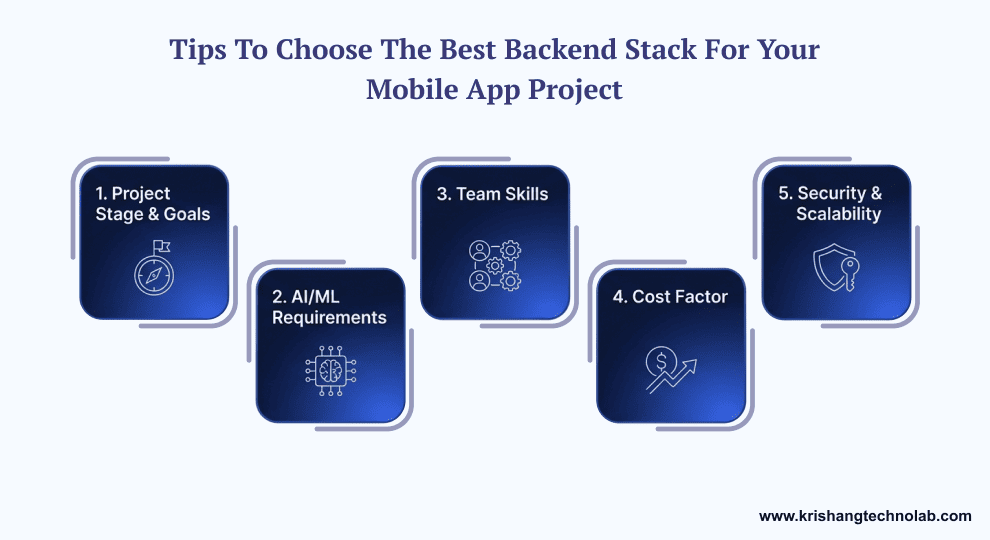
1. Project Stage & Goals
Startups have to move fast. They also need flexibility. Big companies are about scale and about growth at scale. So, what your mobile app technology stack looks like depends on your goals. Fast launch is achieved by using Firebase or Node.js for many startup mobile app development services. These tools are also easy to scale later.
2. AI/ML Requirements
Some apps require AI features. In that case, Python tools like Django are a good choice. They are easy and flexible. They work well with data-heavy apps, too. That’s why they’re so heavily used in modern mobile backend technologies.
3. Team Skills
Use a stack that your team already knows. For example, teams working in JavaScript use Node.js. Teams working in Python use Django. Microsoft Teams uses ASP.NET Core, so it does speed up the work.
4. Cost Factor
In mobile app development, cost is a big factor. Many startups use Firebase or cross-platform tools to save money. These tools speed up the setup as well. They also reduce long-term maintenance costs. So, budgets are easier to manage. This is especially important in custom software development, where cost planning and scalability both matter.
5. Security & Scalability
The tech stack of the mobile app development companies has to be secure and scalable. This becomes critical for applications storing sensitive data like fintech or healthcare applications. A scalable backend ensures that the app grows smoothly. It also handles more users without any slowdown.
Also Read About: Which Architecture Should You Choose Monolithic vs Microservices?
Why Partner with Mobile App Development Experts?
Mobile app developers help companies in creating fast, secure apps. They choose the right tech stack for mobile app development for better performance of the app. Companies can hire mobile app developer teams on an as-needed basis, too. Experts also save time and cut costs. The bottom line is better app quality and faster time to market for companies.
Benefits:
- Kotlin, Swift, Flutter, React Native and other technologies of the modern mobile development stack
- Faster app development and speedy launch
- Lower hiring and development expenses
- Better UI/UX leads to higher user engagement
- Continuous updates with long-term support
- Best stack for mobile app development support
Thus, businesses get a stable and future-ready mobile application.
Also Read About: How to Hire Dedicated Developers for Mobile Apps Development?
Conclusion
Selecting the right tech stack for mobile app development is important. It helps you make apps that are safe and work well. The right mobile app development tech stack enhances speed and reduces cost. Moreover, it helps businesses to grow. Your app’s performance and experience are shaped by every frontend and backend decision. Plus, working with Krishang Technolab helps businesses choose the right mobile app technology stack. This way, businesses can create future-ready solutions for their business needs.
FAQs
What is the best tech stack for mobile app development?
Your requirements determine the best technology stack for mobile app development. Kotlin and Swift are good for native apps first. They are high performers. Flutter and React Native are good for cross-platform apps. In the current mobile app development of so many businesses, they are a part of the tech stack.
Which backend is best for mobile apps?
Mobile app technology stacks can be Node.js, Django, ASP.NET Core, Laravel, Firebase and many more. Node.js is great for real-time applications. Django is also good in secure applications. Firebase is simple for startups and MVPs, though.
Flutter vs React Native: Which is better?
Both are popular in the mobile development stack. First, Flutter provides smooth UI performance. Thereafter, React Native helps developers to build apps faster. So both are good options.
How much does mobile app development cost?
The cost of mobile app development varies with the size of the app. Then it depends on the features and the platform. First, simple apps cost less. That means complex apps are costlier.
What technologies do mobile app development companies use?
The tech stack of a mobile app development company usually has Kotlin, Swift, Flutter, React Native, Node.js, Django, and Firebase in it. To begin, these tools help make apps quickly. They also make things safer and easier to expand.
Which tech stack is best for startups?
Startups often choose the most cost-effective stack for mobile app development. First, Flutter with Firebase is good for MVPs. Second, React Native with Node.js speeds up the process of making apps for companies. Therefore, they save both time and cost.
Found this post helpful? Don't forget to share it with your network!