Quick Overview: Shopify development for D2C brands helps transform a standard online store into a powerful, conversion-focused sales platform. This guide covers essential features, the development process, pricing considerations, growth strategies, and tips for selecting the right Shopify development company or agency to support sustainable business growth.
Launching an online store is easy. Building one that grows your sales month after month is much harder. Plenty of founders open a Shopify account, pick a theme, and upload products. Then they wonder why visitors do not buy. Although the store may appear visually appealing, slow loading speeds, a poor mobile experience, and low conversion rates can prevent visitors from becoming repeat customers.
This is where Shopify development for D2C brands makes the difference. Good development shapes the design, speed, checkout, data, and tools so every visit earns more. It serves as a fundamental element of effective shopify D2C website development.
In this post, you will learn what Shopify development for D2C brands includes, which features matter most, how to build a store step by step, what it costs, and how to pick the right partner. Each section uses plain words and clear steps, so you can act on it right away. Whether you are exploring Shopify for D2C for the first time or fixing a store that already exists, each section uses plain words and clear steps, so you can act on it right away.
What Is the Direct to Consumer Meaning in Ecommerce?
Let us start with the basics. The D2C meaning is simple: a brand makes a product, and sells it straight to the buyer, with no wholesaler or retail shop in between. The direct-to-consumer model is commonly abbreviated as D2C or DTC. Searches for Shopify D2C or Shopify DTC typically reflect an interest in understanding how to build, manage, and grow a direct-to-consumer business using Shopify. In plain terms, Shopify for D2C means using one platform to sell, ship, and stay in touch with your own customers.
Direct-to-consumer ecommerce gives brands three big benefits. First, you own the customer relationship and the data. Second, you control pricing, branding and the shopping experience. Third, you keep more profit because no retailer takes a cut.
These benefits drive D2C ecommerce growth, but only when your website is strong. Your store acts as your shop window, sales team and support desk at once. That is why smart Shopify development for D2C brands matters so much.
Why Is Shopify a Good Platform for D2C Businesses?
Shopify works well for direct selling because it takes care of hosting, security, payments and checkout so you don’t have to. It plugs into thousands of apps, too. That means you can launch quickly and keep growing without ever having to switch platforms.
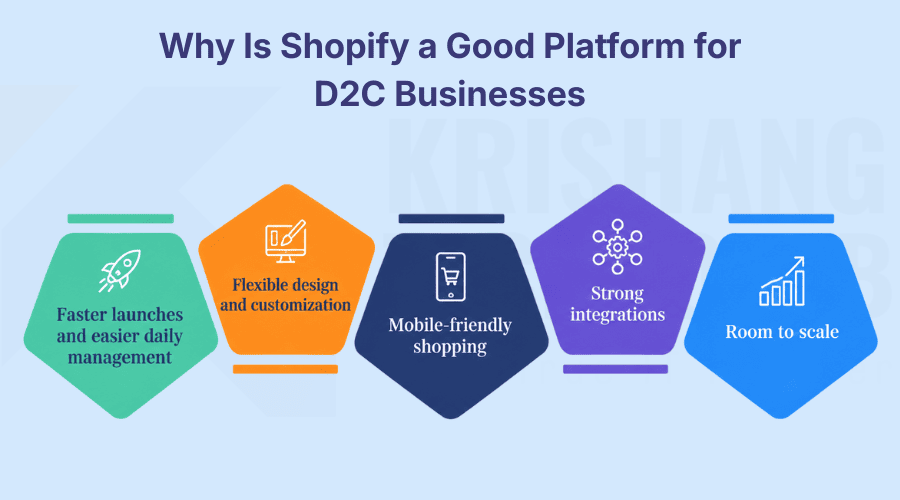
Faster launches and easier daily management
Shopify’s admin is simple to learn. Your team can add products, change banners and start sales without calling a developer for every small task. That speed helps D2C brands that launch new items often. That speed is a big reason Shopify for D2C suits brands that launch new items often.
Flexible design and customization
You can start with a ready theme, or build a custom Shopify theme that matches your brand. Developers can customize page layouts, build unique sections, and implement tailored functionality using Liquid, Shopify’s dedicated template language. Many brands work with a studio that handles Shopify website design so the look and the code come together.
Mobile-friendly shopping
Most online shoppers browse on their phones. SShopify themes adapt to different screen sizes, while a mobile-first ecommerce design ensures that buttons, product images, and the checkout process remain accessible and user-friendly on smaller devices.
Strong integrations
Shopify connects with email tools, review apps, subscription tools, shipping partners, and analytics platforms. These links save time, and cut manual work.
Room to scale
Shopify handles growing catalogs, more orders, and traffic spikes during sales. Many founders choose it as a long-term home for that reason. That is why many founders see Shopify for D2C as a long-term home rather than a starter platform.
Best Shopify Features for D2C Ecommerce
Not every feature matters equally. The ones below are the best Shopify features for D2C ecommerce, and together they make up the core toolkit of Shopify for D2C. Any plan for Shopify development for D2C brands should include them.
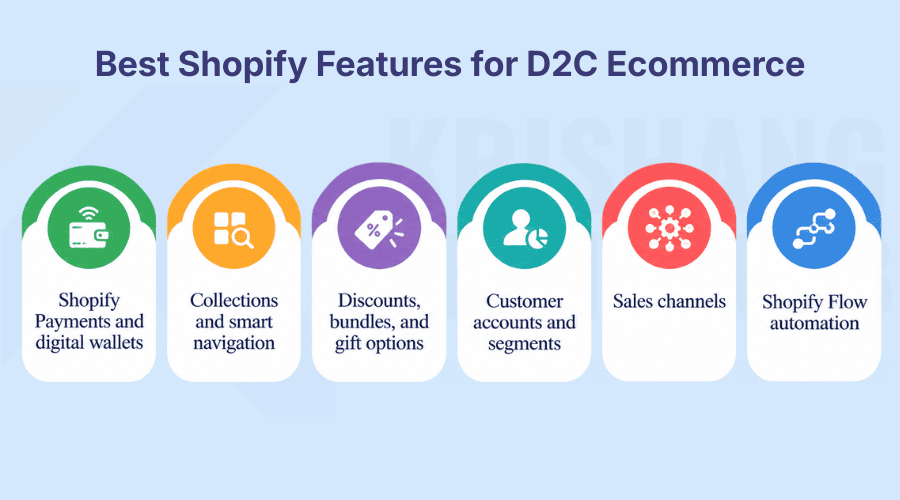
Shopify Payments and digital wallets
Fast, trusted payment options reduce drop-offs at checkout. Shopify Payments, along with wallets such as Apple Pay, and Google Pay, lets returning shoppers pay in a few taps, which suits mobile buyers especially well.
Collections and smart navigation
Clear menus, and well-planned collections help shoppers find products quickly. Organize products by category, season, or customer needs, and maintain a simple navigation menu that helps shoppers find their desired products within two or three clicks.
Discounts, bundles, and gift options
Built-in discount tools let you run percentage offers, free shipping and buy-one-get-one deals. Product bundles and gift options can increase average order value by offering customers convenient, pre-selected combinations rather than requiring them to purchase each item separately.
Customer accounts and segments
Customer accounts store order history, and saved details, while segments group buyers by behavior, such as first-time shoppers or big spenders. This allows you to deliver personalized offers to each customer segment based on their purchasing habits and product preferences.
Sales channels
Shopify lets you manage sales across your website, social media channels, and online marketplaces through a centralized dashboard. Inventory, and orders stay in sync, which supports omnichannel ecommerce without extra spreadsheets, or tedious manual updates.
Shopify Flow automation
On higher plans, Shopify Flow automates routine work, such as tagging VIP customers, flagging risky orders or alerting your team about low stock. This kind of ecommerce automation saves hours every week.
Which Shopify Integrations Are Essential for D2C Brands?
Email and SMS marketing, reviews, subscriptions, support, shipping, and analytics come first. These Shopify integrations for D2C brands cut manual work, but pick Shopify app integrations that solve a clear need, because too many apps slow your site.
Headless commerce and custom code
Some enterprise-level brands adopt headless commerce, an approach that separates the storefront’s front end from Shopify’s backend while allowing both systems to work together through integrations. It offers total design freedom but costs more, so most growing brands begin with a well-built theme and solid Shopify Liquid development.
Scalable ecommerce architecture
Plan ahead when you set up your store. A scalable ecommerce architecture means your structure, data, and integrations can handle more products, more traffic, and new markets without a rebuild, and solid ecommerce development makes that possible.
How Does Shopify Help D2C Brands Scale?
Shopify removes tech restrictions to scale D2C brands. Stable hosting, flexible tools and a large network of applications and partners. As you sell more, you get to add features, new markets and automation, without starting over. And on top of that is strategic Shopify development for D2C brands that layers speed, automation, and smarter checkout.
To learn how to scale a D2C brand with Shopify, focus on four areas:
- Speed: The faster your pages, the more sales you’ll make and the higher you’ll rank in search results.
- Conversion: Small improvements to product pages and the checkout process can collectively drive higher conversion rates and generate more revenue.
- Retention: Existing customers are cheaper than new ones.
- Operations: Ecommerce automation frees your team from repeat tasks.
Prepare for busy seasons too. Shopify for D2C copes well with sales spikes, but you still need to test your store before big sales, keep apps light, and make sure inventory and shipping tools can keep up with more orders.
What Features Should a High-Converting D2C Shopify Store Have?
A high-converting Shopify store makes buying feel easy and safe. These are the features it should include, and they apply to almost any Shopify for D2C build.
A clear homepage and simple navigation
Your homepage should say what you sell, who it is for, and why it is better, all within a few seconds. Show best sellers, trust badges, and a clear shop button.
Strong product pages
Product page optimization is one of the fastest ways to lift sales. Sharp photos, short videos, clear benefits, size or usage details, reviews, and a bold add-to-cart button all help. Provide answers to frequently asked questions directly on the relevant page.
Fast, mobile-first pages
Follow Core Web Vitals, Google’s set of speed and stability scores. Optimize images, uninstall unnecessary apps, and maintain clean, efficient code to improve store performance. A fast site ranks better and sells better, which is why speed work often sits beside search engine optimization.
A simple cart and smooth checkout
Checkout optimization means fewer steps, guest checkout, many payment choices, and clear shipping costs. Unexpected charges during checkout are one of the main reasons customers abandon their carts.
Upsells, bundles, and subscriptions
Average order value optimization relies on bundles, frequently-bought-together offers and free-shipping bars. Subscriptions also turn one-time buyers into repeat customers.
Trust signals
Display customer reviews, estimated delivery dates, clear return policies, and secure payment icons to build shopper confidence. Good ecommerce UX/UI design places each trust signal where shoppers need it most.
How to Build a Shopify Store for a D2C Brand: Step by Step
Here is a simple answer to how to build a Shopify store for a D2C brand. Follow the steps in order, and reuse them as a Shopify store development checklist before every launch. The same process forms the base of any Shopify ecommerce development project, big or small. These steps work for any Shopify for D2C launch, whether it is your first store or your fifth.
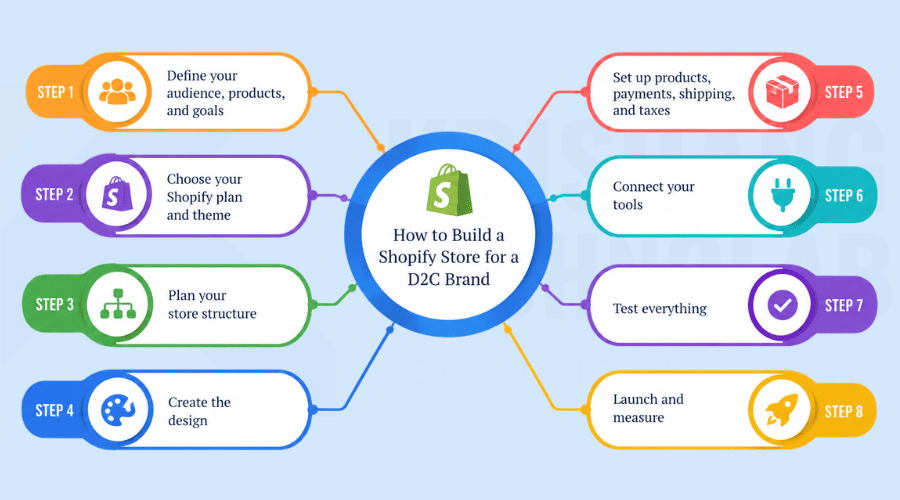
Step 1: Define your audience, products, and goals
Begin by naming who you are selling to and what a good result looks like. Set measurable benchmarks, such as conversion rate and revenue, for your D2C website development project. A Shopify for D2C development company can help.
Step 2: Choose your Shopify plan and theme
Choose a plan that fits today’s sales and a theme that loads quickly. A ready theme is a fine start for Shopify for D2C, but brands needing a unique look can turn to Shopify theme development services.
Step 3: Plan your store structure
Sketch out your collections, menus, and key pages before touching the design. A clear structure helps shoppers find products quickly and gives search engines an easy path through your catalog, which is where Shopify SEO services often start.
Step 4: Create the design
Choose colors, fonts, and messaging that stay consistent across the store. Strong Shopify website design and development works as one team effort at Krishang Technolab, which pairs D2C Shopify store design services with clean code.
Step 5: Set up products, payments, shipping, and taxes
Write helpful product descriptions, upload sharp images, and add every variant. Then test every payment method, shipping rule, and tax setting so customers never meet a checkout surprise on launch day. Large catalogs may need Shopify store development services.
Step 6: Connect your tools
Connect email marketing, reviews, analytics, inventory, and CRM tools. These Shopify integrations for D2C brands should fit how your team works, and a custom Shopify development company can fill gaps. Keep the list short so no app slows pages.
Step 7: Test everything
Check the store on several phones and browsers, and place test orders from start to finish. Confirm that tracking fires, emails send, and discount codes work, because small bugs cost real sales in direct-to-consumer ecommerce.
Step 8: Launch and measure
Go live, then watch your data closely. At Krishang Technolab, this Shopify store development approach turns real customer behavior into fixes, with Shopify CRO services and Shopify maintenance and support services keeping the store improving.
How Do You Optimize a Shopify Store for Conversions?
To optimize a Shopify store for conversions, find where visitors drop off, fix those spots and test one change at a time. Start with page speed, mobile layout, product pages and checkout.
To improve Shopify conversion rate, implement a structured optimization strategy that focuses on enhancing the shopping experience and encouraging more purchases. Study your data first, because strong ecommerce analytics and tracking shows where people leave. Fix the biggest leak next, which is often the product page, or checkout. Change one thing at a time, such as a headline, an image or a button, so you know what actually moved the numbers. Cut extra form fields and confusing steps to reduce friction. Win back lost buyers with reminder emails, and a simpler checkout, since cart abandonment reduction pays off fast.
This work is called ecommerce conversion rate optimization or CRO. Regular Shopify store optimization keeps the site improving long after launch and design choices that lift conversions are a good place to begin. With Shopify for D2C, this steady testing is where much of the growth comes from.
How can a Shopify store improve customer retention?
A Shopify store improves retention through email and SMS follow-ups, loyalty rewards, subscriptions, and helpful post-purchase service. Because you own the customer data, Shopify for D2C makes these follow-ups easy to personalize. A solid customer retention strategy keeps buyers coming back and raises customer lifetime value, the total money a customer spends with you over time. Effective digital marketing streamlines customer follow-ups, while stronger retention reduces reliance on expensive paid advertising campaigns.
Custom Shopify Store vs Shopify Theme
Many founders ask about custom Shopify store vs Shopify theme. The short answer depends on budget, timeline and how unique your store needs to be.
A theme-based store is faster and cheaper and it suits new brands with small catalogs and standard needs. A custom store costs more but fits your brand, and goals exactly. It suits brands that need special features, a unique design, or top speed, and this is where custom Shopify website development adds value.
If you plan a custom build, look for Custom Shopify website development services and Shopify theme development services that cover design, code, testing and support. A custom build should be light and no heavy apps so pages load fast.
Shopify Plus vs Shopify for Growing Brands
Shopify Plus is the enterprise-level plan. It offers more control over checkout, more automation, higher limits and tools for managing several stores, while standard Shopify is enough for many young brands. Think of it as the heavy-duty tier of Shopify for D2C.
When weighing Shopify Plus vs Shopify for growing brands, ask yourself whether you need advanced checkout control, heavy automation, multiple storefronts or large-scale selling in many countries. If so, it may be time to move up, and moving to Shopify Plus works best with a plan. Always check Shopify’s current pricing page, because plans and features change.
As your business expands, upgrading your Shopify plan can become a key part of Shopify development for D2C brands, helping support increasing sales volumes and evolving business requirements. Brands that upgrade often rely on Shopify Plus development services to set up checkout changes, and automation. A Shopify Plus agency for scaling brands can guide the move and some brands prefer a Shopify Plus development company that has handled complex setups before.
Shopify Migration and Website Redesign
Sometimes the right move is to switch platforms, or refresh your current store, and both fit within Shopify development for D2C brands.
Shopify migration for D2C brands means moving products, customers, orders, and content from another platform to Shopify. The risk is losing data, or search rankings, so good Shopify migration services protect URLs, set up redirects and test everything before launch. Teams that handle website migration should also check your content, tags and old links.
A Shopify website redesign for ecommerce brands can help address an outdated appearance, slow page performance, and low conversion rates while creating a smoother shopping experience. Hire a Shopify developer for store redesign who studies your data first, so the new design fixes real problems instead of only looking nicer.
Shopify Development Cost for D2C Brands
Costs vary by scope, and budgets for Shopify for D2C projects can swing widely, so treat these figures as rough planning ranges and confirm them with real quotes. The overall Shopify development cost varies based on your design requirements, desired functionality, third-party integrations, and the level of custom coding involved. A good rule is that the more unique your store, the higher the price and the cost of building a Shopify website shows what typical budgets look like.
Treat the budget as an investment, because strong Shopify development for D2C brands pays back through higher conversion, and repeat sales.
| Project type | What it includes | Relative cost | Typical timeline |
| Theme-based store | Ready theme, branding, setup | Lowest | Weeks |
| Customized theme | Design edits, extra sections, app setup | Medium | Several weeks |
| Fully custom store | Custom design, custom code, integrations | Higher | Two to four months |
| Shopify Plus build | Advanced checkout, automation, multi-store | Highest | Several months |
A full budget for Shopify store development cost for D2C brands also covers what comes after launch. App subscriptions, theme licenses, speed fixes, and ongoing CRO all add up, as does ongoing website maintenance. Set aside money for these, not just the build.
Shopify Services a D2C Brand May Need
Most businesses require a combination of the services listed below to support Shopify development for D2C brands, bringing together all the essential elements needed for comprehensive Shopify solutions for D2C brands. Building the store from scratch falls under Shopify store development services, while Shopify store design services shape the layout, branding and user experience. Shopify theme development services help create customized themes and page sections, while Shopify Plus development services support advanced checkout customization, streamlined workflows, and business automation.
Moving your store from another platform is the job of Shopify migration services, and Shopify CRO services test and improve conversion. For visibility in search, Shopify SEO services matter, while Shopify store speed optimization services deliver faster pages, and better Core Web Vitals. After launch, Shopify maintenance, and support services cover updates, bug fixes and monitoring.
Krishang Technolab delivers these as one connected team, so design, development, SEO, and conversion work stay aligned across every Shopify development services for D2C brands project.
How Do I Choose the Best Shopify Development Company For D2C Brands?
Choosing a partner is a big decision, because the results of Shopify development for D2C brands depend heavily on who builds your store. If you wonder how to choose a Shopify development agency, the checks below will help.
What should I look for when hiring a Shopify developer?
Choose a partner with a strong portfolio of completed stores, transparent communication, and a well-defined development process. Don’t just ask for screenshots, ask to see live stores and past projects. Ask them how they test, support and price changes post launch. Check their skills in Liquid, apps, speed and SEO.
Key checks for any partner
- D2C experience: A Shopify development company for D2C brands understands subscriptions, bundles and retention, not just product pages.
- Full skills: Look for design, code, SEO and CRO under one roof.
- Clear scope, and pricing: You should know what you get, when and for how much.
- Post-launch care: Support, and improvement matter after go-live.
- Real reviews: Third-party reviews, and measurable results show what a team delivers.
Types of providers to compare
A Shopify website development company builds your site and a D2C ecommerce development company knows direct-selling needs. A Custom Shopify development company builds personalized storefronts and custom features designed to align with a business’s unique goals, operational needs, and customer expectations. Many brands also look at a Shopify ecommerce agency or D2C ecommerce agency for marketing and growth support. When you want both looks and code, a Shopify design and development agency fits. To lift sales from the traffic you already have, turn to a Shopify conversion optimization agency.
Your stage matters too. A Shopify agency for startups keeps scope lean, and pricing flexible. Complex integrations, migrations and large catalogs call for a Shopify agency for established brands. Any Shopify agency for D2C brands should explain how it has helped stores like yours grow.
If you want the best Shopify development agency for D2C brands, do not rely on ranking lists alone. Speak to the team, look at their work and notice whether they listen. If you prefer a Shopify development company in India, ask about time-zone overlap, communication tools, and reporting so projects run smoothly across regions.
Should a D2C Brand Hire a Shopify Development Agency or Build In-House?
It depends on your size and goals. An agency brings a full team and fast results. A freelancer fits small, clear tasks and an in-house developer suits brands with constant, ongoing work.
| Option | Best for | Main benefit | Main risk |
| Agency | Growth projects | Full team and process | Higher cost |
| Freelancer | Small fixes, one-off tasks | Lower cost, flexible | Limited capacity |
| In-house | Constant daily development | Deep brand knowledge | Salary and hiring time |
When seeking external expertise, choose a development partner whose skills and services align with your specific business goals and project requirements. If your store needs people who know subscriptions, bundles and retention tools, hire Shopify developers for D2C brands who have worked on stores like yours. For general build and fix work, hire Shopify ecommerce developers who can handle theme edits, and app setup. Owners who only want a quick audit often type “hire Shopify expert for my online store” into search, and a short review from Shopify experts can cover that need.
Larger projects call for more. For advanced enterprise functionality, consider hiring Shopify Plus developers with the right technical expertise. If your goal is a complete store redesign or a long-term growth strategy, partner with a Shopify development agency that brings design, development, and conversion optimization under one roof. Businesses with ongoing project requirements can hire dedicated Shopify developers for ecommerce, while those seeking tailored storefront designs can hire Shopify theme developers to create custom themes that align with their brand and business goals. Before building anything, hire a Shopify consultant for a D2C brand to plan strategy. This kind of Shopify consultant for D2C business support is usually short and focused.
Krishang Technolab works with brands on all of these needs, from a quick consultation to a full build.
Shopify Development Company and Agency Options for US Brands
Many US brands start by searching for a Shopify development company in the United States, then compare the top Shopify development companies in the USA by results instead of rankings. The best Shopify development company USA owners choose usually shows live stores, clear reporting, and a solid grasp of American shoppers, payments, taxes, and shipping.
Judge each provider on proof of results, communication and fit with your goals, not only on location. Ask about time-zone overlap, and how often the team reports progress.
The right type of partner depends on the project. For full builds, and redesigns, the best Shopify development agency USA brands trust is the one that can explain its process clearly. A Shopify agency for D2C brands in the USA suits stores built around direct selling, while a Shopify CRO agency USA earns its fee when traffic is healthy but sales are flat. Enterprise-level builds usually call for a Shopify Plus development company in the USA.
Once you are ready to hire Shopify developers USA stores trust, begin with a small paid task. It gives you a clear understanding of their working process, collaboration style, and communication skills. Larger projects may need a full team and owners who hire a Shopify development agency USA should ask for a clear scope, timeline, and reporting plan. For steady monthly help, dedicated developers in the USA can work as an extension of your team.
Whichever route you pick, ask for references, review live stores and agree on scope in writing.
Conclusion: Build a Shopify Store Designed for Long-Term Growth
A beautiful store is not enough. D2C brands achieve sustainable growth with ecommerce stores that deliver fast performance, intuitive navigation, a trustworthy shopping experience, and features that encourage repeat purchases. That is the real goal of Shopify development for D2C brands: a store built for strategy, speed, and scale from day one.
To recap, start with clear goals, build for mobile, simplify checkout, track your data and improve a little every week. Choose a partner who understands direct selling, and cares about your results.
Ready for a store that grows with your brand? Krishang Technolab can map out a plan, timeline and quote through its Shopify store setup and support team.
Frequently Asked Questions About Shopify Development for D2C Brands
What is Shopify development for D2C brands?
Shopify development for D2C brands is the work of designing, building and improving a Shopify store for brands that sell straight to customers. It covers design, custom code, integrations, speed, checkout, SEO and ongoing optimization, so the store sells well and can grow.
How much does Shopify store development cost?
The cost depends on your design needs, features and integrations. A theme-based store costs the least, a custom store costs more and a Shopify Plus build costs the most. Plan for apps, maintenance, and ongoing optimization too and ask for a written quote based on your exact scope.
What is the difference between Shopify and Shopify Plus?
The standard Shopify plan suits most small, and mid-size brands. Shopify Plus is built for large, fast-growing ones, with more checkout control, stronger automation, higher limits and multi-store tools. Move up to Plus when the standard plans stop meeting your needs.
Should a D2C brand hire a Shopify development agency?
Yes, if you need custom features, fast growth or a full team. An agency covers design, development, SEO and CRO under one roof. For smaller needs, a freelancer may be enough and an in-house developer suits brands with constant work.
How long does it take to develop a custom Shopify store?
A Shopify store built with a pre-designed theme may be ready within a few weeks, whereas a fully customized storefront can require approximately two to four months to complete. Design rounds, feature count, integrations, content readiness and how fast you give feedback all affect the timeline.
Can Shopify handle high-traffic ecommerce stores?
Yes. Shopify is built to handle growing traffic and busy sales periods. Keep your store fast by limiting heavy apps, compressing images, and testing before big campaigns and ask your development team to check your setup for peak loads.
Found this post helpful? Don't forget to share it with your network!