Quick Overview: Shopify development for enterprise brands combines Shopify Plus, B2B tools, and headless options to scale faster. Explore key features, common challenges, and proven solutions for a successful enterprise Shopify implementation.
Shopify used to be a tool for small shops and side hustles. However, that reputation is outdated. Today, Shopify development for enterprise is a real category, backed by global brands, large transaction volumes, and a growing partner ecosystem built specifically for complex businesses.
Large retailers, consumer goods companies, and B2B distributors now rely on enterprise Shopify development to run their core commerce operations, processing millions of dollars in orders during single sales events. This transition came about for a reason, not through happenstance. In fact, Shopify has spent years building enterprise-grade infrastructure, native B2B tools, and flexible architecture options that simply did not exist when the platform first launched. The result is a system built for Shopify Plus development for enterprise brands that need speed without the slow, expensive builds older platforms often require.
If your team is evaluating Shopify for enterprise development or trying to get more out of an existing Shopify Plus store, this guide breaks the decision into three parts. First, we look at the features that make enterprise-grade Shopify development possible. Then we cover the real challenges teams run into once they start building. Finally, we walk through practical solutions for a successful enterprise Shopify implementation.
This is written for e-commerce leaders, IT decision-makers, and development teams who need a clear, honest picture before committing budget and time.
Why Enterprise Brands Are Choosing Shopify Development
Growth exposes platform weak spots fast: slow launches, duplicated regional work, and developer-dependent promotions. That’s not failure. Instead, it means your platform has stopped keeping pace with your growing business operations.
Moreover, Shopify Plus today rivals legacy enterprise systems on scalability, checkout performance, and total cost of ownership, offering three clear enterprise paths: full platform, headless commerce, or modular commerce components.
What Is Shopify Enterprise Development?
Shopify enterprise development is not just about buying a higher-tier plan. Instead, it is the work of turning Shopify’s platform, tools, and APIs into a commerce system that fits your business model, your integrations, and your team’s day-to-day workflows.
Enterprise development covers custom checkout logic, B2B storefront experiences, ERP and CRM integrations, automation, and in some cases, a fully custom frontend built on Shopify’s APIs. Many brands bring in custom Shopify development services to turn these pieces into one working system.
Shopify Plus vs. Standard Shopify vs. Commerce Components
Before any development work starts, it helps to know which version of Shopify you actually need. Below is a quick breakdown of the three main paths enterprise teams choose between, based on how much control, speed, and flexibility the business requires.
- Shopify Plus: One platform with integrated shopfront, checkout, B2B tools, and app support. Perfect for brands who want the fastest time to market with the lowest engineering overhead.
- Shopify Headless: When you sell something, Shopify is still in the backend, but your team builds a completely new frontend using tools like React or Vue. Perfect for brands wanting to stand out from the crowd through customer experience.
- Commerce Components: Modular. Composable. Commerce. Use only the Shopify services you want, like checkout or cart, in a bigger custom architecture. Ideal for large enterprises that have systems they want to retain.
Standard Shopify plans, however, are intended for smaller catalogues and simpler operations. They don’t have the B2B tools, checkout customization, and scalability guarantees that enterprise commerce truly requires.
Who This Is Built for in Enterprise Ecommerce
Shopify enterprise development is not meant for every business. Instead, it fits a specific type of company, usually one that has outgrown a simpler setup and needs more structure without more complexity.
- Multi-brand companies that operate multiple storefronts, regions, or product lines from a single organization.
- High-GMV merchants that need proven scalability during peak traffic events like Black Friday.
- Hybrid B2B and DTC brands that want to serve wholesale buyers and retail customers from the same platform.
- Businesses replatforming from a legacy system like Adobe Commerce or Salesforce Commerce Cloud that want a lower total cost of ownership.
Core Features of Shopify for Enterprise
The real value of Shopify for enterprise shows up in its feature set. Together, these are the building blocks that make large-scale commerce possible on a platform once dismissed as too simple for big business.
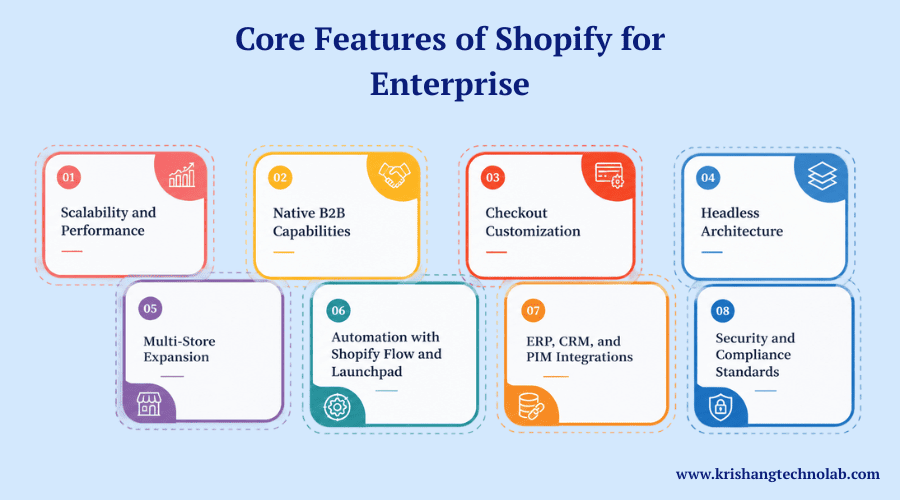
1. Scalability and Performance
Scalability sits at the core of every Shopify development for an enterprise project. In particular, enterprise Shopify development must absorb sudden traffic spikes without slowing checkout. It’s this reliability, along with the other benefits of Shopify Plus, that makes it a trusted base for enterprise-grade Shopify development at scale.
2. Native B2B Capabilities
B2B functionality is one of the main features of enterprise Shopify development services. Now, enterprise brands get native company accounts and custom pricing in their Shopify development. As a result, they don’t need separate wholesale platforms for most enterprise commerce development builds.
3. Checkout Customization
Checkout control is the heart of enterprise Shopify development that has a direct impact on conversion and compliance. In addition, Shopify development with checkout extensibility and Shopify functions allows enterprise teams to build custom logic safely—without breaking future platform updates.
4. Headless Architecture
Headless commerce represents one of the most advanced paths in enterprise Shopify development. Shopify development with hydrogen and oxygen is a popular choice for enterprise brands that want to have full control over the frontend and trust Shopify Plus as the backend engine.
5. Multi-Store Expansion
Global scale is often a driver of enterprise Shopify development. In fact, when developing Shopify for enterprise brands that are expanding internationally, markets and expansion stores are used, so one Shopify Plus contract can cover multiple regions, all within one enterprise commerce development strategy.
6. Automation with Shopify Flow and Launchpad
Enterprise Shopify development is not only about features but also about operational efficiency. For example, Shopify Flow and Launchpad remove repetitive work from enterprise teams’ Shopify development so developers are able to spend their time on higher-value enterprise-grade Shopify development work.
7. ERP, CRM, and PIM Integrations
Integration depth defines successful enterprise Shopify development. Experienced ecommerce development teams link ERP, CRM, and PIM systems using Shopify’s API-first architecture, a critical layer in any serious enterprise Shopify implementation plan.
8. Security and Compliance Standards
Compliance is a must in enterprise Shopify development. Fortunately, Shopify development for enterprise brands is more secure thanks to built-in PCI DSS and ISO 27001 standards, which also lighten the security load on internal teams developing enterprise commerce.
Challenges in Shopify Enterprise Development
No platform is perfect, and Shopify is no exception. With that in mind, these are the challenges enterprise teams run into most often, especially once a project moves past the planning stage and into real development.
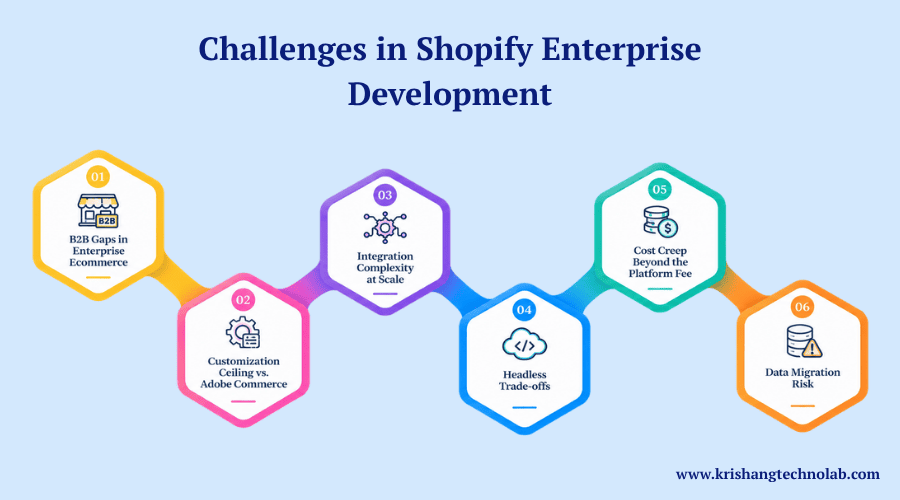
1. B2B Gaps in Enterprise Ecommerce
Not all requirements fit neatly into Shopify Plus enterprise development. Native B2B tools usually do not cover complex procurement models, contract pricing, and approval chains. So, during large-scale Shopify development work, teams gravitate to apps or custom web application development services.
2. Customization Ceiling vs. Adobe Commerce
Shopify’s enterprise architecture is a trade-off, giving up some backend flexibility for speed and stability. This structured approach can at times be restrictive for teams migrating from Magento web development services, particularly when legacy systems had deep custom logic that enterprise-ready Shopify development doesn’t support.
3. Integration Complexity at Scale
Rudimentary connectivity usually does not hamper enterprise Shopify development. Instead, the real difficulty is in the planning of where business logic lives in ERP, CRM, and shipping systems, a planning gap that often moves timelines on complex Shopify enterprise builds.
4. Headless Trade-offs
Frontend freedom in Shopify Plus for enterprise teams comes with a real cost. For instance, the native theme editor is no longer available, so developers must now make every storefront change, which changes how marketing teams operate post-enterprise Shopify migration.
5. Cost Creep Beyond the Platform Fee
Subscription pricing is rarely a good indication of the total budget for an enterprise Shopify project. Apps, integrations, and ongoing optimization all add up quietly, so realistic Shopify development cost planning must think beyond the base platform fee.
6. Data Migration Risk
Moving historical data safely is one of the hardest parts of Shopify development for growing enterprises. Redirects, SEO equity, and legacy records all carry risk, so a Shopify migration checklist and experienced web migration services are essential before any migration begins.
Solutions for Successful Shopify Enterprise Development
Every challenge above has a practical solution. Below, we cover how experienced teams actually approach Shopify enterprise development to avoid the most common and costly mistakes.
Choosing the Right Architecture for Enterprise Shopify Development
The architecture decision shapes every part of the project that follows, so it deserves more time than most teams give it. Ultimately, choosing between Shopify Plus, headless, and Commerce Components comes down to three simple questions.
- Where does the business need operational separation, such as separate regions, brands, or teams that need to move independently?
- Where does the customer experience need creative freedom that a standard theme cannot deliver?
- Who will take ownership of the added complexity post-launch, including ongoing frontend maintenance or composable architecture management?
If speed and simplicity matter most, Shopify Plus alone is usually enough. If the frontend experience is a genuine competitive advantage, headless is worth the investment, ideally built with a React development company that understands storefront performance. However, if your business already runs on a complex, multi-system stack, Commerce Components offers a way to adopt Shopify gradually.
Solving the B2B Gap with Native Features and Apps
The right approach to B2B is rarely all native or all custom. Instead, most successful enterprise builds use Shopify’s native B2B tools for standard wholesale operations, then extend selectively where the business truly needs more.
First, begin with company accounts, custom pricing, and purchase orders, as these cover most common B2B use cases and require no extra development. Then, for advanced needs like punchout integrations or multi-step approvals, bring in a vetted app or targeted custom development, rather than trying to force every requirement into native functionality that was not designed for it.
Building a Disciplined Integration Strategy for Shopify Development
Integration problems usually come from a lack of planning, not from any real limitation in Shopify’s API. For this reason, a disciplined integration strategy prevents most of the common issues before development even starts.
First, decide early on what platform will own what piece of business logic, and plan exactly which systems will need to connect to Shopify. A direct connector is good for simple data, but pricing rules, inventory sync, and customer segmentation generally require a more structured integration layer, sometimes through middleware, to prevent conflicting updates between the systems.
A Phased Roadmap for Enterprise Shopify Development
Enterprise Shopify projects succeed when they are treated as structured programs, not single big-bang launches. As a result, a phased roadmap reduces risk at every stage of the build.
- Discovery: Map business requirements, integration dependencies, and B2B rules before you start any development.
- Migration and build: When you move the data, build the theme or empty the browser and connect test data that is similar to the real data; be careful.
- Launch: Test checkout, payments, and fulfillment with a well-defined rollback plan.
- Optimization: Once live, you should improve the operational, conversion, and marketing processes.
Additionally, the phased approach provides marketing, operations, and finance stakeholders with a clear checkpoint to review progress, rather than only hearing about problems at launch.
Managing the Total Cost of Shopify Development from Day One
A realistic budget looks past the monthly Shopify Plus subscription and accounts for every layer of the project. In fact, this is the single biggest factor in whether an enterprise Shopify build stays on budget.
Build your cost model around five areas: platform licensing, apps and SaaS tools, implementation and custom development, integrations, and ongoing web maintenance services. Comparing Shopify’s total cost of ownership only against a competitor’s license fee, without including these other categories, almost always underestimates the real investment required.
Working with the Right Shopify Development Partner
Technical skill alone does not make a good enterprise Shopify partner. The right partner also knows when to use a native feature, when to customize, and when to say no to unnecessary complexity.
Look for a team that can point to real enterprise implementations, explain trade-offs in plain language, and document decisions clearly so your internal team is not dependent on one developer after launch, whether you work with dedicated Shopify experts or hire Shopify developers to extend your team. A strong partner protects your long-term flexibility, not just the deadline for your launch date.
Shopify Plus vs. Adobe, Salesforce, and BigCommerce
Shopify Plus is not the only enterprise platform out there. Adobe Commerce lets you tailor the backend extensively; the trade-off is increased expense and maintenance effort. Salesforce Commerce Cloud has good functionality with complex, multi-service architecture. Headless builds? BigCommerce is an open, API-first alternative. Commercetools and Elastic Path take composability even further, trading off simplicity for maximum architectural flexibility.
The table below summarizes how these platforms typically compare on the criteria enterprise teams care about most.
| Criteria | Shopify Plus | Adobe Commerce | Salesforce Commerce Cloud |
| Time to market | Fastest, often weeks | Slower, custom development required | Moderate to slow, partner-led delivery |
| Backend extensibility | Limited, API and Functions based | Full backend access | Good, API and service based |
| Total cost of ownership | Lower, predictable pricing | High, licensing and hosting costs | High, licensing and multi-cloud costs |
| B2B capabilities | Native and improving quickly | Mature and highly flexible | Mature, separate B2B product |
| Best fit | Speed and unified admin | Deep customization needs | Enterprise multi-service architecture |
Overall, Shopify Plus is usually a better option for brands that care about speed, one admin, and total cost of ownership. However, if your business requires deep backend control or very specific workflows that Shopify’s structure can’t accommodate, Adobe Commerce or Salesforce Commerce Cloud might be worth the added complexity.
Real-World Enterprise Shopify Development Examples
Real-world use shows Shopify’s range: consumer brands launch DTC stores within days using Shopify Plus, while media companies build immersive headless experiences with real-time checkout, and global product companies adopt Commerce Components to modernize multi-brand selling. Ultimately, each path—full platform, headless, or composable—fits a different business model.
Measuring Shopify Development Success After Launch
A successful launch alone doesn’t define success. Instead, four metrics reveal real progress: conversion efficiency, average order value, customer lifetime value, and operational health. Taken together, these numbers show whether Shopify is actually reducing friction and delivering measurable results, not just confirming the site launched on time.
Conclusion: Is Shopify Development Right for Your Enterprise?
Shopify has clearly earned its place in enterprise e-commerce conversations. Indeed, Shopify development for enterprise is no longer a fringe idea reserved for legacy holdouts; it is a proven path for brands managing serious scale. The features are real: enterprise-grade checkout performance, native B2B tools, global infrastructure, and a total cost of ownership that is often lower than legacy alternatives like Adobe Commerce or Salesforce Commerce Cloud.
Meanwhile, the obstacles are no less real. Advanced B2B requirements, integration complexity across ERP and CRM systems, and costs that extend well beyond the base subscription all demand honest planning before any enterprise Shopify implementation begins.
The right decision depends on your business model, your existing systems, and how much architectural flexibility your team genuinely needs. In other words, there is no one-size-fits-all answer. That said, for most growing enterprise brands, a disciplined approach to Shopify enterprise development is what works best.
Specifically, this means matching Shopify Plus, headless commerce, or Commerce Components to actual requirements. When this is paired with realistic budgeting and a capable development partner, it turns Shopify’s features into measurable business results.
If your team is weighing Shopify development for enterprise, start with a clear-eyed Shopify store audit of your current platform, integration needs, and B2B complexity before choosing an architecture. That single step, taken early, prevents most of the expensive mistakes covered throughout this guide.
Frequently Asked Questions
1. Is Shopify good for enterprise businesses?
Yes. Shopify Plus is a credible option for large, complex commerce operations today, with high transaction volume, native B2B tools, global scalability, and a lower total cost of ownership than most legacy platforms.
2. What is the difference between Shopify and Shopify Plus?
If you have a small catalogue and simple processes, then you want standard Shopify. On the other hand, Shopify Plus has enterprise features like custom checkout logic, managing multiple stores, better performance guarantees, and dedicated support for large and complex businesses.
3. How much does a Shopify enterprise build cost?
Prices vary widely depending on scope. However, the base subscription price is not all you’ll need to factor in—custom development, third-party integrations, app licensing fees, data migration, ongoing optimization, and the monthly platform fee all need to be considered.
4. Can Shopify handle B2B and wholesale selling?
Yes. Company accounts, custom pricing, purchase orders, and payment terms are native tools. However, more complex buying needs (e.g., punchout integrations or multi-step approvals) usually need extra apps or custom extensions.
5. What is headless commerce on Shopify?
Headless separates Shopify’s front-end customer experience from its back-end engine. In practice, Shopify teams using frameworks like React build custom experiences and manage products, orders, and checkout invisibly.
6. How long does it take to migrate to Shopify Plus?
Timeframes depend on catalogue size, number of integrations, and degree of customization. In most cases, enterprise migrations are phased: discovery, data transfer, build, testing, and launch. Overall, they usually take several months.
7. Is Shopify Plus better than Adobe Commerce for large brands?
The right answer hinges on your priorities. On one hand, Shopify Plus gives you faster deployment and less maintenance overhead. On the other hand, Adobe Commerce offers greater customization on the backend. Ultimately, brands are caught between the need for speed and the need for architectural control.
8. What integrations does Shopify support for large companies?
Shopify’s API-first architecture and app ecosystem, which includes NetSuite, SAP, Salesforce, and HubSpot, connect with ERP, CRM, and PIM systems to help enterprises run more efficiently.
Found this post helpful? Don't forget to share it with your network!