Quick Overview: The online retail world is a fast moving one. E-commerce technology trends like AI personalisation, AR shopping, headless commerce and sustainable tech are all changing the way businesses grow. These tools also help brands to improve customer experience and drive sales. This way companies can be ahead of the competition in the market. Discover what are the best ecommerce technologies to adopt in 2026 and stay ahead of the competition.
The world of online shopping is changing faster than ever. The future of ecommerce in 2026 will include more than just online goods sales. It’s about using powerful new technologies to deliver smarter, faster and more personal shopping experiences through advanced eCommerce website development services.
Ecommerce revenue across the globe is expected to exceed $8 trillion by 2027. Much of that growth is driven by e-commerce innovations rewriting the rules of digital retail with AI assistants shopping for you and augmented reality tools for trying clothes on from your sofa.
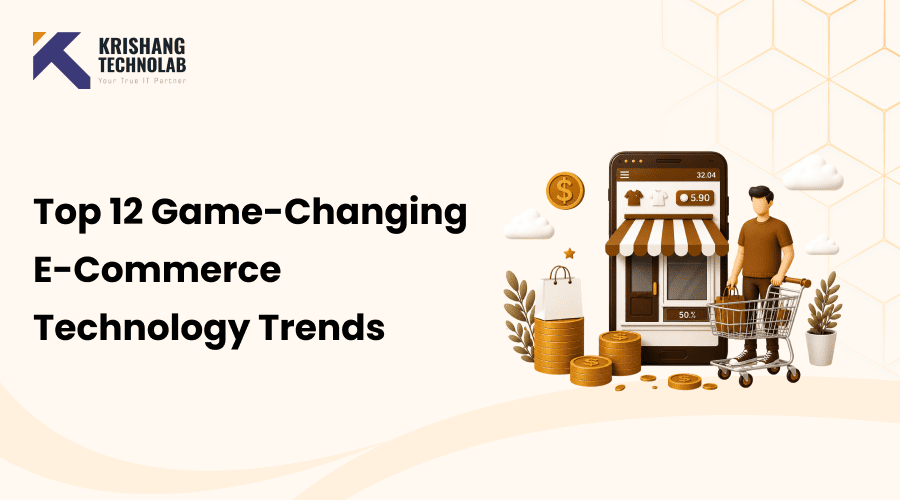
This blog covers the top 12 e-commerce technology trends in 2026, what they are, why they matter and how your business can use them to grow. No matter if you’re a new business or an established company, it’s important that you understand these new trends in e-commerce and invest in advanced eCommerce website development services so you can stay competitive.
What Are E-Commerce Technology Trends and Why Do They Matter?
E-commerce technologies are the tools, platforms and systems. They run an online shop. At every step of the customer process, they have an effect. This includes the website, the checkout page and the payment process. They also influence the product recommendations you see.
These tools are a part of the technology trends in e-commerce. This trend, in turn, is changing the way online stores operate. They also change how shoppers shop. Many businesses now work with eCommerce website experts to stay updated with these changing trends.
Businesses that use e-commerce new technologies can serve customers better. They can also save money. And they grow faster as well. But ignoring these trends leaves companies behind their competitors. In fact, there are many competitors already using these tools.
Three key forces are driving e-commerce developments in 2026. The first is that customers are demanding more speed and more personalization. The second is the emergence of artificial intelligence. Third, shopping on mobile devices is growing.
Together, these forces are changing online retail. They, in turn, redefine what it means to run a successful online store.
Also Read About: Why Hire Shopify Developers Instead of Using Theme?
Top E-Commerce Trends Shaping in 2026
Let’s dive deeper into each of the e-commerce technology trends. We will also look at real impact data.
Trend 1: AI-Powered Personalization & Hyper-Personalization
The AI in e-commerce has grown very fast. Now it’s more than just basic product recommendations. By 2026, AI-powered hyper-personalization has become standard. This makes every shopper have a unique store experience. These include custom homepages, emails and product feeds.
AI also analyzes users’ behavior. It then makes better product suggestions through AI product recommendations. It also refreshes content in real time. So shopping becomes more personal.
AI-powered ecommerce personalization improves conversion rates. Indeed, 67% of consumers want a personalized experience. Brands that meet this demand perform better as a result. They can see revenues as much as 40% higher per visit. We compare this figure to stores with conventional layouts.
Many leading platforms now use recommendation systems. These systems account for a big part of the total revenue. These tools will be readily available by 2026. To do this, Shopify, Magento and custom AI tools from a generative ai devlopment company are available for businesses of all sizes.
So more brands are going with AI personalization. They say they get 40% more revenue per visitor. They also see cart abandonment drop by 20%.

Trend 2: Agentic AI & Autonomous Shopping Assistants
One of the most exciting e-commerce technologies of 2026 is agentic AI commerce. If you’re using software that can think, decide and act on your behalf, that’s agentic AI. This refers to AI shopping assistants used in online shopping. These tools allow you to examine products. They can look at different prices. They can also have payments made instantly. That speeds and simplifies shopping.
In fact, 23% of organizations are already scaling conversational commerce AI systems. And retailers using agentic AI are seeing up to 10x higher conversion rates in chat-based shopping flows. The results show impressive growth. Generative AI e-commerce tools are good for business too. They are describing products. They answer questions from customers. It also creates ad copy at scale.
Trend 3: Headless & Composable Commerce Architecture
Headless commerce in 2026 separates the front-end from the back-end. It allows businesses to provide flexible shopping experiences. Composable commerce architecture helps brands, as well. This allows them to combine and choose the right tools for themselves. Additionally, it enhances speed and flexibility.
The headless e-commerce development market is growing rapidly. It has a CAGR of 22.4%. Also, by 2032, it is expected to reach $7.16 billion. API-first e-commerce platforms enable this growth. They let brands launch on web, mobile, voice and IoT channels. This growth occurs without the need to re-architect core systems. Brands can scale across channels more quickly with support from an experienced eCommerce development company and by implementing effective headless commerce solutions.
Retailers that are using a headless architecture can launch new shopping experiences up to 3x faster. That contrasts with traditional monolithic platforms.

Trend 4: Augmented Reality (AR) & Immersive Shopping Experiences
AR shopping experiences let customers see products in their real-world environment before buying. Augmented reality in e-commerce enables shoppers to place a sofa in their living room, try on glasses on their face, or see how a paint colour looks on their wall – all via their phone or laptop camera.
According to Shopify data, e-commerce with 3D product visualization has a 94% higher conversion rate than regular listings. Virtual try-on technology also reduces returns by as much as 40%, which is an enormous help in reducing fulfilment costs. AR is quickly becoming a standard feature in forward-thinking online stores as the technology becomes more affordable.
Trend 5: Voice Commerce & Conversational Shopping
Voice commerce trends 2026 almost half of US consumers use voice searches when shopping. In voice search e-commerce optimization is no longer optional; it’s essential, whether via smart speakers, phone assistants or in-car systems.
Voice searches are conversational, based on questions. Which means your product pages and content need to be optimised for natural language queries – not just short keywords. Add conversational commerce AI, and voice commerce offers an effortless, hands-free shopping experience that meets customers where they are and how they want to engage.
Also Read About: How Shopify Stores Optimize for Voice Search?
Trend 6: Social Commerce & Livestream Shopping
Social commerce 2026 has made platforms like Instagram, TikTok and YouTube into full shopping destinations. Live shopping trends push this further. Brands are doing live video events too. Audiences can ask questions, see demos and buy on the spot, which also fuels comparisons like TikTok Shop vs Shopify for brands choosing the right sales channel.
Livestream shopping technology is also growing at a CAGR of 39.9% through 2033. Social commerce penetration globally is now at 31%. Shoppable video e-commerce on platforms like TikTok Shop and Instagram also makes impulse buying faster and more social. That means live shopping events can convert up to 8x better than traditional product pages. This makes it one of the most powerful new trends in e-commerce for D2C brands to implement right now.

Trend 7: Mobile-First Commerce & Progressive Web Apps (PWA)
Mobile commerce trends 2026 are a major change. More than 73% of all e-commerce transactions are now done on a mobile device. And that’s why a mobile-first ecommerce strategy is necessary now. That means designing your store for small screens first. After designing for small screens, the next step is to optimize the store for desktop use with professional eCommerce website development services.
Progressive Web App e-commerce solutions offer rapid performance. Progressive Web Apps actually feel like native apps. But users don’t need to download anything. The PWA for online stores loads in less than a second. They also work in offline mode. It also supports push notifications. They therefore help keep mobile shoppers engaged. They also reduce drop-off across the sales funnel.
Trend 8: Flexible Payments: BNPL, Crypto & Embedded Finance
Ecommerce payment trends 2026 focus on flexibility. Shoppers want more payment options. For example, they use buy now pay later e-commerce options, digital wallets, cryptocurrency and one-click checkout.
BNPL technology is booming. That’s especially true for Gen Z and millennial shoppers. Embedded payments in e-commerce allow brands to offer financial services. Things like credit, insurance and loyalty rewards are included. The shopping experience seamlessly integrates all of these features.
The end result is fewer abandoned carts when checkout is easy. Thus, the ability to offer flexible payment options directly impacts revenue growth.
Also Read About: How to Set Up Shopify Payments and Checkout Options?
Trend 9: Omnichannel & Unified Commerce Experiences
Omnichannel e-commerce solutions unify all the channels a customer shops through. This includes your website, app, social media, marketplace and physical store. Therefore, all channels operate as a single, unified system.
E-commerce customer experience in 2026 demands full flexibility right now. For instance, a customer may start with Instagram. Then they might come to your website. Finally, they might purchase it in store. Plus, their history and preferences travel with them.
Brands that have solid omnichannel strategies do better. In fact, they retain 89% of customers. But weak cross-channel experiences retain only 33%. Therefore, omnichannel is a powerful growth driver.
Unified commerce is the direction both D2C e-commerce technology and B2B e-commerce are taking. Everything is run by one platform in this model. This model includes inventory, pricing, customer data and delivery.
Trend 10: AI-Driven Inventory & Supply Chain Automation
Predictive inventory AI e-commerce is powered by machine learning. It helps in predicting demand. It also helps to prevent stockouts. Also, it can automatically reorder products.
E-commerce supply chain technology in 2026 erases manual work. It also minimises errors. This means delivery is faster and more reliable, especially when supported by AI-powered software development.
The success of AI-enabled real-time inventory management has been extensive. For example, it cuts overstock costs by as much as 30%. It also cuts stockout rates by 50%.
When paired with e-commerce automation tools, businesses can operate on a leaner basis. So teams can concentrate on growth. 70% of customers switch to a competitor solely due to stockouts. Thus, this phenomenon is one of the most important trends.

Trend 11: Zero-Party & First-Party Data Strategy
Third-party cookies are going away. This is why a zero-party data e-commerce strategy is becoming more of a priority. Zero-party data is information that a customer gives you voluntarily. They share it through quizzes, forms, preferences and loyalty programmes. First-party data e-commerce is data collected from website activity.
Cookieless tracking e-commerce is already joining in online business nowadays. So, brands are now concerned about e-commerce data privacy trends and safe data collection.
Customers also trust brands that are transparent about how they use data. Personal shopping experiences are also a favourite. As a result, a smart data strategy increases brands’ trust, engagement and loyalty.
Trend 12: Sustainable & Green E-Commerce Technology
Sustainable e-commerce technology enables businesses to operate in an eco-friendly way. It has green hosting, recycled packaging, carbon offsetting tools, and circular commerce programmes. Brands will also often spend money on ethical sourcing and waste reduction. Green e-commerce in 2026 is a business and moral imperative.
Many shoppers today are trying to be kinder to the environment. That’s why brands are talking more about how they’re helping the environment. Companies, for example, put badges on their carbon-neutral shipping, offer recycled packaging, and label their ethical sourcing.
Also, brands that leverage e-commerce innovation in 2026 with sustainability can increase customer trust and retention. Sustainability is no longer a bolt-on.
How to Adopt New E-Commerce Technology for Your Business
Knowing the best new e-commerce technology trends to adapt in 2026 is half the battle. But success is a matter of doing. So you need a clear plan. Below are five easy steps to help you implement the right e-commerce technologies for your business.
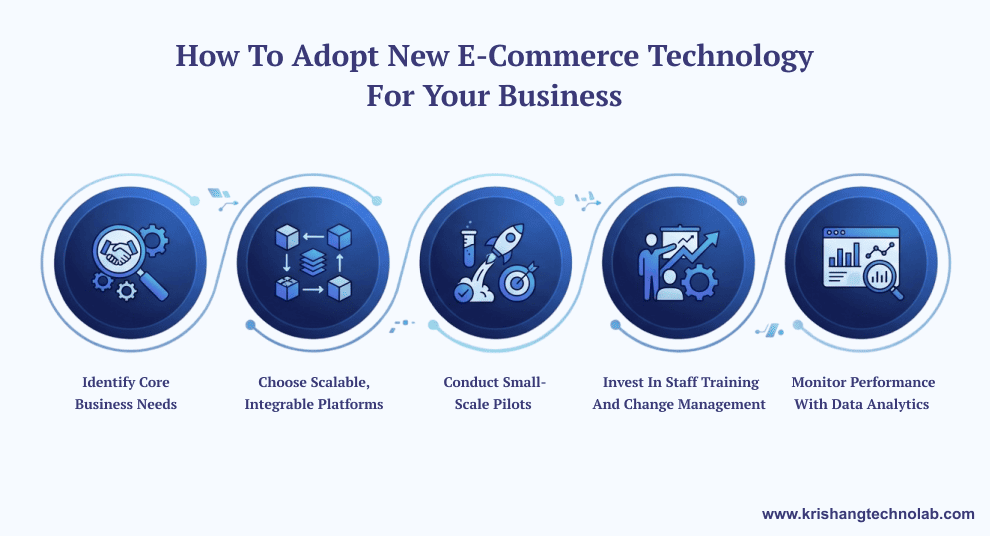
Identify Core Business Needs
Know your major problems before you implement any new e-commerce technology. For example, are customers leaving at the checkout? Is your inventory moving slow? Is mobile sales sucking? Additionally, list each problem. Thus, you can choose better e-commerce technology trends. This also keeps you focused on real needs and not just popular trends.
Choose Scalable, Integrable Platforms
Not all e-commerce technology is equally effective. So choose wisely. Start with easy questions. Does it scale with your business? Does it work with the tools you already have? Also, choose systems with open APIs. Also similar to a composable commerce design. Consequently, you can scale easily. Parts are also upgradeable without rebuilding the system. This step helps you choose the right tech stack for long-term success.
Conduct Small-Scale Pilots
You don’t need a total change all at once. So the small ones go. Test AI personalization, for example. Or try a PWA upgrade. Then do it with a few other people. Measure the results, step by step. That means you can resolve problems early. You also mitigate risk. Thus, small tests build confidence before a full rollout.
Invest in Staff Training and Change Management
Even new technologies for advanced e-commerce do not work without trained people. So training counts. Help your group understand how to use new tools. Also support change management. The system getting to the teams makes for a better adoption. This approach means that e-commerce automation solutions and AI systems are more effective.
Monitor Performance with Data Analytics
When your e-commerce technology trends solutions are live, track everything. Look at your review conversion metrics, bounce rates and cart abandonment. Also use live inventory data. Also use insights from AI. Monitor revenue per visitor too. This way you can improve step by step. So think of tech adoption as a continuing process. This is not a one-time thing.
Benefits of Staying Ahead of E-Commerce Technology Trends
Businesses that keep up with e-commerce trends enjoy the real, measurable advantages. Here’s what early adopters consistently say:
- Higher conversion rates through personalisation, AR, and faster checkout
- Better customer retention with omnichannel and loyalty-driven data strategies
- Lower operational costs through AI automation of inventory and customer service
- Stronger brand trust by embracing sustainability and data privacy
- Faster time-to-market with headless and composable commerce architecture
The brands that are willing to invest in e-commerce conversion rate optimization and e-commerce customer experience 2026 improvements now – before their competitors – own the future of e-commerce technology.
Final thoughts
E-commerce technology trends for 2026 are already changing how we shop online. AI-powered hyper personalization to green e-commerce 2026, brands that adopt these e-commerce technologies today will be ahead of the curve tomorrow.
Start with one or two trends that align with your biggest opportunity for growth. At Krishang Technolab, help our clients to transform these trends into actual e-commerce solutions that work. Also, our team concentrates on practical strategies to grow in the long term. This allows businesses to be more agile and respond to changing customer expectations. Get ahead of the curve on the future of e-commerce; we’re here to help you get there.
Frequently Asked Questions
What are E-Commerce Technology Trends?
E-commerce technology trends are new online business tools. They include AI, AR and headless commerce. These are tools that aid in business development. They add to customer experience.
What are the top e-commerce technology trends in 2026?
Among the top trends are AI personalisation, AR shopping, voice commerce, social commerce, PWAs and BNPL payments. Many brands are also using headless commerce and AI automation now.
What is the future of ecommerce technology?
Ecommerce technology will be straightforward and intelligent in the future. Artificial intelligence, augmented reality and voice commerce are revolutionising the way we shop online.
How do new trends in ecommerce impact small businesses?
The new e-commerce trends are more user-friendly. They are also more affordable. Which means that small businesses can compete against the bigger brands.
What are the best ecommerce technologies to adopt in 2026?
Mobile optimization and AI recommendations are where businesses should start. They can then add social commerce and AR tools. This can help improve growth.
Why should businesses follow e-commerce technology trends?
E-commerce technology trends followed by the businesses can enhance sales and customer loyalty. They can also stay competitive while cutting costs.
Found this post helpful? Don't forget to share it with your network!