
Quick Overview: Vibe coding vs traditional coding compares AI-powered app development with hand-written software engineering. Explore speed, cost, code quality, scalability, and security across popular AI coding tools, custom software development, and MVP development — helping startups, founders, and dev teams choose the best coding approach for 2026.
Software gets built in new ways today, and the change is happening fast. So, developers now choose between two clear paths: vibe coding or traditional coding. One path relies on AI prompts and instinct. Meanwhile, the other relies on structured logic and hand-written code. As a result, this shift raises a real question for founders, teams, and hobbyists alike — should you go with vibe coding vs traditional coding for your next build?
For your next build, should you go with vibe coding, or stick to regular coding? So basically, it is contingent upon your goals, budget, and timeline. Here’s a simple comparison of Vibe Coding vs Regular Coding. You will also learn how each method works and where it shines.
Then we compare speed, cost, quality, long term growth, with real project scenarios. At the end you will know which method is the best for your project. Whether you’re a one-person founder or a big team, this guide helps you make a confident, clear decision.
So in this article we will discuss about Vibe Coding vs Traditional Coding step by step. We will start by reviewing the basics of each method and how it can be applied in practice. Then we compare them in detail, side by side. To summarise, this guide gives you an easy and practical way to make a decision.
What Is Vibe Coding?
Vibe coding is a style of software creation driven by plain language. Instead of writing every line yourself, you describe what you want, and an AI code generator creates the code. Coined by developer Andrej Karpathy in 2025, the term has quickly gained traction.
Today, AI development services companies use vibe coding to speed up prototyping and application development, making software creation more accessible to founders, marketers, and non-technical users. This shift is central to understanding Vibe Coding vs Traditional Coding.
How Vibe Coding Works
The process starts with a simple prompt, such as “build a login page.” The AI tool then generates the code and may test or fix small issues along the way, giving you a working demo in minutes. The Complete Prompt Engineering Guide explains how clear prompts, feedback, and follow-up instructions can shape the AI’s output. Most platforms also let you preview changes live, making vibe coding feel more like a conversation than traditional code writing.
Popular Tools Used in Vibe Coding
Several platforms lead the vibe coding space in 2026. Cursor remains one of the most widely used AI code editors, while Claude Code serves as a terminal-based agent for larger projects. Teams can hire dedicated Claude Code developers when they need expert support for complex AI-powered development.
Tools like Lovable, Bolt, and v0 focus on rapid app creation, while Replit Agent and Zite help non-technical teams launch products quickly. With options for both beginners and experienced developers, the right vibe coding tool ultimately depends on your skills, project needs, and goals.
Also Read About: Best vibe coding tools for developers
What Is Traditional Coding?
Traditional coding means writing software by hand, line by line. Developers work directly with languages such as JavaScript, Java, or Python to build system logic and test each component. This approach has powered software development for decades and remains common for complex, high-stakes systems.
Web app development solutions built through traditional coding also give teams greater control over functionality, performance, and security. Unlike vibe based development, this level of control is especially valuable for large teams and critical projects, making it an important factor in the Vibe Coding vs Traditional Coding debate.
How Traditional Coding Works
A developer starts with a plan and a system design. Then they write code across files and modules and databases. Then they check the code with unit tests and manual checks. Debugging is done step-by-step, often with special tools. That careful process means traditional coding takes more time up front. But it makes software that the teams understand and can maintain entirely.
Skills Required for Traditional Coding
Programming requires strong technical skills and problem-solving ability. Developers need to understand databases, frameworks, programming languages, algorithms, and data structures, along with debugging, security, performance practices, and Git version control.
Building this expertise can take years, especially for complex projects. Businesses can hire skilled software developers when they need experienced professionals to handle challenges that AI coding tools cannot solve on their own. Strong programming knowledge remains essential for senior technical roles and large-scale software development.
Vibe Coding vs Traditional Coding: Comparison
Comparing vibe coding vs traditional coding side by side makes the differences clear. This table highlights speed, cost, skill level, scalability, code quality, and reliability — helping you quickly pick the best approach for your project.
| Factor | Vibe Coding | Traditional Coding |
|---|---|---|
| Development Speed | Hours to days | Weeks to months |
| Skill Level Required | Little to no coding experience | High technical and programming skills |
| Cost for Small Projects | Lower; often free or uses low-cost tools | Higher; requires skilled developer resources |
| Code Quality & Control | AI-generated; requires human review | Developer-written and thoroughly reviewed |
| Scalability | Can struggle with large, complex systems | Designed to scale for large, complex applications |
| Maintenance | Depends on code clarity and quality of AI-generated output | Easier with a development team’s full understanding of the codebase |
| Best Suited For | MVPs, prototypes, experiments, and small business applications | Regulated, large-scale, and mission-critical software |
Vibe Coding vs Traditional Coding: Key Differences
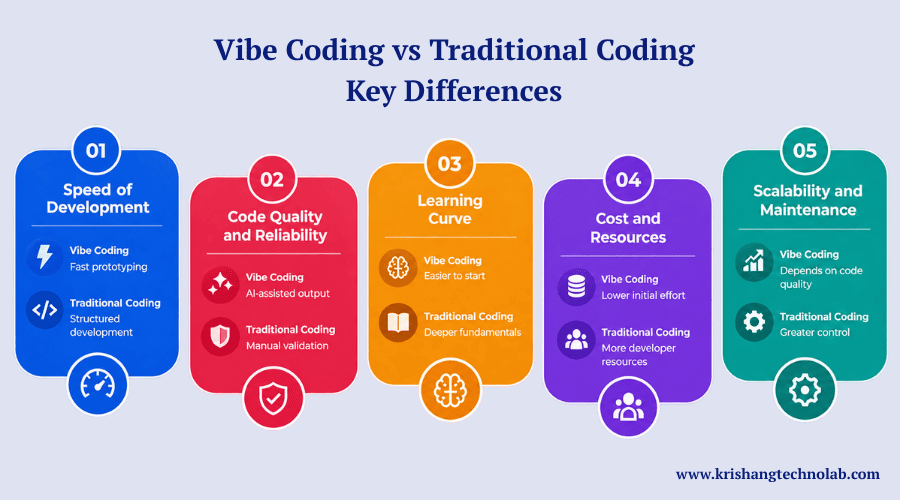
Key contrasts are noted when comparing Vibe Coding vs Traditional Coding. These differences impact speed, quality, learning time, and cost. Knowing them helps you pick the right approach for your project. Below we look at each of the factors in detail.
Speed of Development
Vibe coding clearly wins when speed matters most. You can build a working demo in hours rather than weeks, while traditional coding takes longer because developers write and test each feature manually. Experienced vibe coding developers can build and refine applications quickly, making this approach well suited to tight deadlines.
However, faster development can sometimes mean less control over the finer details. So, when comparing Vibe Coding vs Traditional Coding, vibe coding has a clear advantage when speed is the priority.
Code Quality and Reliability
Traditional coding often produces more consistent and predictable results because developers understand and control every line of code. Teams that hire dedicated software developers can also maintain greater control over code quality, security, and debugging.
In contrast, vibe coding may introduce hard-to-trace bugs, structural issues, or missing safety checks in AI-generated code. That’s why many teams review and test AI output before launch. Traditional coding still has an edge in reliability, although AI tools are becoming better at producing clean, usable code.
Learning Curve
Vibe coding is much easier to learn for beginners. Anyone can explain an idea and get working software up and running quickly. But traditional coding can take months or years of hard study. Developers need to know the syntax, logic and debugging skills. So vibe coding expands software work to a much larger group. This ease of use is one of its biggest strengths. Comparison vibe coding vs traditional programming in terms of learning speed – a clear winner for fast starters.
Cost and Resources
Vibe coding tools can be a cheaper alternative to hiring a full development team. Most platforms offer free or low-cost plans, while traditional coding requires skilled developers and can involve multiple specialists for complex projects. MVP development services can be a practical option for startups looking to build and test an early-stage product within a limited budget.
However, larger systems may still require traditional development resources, and costs can increase later with scaling, maintenance, and security needs. So, while vibe coding often has a lower upfront cost, long-term expenses depend on how well the code performs as the product grows.
Scalability and Maintenance
Traditional coding tends to scale better for large, complex apps because developers can fine-tune performance and manage growing codebases carefully. Vibe coding tools can struggle with larger systems, especially when the code lacks a clear structure.
However, many platforms now generate clean, editable code, making long-term growth more practical. A software development outsourcing company can be a good option as projects grow, particularly when teams need extra development resources for scaling and maintenance. Planning for scalability early can also prevent higher costs as user numbers increase.
Vibe Coding vs Traditional Coding at a Glance
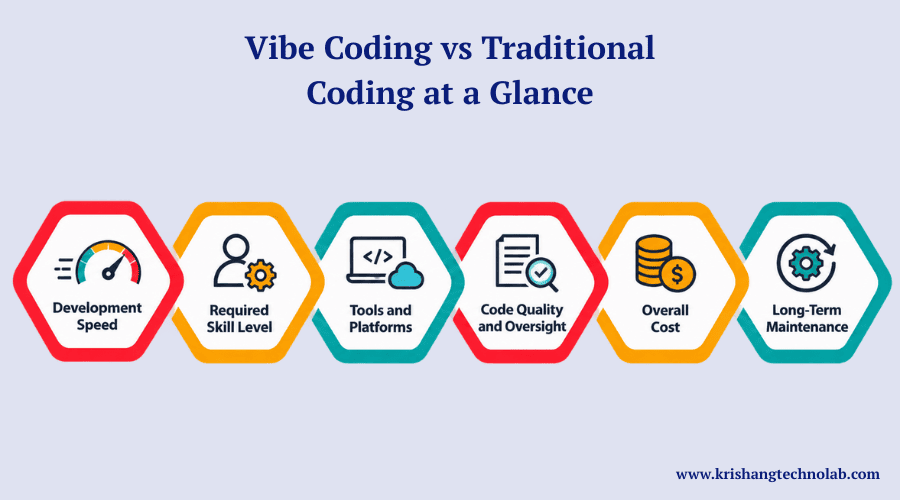
Vibe coding uses AI prompts to quickly generate code, favouring speed and experimentation. In the conventional coding, reliability and control are ensured through manual logic. Prototype using vibe coding and stable, long-term software using traditional coding.
Speed
With vibe coding you get results in hours or days because most of the coding is done by the AI instantly. All of this takes weeks or months instead of days, because each feature is hand-coded and hand-tested.
Skill Level Needed
Vibe coding involves little or no coding experience, because AI does most of the technical decision making for you. Traditional coding requires a high level of programming skill and training, as developers need to write, debug and structure each line themselves.
Tools Used
Vibe coding uses AI tools such as Cursor and Claude Code to generate, refine, and improve code quickly. The best vibe coding tools for developers can speed up development by handling tasks that would otherwise require manual coding. Traditional coding, on the other hand, relies on IDEs, compilers, and debugging tools, giving developers direct control over every step of the development process.
Code Quality Control
“Vibe coding relies heavily on AI accuracy and review, so errors can sneak by without careful review.” With traditional coding, developers have direct hands-on quality control since every line is written and reviewed by hand.
Cost
For small projects, vibe coding might be a cheaper option. AI cuts down development development hours. The traditional model for the production of complex large scale or highly customised software is to use skilled labour which is costly.
Maintenance
Vibe coding upkeep depends on code clarity and exports, since AI-generated logic isn’t always easy to follow. Traditional coding upkeep benefits from full team understanding, making updates and fixes faster and far more reliable.
Pros and Cons of Vibe Coding
Vibe coding is for fast development, easy access and quick experimentation with ideas and prototypes. However, it frequently leads to inconsistent code quality, poor long-term structure and a heavy dependence on the accuracy of AI. “Better than complex mission critical software for early stage projects.”
- Speeds up development for simple projects
- Makes software creation more accessible to non-technical founders and teams
- Lowers costs by reducing the need for a large development team
- Many tools include built-in features such as hosting
- An MVP guide for startups in 2026 shows how vibe coding makes it easier to build and test an early product
- Lets founders validate ideas and gather feedback before investing in a full-scale development project
- Enables teams to act on feedback almost instantly during early stages
Advantages of Vibe Coding
Vibe coding can speed up development for simple projects while making software creation more accessible to non-technical founders and teams. It can also lower costs by reducing the need for a large development team, while many tools include features such as built-in hosting. An MVP guide for startups can show how vibe coding makes it easier to build and test an early product. Founders can validate ideas, gather feedback, and make changes before investing in a full-scale development project.
Disadvantages of Vibe Coding
AI generated code may have bugs or security holes. Also, during creation, AI tools are often mistaken for complex logic. Likewise, long-term upkeep can be a challenge without technical expertise available. Also some platforms restrict custom work for advanced features. So, vibe coding probably doesn’t work for big, complex apps. This can also result in vendor lock-in through heavy reliance on AI. So teams still require some technical oversight to be safe.
Pros and Cons of Traditional Coding
With traditional coding you get a solid structure, reliable performance and full control over every technical decision you take. However it does take longer, add more complexity and cost more for smaller or simpler projects. It is best for complex, long-term, mission critical software.
Advantages of Traditional Coding
Traditional coding offers full control over structure and logic, making it well suited to complex, large-scale, and high-stakes systems. Developers can fine-tune performance, manage security requirements, and integrate custom third-party tools with fewer limitations. Professional remote developers can also work on specialized software while maintaining the level of control these projects require. As a result, traditional coding remains important for products that demand reliability, customization, and compliance with strict industry regulations.
- Offers full control over structure and logic
- Well suited to complex, large-scale, and high-stakes systems
- Lets developers fine-tune performance down to the smallest detail
- Makes security requirements easier to manage directly
- Professional remote developers can work on specialized software while maintaining the level of control these projects require
- Supports custom third-party tool integration with fewer limitations
- Remains vital for products that demand reliability, customization, and compliance with strict industry regulations
Disadvantages of Traditional Coding
Traditional coding can take longer to build and launch because it requires skilled developers and more upfront planning. The learning curve can also be steep for new coders, while smaller projects may not need such a detailed development process. An offshore engineering development center can provide access to skilled development resources without the cost of building a large in-house team. Still, traditional development often requires more initial time and investment, especially for complex projects.
Which Approach Is Best for Your Project?
Vibe coding is great for small projects, for limited budgets and time, but also for quick prototypes and MVP’s. For software that needs to be reliable, safe and easy to maintain in the long run, traditional coding is the best way forward. That’s especially true for complex, scalable or mission-critical applications.
When to Choose Vibe Coding
Choose vibe coding for fast demos and simple MVPs. Also, it works well for internal tools and small business apps. If you lack coding skill, vibe coding removes that barrier fully. It also helps startups trying out new ideas with its speed. So, in those cases, vibe coding is the better way forward.
When to Choose Traditional Coding
If the system is complex, large-scale or regulated, then go for traditional coding. It also works well for projects where you need a lot of custom work and tight security. So usually big teams with dedicated dev staff prefer this steady route. This is also true for long term products that need careful design. To summarise, traditional coding is still the key for serious, scalable software.
The Future of Vibe Coding and Traditional Coding
The future will likely be a mix of the two approaches rather than replacing one with the other. AI coding tools will become more accurate and capable, while complex system design will remain an area where traditional coding skills are important. Developers will increasingly use AI tools alongside handwritten code, making hybrid workflows a normal part of software development.
AI for Software Development is changing how developers work, with AI handling routine tasks while people focus on architecture, logic, and more complex decisions. Traditional coding still offers control and reliability, while vibe coding brings speed. Many teams already combine both methods in their daily work. As AI-assisted development becomes more common, human judgment will remain essential for building reliable and well-designed software.
Conclusion
Vibe Coding vs Traditional Coding The battle has no clear winner. The methods have different goals, teams and project types. Vibe coding is fast, easy, and cheaper for simple builds. “Complex systems need control, reliability and evolutionary growth which traditional programming offers.” Ultimately, the best approach depends on your project’s specific needs.
Small startups and solo founders may find vibe coding useful for getting ideas off the ground quickly, while mission-critical systems still require traditional development. A custom MVP development company can be a practical choice for startups that need to turn an idea into a working product. Many teams now combine both approaches to balance development speed, flexibility, and reliability. As AI tools improve, so too is this hybrid approach likely to change. Finally, learning to Vibe Code vs Traditional Code will allow you to make confident choices. Choose one that suits your budget, your time and your level of expertise.
Small initial projects to quickly test ideas with Vibe. Then as scope and scale increase, go to traditional coding. Both will improve as better AI tools are developed. “So the best teams will use each method where it makes the most sense.” This is a balanced plan to enable you to build faster but not at the expense of the software’s quality in the long term. “Whatever path you take, have clear objectives and advance.” That way of thinking is more important than any specific coding tool or technique.
Frequently Asked Questions (FAQs)
What is vibe coding, and how does it work?
Vibe coding uses AI to generate code from natural-language instructions, helping developers build, modify, and prototype software faster with less manual coding.
What is the difference between vibe coding and traditional coding?
Vibe coding uses AI-generated code from prompts, while traditional coding involves developers writing code directly, providing greater control over logic, architecture, and implementation.
Is vibe coding better than traditional coding?
Vibe coding isn’t always better. It works well for rapid development and prototypes, while traditional coding offers greater control for complex, secure, and scalable projects.
Can vibe coding replace traditional coding?
Vibe coding cannot completely replace traditional coding. Developers still need to review, test, debug, secure, and maintain AI-generated code throughout the software development lifecycle.
What are the pros and cons of vibe coding?
Vibe coding offers faster development and easier prototyping but may produce inaccurate, insecure, or difficult-to-maintain code without proper developer review, testing, and validation.
Is vibe coding suitable for production applications?
Vibe coding can support production applications when AI-generated code undergoes thorough human review, testing, security checks, performance optimization, and proper quality assurance before deployment.
When should you choose vibe coding over traditional coding?
Choose vibe coding for prototypes, MVPs, simple applications, and rapid experimentation. Traditional coding is better for complex systems requiring precise control, security, performance, and scalability.
Can developers use vibe coding and traditional coding together?
Yes. Developers can combine AI-generated code with traditional programming to accelerate development while maintaining control over architecture, quality, security, performance, and long-term maintainability.
Found this post helpful? Don't forget to share it with your network!