Quick Overview: White label AI agents are changing SaaS. They make deployment fast and easy. They also saved money for businesses. These tools enable scalable automation. They are used by companies to ease daily work. They also enhance the user experience. Understanding how white label AI agents work helps companies adopt AI easily. It also avoids complicated in-house development.
White label AI agents are now a huge player in modern software development. Businesses are quickly embracing AI in SaaS and white label AI services. They leverage these tools to accelerate, reduce costs, and scale. Meanwhile, they do not increase complexity. This approach has led to a growing demand for AI-powered automation. That’s why SaaS companies are moving to smarter, faster, and more flexible AI SaaS solutions.
Developing AI systems in-house also takes time and skilled technical talent. This is why many companies are turning to global outsourcing models like 75% of US & EU companies hire dedicated developers to reduce costs and access skilled expertise faster. Many companies also suffer from slow deployment cycles. They are also facing increasing customer demands for immediate service and personalization. Industry reports say that for over 70% of SaaS companies, the biggest operational challenges are scalability and cost efficiency.
This is where white-label AI agents are making a difference. These solutions enable companies to rapidly roll out sophisticated AI in software development capabilities. They do it by not building systems from scratch. This in turn reduces development time and costs. They also enhance customer experience. To summarize, white label AI agents are revolutionizing the future of AI for SaaS and automation.
What Are White Label AI Agents?
White Label AI Agents are ready-made AI platforms that companies can rebrand and run on their platforms. They are elements of the modern white-label AI solutions that are designed for quick adoption and customization.
In simple words they are plug-and-play AI systems that are customizable AI agents for different needs of business. SaaS companies can change branding, workflows and features without building AI models from the ground up.
Also Read About: What is a white label service and how does it help agencies scale?
How White Label AI Agents Work
White label AI technology functions in a simple way:
- A provider builds a ready-made AI system
- SaaS companies integrate it into their platform
- Businesses customize it for branding and workflows
- The AI runs tasks like support, automation, analytics, and communication
This accelerates and greatly simplifies AI integration for SaaS.
Why SaaS Companies Use Them
Companies prefer White Label AI Services because they lower the development cost and accelerate deployment.
- AI development costs can be reduced by up to 60–80%
- Development cycles shrink from months to just days
- Less technical expertise is required to get started
- Fast deployment and high scalability become achievable
Also Read About: What is Dedicated Software Development Team Strategy, Costs, and ROI in 2026?
Companies prioritize growth and customer experience over building AI from scratch, often leveraging software development outsourcing.
The Role of White Label AI Agents in SaaS
SaaS White Label AI is transforming how software businesses operate. It speeds things up. It also boosts the industry’s efficiency and profitability.
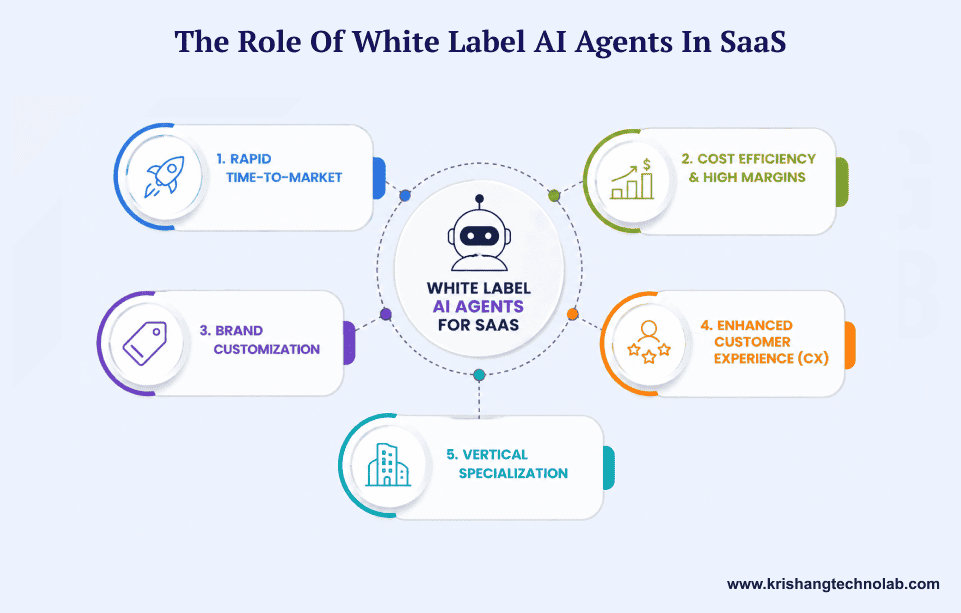
Rapid Time-to-Market
One of the biggest advantages is quick time-to-market. AI-powered SaaS solutions help SaaS companies release features faster. In fact, they can be 3x faster than traditional development models.
For example, a feature that used to take 6 months can now be built in 2-4 weeks. You can do the same with quick AI deployment tools. That means teams can move quicker. They also push out updates more frequently.
Cost Efficiency & High Margins
Cost savings from white label AI are very high. Companies save on AI engineers, data scientists, and infrastructure teams.
Research also delivers concrete results. Businesses can reduce costs by 30-50% through AI-driven automation. That translates to bigger profits. They also build higher margins over time.
Brand Customization
SaaS companies can fully brand the AI with customizable AI agents. They can easily rename, redesign and modify the AI experience.
This branding flexibility means that users experience the AI as part of the product. It doesn’t feel like outside. It looks, instead, perfectly integrated.
Enhanced Customer Experience (CX)
A key advantage is AI customer experience. AI-Driven CX systems enable support to be faster and easier.
They offer:
- Instant responses
- Personalized recommendations
- 24/7 support availability
Moreover, studies show that 80% of customers prefer having AI support in real time. Therefore, AI boosts satisfaction. It also boosts customer retention powered by an AI tech stack for startups.
Vertical Specialization
White label AI technology is also beneficial for niche markets. AI for Industry Verticals helps companies build targeted solutions.
It is used, for example, in:
- Healthcare
- Finance
- E-commerce
- Legal services
This vertical-specific SaaS AI approach thus improves accuracy. It boosts relevance and user confidence, too.
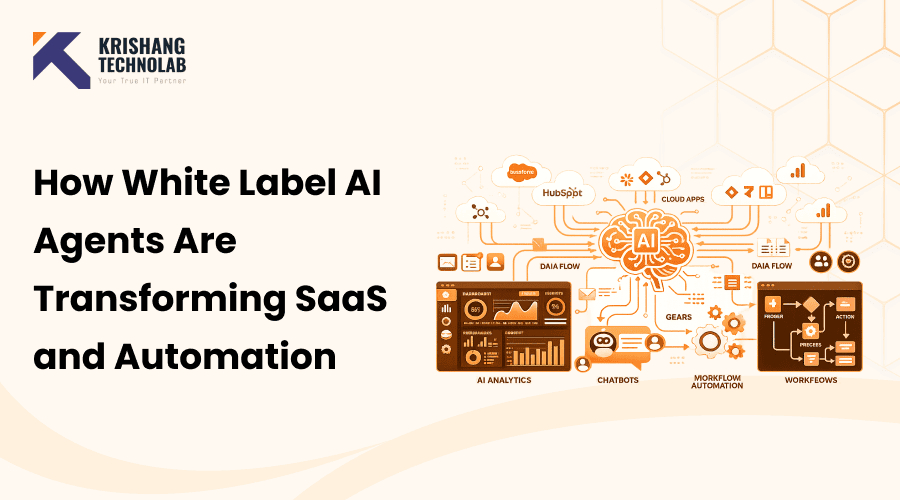
How White Label AI Agents Are Transforming Automation in SaaS
AI-powered automation drives SaaS transformation. SaaS automation with AI, with help from a generative ai development company, is reaching a wider audience than ever with white label systems. This means that even smaller companies can rapidly implement advanced solutions, such as customer relationship management systems or data analytics tools, which were previously only accessible to larger enterprises.
AI-Powered Automation Tools
AI workflow automation is taking over the manual work on SaaS platforms. For example, the following activities are included:
- Customer support
- Data processing
- Reporting and analytics
These tasks are now handled automatically. They also reduce the requirement for continuous human intervention. So teams can focus on more strategic work.
Increased Efficiency
AI-powered SaaS efficiency can cut human workload by up to 40% for companies. Automated SaaS operations also reduce repetitive tasks and errors. That’s why businesses can achieve results faster. And in turn, the total productivity increases substantially.
Continuous Learning
Modern AI model learning will get better over time. Actually, adaptive AI agents understand user behavior and optimize performance on an ongoing basis. As a result, systems become more intelligent with each interaction.
AI optimization in SaaS leads to better accuracy and smarter decisions. It helps businesses to remain competitive in a rapidly evolving market.
24/7 Availability
A big plus is the fact that AI is available 24/7. Always-on SaaS AI systems are available to assist customers at all times.
This speeds up the response time. The approach also reduces churn and increases customer satisfaction rates by a significant margin. This approach allows businesses to build better customer relationships.
Key Benefits of White Label AI Agents for SaaS
White label AI agents are disrupting the SaaS industry. They have AI solutions that are ready to deploy. These solutions are easily customizable. They help businesses move faster. It also saves money. They also enhance the customer experience.
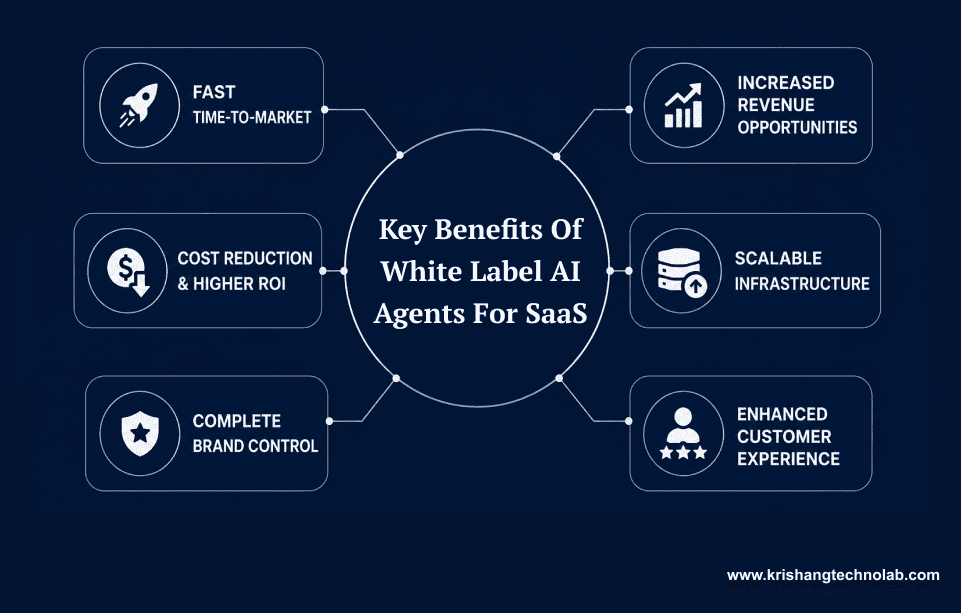
Fast Time-to-Market
White Label AI, an ai development company, allows SaaS companies to deploy AI features quickly. This means companies can be launched within days. This eliminates long launch cycles. Pre-trained systems eliminate long data training. They also reduce set-up time. This lets companies concentrate on creating new ideas. They also tend to grow faster in competitive markets.
Cost Reduction & Higher ROI
It’s expensive to build AI yourself. It requires expert teams. It also needs good infrastructure. White Label AI, however, can save costs by up to 80%. This approach saves companies money. They can spend more on advertising. It can also scale their product. They can also aid in customer acquisition. This approach makes it easy even for startups to adopt AI.
Complete Brand Control
White Label AI offers fully customizable features for businesses. For example, they can align design with their brand. They can also match tone and work flows. This provides a seamless user experience. It seems like it belongs on the platform. And it builds trust in turn. It also maintains brand consistency.
Increased Revenue Opportunities
White Label AI opens new revenue streams. For example, companies might offer subscriptions to AI. It can also switch to usage-based pricing. They can also sell automation features. They can also sell analytical tools. That means companies can boost recurring revenue 20% to 35%.
Scalable Infrastructure
White Label AI is cloud-based. That’s why it scales with demand. SaaS companies are limitless in growth. They don’t need to worry about how well they do. And so the system remains quick. Even better, it always stays stable.
Enhanced Customer Experience
AI-backed support enhances user engagement. Also offers personalized suggestions. This helps to increase engagement. Such features can lead up to 25% churn reduction for businesses. And, with 24/7 support, you get fast answers. This will increase customer satisfaction. It develops long-term loyalty.
Real-World Applications of White Label AI Agents in SaaS
White Label AI agents are already used across industries as real-world AI applications.
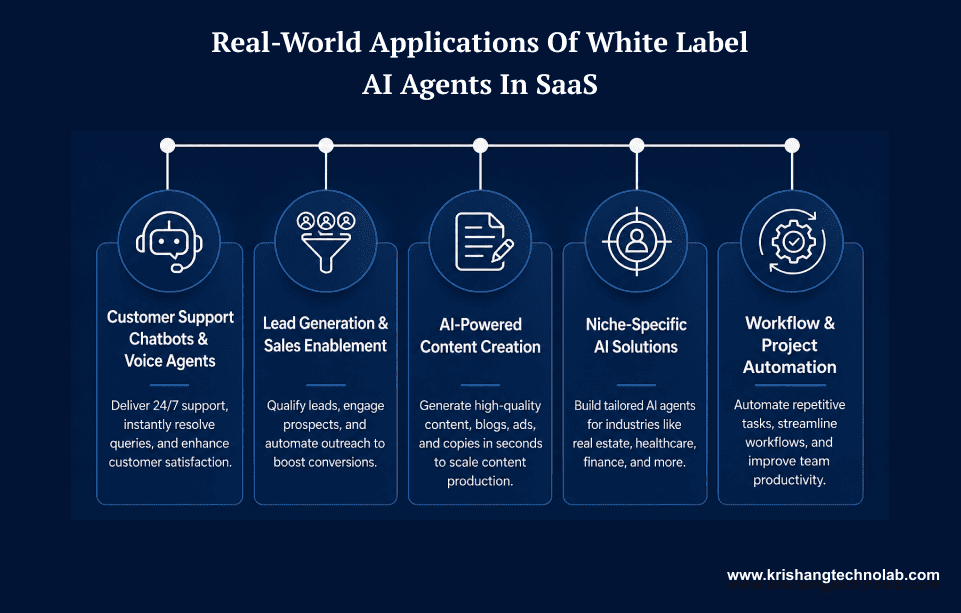
Customer Support Chatbots & Voice Agents
One of the most common real-world AI applications is the automation of customer support. AI chatbots for support are now handling up to 70% of customer queries. They operate with no human agents.
So companies reduced their support costs. They’re much more responsive too. Users get instant answers, not hours of waiting. AI customer experience systems provide clear and consistent answers.
Lead Generation & Sales Enablement
White label AI agents are also disrupting sales processes. AI Sales Tools for SaaS Companies to Generate Quality Leads. They also monitor consumer behavior. They also automate follow-up.
That’s why teams save time and effort. Companies that use AI-driven sales automation see conversion rates climb 20% to 30%. Thus, the revenue grows faster.
AI-Powered Content Creation
Popular uses for AI content tools include the following:
- Blog writing
- Email marketing
- Social media posts
This means the marketing teams are quicker. The time it took to make things was also cut down. In layman’s terms, they create more content in less time, especially when combined with eCommerce development solutions.
Niche-Specific AI Solutions
White label AI for SaaS benefits gets stronger in niche industries. Look at healthcare SaaS, for example, where AI helps schedule patients. It can also aid in the analysis of symptoms.
Similarly, AI can detect offenses in finance. It can also automatically check for compliance. That’s why companies are safer and more efficient.
Workflow & Project Automation
AI workflow automation is one of the fastest-growing SaaS trends. White label AI agents automate day-to-day tasks. These include project tracking, task assignment, reporting, and approval.
This leads to better team functioning. They also have fewer delays. Also, employees can concentrate on important tasks.
Challenges and Considerations for Implementing White Label AI Agents
Despite the benefits, there are still challenges with AI SaaS. These challenges may impact performance and outcomes. So companies have to plan carefully. They also need a clear strategy to deal with them. Furthermore, the earlier you prepare, the fewer problems you experience later.
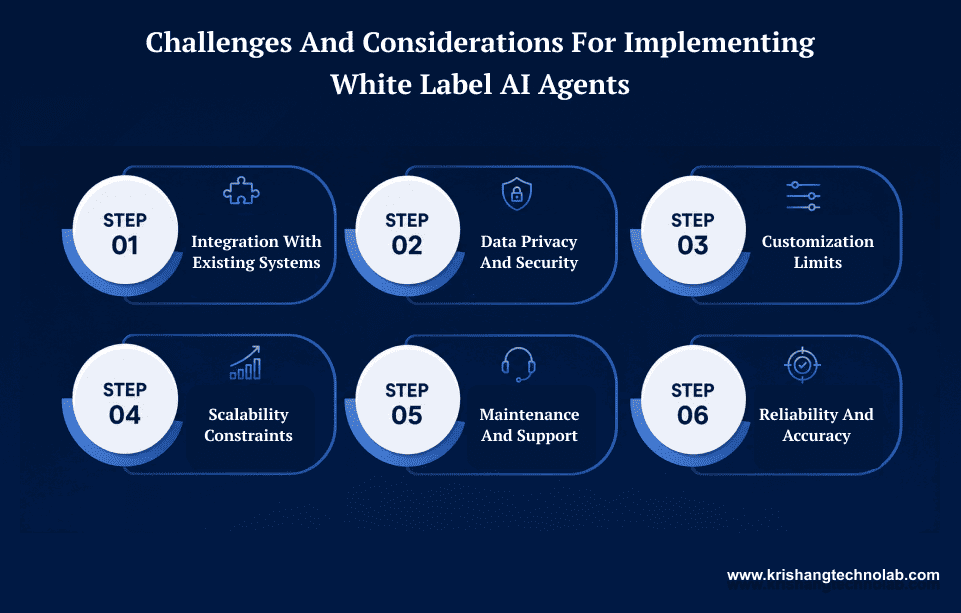
Integration with Existing Systems
AI system integration can be complicated. This is doubly true for legacy platforms. Many SaaS companies are still using legacy systems. Such systems therefore often require upgrades or middleware.
Sometimes companies have to make major updates. But these updates enable modern AI solutions. Otherwise, the system performance may decrease. Therefore, effective planning is important, especially when combined with website migration services.
Data Privacy and Security
Data privacy in AI is a concern. SaaS companies have to protect sensitive user data. So they have to adhere to strict rules such as GDPR.
Companies also have to build solid security systems. Not following the rules could lead to serious consequences. Also, they might lose the trust of customers. That means safety has to come first.
Customization Limits
Branding flexibility with white-label AI, but there are limits to deep customization. However, a fully custom AI offers more choices.
This means companies can’t always tweak AI behavior to the fullest. They may also have problems in adapting workflows to exact requirements. So teams have to operate within these limits.
Scalability Constraints
AI scalability limitations may appear in high-traffic environments. This is what happens when teams do not properly optimize systems. AI running in the cloud scales well.
However, a bad configuration can still cause issues. For example, systems may slow down during peak use. Teams should prioritize optimizing the setup as soon as possible.
Maintenance and Support
AI maintenance requires regular updates and monitoring. Systems also need to be tuned over time. Without these steps, performance may decline.
And companies require continuous support. Otherwise, AI systems can lose accuracy. They might also stop performing well. Thus, regular maintenance is a must.
Reliability and Accuracy
The performance of AI agents depends on their reliability. Bad data or bad training can cause inaccuracies. This results in a decline in user trust.
So teams need to constantly test systems. And they should verify results regularly. And so they have reliable and accurate systems over time.
Future Trends: The Next Evolution of White Label AI in SaaS
The future of the white label AI agents is very bright. Further, technological advancement is driving this change at a rapid pace. These developments will enable AI solutions to continue to improve. Such progress means better, more efficient growth and innovation tools for SaaS businesses.
Advancements in AI & Machine Learning
AI systems will become more advanced as machine learning evolves, driven by machine learning development services. They will understand better human-like complex interactions. There will also be a big increase in NLP and generative AI. This will lead to AI having a better understanding of context, emotions, and intent. SaaS platforms will therefore offer more personalized and simplified experiences, which will increase user engagement. Businesses will increasingly hire AI developers.
AI as a Service (AIaaS)
AIaaS is going mainstream. It’s also making AI tools more democratic. It allows companies to utilize AI without in-house teams or infrastructure. This simplifies the use of AI for small and mid-sized businesses. This enables them to compete with larger companies. Also, AIaaS will have ready-made solutions for many use cases.
Personalized SaaS Experiences
Hyper-personalization will be the norm with the explosion of real-time data. AI will also learn on the fly based on the behavior of the user. This will result in journeys designed for each user. This will therefore increase retention and satisfaction.
Expanding Automation Capabilities
AI will also eat into HR, finance, and business intelligence. Over 80% of SaaS platforms will have AI automation capabilities by 2030, encouraging companies to hire ChatGPT developers to stay competitive.
Conclusion
White-label AI agents are revolutionizing SaaS and automation. They are fast and scalable and cost-saving. Moreover, businesses can also rapidly implement AI solutions through white label services such as Krishang Technolab. So there is no need to build systems from scratch.
AI-powered SaaS solutions also enhance workflow automation. They also improve efficiency and customer experience. That means companies can move faster and smarter. The rise of AI in SaaS makes adoption an even more important area. Also, getting started with White Label AI Solutions early provides a great competitive advantage. The time is now to scale with flexible AI systems.
FAQs
What are white-label AI agents in SaaS?
SaaS white label AI agents are pre-engineered AI tools that companies rebrand. They embed these tools in their platforms, as well. They automate tasks and make you more productive. It also improves the user experience without building AI from scratch.
How are white-label AI agents transforming SaaS platforms?
White label AI agents speed up SaaS development. And they save money as well. They also bring AI-powered automation without having to build systems from scratch.
What role do white-label AI agents play in SaaS automation?
They automate processes such as customer support, data processing, and workflows. This makes it more efficient. It also reduces manual work on SaaS platforms.
Why are white label AI agents important for modern SaaS companies?
They help companies grow quickly. They also help get features out the door faster. At the same time, they meet growing demand for AI-driven experiences without a large investment.
How do white label AI agents improve business automation?
They make repetitive processes automatic. They also reduced human errors. This allows them to enable real-time decision-making and to make operations faster and more efficient.
What benefits do white label AI agents bring to SaaS businesses?
They offer faster time to market, cost savings, and scalability. They also enhance the customer experience. And they create new revenue streams.
How do white-label AI agents reduce SaaS development costs?
They remove the need to build AI in-house. This saves on the cost of hiring. It also reduces the costs of infrastructure and long development cycles.
Can white label AI agents enhance customer experience in SaaS?
Yes, they offer instant responses and personalized conversations. They also have 24/7 support. That increases user satisfaction and retention.
What industries benefit most from white-label AI agents in SaaS?
Industries such as healthcare, finance, e-commerce, and legal services will benefit the most. They use AI to automate processes, analyze data, and interact with customers.
How do white label AI agents help SaaS companies scale faster?
They handle large numbers of tasks and users automatically. And this helps businesses grow. It also prevents operational complexity from increasing.
Found this post helpful? Don't forget to share it with your network!