
Quick Overview: This blog explores why SaaS teams are choosing White-Label Dev in 2026 to scale faster, reduce development costs, accelerate product launches, and expand capabilities. It highlights key benefits, comparisons with in-house development, and future trends shaping SaaS growth strategies.
The Software-as-a-Service (SaaS) business has changed a lot in the last ten years. The market will be different, more competitive, and full of new ideas by 2026. Things wear out faster, businesses grow faster, and people want more. It’s no longer enough for SaaS companies to compete on features alone. They also have to compete on speed, scalability, integrations, AI capabilities, and user experience. To meet these growing demands, many SaaS companies are turning to White-Label Dev as a strategic growth solution.
There is a lot of pressure on SaaS teams, so many of them are making a big strategic change by going with white-label development.
White-label development is no longer just a way to save money. It has become a way to grow strategically. White-label dev helps startups, mid-sized SaaS companies, and even enterprise teams get their products to market faster, lower their risk, make their products more scalable, and use their internal resources more effectively.
This article explores why SaaS teams are choosing white-label solutions in 2026, how it differs from outsourcing, and how to select the right white label agency services provider for long-term success.
Understanding White-Label Development
A partnership-driven product strategy is the best way to think about white-label development. A company doesn’t build every part of a SaaS product itself; instead, it uses a technology framework that a specialized development partner has already made. Then, the SaaS company makes the solution its own by customizing it, branding it, packaging it, and marketing it.
This model has matured significantly. Modern white-label platforms are:
- Cloud-native
- API-first
- AI-enabled
- Modular and scalable
- Designed for multi-tenant SaaS environments
White-label frameworks today are very flexible, unlike simple template-based systems of the past. On top of the white-label core, companies can change workflows, add third-party tools, change UI elements, and even add their own custom layers.
White-label development now spans:
- CRM platforms
- Fintech infrastructure
- Learning management systems
- Telehealth platforms
- Marketing automation tools
- Data analytics dashboards
- Industry-specific SaaS solutions
Instead of coming up with new basic architectures, SaaS teams use systems that have already been proven to work and focus their innovation on what matters most: customer value and differentiation.
What Is White-Label Dev?
In a white-label development model, one company makes a software product or system that other companies can rebrand and sell as their own. The end user still can’t see the original developer.
For example, a SaaS founder may hire a white label web development agency to build the technical backbone of their platform.
In practical terms, this means:
- A white-label provider builds and maintains the core infrastructure.
- The SaaS company customizes branding, UI elements, workflows, and pricing.
- Customers interact only with the SaaS company’s brand.
- Technical maintenance, updates, and infrastructure management are handled behind the scenes.
In 2026, white-label dev often includes advanced capabilities such as:
- Built-in AI automation engines
- Advanced analytics modules
- Compliance-ready infrastructure
- Enterprise-grade security protocols
- Integration marketplaces
This means that startups don’t have to do years of backend engineering work. For SaaS companies that are growing, it means adding more products without putting too much pressure on their internal teams.
The result is faster validation, quicker revenue generation, and reduced operational complexity.
How White-Label Development Differs from Outsourcing
White-label development and outsourcing are two very different ways of doing things, even though they are often grouped together.
1. Strategic Orientation
When you outsource, you usually hire an outside team to make a product from the ground up based on your specifications. You are in charge of the roadmap, the development milestones, and the architecture. Many teams now explore white label agency vs outsourcing questions before choosing a partner that fits their strategic roadmap.
In contrast, white-label development builds on a foundation that is already there. The focus changes from building infrastructure to setting it up and making it work for your target market.
2. Time-to-Value
When you outsource, you usually hire an outside team to build a product from the ground up according to your exact specifications. You are in charge of the development milestones, the architecture, and the roadmap.
White-label development, on the other hand, builds on something that is already there. This means it uses products or services that are already available and can be rebranded and tailored to fit your business. Instead of building infrastructure, the focus is now on setting it up and making it work for the people you want to reach.
3. Risk Profile
Outsourcing can lead to technical problems, scope creep, and costs that go over budget. Every new feature makes things more complicated.
Most of the time, white-label platforms have been tested with a lot of different clients. Problems with performance, scalability, and security holes have already been fixed.
4. Operational Burden
When you outsource, you are still in charge of making decisions about long-term maintenance and growth.
When you work with a white-label partner, the agreement usually includes things like updating infrastructure, monitoring systems, and optimizing the backend.
In 2026, SaaS teams want white-label development’s main strengths: predictable scalability and less technical volatility.
The SaaS Landscape in 2026
To understand the rise of white-label development, we must examine the broader SaaS environment.
AI as a Standard Expectation
Most successful SaaS products now have built-in artificial intelligence. Customers expect smart features, whether it’s automation, predictive analytics, personalization, or conversational interfaces.
Companies like OpenAI have made AI-powered experiences normal, which has raised the bar for all software companies. To embed intelligent automation into SaaS products, many teams choose AI white label development services backed by scalable infrastructure and predictive analytics.
Vertical SaaS Expansion
SaaS that is made for a certain industry has grown a great deal. The legal, healthcare, logistics, fintech, and real estate fields require specialized rules and procedures. Building these systems in-house takes a lot of time and work.
White-label providers often focus on solutions that are ready for vertical markets, which makes it easier to get into niche markets. For SaaS teams entering ecommerce or marketplace verticals, white label Shopify development services provide rapid route-to-market with branded storefront solutions.
Investor Focus on Efficiency
After the market corrections of 2023, investors’ priorities changed. It is no longer possible to grow at any cost. Putting money to good use and growing in a way that lasts are more important than hiring many people quickly.
White-label development, which refers to the practice of creating products or services that other companies can rebrand as their own, helps lean operational models, which is what investors want.
Customer Demand for Integrations
Today’s SaaS tools need to work well with platforms like Slack, Shopify, and Stripe. Building and keeping dozens of integrations in-house takes a lot of time and money.
Many white-label providers offer integration ecosystems that are already built.
In short, the SaaS market in 2026 rewards flexibility, intelligence, and being connected to other ecosystems. These are all things that white-label development does well.
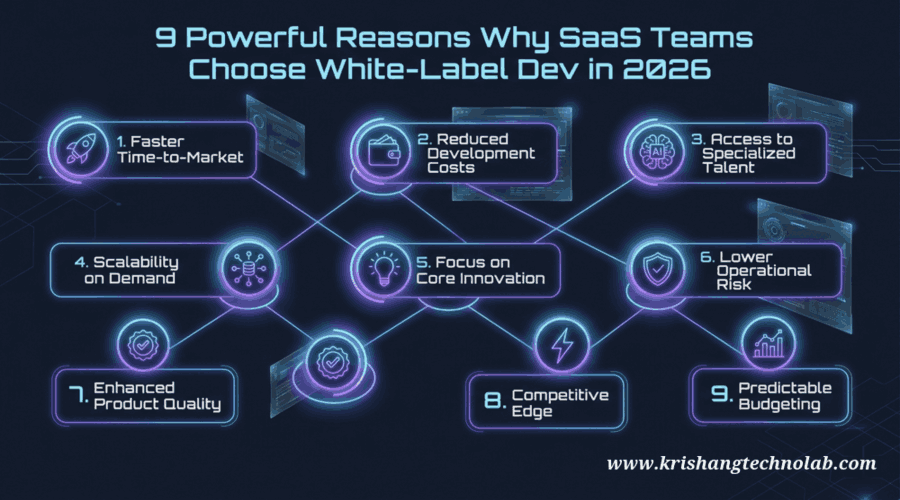
9 Powerful Reasons Why SaaS Teams Choose White-Label Dev in 2026
1. Faster Time-to-Market
Timing can mean the difference between life and death in SaaS. Launching six months earlier can help you get early adopters, make partnerships, and close funding rounds before your competitors.
White-label frameworks allow companies to:
- Deploy MVPs in weeks
- Test pricing models quickly
- Enter new verticals rapidly
- Respond to market shifts faster
SaaS teams can focus on getting new customers and getting feedback instead of spending 12 to 18 months building infrastructure.
2. Lower Development Costs
In 2026, it will be expensive and challenging to find experienced engineers. Salaries, benefits, onboarding, and retention efforts all raise the burn rate by a lot.
An affordable white label development services model distributes costs across multiple clients, reducing financial strain. Teams that use SaaS can:
- Operate with leaner engineering departments
- Allocate more budget to marketing and growth
- Extend runway
- Reduce fundraising pressure
For early-stage startups, this cost efficiency can be decisive.
3. Access to Specialized Expertise
Modern SaaS requires expertise in:
- AI/ML engineering
- DevOps and cloud optimization
- Cybersecurity compliance
- API architecture
- Data analytics
Building this internally can take years.
White-label service providers send teams of experts from different fields, which means they offer services that other companies can rebrand as their own. SaaS (Software as a Service) companies can use advanced features right away without having to go through long hiring or training processes.
4. Reduced Technical Risk
Technical debt silently destroys SaaS companies. Poor architectural decisions made early can limit scalability later.
White-label systems are typically:
- Performance-tested
- Security-audited
- Scalable by design
- Continuously updated
This reduces the risk of catastrophic failures or costly rebuilds.
5. Focus on Core Competencies
Many founders are great at sales, partnerships, vision, and storytelling, but not at building infrastructure.
White-label development frees internal teams to concentrate on:
- Customer experience
- Market expansion
- Strategic partnerships
- Revenue optimization
- Brand positioning
This strategic focus often accelerates growth more than internal coding efforts would.
6. Easier Scalability
Scaling a SaaS platform involves:
- Load balancing
- Cloud management
- Security monitoring
- Performance optimization
Most white-label providers offer infrastructure that can grow with your business. As the number of users grows, performance stays the same without needing to change the internal system.
7. Faster Feature Expansion
Expectations of customers change quickly. White-label partners often release new modules and updates that clients can use.
This allows SaaS companies to:
- Stay competitive
- Introduce AI enhancements
- Expand automation
- Add integrations
All without rebuilding architecture.
8. Improved Investor Appeal
Customers’ expectations change very quickly. White-label partners often give clients new modules and updates that they can use.
Investors value:
- Reduced technical uncertainty
- Predictable scalability
- Faster revenue generation
- Lower operational overhead
White-label partnerships can strengthen funding narratives.
9. Competitive Differentiation Through Branding
Modern white-label solutions allow deep customization:
- Custom UI/UX
- Branded dashboards
- Unique workflows
- Tailored onboarding experiences
The engine that powers the system may be the same, but the experience for the customer is different. SaaS companies have complete control over pricing and positioning. With access to white label WordPress development services, SaaS teams can offer unique branded experiences while leveraging robust CMS flexibility.
White-Label Dev vs In-House Development
| Criteria | In-House | White-Label Dev |
| Cost | High fixed costs | Flexible pricing |
| Speed | Slower | Rapid deployment |
| Talent Access | Limited | Global expertise |
| Risk | Higher | Shared risk |
| Scalability | Slower hiring cycles | Immediate scaling |
For many 2026 SaaS teams, a hybrid approach is emerging: white-label core systems combined with in-house innovation layers. For companies looking to offload CRM integration or marketing automation, white label HubSpot development services offer a compelling alternative to internal builds.
Also Read About: White-Label Shopify Development vs In-House Shopify Development Team
How to Choose the Right White-Label Partner
Selecting a partner is a strategic decision.
1. Technical Architecture
Evaluate whether the system is:
- Cloud-native
- API-driven
- Microservices-based
- Scalable across regions
2. Customization Depth
Ensure branding flexibility and workflow adaptability.
3. Security & Compliance
Look for compliance with:
- SOC 2
- GDPR
- Industry-specific regulations
Security standards should match enterprise expectations.
4. Roadmap Alignment
Choose a provider whose innovation pace aligns with your long-term vision.
5. Support Infrastructure
Reliable SLAs, proactive communication, and transparent documentation are essential for sustainable partnerships.
Future Trends in White-Label SaaS Development
AI-Native Infrastructure
In the future, white-label platforms will be AI-first, not AI-enhanced. By default, predictive automation, which uses data to forecast future outcomes, adaptive UX (user experience), which adjusts based on user behavior, and machine learning personalization, which tailors content to individual preferences, will be built in.
Modular SaaS Ecosystems
Platforms will be ecosystems of interchangeable modules instead of one big system.
Vertical Hyper-Specialization
Expect to see more white-label solutions that are ready for compliance and are made for the healthcare, fintech, and legal fields.
Hybrid Development Models
SaaS teams will increasingly combine:
- White-label infrastructure
- Proprietary feature layers
- Open-source integrations
This flexible model maximizes both speed and differentiation.
Related to Read: Why White-Label Services Are the Future of Agency Expansion
Conclusion
In 2026, white-label development will change the way SaaS products are made and grown. It helps businesses move faster, lower their risk, save money, and focus on innovation where it really counts.
As competition grows and AI becomes more common, SaaS teams need to use their resources wisely. White-label development is a good way to grow your business in a way that ‘s good for the environment without giving up quality.
The SaaS companies that do the best in 2026 aren’t always the ones that build everything from scratch. Instead, they’re the ones that build things strategically.
Found this post helpful? Don't forget to share it with your network!