
Quick Overview: Choosing the right white label software development partner can shape your business growth. Compare technical expertise, pricing models, security, and engagement options. Discover how white label software development services work, evaluate vendors, avoid risks, and build lasting partnerships.
Learn which white label software development partner matches your business needs and long-term plans. The selection criteria include technical expertise, pricing models, and security. Discover proven strategies to make a long-term relationship work.
Software teams face a tough decision in today’s market. Hiring in-house engineers takes months and costs a lot. Meanwhile, clients expect faster launches, smarter features, and fair prices. Because of this, agencies increasingly rely on a white label software development partner for extra delivery capacity.
Still, providers differ widely in quality. Some firms skip testing. Others hide how they handle your code. A careful choice protects your brand, your margins, and your client relationships. A weak choice does the opposite. Poor delivery then hurts every client you serve.
Cost is only one factor. A strong white label software development company explains its process clearly and sets realistic timelines. It can deliver white label software solutions tailored to each client’s requirements. Good security and effective communication also matter. Consequently, your team solves fewer problems and spends more time on revenue growth.
This guide explains each factor in plain language. This guide explains how white label software development services operate from start to finish. You will also see which red flags to avoid and what pricing to expect. A simple scorecard will then let you compare vendors. Apply these steps to select the right white label software development partner with confidence. Keep reading to create a reliable shortlist.
What Is White Label Software Development?
White label software development is a business arrangement where one company builds the product and another sells it. The buyer adds its own logo, colors, and pricing. Customers see only the seller, never the team behind the code. Agencies, startups, and consultancies use this model to launch products quickly. Instead of recruiting engineers, they rely on a white label software development partner.
That partner designs, codes, tests, and maintains the solution in the background. This approach works for apps, platforms, and custom business tools. The model saves time and money. A white label software development company already has tested processes and skilled developers. As a result, you avoid slow hiring cycles and costly errors.
Therefore, white label software development services suit teams that want growth without extra payroll. You keep control of the client relationship while experts handle the technical work. Your clients also enjoy a single point of contact.
How Does White Label Software Development Work?
White label software development means one firm builds a product and another sells it as its own. First, you share your requirements. Next, your white label software development partner designs, codes, and tests the solution. At the end, the finished product goes live under your company name. Your client never meets the builder. For example, a startup may share app ideas, while the partner plans features and timelines. As a result, your white label software development partner works quietly behind your brand.
White Label Development vs. Traditional Outsourcing
Traditional outsourcing often shows the vendor’s name to your client. By comparison, white label software development services keep the vendor out of sight. You decide on communication, branding, and pricing. For instance, a client who calls with a bug reaches your team, not the vendor. As a result, your agency keeps the relationship and the credit for good work.
| Factor | White Label Development | Traditional Outsourcing |
| Vendor visibility | Hidden from your client | Often shown to your client |
| Branding | Your brand only | Vendor name may appear |
| Client relationship | Stays fully with you | May be shared with the vendor |
| Pricing control | You set the final price | Often set by the vendor |
| Communication | Runs through your team | May reach the vendor directly |
| Best for | Agencies and resellers | Internal or one-off projects |
White Label Development vs. In-House Development
With an in-house team you have complete control, but it takes time to recruit. A white label software development agency provides skilled engineers without those extra costs. Projects can begin within weeks instead of months. In addition, a partner already has designers, testers, and developers ready to start. Therefore, you skip the long search and avoid paying for unused desks and tools.
| Factor | White Label Development | In-House Development |
| Hiring time | Projects can begin within weeks | Recruitment often takes months |
| Upfront costs | Low, with no extra overheads | High, with salaries and equipment |
| Skills available | Ready designers, testers, and developers | Limited to the people you hire |
| Cost during quiet months | Pay only for active work | Salaries continue regardless |
| Control over work | Shared with the partner | Complete control |
| Best for | Fast growth and uneven workloads | Long-term core products |
Who Needs a White Label Software Development Partner?
Digital agencies, consultancies, and startups gain the most from this model. Product companies also need extra capacity during busy periods. Many white-label software companies serve such buyers on a daily basis. These businesses can then market white-label software solutions under their label.
For example, marketing agencies often resell apps and web tools to their own clients. Likewise, startups use a white label software development partner to launch a first product before raising more funds.
Why Choosing the Right White Label Software Development Partner Matters
The partner you pick shapes every project you deliver. A weak choice leads to missed deadlines, buggy code, and unhappy clients. A strong white label software development partner does the opposite. It adds skilled engineers, speeds up delivery, and protects your brand and client trust. As a result, you win more work and keep clients longer. Therefore, treat this decision as a long-term investment rather than a quick, one-time purchase.
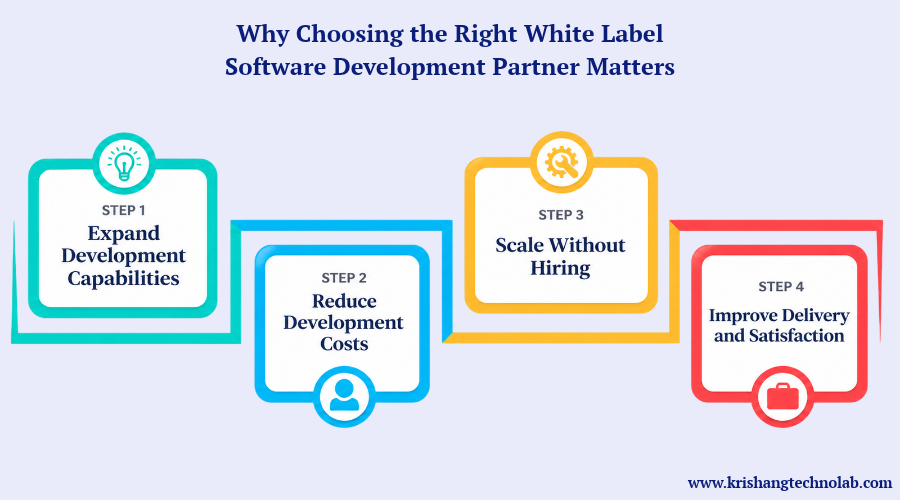
- Expand capabilities: Gain skills you lack in-house, such as mobile apps and AI features.
- Reduce costs: Avoid salaries, equipment, and recruitment fees for full-time hires.
- Scale faster: Hire dedicated developers within days and release them when projects end.
- Improve delivery: Experienced teams ship quicker with fewer defects and happier clients.
1. Expand Your Software Development Capabilities
The right partner adds skills you lack in-house. Strong white label app development services, for example, let you offer native and cross-platform apps at once. Software development talent becomes available on demand. Consequently, you can say yes to more client requests. In addition, you can enter new areas like AI features or cloud tools without any training delay.
2. Reduce Development and Operational Costs
Full-time engineers need salaries, benefits, and equipment. A partner removes most of those fixed costs. Moreover, top white label software development companies spread tool and management costs across many clients. As a result, your budget stays flexible and your margins on each project improve.
3. Scale Your Business Without Hiring an In-House Team
Growth often stalls because hiring is slow. A partner lets you hire dedicated developers within days. You can also hire software developers for brief sprints when deadlines get tight. Therefore, you can accept bigger projects without long recruitment cycles or fixed payroll. In addition, you can release unused capacity when a project ends and avoid paying for idle time.
4. Improve Project Delivery and Client Satisfaction
Experienced teams ship with fewer defects and more quickly. At the same time, your attention stays on clients and their goals. Happy clients then renew contracts and refer to new work. A dependable white label software development partner also keeps your good name intact. Finally, steady delivery builds the trust that turns one project into a long-term relationship.
10 Essential Factors to Consider When Choosing a White Label Software Development Partner
Ten factors decide whether a vendor deserves your trust. Start with technical skill, industry experience, and clear communication. Then check code ownership, security practices, and testing standards. Next, compare pricing, scalability, and post-launch maintenance. Finally, read client reviews and speak with references. Each factor reveals a different risk to your projects and budget. Together, they give you a complete picture of any white label software development partner before you sign.
1. Evaluate Technical Expertise and Development Capabilities
First, ask if the team builds web, mobile, cloud & AI products. Strong AI development skills become more important every year. A reputable AI software development company can add chatbots, analytics, and automation to the client projects. Hire AI developers who have delivered real models used in machine learning work.
For example, ask the team to show a working chatbot or an AI white label product. Moreover, check whether engineers keep learning new frameworks and cloud platforms. Therefore, a capable white label software development partner should explain its tech stack in simple terms.
2. Review Industry Experience and Previous Projects
First, look for past work that matches your client’s requirements. Then ask for case studies, live demonstrations, and named references. The top white label app development companies publish verifiable examples for every vertical. Besides that, read how each firm solved problems similar to yours. For instance, a travel app case study shows more than a generic portfolio page. Consequently, you can predict how the team will handle your own client’s needs.
3. Check Communication and Project Management Processes
Most problems in delivery are avoided by straightforward communication. Ask for daily updates, sprint reviews, and escalation paths. A good white label software development partner has plans in place before work starts.
In addition, agree on one main contact person for each side. Likewise, ask which tools the team uses for tasks, chats, and reports. As a result, white label software development services feel smooth and predictable for your clients.
4. Verify Code Ownership and Intellectual Property Rights
First of all, your contract has to assign you all the code. Otherwise you may lose control of the product you sell. Make sure the agreement covers source files, designs, and documentation. Reputable white-label software engineering firms include IP assignment clauses by default.
In addition, ask who owns third-party libraries and reusable components. For example, some firms keep rights to code they reuse across clients. Therefore, resolve these details in writing before the first sprint begins.
5. Ensure Strong Security and NDA Agreements
Security protects you and your customers. Please sign an NDA before discussing the project. Additionally, quality white label software development services comply with standards like GDPR and ISO 27001. Furthermore, ask how the team stores passwords, files, and client data. Similarly, confirm that only approved engineers can access your repositories. Consequently, a secure white label software development partner protects both your reputation and your clients.
6. Evaluate Quality Assurance and Testing Procedures
Quality assurance should run through every sprint. Also confirm who fixes defects after delivery. The testing discipline is what separates a reliable white label software development company from a risky one. In addition, ask how the team runs code reviews before each release. For instance, strong teams test on real devices and different browsers. Consequently, your clients meet fewer bugs after launch.
7. Understand Pricing and Engagement Models
Before signing, verify fixed, hourly, and team-based pricing. Ask what is included and excluded in each quote, too. Hence, each software development estimate must state every expense in writing. Next, ask whether quotes include design, testing, and project management time. Otherwise, hidden extras can quickly raise the final bill. Overall, clear pricing lets you set fair margins for your own clients.
8. Check Scalability and Team Availability
Your needs will change over time. So, confirm that the partner can add engineers fast. Check, too, whether you can hire dedicated developers for extended projects check, too, if they can hire AI engineers for machine learning later.
Meanwhile, ask how quickly the team can replace a developer who leaves. In addition, check if you can scale up before a big client launch. Therefore, a flexible partner lets you hire dedicated software developers on short notice.
9. Assess Post-Launch Support and Maintenance
Patches, updates, and performance tuning. Software needs all these. Inquire about service level agreements and response times. A good white label software development agency provides maintenance plans once the product goes live. Moreover, ask who will fix urgent bugs during weekends or holidays. In fact, fast responses often matter more than low monthly fees. Therefore, choose a plan that matches how critical your client’s software is.
10. Check Client Reviews, References, and Reputation
Check out reviews on Clutch, GoodFirms, and Google. Then, talk to at least two previous customers. Ask about problem solving, honesty, and deadlines. Reputation is what separates leading white label software companies from the rest. Beyond that, look for patterns in reviews rather than one single comment. For example, repeated praise for deadlines is a strong positive sign. Finally, trust your own checks before you sign any contract.
What Are the Red Flags to Avoid When Choosing a White Label Development Partner?
Some warning signs appear early. Prices far below the market average often hide weak talent or skipped testing. Vague answers about process, ownership, or confidentiality should worry you. Slow replies and missed deadlines usually continue after the contract starts. Also be careful with firms that cannot show live projects or real references. If you notice two or three of these signs in a white label development partner, walk away immediately.
Unrealistically Low Development Pricing
A price far below the market average is a warning sign. Moreover, cheap quotes often hide junior staff or skip testing. Exercise caution when considering any white label development partner whose pricing appears excessively favorable.
For example, a quote that is half the average usually means rushed work. Besides that, low prices often grow later through extra fees and change requests. Therefore, compare every offer by total value, not by the first number you see.
Lack of Transparency in Development Processes
You should see how work moves from ticket to release. If a firm refuses to share dashboards or demos, walk away. Open processes build trust. In contrast, secrecy usually signals trouble. For instance, ask to see sprint boards, task lists, and recent release notes. Likewise, a reliable white label development partner explains delays instead of hiding them. Consequently, you can warn your clients early and protect your own reputation.
Poor Communication and Missed Deadlines
If you’re slow in the sales stage, you’ll be slow in the later stages. Repeated schedule changes are also a sign of weak planning. In addition, watch for vague answers, late replies, and promises without dates. For example, a team that misses early milestones will likely miss bigger ones. As a result, raise concerns quickly and ask for a clear recovery plan.
Unclear Code Ownership and Confidentiality Policies
Vague contracts create legal risk. Therefore, insist on written clauses covering IP, confidentiality, and non-compete terms. Otherwise, a rival could receive a copy of your product. A professional white label software development partner accepts these terms without argument.
For example, some vendors reuse your code for other clients without permission. In addition, weak confidentiality terms can expose client data and damage trust. Therefore, ask a lawyer to review the contract before you sign.
No Proven Portfolio or Verifiable Client References
Every credible firm shows real work. If a portfolio only contains screenshots, ask for live links. Request the contact information of previous clients. These are shared promptly by reliable white label app development companies. In addition, open each live link and test the product yourself. Meanwhile, speak with at least two former clients about deadlines and honesty. As a result, you confirm real results instead of trusting a polished sales pitch.
Which White Label Software Development Engagement Model Is Right for Your Business?
Your project type decides the best engagement model. Fixed-price contracts suit small projects with clear requirements. Time and materials work better when scope may change. A dedicated team fits long-term products that need steady progress. Project-based contracts give you a defined outcome with milestone payments. Most white label software development services offer all four models. Compare costs and timelines. Then choose the model that gives you control without adding risk.
| Model | Best for | Payment style | Flexibility | Main risk |
| Fixed-Price | Small projects with a clear scope | One agreed price | Low | Changes need new quotes |
| Dedicated Team | Long-term product work | Monthly fee for the team | Medium | Paying for idle capacity when work slows |
| Time and Materials | Early products with evolving features | Actual hours worked | High | Budget can grow without caps |
| Project-Based | A defined outcome, such as an app or API platform | Milestone payments | Medium | Delays when requirements are vague |
Fixed-Price Development Model
Fixed-price contracts are most suitable for projects with a well-defined scope and fixed requirements. You know what it costs, too, up front. However, changes require new quotes. Many white-label software development services offer this model for small builds. For example, a simple website or a basic app with clear features fits this model well. Therefore, write the scope in detail before you sign so both sides agree on the outcome.
Dedicated Development Team Model
Under this model, a full team works exclusively on your projects. You can hire dedicated developers, designers, and testers together. As a result, knowledge stays within the team. It suits long-term product work. In addition, the team learns your clients, tools, and standards over time. Consequently, delivery becomes faster and more consistent with every sprint.
Time and Materials Model
You pay for actual hours worked. Therefore, scope can change as you learn. Still, set budget caps and weekly reviews. For instance, this model works well for early products where features keep evolving. Moreover, ask for weekly time reports so you always know where the budget goes. In addition, review the hours against finished tasks each week so small overruns never turn into big bills.
Project-Based Development Model
Here, the partner owns the delivery of a defined outcome. For example, you can ask for a mobile app or an API platform. This is how most of the white label mobile app development services work. In addition, payments usually follow milestones, such as design approval or beta release. As a result, you pay only after each stage meets the agreed standard.
How to Evaluate and Shortlist the Best White Label Software Development Companies
Shortlisting works best as a simple process. First, write down your goals, budget, timeline, and features. Next, research five to eight qualified firms and compare their portfolios. Then interview the engineers and request detailed proposals. Finally, run a small paid pilot with your top choice. This approach lets you test quality before a large commitment. It also keeps your search for white label software development companies organized, objective, and fair.
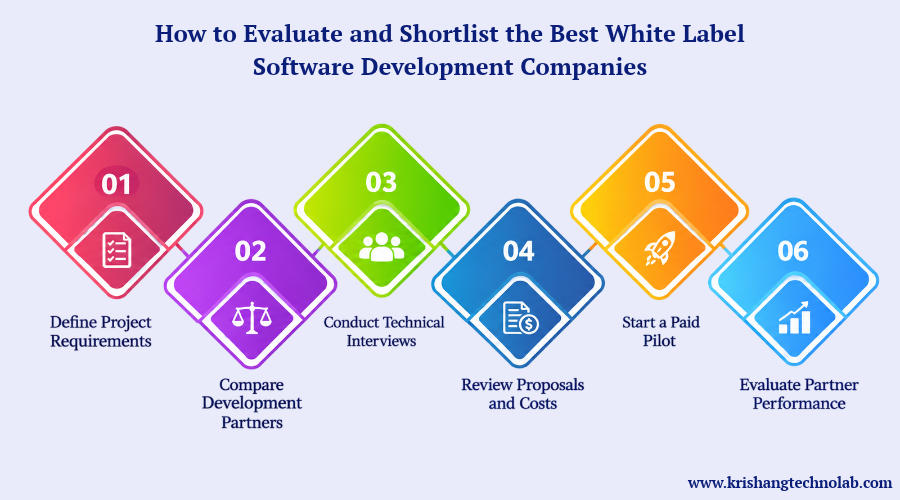
- Define requirements: Write down goals, budget, timeline, and must-have features before contacting vendors.
- Research and compare: List five to eight qualified firms and review their portfolios and client reviews.
- Interview the engineers: Talk directly to the people who will build your project.
- Request detailed proposals: Ask for scope, timelines, team size, and a clear cost estimate.
- Run a paid pilot: Test code quality, speed, and communication on one small feature.
- Score each vendor: Rate every candidate from one to five on a simple scorecard.
1. Define Your Business and Project Requirements
First, write down goals, budget, timeline, and must-have features before contacting vendors. Accurate quotes result from clear requirements. Finally, provide each firm an issue brief to compare equal proposals. For example, include target users, preferred technologies, and expected launch dates. Consequently, every vendor starts from the same facts and gives you realistic answers.
2. Research and Compare Potential Development Partners
First, build a list of five to eight firms. See portfolios, directories, and reviews. Do a comparison of your requirements with the top white label app development companies. Include one specialist white label software development agency for balance. In addition, note each firm’s team size, specialties, and typical project length. As a result, you can drop poor matches before spending time on calls.
3. Conduct Technical Interviews
Next, talk directly to the engineers who will build your project. Then ask them to explain past architecture decisions. Their answers reveal real skill better than any sales deck. For instance, ask how they solved a hard bug or a missed deadline. Moreover, notice whether they answer in plain language and admit past mistakes.
4. Request a Detailed Proposal and Cost Estimate
A strong proposal lists scope, assumptions, timelines, and team size. It also separates the one-off costs from the ongoing fees. Then, compare proposals line by line. You then avoid surprises after the contract begins. In addition, check that the proposal names the technologies and tools it will use. Likewise, confirm how change requests affect the price and delivery dates.
5. Start With a Small Paid Pilot Project
A pilot reduces risk before a large commitment. Choose a small feature or module, first. Then measure code quality, speed, and communication. You will learn how a white label software development partner behaves under real deadlines. For example, a login feature or a simple dashboard works well as a test task. Afterward, share honest feedback and see how quickly the team responds.
6. Use a Partner Evaluation Scorecard
A scorecard turns opinions into numbers. Rate each candidate from one to five on every factor listed below. Then add the totals for each vendor. This simple method keeps the decision fair and easy to defend with stakeholders. For instance, give extra weight to security and communication if your clients handle sensitive data. Finally, share the scores with your team so everyone agrees on the best white label software development partner.
- Technical skills and AI development capability
- Security, NDA, and IP terms
- Communication and project management
- Pricing clarity and flexibility
- References and reputation
How Much Does White Label Software Development Cost?
Costs mainly depend on project size, technology, team seniority, and location. Hourly rates often range from $20 to over $100. Specialized skills, such as artificial intelligence, usually cost more. Complex platforms need larger budgets. However, a partner bills only for active work, so you avoid recruitment fees and idle salaries. Always request a detailed written estimate that lists every expense. Then compare total value instead of the lowest hourly rate.
Factors That Influence White Label Development Costs
The final price is shaped by several elements. The most important factors are the size of the project, the technology stack, and the seniority of the team. Rates can vary from $20 to $100+ per hour, and location can be a factor as well. Typically, an artificial intelligence software development company will charge a premium for specialized talent.
White Label Development vs. In-House Development Costs
In-house hiring adds recruitment fees, benefits, and equipment. A partner bills only for active work. White label software development companies often reduce total spend on uneven workloads. For example, an in-house team still draws salaries during quiet months. In contrast, a partner lets you scale spending up or down with each project.
How to Choose a Cost-Effective Development Partner
Prioritize value over the cheapest rate. Also ask which tasks the quote excludes. A dependable white label software development partner explains every line item clearly. In addition, compare what each quote includes, such as testing, project management, and post-launch fixes. As a result, you judge offers by total value instead of the headline price.
Questions to Ask Before Hiring a White Label Software Development Partner
Good questions reveal how a vendor really works. Ask about similar projects, team experience, and the technologies they use daily. Then ask who owns the code, how data stays protected, and which NDAs apply. Also confirm timelines, reporting habits, and what happens when scope changes. Finally, ask about warranty periods and maintenance. Before you hire a white label software development partner, write these questions down and compare every answer carefully.
- Similar projects: Ask for examples of past work that match your needs.
- Team experience: Confirm how long the engineers have used the technologies they will assign.
- Code ownership: Make sure all code, designs, and documents transfer to you.
- Data protection: Review how the vendor stores and protects client data.
- NDAs: Check which confidentiality agreements apply to every team member.
- Timelines and reporting: Confirm delivery dates, update schedules, and report formats.
- Scope changes: Understand how the team handles new requests and extra costs.
- Warranty and maintenance: Review bug-fix periods and ongoing maintenance plans.
How to Build a Successful Long-Term White Label Development Partnership
A lasting partnership needs clear habits from both sides. Agree on communication channels, meeting rhythms, and response times early. Set measurable goals such as delivery speed, defect rates, and client satisfaction. Review results every quarter and share honest feedback. Give your partner access to shared boards and planning sessions. Over time, this openness builds trust and produces better software with fewer surprises. Strong white label development partnerships grow this way.
Establish Clear Communication and Expectations
Agree on channels, meeting rhythms, and response times in week one. Misunderstandings then shrink. Strong white label software development partners make the rules of communication part of the contract. For example, write down who approves changes and who answers urgent questions. Likewise, choose one shared channel for daily updates to avoid scattered messages. As a result, your white label software development partner and your team stay aligned from the start.
Set Measurable Project Goals and KPIs
The first is to pick metrics like sprint velocity, defect rate, and on-time delivery. Tie goals to client outcomes such as retention or revenue. Numbers keep the relationship objective. In addition, review each metric weekly so small problems never grow. For instance, a falling defect rate shows that testing is working. Consequently, both sides know what success looks like before the next sprint begins.
Maintain Regular Performance Reviews
Next, set up quarterly reviews with your partner. Then discuss wins, delays, and things to improve. Regular reviews let a white label software development partner improve steadily. During each review, compare planned results with actual results. Moreover, invite client feedback so the discussion stays grounded in real needs. In turn, honest conversations build trust between you and your white label software development partner.
Build a Transparent and Collaborative Workflow
You and your partner share boards, repositories, and chat channels. “Also including them in planning meetings.” Teams that collaborate openly deliver better software development results. Furthermore, agree on a shared definition of done for every task. Similarly, record decisions in one place so nobody repeats old discussions. Therefore, software development moves faster and your clients see steady progress.
Conclusion: Choose a White Label Software Development Partner That Supports Your Growth
Choosing a white label software development partner shapes your agency’s growth for years. Your choice will affect delivery, client trust, and profit. The right firm adds skills, speeds delivery, and protects your brand. The wrong decision chews up budgets and breaks trust. Treatment selection is a strategic decision, not a quick buy.
Start with technical expertise, security, and code ownership. And then look for pricing models and engagement structures. Then interview candidates, and maybe a small paid pilot. Finally, score each firm on a simple scorecard. Each step lowers risk and builds confidence.
Clients also expect intelligent features today. Therefore, many agencies hire AI engineers through partners. Those expectations pay off with a reputable AI software development company. This means your name is attached to smarter products that clients see. Meanwhile, trustworthy white label software development services maintain your brand on the first plan. High-quality AI development and white-label AI services will also help differentiate your agency.
Today’s market rewards agencies that act early. The best relationships grow over time. “Set goals. Check results often. Communicate openly.” Follow these steps, and your next white label software development partner becomes a real growth asset. Your clients will notice the difference. Start building your shortlist today.
Frequently Asked Questions About White Label Software Development Partners
What Should You Look for in a White Label Software Development Partner?
Look for proven technical capabilities, applicable case histories, sound security practices, clear contracts, and transparent pricing models. Check client references and maintenance after launch. A successful white label software development partner does quality work silently while your brand is out front. For example, ask the vendor to share a recent project with similar goals. Therefore, a trustworthy white label software development partner answers these requests without hesitation.
How Do You Choose the Best White Label Software Development Company?
Define your requirements. Then select three to five companies to interview their engineers and check their references. Finally, run a small paid pilot. The best white label software development company proves quality before you commit to a large budget. In addition, compare at least two written proposals before making a final choice. As a result, you spot weak offers early and avoid costly surprises.
Is White Label Software Development Better Than Outsourcing?
It depends on your goals. White label models mask the vendor, which is beneficial for your brand. But traditional outsourcing may be appropriate for internal projects. For agency work, white label usually gives stronger client ownership. In other words, outsourcing keeps the vendor visible, while white label keeps your name alone on the work. Therefore, choose the model that matches how you want clients to see your business.
How Much Does White Label Software Development Cost?
The cost depends on the scope, region, and technology. Hourly rates can start at $20 and go up to over $100. But the more complex platforms need much bigger budgets. Always ask for a detailed estimate. For example, small projects often cost less, while long-term products need larger monthly budgets. Additionally, compare quotes by total value rather than hourly rate alone.
Who Owns the Code in a White Label Development Partnership?
All code, designs, and documentation will be yours. So add a contract clause that covers IP assignment. Without this clause, the partner can legally hold onto rights. Besides that, confirm that ownership transfers once you complete payment. Consequently, you can modify, resell, or move the product without legal worries.
Is White Label Software Development Suitable for Startups and Agencies?
Yes. Startups speed up and save money. Agencies expand services without hiring. Moreover, white label app development services can help both groups add apps quickly. For instance, agencies can add mobile apps, web platforms, and AI white label features to their offers. Meanwhile, startups can test ideas faster and keep early costs low.
Found this post helpful? Don't forget to share it with your network!