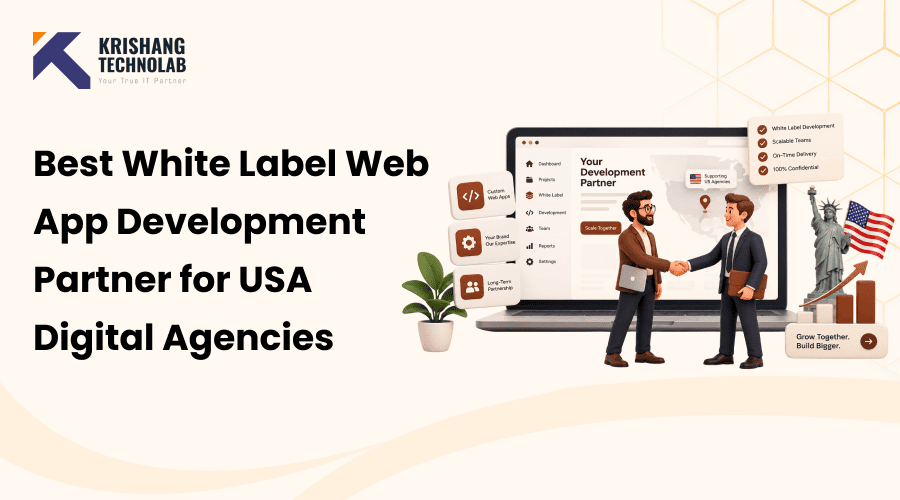
Quick Overview: This guide breaks down white label web app development for US digital agencies, explaining how partnering with a development team lets agencies scale faster without hiring in-house. It covers key benefits, red flags to avoid, top partners for 2026, pricing models, and what separates a reliable web app development partner from a risky one.
Client demand for custom web and mobile applications has never been higher, but most US digital agencies simply don’t have the in-house bandwidth to deliver every project themselves. Hiring full-time developers is expensive, recruiting takes months, and not every agency wants to carry that overhead year-round.That’s where a web app development partner comes in.
Agencies can partner with a White Label Web App Development team and take on more projects, deliver faster, and grow revenue, all without increasing their internal headcount. In this guide, we’ll explain what white-label web app development is all about, why it’s relevant to USA agencies in particular, and how to find the right web app development partner for your business.
What Is White Label Web App Development?
White label web app development is a business arrangement where a specialized development company builds a web application on behalf of an agency, and the agency then brands, presents, and sells that work as its own to the end client. The development partner works quietly in the background; there’s no mention of their name in client communications, proposals, or deliverables.
This is not like regular outsourcing or subcontracting, where the third party might be visible to the client or loosely coordinated. A true white label web app development partner will have a relationship built on confidentiality, consistency, and smooth integration into the agency’s existing workflow, often through custom web application development that’s tailored to each client’s exact requirements. To the end client, it appears as if the agency did all the work in-house.
The key players in this arrangement are simple:
- The agency owns the client relationship, strategy, and branding.
- The white label partner handles the technical build, often including design, development, QA, and sometimes ongoing support.
- The end client receives a finished product without knowing (or needing to know) who built it behind the scenes.
Why US Digital Agencies Need a Web App Development Partner
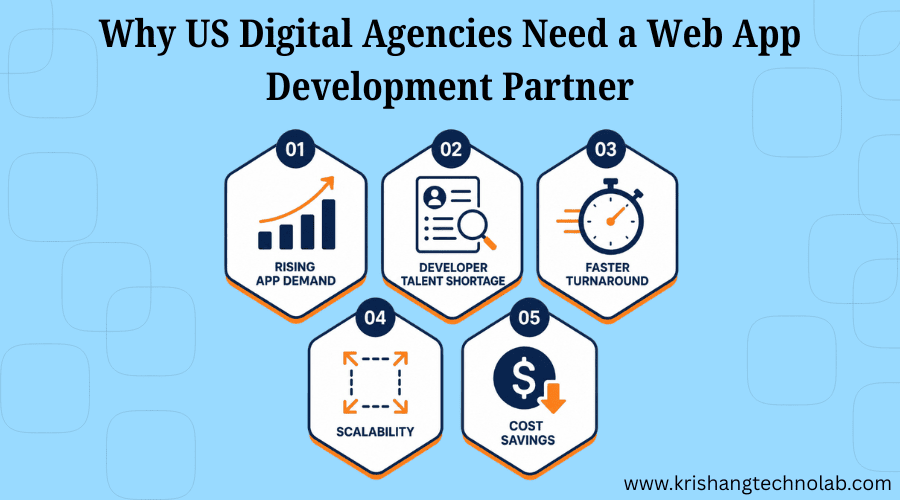
The pressure on US agencies to deliver web and mobile applications has grown significantly. Clients increasingly expect not just websites, but also functional apps, client portals, internal tools, e-commerce platforms, SaaS products, and even dedicated mobile app development alongside their web builds. Meeting that demand in-house is getting harder for a few clear reasons.
- Increased demand for mobile and web apps from clients: If more industries want custom apps, agencies that cannot provide them will lose business to those that can.
- The US developer talent shortage: It’s difficult to find experienced developers, especially with modern frameworks, and it’s costly to do so. Salaries for senior developers in the USA often make it impractical for small and mid-sized agencies to build a full in-house team.
- Reduced turnaround expectations: Clients want things done faster. Generally, a web app development partner with a ready team can move faster than an agency that needs to build capacity from scratch.
- Flexible scalability: all projects are of different sizes. White label partners allow agencies to scale up or down their development capacity without the fixed cost of full-time salaries.
- Concentrate on your core strengths: Agencies are generally good at strategy, branding, and client relationships but not necessarily backend architecture or DevOps. A development partner could fill that gap and allow the agency to do what it does best.
Key Benefits of Partnering with a White Label Web App Developer
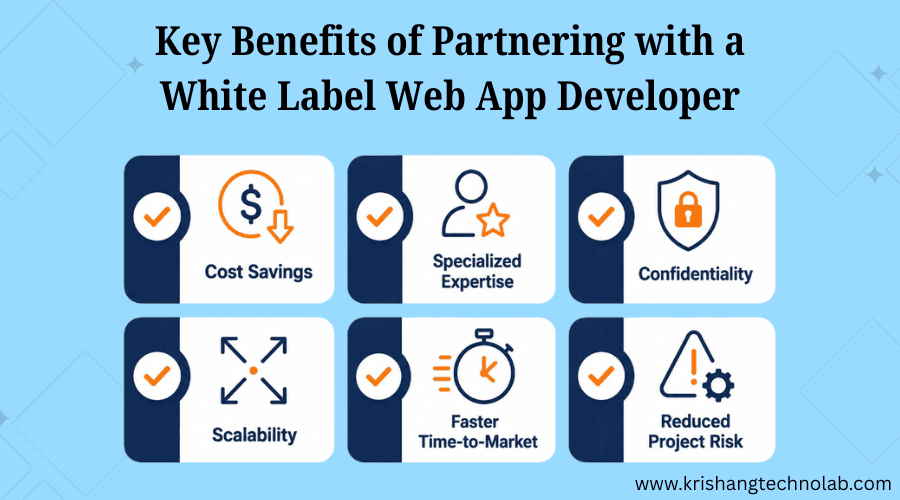
Besides solving the capacity problem, there are some tangible benefits of working with the right White Label Web App Development partner:
- Cost savings: You avoid the cost of full-time salaries, benefits, and recruitment costs to build an in-house dev team.
- Access to specialized expertise: Hire dedicated developers experienced in specific stacks like React, Angular, Node.js, Laravel, and more without hiring for every niche skill set in-house.
- Confidentiality: Working with reputable partners on strict NDAs and unbranded work helps protect the agency’s reputation and client relationships.
- Scalability: Ramp up resources during busy times and scale back down when things slow, keeping costs in line with actual workload.
- Faster time-to-market: An ad hoc team won’t be as efficient as a development team with established processes in getting through discovery, design and build phases.
- Reduced project risk: Working with a seasoned firm reduces the likelihood of scope creep, missed deadlines or technical errors that can undermine client trust.
What to Look for in a Web App Development Partner
Not every development shop is ready to be a true white label partner; the wrong choice in software development outsourcing can cost an agency time, money, and client trust. Here’s what makes a good partner and what makes a bad one.
1. Technical expertise across relevant stacks
Your partner should have a proven track record working with the frameworks and technologies that are most relevant to your client base. Be it React, Angular, Node.js, or CMS platforms like WordPress.
2. A strong portfolio and case studies
Ask for examples of past work, preferably in similar industries to your clients’. A partner who can show measurable results builds far more confidence than one who simply lists services.
3. Solid NDA and IP protection practices
You will need your partner to sign a full NDA and establish IP ownership before starting work. This is a must-have for white-label relationships.
4. Transparent communication
Find a partner who gives you regular updates, good project management tools, and a single point of contact, not one who disappears between milestones.
5. Time zone compatibility
For USA agencies, working with a partner who overlaps with US business hours (even partially) makes day-to-day collaboration significantly smoother.
6. Rigorous QA and testing processes
Ask about their testing methodology. A partner without a defined QA process is a liability, not an asset.
7. Post-launch support and maintenance
Development doesn’t stop at launch. Make sure your partner continues the support, updates, and bug fixes once you have gone live with your app.
8. Flexible engagement models
The best partners offer multiple ways to work together, dedicated teams, project-based pricing, or hourly engagements so you can choose what fits your business model.
9. Transparent pricing
Don’t go with partners who don’t pay up front. Transparent itemized pricing means no surprises later and makes it easier to price your own client proposals.
Top White Label Web App Development Partners for USA Agencies (2026)
Now that you know the difference between a safe and risky partner, here’s a look at some of the providers US digital agencies are turning to in 2026. For an expanded view of full-service agencies outside of web app development, here’s a collection of white label agency partners in the USA. Each has a different strength, so the right fit is determined by your agency’s typical project size, industry focus, and budget.
Read More About: Top 10 White-Label Agency Partners in USA
How to Narrow This List Down
With this many capable providers, the deciding factor usually comes down to fit rather than a single “best” option. If you’re still fuzzy on the fundamentals, it’s worth reading what a white label agency actually does before comparing vendors side by side. A few practical filters:
- Project Type: Some partners have experience in WordPress or CMS-based builds; others have experience in custom, code-heavy applications.
- Industry experience: If your clients are concentrated in a specific vertical (healthcare, e-commerce, fintech), prioritize a partner with relevant case studies.
- Team size and capacity: Bigger partners can take on more work; smaller, specialized shops may offer more hands-on attention.
- Engagement flexibility: Make sure that the partner can work on a project basis, a dedicated team model, or both as per your agency model.
Ask for a small pilot project before signing a long-term agreement with any of the partners on this list (or others). It’s the best way to test communication, code quality, and turnaround time before handing over a bigger client engagement.
Red Flags to Avoid When Choosing a Partner
Knowing what not to look for is as important as knowing what to look for:
- No clear NDA or IP agreement: If a partner won’t agree in writing to confidentiality and ownership terms, walk away.
- Poor or inconsistent communication: If you’re getting slow responses or vague updates during the sales process, that’s a preview of how it’s going to be to work with them.
- Inconsistent portfolio quality: Some of the polished examples, and some of the less polished, may suggest inconsistent internal standards.
- Hidden costs: Look out for prices that suddenly inflate during a project, a sign of fuzzy scoping practices.
- No post-launch support: A partner that thinks the relationship is over once the launch is over leaves you vulnerable when inevitably something goes wrong.
How White Label Web App Development Works: The Process
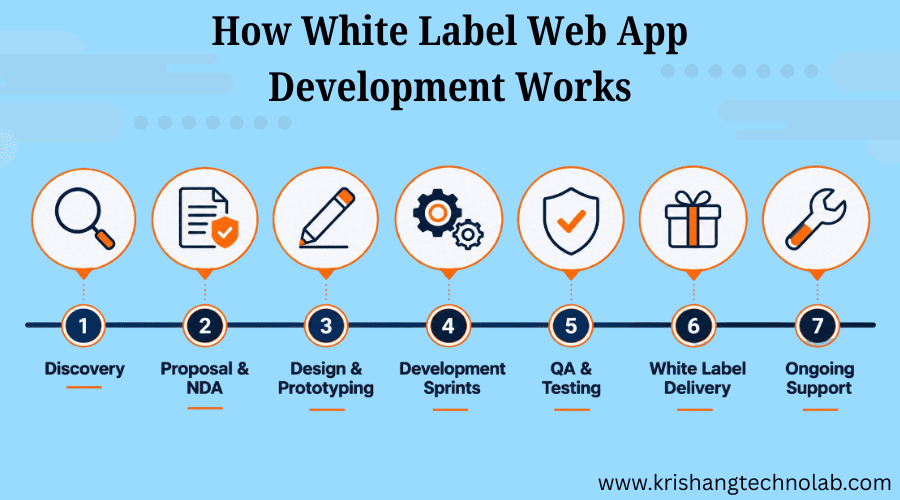
A well-run white label engagement typically follows a structured process:
- Discovery and requirement gathering: The partner works with your agency to understand the client’s goals, technical requirements, and timeline.
- Proposal and NDA signing: Terms, scope, and confidentiality agreements are finalized before development begins.
- Design and prototyping: Wireframes and UI/UX designs are created and reviewed, often with the agency managing client-facing feedback.
- Development sprints: The technical build happens in iterative sprints, with regular check-ins so the agency stays informed.
- QA and testing: The application is rigorously tested for functionality, performance, and security before delivery.
- White label delivery and handoff: The finished product is delivered unbranded, ready for the agency to present to its client.
- Ongoing support and maintenance: Post-launch, the partner continues to provide updates, bug fixes, and technical support as needed.
Cost of Working with a Web App Development Partner
The cost of white label web app development can vary greatly, depending on the scope, complexity, and chosen engagement model. Pricing structures often include:
- Hourly rates: Best for smaller projects or ongoing maintenance work
- Fixed-price contracts: Common for well-defined projects with clear scope
- Dedicated team model: A monthly retainer for a consistent team, ideal for agencies with recurring project volume
The complexity of the application, technology stack, integrations, and the project timeline also affect prices. Agencies should request detailed quotes from several partners and compare not only the price but also what’s included. Quality assurance, project management, and post-launch support vary considerably from provider to provider. The guide to dedicated development team pricing is a good reference for a more detailed look at hourly rates by region and seniority.
Choosing the Right Fit for Your Agency
There is no single “best” web app development partner for every agency. Your client base, typical project scope, budget, and how involved you want to be in the development process will all influence the right fit. Some agencies prefer a fully managed dedicated team, others lean on an offshore development center for long-term capacity, and some just want a partner they can bring in project-by-project as needs arise.
Before committing, it’s worth requesting a small pilot project or trial engagement. This provides a low-risk way to evaluate communication, code quality, and reliability before passing off a larger client project.
Why Agencies Are Partnering with Krishang Technolab
If you’re looking for more than one area of expertise,Krishang Technolab is another option to consider along with the providers above, if you’re an agency looking for a partner to cover the whole range of web and mobile work.
The company has over 8 years of experience and has delivered 1,000+ projects for more than 250 clients across the US, UK, Canada, and other markets, working with everyone from early-stage startups to Fortune 500 companies. They provide a full spectrum of white label development, including web design, mobile apps, e-commerce platforms, APIs, and dashboards. Krishang stays behind the scenes, while the partner agency’s brand is front and center.
A few things that stand out for agencies specifically:
- Broad technical range. They work with React, Angular, Vue.js, Node.js, Laravel, PHP, Python, Flutter, and React Native, as well as CMS platforms WordPress, HubSpot, and Shopify, which can be a big help to agencies who don’t want to be juggling a bunch of vendors for different tech stacks.
- Agency-friendly workflow. Their team works inside tools agencies already use, like Asana, Slack, and ClickUp, and can join client calls white-labeled if needed, rather than forcing agencies to adapt to a separate process.
- Signed NDA protection. Confidentiality is built into their engagement model from the start, with signed NDAs and full IP ownership handed to the client agency.
- Flexible engagement options. Agencies can hire dedicated developers on a project basis or set up an ongoing team, depending on workload.
As with any partner on this list, it’s worth requesting a small pilot project before committing to a larger engagement, but their combination of technical breadth and agency-specific workflow support makes them a reasonable option to add to your shortlist.
Final Thoughts
Choosing the right web app development partner can be the difference between an agency that struggles to keep up with client demand and an agency that scales confidently. US digital agencies that value technical expertise, straightforward communication, strong confidentiality practices, and reliable post-launch support can build long-term relationships that enable them to take on bigger projects without the overhead of having to build an in-house dev team from scratch.
If you’re evaluating potential partners, take the time to vet them properly: review portfolios, ask about their process, and consider a trial project before committing to a long-term relationship. Whether you need full application builds or lighter-touch white label web design support, a dependable white label web app development partner won’t just build your client’s app; they’ll help your agency grow.
Found this post helpful? Don't forget to share it with your network!



)