Quick Overview: Validate your Mobile App Idea with insights into MVP Development Services, UI/UX Design Services, and Mobile App Development Platforms. Work with a Mobile App Development Agency to Hire Mobile App Developers for Android App Development, iOS App Development, and Cross-Platform App Development solutions.
Developing a mobile or web application requires significant time, money, and effort. However, a great idea alone does not guarantee success. Before investing in Mobile App Development Services, businesses should validate their app idea to ensure it solves a real user problem. Early validation helps understand customer needs, reduce risks, optimize resources, and build a product with stronger market potential.
Building an app without validation can be costly. If a product fails to meet market demand, businesses may waste development costs, marketing efforts, and valuable time. Instead of building a complete solution based on assumptions, companies can use MVP Development Services to create a simplified version of their app, test it with real users, gather feedback, and make informed improvements before full-scale development.
Apps fail for many common reasons. They don’t solve real problems, they don’t target the right audience, they don’t have a good user experience or they go into an overcrowded market without a clear value proposition. In many cases, these failures could have been avoided with early market research, customer interviews, prototype testing and ongoing feedback in the planning phase.
This guide takes you through the complete process of validating your app, from identifying your target audience and researching competitors to testing your assumptions with real users and measuring market demand. By the end you will have a practical framework to validate your app idea, minimise development risks and increase your chances of building a product that customers really value and want to use.
What Is Mobile App Idea Validation?
A creative mobile app idea alone is not enough to build a successful application. Mobile app idea validation helps businesses determine whether their idea solves real user problems and meets market expectations before investing in development. It also provides valuable insights into customers, competitors, and market opportunities.
Validation reduces risk, identifies improvement areas, and supports informed decision-making. When combined with MVP Development Services, businesses can test core features, gather user feedback, and refine their product before moving to full-scale development.
Definition of Mobile App Idea Validation
Mobile app idea validation is the process of analysis of an application development idea before building the full application. It’s about user research, assumptions testing, competitive analysis and collecting feedback. Prototypes, surveys and early testing methods can also give businesses a sense of interest. Validation, therefore, verifies whether a mobile application idea has a chance in the target market. It also helps companies to turn their ideas into valuable solutions.
Why Mobile App Idea Validation Is Different from App Development
Product development has two critical but distinct stages: validation and app development. Validation helps businesses determine whether an idea is worth pursuing, while development involves designing, coding, testing, and launching the application. During the early development stage, MVP Development Services allow businesses to create a functional version of their app idea, test it with users, and make improvements before building the complete product.
Mobile App Idea Validation vs Market Research
Market Research and Validation: Similar, Yet Different Market research is all about understanding the industry, the competition and the general behaviour of the customers. But validation tests a specific innovative mobile app idea to see how good it really is. Validation also includes prototype testing, user feedback and feature evaluation. It therefore provides richer insights than conventional research methods. Also, the fusion of the two strategies helps businesses to come up with a more powerful and successful unique mobile app idea.
Why You Should Validate Your Mobile App Idea
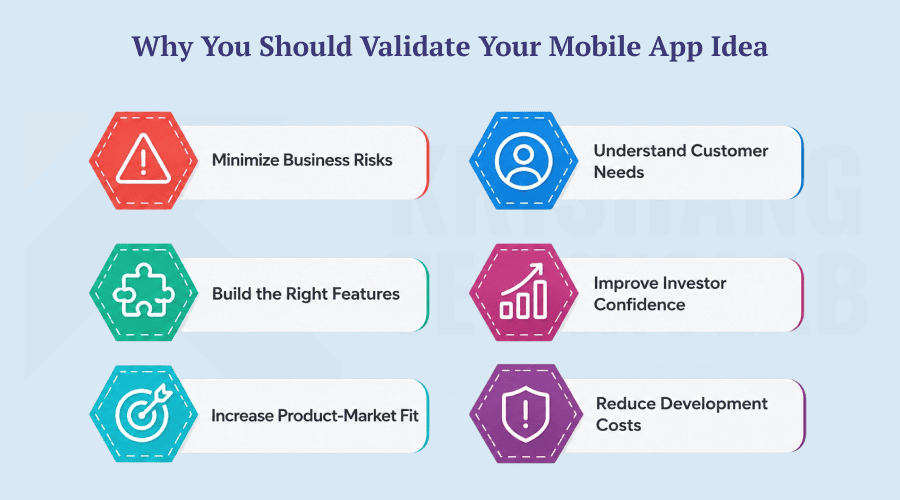
Launching a mobile app without validating it first can result in wasted time, money, and resources. Validating your idea before development helps businesses understand market demand, identify user needs, and make better product decisions. This process also helps teams create a strong foundation for UI/UX Design Services, ensuring the app experience is designed around real user expectations and delivers meaningful value. Once the idea is validated, businesses can confidently move forward with Mobile App Development Services to build a scalable and user-focused application that aligns with customer expectations and market requirements.
Minimize Business Risks
Early validation can help provide insight on the market competition and customer concerns before you spend a lot money. Getting real user feedback means you can pivot your strategy and reduce the risk of launching an app that doesn’t engage or retain the user.
Understand Customer Needs
Customer Research and Testing are powerful tools to understand user expectations of a product or service, the pain points they face and their preferences . The results help companies to identify features that solve real problems rather than unnecessary functionality. Validation, UI/UX Design Services & MVP testing to ensure the product is user-friendly and has higher chances of adoption.
Build the Right Features
Building the right features starts with understanding what users actually need rather than adding every possible function. Customer feedback, market research, and idea validation help businesses prioritize features that solve real problems, improve usability, and deliver meaningful value. This focused approach reduces development costs while creating a product that aligns with user expectations and business goals.
Improve Investor Confidence
You’ve validated your app idea with market research and user feedback You have business planning and potential This lends credibility to investors and stakeholders. Having a proven MVP means that you have a tangible idea ready for the market and this gives you a better chance of getting funding.
Increase Product-Market Fit
Validation is the proof that your application is meeting customer expectations and marketplace demand. By testing your assumptions and iterating your product you will be able to increase customer satisfaction, improve product-market fit and build a strong foundation for long term growth and success.
Reduce Development Costs
Validation is a way of discovering what features are actually needed by users before we go into development. This allows you to concentrate on core functionality without unnecessary development costs, rework and better use of budgets. The Mobile App Development Cost Guide makes it easy to budget correctly.
Signs Your Mobile App Idea Is Worth Validating
There are several app concepts that you should avoid. Before investing in development, businesses must make sure that the concept addresses a genuine issue and has genuine market potential. Early validation reduces risk, improves planning and ensures resources are spent on ideas that can provide long-term value.
Real Problem Exists
The successful apps solve real customer pain points, not ones that are hypothetical. Customer research, surveys and interviews are the way to know what problems their users face and if their idea is going to be of meaningful value.
Existing Solutions Are Weak
Many successful apps enter competitive markets with a better experience than what’s available now. Opportunities to develop a more effective product can be found in gaps such as slow performance, restricted functionality, and poor usability. We concentrate on user experience and concrete improvements to increase adoption.
Growing Market Demand
The likelihood that your app idea will succeed increases with the level of demand for the issue your app addresses. “By looking at trends, customer behaviour and competitor performance businesses can assess whether there is enough interest before investing in development.”
Clear Target Audience
To validate successfully you need to know who will use the app. Knowing your target audience – demographics, behaviours, and needs – lets you plan features, position your product, and market to them. A well-defined audience also makes collecting meaningful feedback during the validation process easier, which helps increase the odds of building a product that meets real customer expectations and leads to stronger product-market fit.
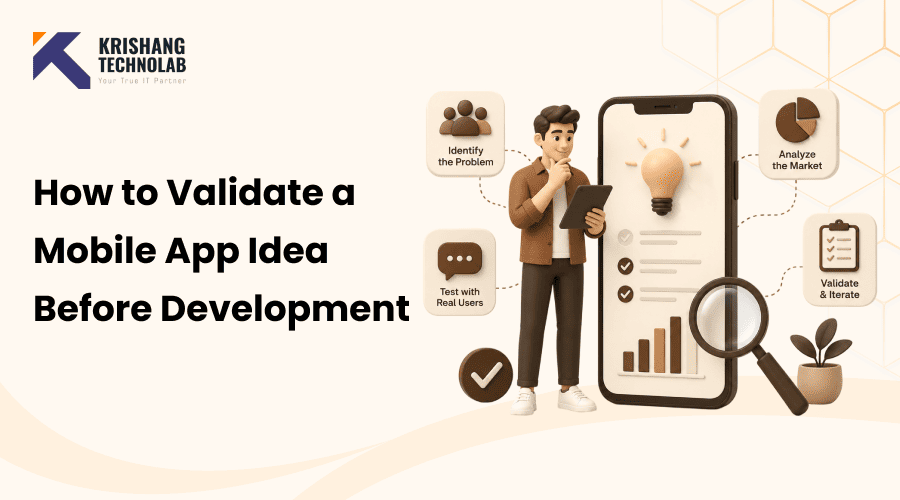
Step-by-Step Process to Validate a Mobile App Idea
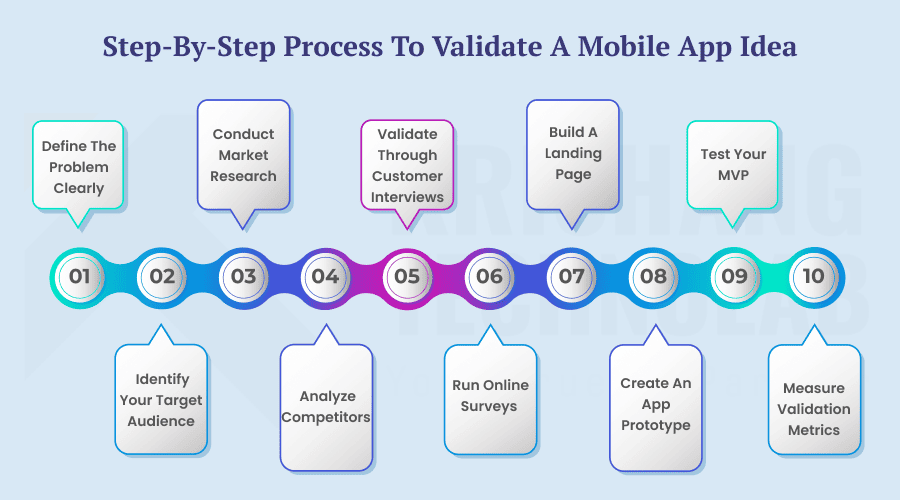
Validating a mobile app idea is a process that helps companies to evaluate market demand, understand user needs, and minimise development risks. Proper validation process can help better planning, more features and more solid basis for successful app development.
Step 1: Define the Problem Clearly
The best Mobile App Idea begins with finding a real problem users face in their daily lives. Before development begins entrepreneurs must have a clear problem statement. A strong statement defines the user challenge, current solutions and expected improvement. Product Discovery Services also enable companies to find gaps in the market and develop valuable app opportunities.
Customer pain points highlight the gaps between what users need and what existing solutions provide. By identifying common frustrations, difficulties, and unmet expectations, businesses can define a clearer direction for their application. A Mobile App Development Agency can transform these findings into practical app features that solve real-world challenges. This user-focused approach also prevents unnecessary development efforts and supports better planning through the Mobile App Development Cost Guide.
Also, a good problem definition leads to better product decisions during the development. Research insights that teams can use before investing in MVP Development Services. This method allocates resources to important user needs. Additionally, Software Development Services become more effective when teams know the exact problem behind the Mobile App Idea.
Step 2: Identify Your Target Audience
If you know who your target audience is, then you know who will be using your application. Therefore, detailed user personas are crucial in the early stages of planning. These personas describe the needs, challenges, preferences and expectations of the users. UI/UX Design Services also use personas to create experiences that satisfy the needs of the users.
Demographics can be very informative in terms of your potential users. Businesses should look into age, location, income, profession and technology preferences. In addition, behaviour analysis explains users’ behaviour with digital products. Android App Development and iOS App Development strategies work better when they are based on the right audience insights.
In addition, understanding user behaviour helps companies to design better engagement strategies. Cross-Platform App Development helps to reach a larger audience across a variety of devices. But before choosing the development methods, companies need to define concrete user groups. This leads to more better product decisions and increases the chance of us validating a successful Mobile App Idea.
Step 3: Conduct Market Research
Market research allows entrepreneurs to understand conditions in the industry before they launch an application. Therefore, it is necessary for businesses to research current trends, customer demands, and emerging technologies. Product Discovery Services offer a structured approach to research to evaluate opportunities. Furthermore, the market insights help to decide if the Mobile App Idea has realistic potential for growth.
Industry patterns reveal changing customer expectations and new competitive opportunities. Therefore, companies can discover areas where innovation can create value. A Mobile App Development Guide can provide better understanding of Market Size Analysis (TAM, SAM, and SOM Calculation), including the total opportunity, reachable customers, and potential market share. These evaluations also support better Mobile App Development Services investments.
Market research also helps in improving financial forecasting and development decision. More accurate Mobile App Development Cost Guide by proper market evaluation. Businesses that offer Android App Development, iOS App Development, and Cross-Platform App Development can come up with more effective strategies. Therefore, research mitigates risks prior to building the final product.
Step 4: Analyze Competitors
Competitor analysis is a tool to understand existing solutions before a business develops a Mobile App Idea. Therefore, companies have to identify direct competitors with similar applications. They should also consider indirect competitors who are solving the same customer problem in a different way. This research supports Product Discovery Services by identifying market opportunities and possible obstacles.
Detailed SWOT analysis of competitors’ Strengths, Weaknesses, Opportunities and Threats. Therefore, businesses can find the areas where their application can be of better value. Feature comparisons give teams insight into those fundamental functions users already expect. Furthermore, MVP Development Services utilises competitor knowledge to prioritise essential features during the early stages of development.
Also, competitor analysis improves strategic planning for Software Development Services. Understanding competitor approaches, user expectations, and technical gaps creates opportunities for better product decisions. The Role of Effective UI/UX Design Services in Creating Unique Business Experiences. Hire Software Programmers to identify technical possibilities across Android App Development, iOS App Development, and Cross Platform App Development Solutions while positioning the Mobile App Idea effectively.
Step 5: Validate Through Customer Interviews
Before you build an application, you can get direct feedback from potential users by conducting customer interviews. Therefore, businesses should ask meaningful questions about the user’s challenges, preferences and existing solutions. These conversations are important to validate if a Mobile App Idea solves a real-world problem. Product Discovery Services also feature interviews to understand customer expectations.
Good interview questions focus on understanding user opinions rather than promoting the app idea. Companies should avoid leading questions that influence responses and create biased feedback. Common interview mistakes include targeting the wrong audience and ignoring negative feedback. Honest answers guide a Mobile App Development Company in making decisions related to MVP planning and application development.
Furthermore, early adopters play a key role in successful validation. MVP Development Services enable companies to develop basic versions for this type of users. UI/UX Designing Services Feedback helps us to improve and plan App Maintenance & Support tactics.
Step 6: Run Online Surveys
Surveys online help a business to collect feedback from a larger audience in an efficient manner. Therefore, they are helpful in validating a Mobile App Idea before you make a huge investment. Surveys can be a measure of customer interest, preferences and expectations. Survey results also help Software Development Services teams understand the features that are required.
There are a number of survey tools that can help you gather structured responses from potential users. Businesses should follow best practices including simple questions and clear language. This method provides more accurate information from respondents. The sample questions should examine user problems, current alternatives and the desire to use a new application. These insights inform better development decisions.
Survey results also allow companies to estimate demand before development starts. They also assist in planning the Mobile App Development Cost Guide. Android App Development or iOS App Development solutions can help you to pinpoint the platform choices. Audience research makes cross-platform app development decisions easier.
Step 7: Build a Landing Page
A landing page is a way for businesses to introduce their Mobile App Idea to potential users before development has even begun. It is therefore a validation tool to measure market interest. The page should clearly describe the app idea, its benefits and how it solves the problem. Product Discovery Services also help you develop messaging that speaks to your target customers.
What you need is a landing page with a waitlist feature to capture interested users. This allows companies to assess demand and find early adopters. CTA Optimisation Improves User Actions by Making Buttons Clear & Engaging Besides, UI/UX Design Services help in creating attractive designs that encourage visitors to interact.
Also, the landing page results offer valuable direction before moving into full development. User registrations, engagement patterns, and responses indicate whether the app concept connects with the target audience. This information shapes MVP Development Solutions by defining priority features and improving the initial product approach. Additionally, Mobile App Development Services teams use these findings to refine Android App Development and iOS App Development strategies.
Step 8: Create an App Prototype
With prototyping, businesses can visualize their Mobile App Idea before full development begins. Prototypes help teams understand user flows and how the application will function. Wireframes provide simple screen layouts that explain the structure and user navigation. Hire UI/UX Design Experts to create prototypes that improve usability and deliver better digital experiences.
You can click on prototypes and play with them as if they were real, without coding them completely. That means companies can test out designs on users early. Design validation helps identify confusing pieces and improves the overall user experience. Product Discovery Services also act as a means of verification that the proposed solution aligns with customer expectations before pouring in development efforts.
Also, prototypes mitigate risks related to Software Development Services projects. Features can be improved before starting full development processes. The Android App Development and iOS App Development projects have the advantage of early design testing across different Mobile App Development Platforms. Also, Cross-Platform App Development becomes more efficient when the teams clearly understand the user requirements.
Step 9: Test Your MVP
An MVP is the most basic version of an app, with only the necessary features. Thus, MVP testing helps to validate whether a Mobile App Idea brings real value to the users. Businesses should rather be looking to solve the core problem and not add unnecessary features. MVP Development Services also help build practical solutions for early market testing.
Core features should be designed around the primary user journey and provide meaningful value. Companies should avoid creating complex applications during the initial validation stage. User testing reveals feedback on functionality, usability, and satisfaction. Outsource Software Development Services to refine applications based on real customer behaviour and improve the overall product experience.
Better investment decisions before scaling the development are also possible with MVP testing. It helps to decide whether Android App Development or iOS App Development needs more expansion. Businesses can also assess Cross-Platform App Development opportunities. Also, App Maintenance & Support becomes easier since early feedback helps in future improvements.
Step 10: Measure Validation Metrics
Measuring validation metrics helps business to know the success of their Mobile App Idea. Thus, companies should monitor important indicators throughout the testing stages. Signup rate indicates interest, activation rate shows successful onboarding. Retention also tells us if the app continues to deliver value for the users.
Conversion rate is a measure of how well the app drives the right behaviours . Companies can analyse data to find areas of improvement. User feedback offers qualitative insight into satisfaction and challenges. Moreover, the teams working in Mobile App Development Services can use these metrics for enhancing the performance of the product.
Tracking metrics can also lead to long-term growth and better decision-making. In their Mobile App Development Cost Guide, businesses can measure results against goals. These insights are applied to Android App Development, iOS App Development and Cross-Platform App Development strategies. In addition, App Maintenance & Support is more efficient if it’s based on measurable user behaviour.
Best Tools to Validate a Mobile App Idea
The right tools can make the app validation process more effective by helping businesses analyze market demand, understand user needs, and test product concepts before development begins. These insights enable companies to make informed decisions, minimize risks, and build products that align with customer expectations. When combined with professional Mobile App Development Services, research, feedback, and analytics tools help businesses validate whether their app idea meets real market needs before investing in full-scale development.
Google Trends
Companies can use the Google Trends platform to track search trends and understand how interested people are in a particular topic. This allows businesses to identify whether demand for a mobile application concept is increasing, decreasing, or remaining stable. These insights are useful for discovering new opportunities, identifying potential leads, and validating market interest before investing in development.
Google Keyword Planner
Google Keyword Planner gives you data on search queries, search volume and competition. With this data, businesses will know what their customers are looking for and will find out the demand for their app development idea. Future marketing plans and content are also influenced by it.
Figma
Figma is a design and prototyping tool that helps companies design interactive apps before they start building them. This gives teams the ability to test user flows, get feedback, and generally improve the user experience. So, visual prototypes are a good way to test a unique mobile app idea.
SurveyMonkey
SurveyMonkey provides online survey solutions to collect customer feedback for business. Companies can use it to understand user preferences, challenges and expectations before they build their application. This insight informs product decisions.
Typeform
Typeform makes beautiful surveys and feedback forms that get people to give you rich answers. It helps companies to collect valuable data on customer needs, and validate their product assumptions.
Hotjar
Hotjar has tools like heatmaps, recordings and feedback that can help you understand how your users are behaving. Seeing user engagement with prototypes and landing pages, they can learn recommendations for improving the experience.
Mixpanel
Mixpanel is a platform that provides you with deep insight into how your consumers are using your digital products. It aids businesses in learning what customers find appealing about a product, how they use it, and what needs to be changed.
Firebase Analytics
Firebase Analytics can provide you with some useful insight into how people are engaging with your app (retention metrics etc). It allows companies to test and validate their mobile application idea with real user data and to measure key performance indicators.
All these validation tools help companies to understand their customers better, test assumptions and build apps that are more successful on the market.
Common Mistakes to Avoid During Mobile App Idea Validation
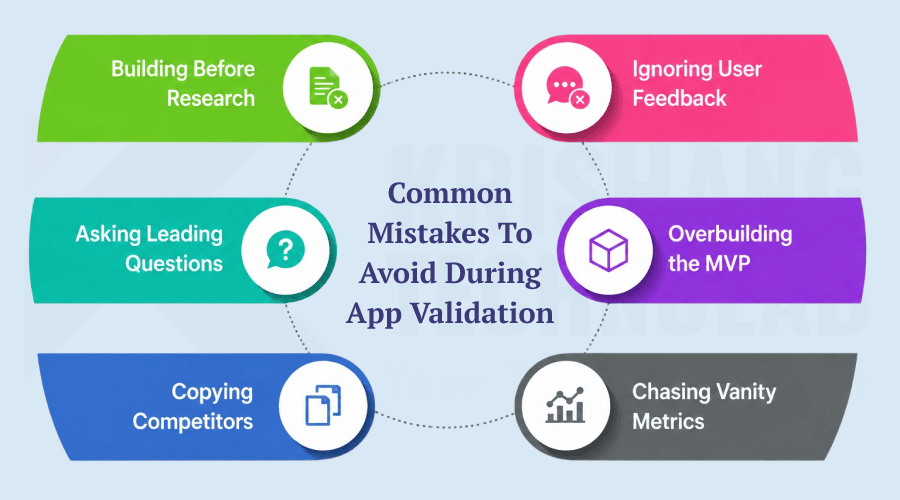
Knowing a mobile app idea helps companies understand what customers want, how much demand exists in the market and if the product is feasible before they spend money on development. However, errors made in this stage can lead to waste, incorrect assumptions and bad product decisions. That’s why businesses must have a structured validation process that focuses on research, user insights and meaningful data.
Companies avoid common validation pitfalls, improve their application concept, reduce development risks and build applications that deliver real value to users. These challenges can teach businesses how to develop better products that have a greater chance to succeed in the market.
Building Before Research
One of the most common mistakes is to start development without any research and end up with an app nobody wants. The first thing any company has to do is research customer pain points, industry trends, and competitor solutions to see if their mobile app idea has legs.
Ignoring User Feedback
User feedback helps to understand customer expectations and guide product improvements. Ignoring feedback can lead to building features that aren’t needed or missing key user requirements. So businesses should gather opinions by way of interviews, surveys and prototype testing in order to improve their app development idea.
Asking Leading Questions
Leading questions can skew responses as they nudge users to answer in a positive way rather than giving their honest opinions. Businesses should be asking open-ended questions that uncover real customer challenges and experiences. This approach helps to create a more correct validation process for a unique idea of a mobile app.
Overbuilding the MVP
Core features that address the primary customer issue should be the major emphasis of an MVP. It is too costly and slows down testing to start with too many features. A simple MVP allows a business to get real feedback from real users and then gradually improve the product.
Copying Competitors
By studying your competitors, a business can learn what the market expects; but copying your competitors directly stiflies innovation. Instead of copying features, companies should find holes in existing solutions and create better experiences. The great mobile app idea should offer something unique to the users.
Chasing Vanity Metrics
You can brag about vanity stats such as downloads or visitors to a website, but they can provide a false sense of accomplishment. Businesses must focus on the appropriate indicators, such as user retention, engagement, conversions, and feedback, in order to fully comprehend how a product is functioning.
Companies that don’t fall into these traps better validate their ideas and build applications that better fit user and market opportunities.
Mobile App Validation Checklist
Validate Your Mobile App Idea Before You Build It Helps to Reduce Risks Validates Demand Ensures Your App Meets Real User Needs Development readiness checklist.
- What specific problem does your app solve and does it solve a real user need.
- Study your industry to see what trends are popping up, what your customers want and where you can grow.
- Determine your target users before you begin to build your app. What do they like? What are their problems? What do they expect?
- Explore other apps available in the market and discover ways to improve client satisfaction.
- Do you, as a potential user, think your problem is solved by the proposed solution?
- Surveys are a great way to get feedback on your app idea and find out what people want.
- Build interactive prototype to test function and navigation and experience.
- Build a landing page to test your value proposition. Get early traffic updates.
- Build a minimum viable product (MVP). The most important features to get real world feedback from real users.
- Use to track user behaviour, retention, feedback and conversion rates to improve your product.
- Play around with pricing models until you find one your customers enjoy and one you can sustain long term.
Real-World Examples of Successful Mobile App Idea Validation
Successful companies often validate their ideas before investing heavily in development and expansion. They focus on understanding customer needs, gathering feedback, and refining their solutions to ensure they solve real problems. By following an MVP approach with Professional MVP Development Services, businesses can test their ideas early and make improvements based on actual market responses.
Airbnb
Airbnb experimented to see if people would rent a room in an apartment from a private individual as opposed to a hotel—and it worked. Initially, the founders’ website allowed users to rent out available spaces for a local event.
The tiny experiment let them gauge demand, see how customers act and get early feedback. Airbnb first tested the market to see if users really wanted affordable and unique travel options, then scaled and improved the platform to improve services.
Dropbox
Dropbox didn’t build a working product, but made a simple demo video of how file storage and syncing would work to validate demand. The team gauged interest with signups and responses, instead of shelling out money on a finished product up front.
The positive response indicated that consumers were looking for a simpler file management system. The validation gave Dropbox the confidence to iterate on its app concept and move forward with full-scale development.
Buffer
They tested the concept with a landing page, and built out a full product (Buffer). The creators launched their social media post scheduling app and tested the waters by measuring how many people interacted with the post and signed up for their email list.
This gave them some idea of the real demand of the people for the service.” When they saw there was demand, Buffer built the platform and iterated on features with user feedback.
Uber
Uber validated its idea by launching a small-scale transportation service in San Francisco before expanding globally. The company was addressing one issue, something that would make transport simpler and more dependable.
Uber tested the service with a select group, got feedback and watched how customers used the service and improved the experience. This early validation was the foundation to evolve a simple mobile app idea into a widely used platform.
These examples show why it’s important to test your assumptions before scaling. Prototype, landing pages or limited launch to validate the unique mobile app idea help businesses understand their users and create products with more market potential.
Frequently Asked Questions (FAQ)
Mobile app idea validation is how businesses figure out market demand, customer needs and product feasibility before spending on development. Below are answers to frequently asked questions about the app validation process.
How Long Does Mobile App Idea Validation Take?
Depends on your app complexity, target audience and validation methods. Basic research can take a couple of weeks. Validation through customer interviews, surveys, testing of prototypes and market analysis takes one to three months. It takes time to get the right insights but it will reduce development risks and help you make better decisions.
How Much Does Mobile App Idea Validation Cost?
The cost of validation will depend on the techniques used. Market research and online surveys are pretty cheap but building prototypes, user testing and consulting experts require a bigger budget. The Mobile App Development Cost Guide helps businesses plan their expenses by beginning with low cost validation methods.
Do I Need Coding Skills to Validate a Mobile App Idea?
Not at all. Testing demand is what validation is not, it’s not building a full product. Entrepreneurs don’t need to know how to code, they can validate ideas with surveys, landing pages, wireframes and no-code prototyping tools. Software Development Services can turn a validated concept into a functioning application.
How Mobile App Idea Validation Differs from an MVP?
Validation is: does your idea solve a real problem and market demand. The Minimum Viable Product (MVP) is the simple version of the app with core functionalities that will allow companies to collect feedback from real users. Validation will happen before or during MVP development.
How many users should I interview?
There’s no set number. The idea is to get qualitative feedback from the target audience until patterns and user needs emerge. “Better to have quality insights than to interview a lot of people.”
Can AI Help Validate a Mobile App Idea?
In fact, AI tools may help you build products, find competitors, analyse market trends, and produce research insights. But there is still room for direct, honest input from customers. because it gives context, emotion and practical knowledge that AI can’t replace.
What If My Mobile App Idea Already Exists?
Competition doesn’t mean your idea can’t win. Many successful apps entered into competitive markets with better features, better usability or better value proposition. Focus on finding holes in the market and improving customer experience.
Should I Patent My Mobile App Idea Before Validation?
In most cases it is better to validate demand before you patent. If you have identified market interest, then you can evaluate the legal protection of your technology, processes or special innovations against the long-term potential of the product.
Conclusion
Validating your mobile app idea before development is one of the most important steps toward building a successful product. It helps businesses understand market demand, identify user needs, test assumptions, and reduce development risks before investing significant time and resources.
Early validation enables businesses to focus on the right features, eliminate unnecessary costs, and build products that align with customer expectations. It also creates a strong foundation for UI/UX Design Services, resulting in intuitive interfaces and a seamless user experience.
Once the idea is validated, businesses can confidently move forward with Mobile App Development Services to transform concepts into scalable, high-performing applications. Experienced teams that Hire Mobile App Developers with the right technical expertise can execute the project using the right technology and development strategy. However, the product journey does not end at launch. App Maintenance & Support plays a vital role in keeping the application secure, optimized, and up to date through continuous monitoring, performance improvements, bug fixes, and user-driven enhancements.
A validated idea, combined with the right development and long-term maintenance strategy, significantly increases the chances of building a successful, user-centric application.
Found this post helpful? Don't forget to share it with your network!