Quick Overview: White label web development for agencies allows you to deliver high-quality websites under your own brand while a trusted development team manages the work behind the scenes. This guide explains the process, services, costs, profit margins, and hiring steps, so your agency can scale faster without payroll.
Your agency has clients. Your sales team can bring in more projects. But your development capacity is limited.
So you face a hard choice. You can hire more developers and carry the payroll. You can rely on freelancers who may not show up on time. Or you can turn projects away and watch revenue walk out the door. Even basic outsourcing can go wrong without a clear process, because clients may end up talking to the wrong people.
This is where white label web development for agencies can make a real difference. You can offer websites and web applications under your own brand while an experienced development partner takes care of the technical execution. You maintain the client relationship, while your team concentrates on winning new business, strategy, and growth.
This white label web development guide is designed as a practical resource for agency owners who want to understand and use white-label development effectively. Inside, you’ll discover:
- What white label web development means and how the process works
- Which services your agency can offer
- What it costs and how agencies make money
- How to choose a partner and hire the right team
- How outsourcing, in-house hiring, and freelancers compare
- What US agencies should plan for
What Is White Label Web Development?
In short, white label web development for agencies is a service where an outside team builds websites and web apps, and the agency sells them under its own brand. The agency remains the client’s sole point of contact throughout the entire project. The partner stays behind the scenes and delivers finished work for you to present.
Here is white label web development explained in simple terms:
- Your agency owns the client relationship.
- Another team handles the development.
- All work is delivered under your brand.
- The client does not need to know who built it.
- The client doesn’t need to know which development team is behind the project.
Think of it like a restaurant sourcing fresh bread from a local bakery and serving it to customers under its own name; the end customer sees the restaurant’s brand, not the supplier. The guest only deals with the restaurant.
What Does “White Label” Mean in Web Development?
In web development, “white label” means the work carries your name, not the builder’s name. In white label web development for agencies, the partner signs an NDA, uses your branding in files and reports, and never contacts your client unless you allow it. You handle the final billing and ongoing client support, keeping the entire customer experience under your agency’s brand.
How Is White Label Web Development Different From Outsourcing?
Many owners ask, “What is the difference between white label and outsourcing?” In simple terms, outsourcing focuses on who handles the project, while white labeling focuses on which brand gets the credit. When you look at white label vs outsourcing, the gap is mostly about process and brand protection. Basic outsourcing often means sending a task to a vendor. The vendor may talk to your client, or work without clear rules. A white label model adds NDAs, brand-safe communication and quality checks.
| Factor | Basic Outsourcing | White Label |
| Brand shown to client | Can be the vendor | Always your agency |
| Client contact | Often direct | Through your agency only |
| Process | Task by task | Structured and repeatable |
| Confidentiality | Varies | Built in with NDAs |
| Best for | One-off tasks | Long-term growth |
How Does White Label Web Development for Agencies Work?
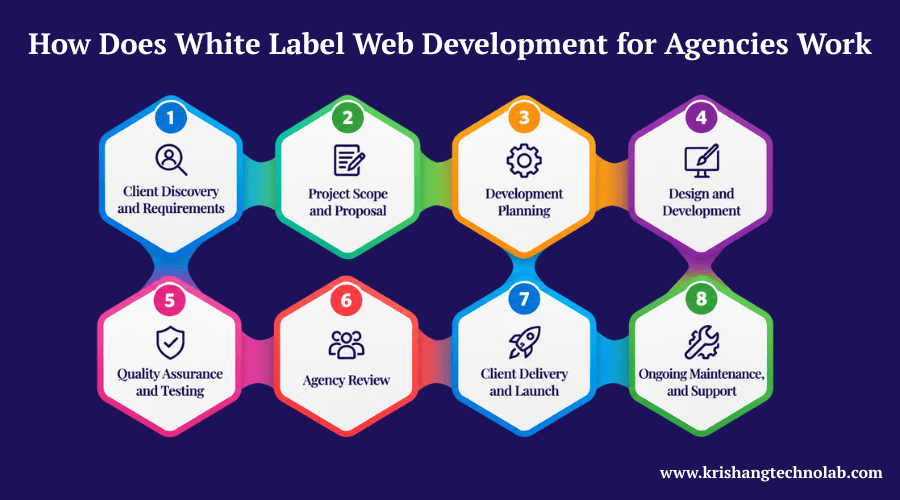
If you wonder how does white label web development works, the answer is a simple, repeatable flow. Learn how white label development works and you will be able to plan for every project with confidence. Here is the typical white label web development process, from first call to launch.
1. Client Discovery and Requirements
Your agency talks to the client first. You learn their goals, audience, brand, and budget, and you collect content, designs, and examples. Good notes at this stage save time later, because your partner will build from them without speaking to the client directly.
2. Project Scope and Proposal
You and your partner define pages, features, platforms, and deadlines. The development partner provides your agency with a clear project quote and estimated delivery schedule. You then add your markup and send your own proposal to the client, so the partner’s pricing stays private and your brand stays in front.
3. Development Planning
The team plans tasks, sets milestones and chooses tools. A clear plan prevents surprise delays and keeps everyone aligned. Many partners also share a simple schedule, so your project manager always knows what is due this week, and what comes next.
4. Design and Development
Designers and developers work together to create and refine the website through each stage of development. The work can include white label frontend development, which covers what visitors see and white label backend development, which covers the logic, data and server side. You receive staging links so you can review progress.
5. Quality Assurance and Testing
Testers check speed, mobile layouts, browsers, forms and links. They also look for broken pages and slow images. This step protects your reputation, because clients judge your agency by the final result and not by who wrote the code behind it.
6. Agency Review
Before presenting the website to your client, your team can review every detail, request revisions, and make sure the final product meets your standards. This quality check is an essential part of white label web development for digital agencies, since the work is delivered under your brand and your agency remains responsible for the client relationship.
7. Client Delivery and Launch
You deliver the completed website under your agency’s brand and oversee the launch, while your development partner handles the technical details behind the scenes, including hosting configuration and final deployment checks. From the client’s perspective, everything feels like a seamless delivery directly from your agency, with no need to reveal the team working in the background.
8. Ongoing Maintenance, and Support
After launch, the site needs updates, backups and security fixes. Many partners offer monthly plans for this work. That means you can sell recurring support to your client while your partner handles the technical tasks in the background.
What White Label Web Development Services Can Agencies Offer?
Here is what white label web development for agencies can cover in practice. A strong white label web development agency can handle many types of work. If you’re wondering, “What services can agencies white label?” The list is long, and the most common white label web development services are below. Many of these also fall under broader white label development services.
White Label Website Development
White label website development is the base service. It covers business sites, landing pages, and multi-page websites. It is the best starting point for agencies that are new to outsourcing, and many partners list it under white label website development services.
White Label WordPress Development
White label WordPress development is popular because WordPress runs about 40% of all websites, and clients like to edit their own content. Skilled white label WordPress developers build custom themes and plugins and fast page layouts for blogs, service sites, and membership sites.
White Label Shopify Development
White label Shopify development helps agencies serve online store owners. A partner can set up themes, product pages, apps, and checkout flows. Skilled white label Shopify developers let you take Shopify store projects without a Shopify team of your own.
White Label Webflow Development
White label Webflow development suits design-led agencies. Webflow gives pixel-level control with clean code. Experienced white label Webflow developers can turn your designs into live sites quickly, which helps when you sell marketing sites that must look exactly as designed.
White Label Ecommerce Development
White label ecommerce development covers online stores on any platform. It includes catalog setup, payments, shipping, and speed tuning. With white label ecommerce development services, you can offer a full store build, including links to inventory, and CRM tools.
White Label WooCommerce Development
White label WooCommerce development is a good fit for clients who already use WordPress, and want to sell online. It offers flexibility, and lower platform fees and it works well for stores that need custom features or unusual shipping and tax rules.
Custom Web Development
White label custom web development is for needs that templates cannot meet. White label custom website development gives clients unique layouts, tailored features and room to grow, which suits brands that want a site built around their exact workflow.
Web Application Development
White label web application development covers portals, dashboards, booking tools, and client apps, and a partner can build custom web applications of any size. Some partners also offer white label SaaS development for agencies that want to launch software products for their clients.
Website Migration and Integration
Clients often need to move sites to new hosts or platforms. A partner can handle the move without downtime, keep page addresses working, and protect search rankings. This saves your team from risky technical work and keeps the client calm during the switch.
Website Maintenance and Support
Monthly care plans keep sites updated and secure. They cover backups, plugin updates, uptime checks, and small fixes. For agencies, maintenance is a steady source of recurring revenue that needs very little of your own team’s time.
Website Performance Optimization
Slow sites lose visitors and sales. Partners can improve load times, compress images, clean up code, and fix Core Web Vitals issues. Faster pages help clients rank better, and convert more visitors, so this is an easy service to sell after launch.
API and Third-Party Integrations
Developers connect sites to payment gateways, CRMs, email tools and booking systems. These links save clients time, and reduce manual work. Because integrations need careful testing, they are a good example of work that a skilled partner handles better than a generalist.
Why Are Digital Agencies Using White Label Web Development?
It solves real growth limits. Should agencies use white label development at all? For most growing agencies, yes. Here are the main benefits of white label web development, and you can also see the benefits agencies get from this model in more detail.
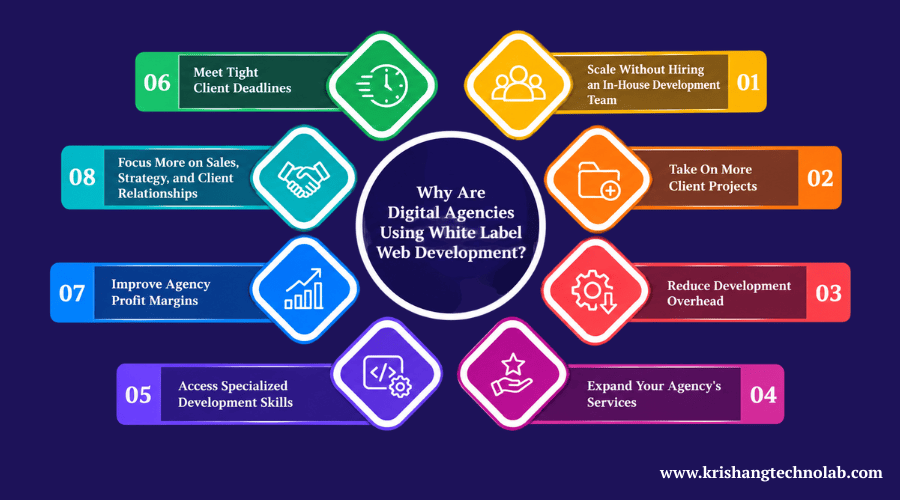
Scale Without Hiring an In-House Development Team
How can a digital agency scale without hiring developers? Instead of building an in-house team, agencies can scale by using an external development team when needed. Many agencies choose white label web development for agencies because they get skilled developers when they need them and pay only for the work, with no hiring delays or long contracts.
Take On More Client Projects
You can say yes to more leads. Instead of turning projects away because your team is full, you pass the build work to your partner. One of the clearest advantages of white label web development is that your sales team is no longer limited by your headcount.
Reduce Development Overhead
You skip salaries, benefits, software licenses, hardware, and training. Costs become flexible instead of fixed, so a slow month does not leave you paying for developers who have no work to do. This makes your monthly budget much easier to plan.
Expand Your Agency’s Services
A branding or marketing agency can add website building without a hiring plan. This is how white label development for agencies supports growth: you sell new services to current clients, and earn more revenue from each account.
Access Specialized Development Skills
One partner can offer WordPress, Shopify, Webflow and custom code experts. Few small agencies can afford all of those skills in-house. With a partner, you can match each project to the right developer without a long search or any training costs.
Meet Tight Client Deadlines
A bigger bench means faster delivery. You can run several builds at the same time and keep each project on schedule. When a client suddenly asks for an earlier launch date, your partner can add more people to the work.
Improve Agency Profit Margins
You pay the development partner for their services and set your own pricing when billing the client. The gap is your margin. Because you have no fixed payroll for idle time, more of each project’s price stays in your agency, especially on repeat work.
Focus More on Sales, Strategy, and Client Relationships
Your team can spend its time on what it does best, such as sales, strategy, and client care, while the partner handles the build. Clients feel the difference because your account managers are no longer buried in technical tasks.
White Label vs In-House Development vs Freelancers
Agencies that are weighing their options are often close to making a decision. A straightforward comparison of white label vs. in-house development and white label vs. freelancers can help clarify the differences and make the right approach easier to choose.
| Factor | White Label | In-House | Freelancer |
| Upfront cost | Low | High | Low |
| Scalability | High | Medium | Medium |
| Monthly payroll | Flexible | Fixed | Flexible |
| Management | Partner-managed | Agency-managed | Agency-managed |
| Capacity | On demand | Fixed | Variable |
| Best for | Growing agencies | Large teams | Small projects |
A common question among agency owners is: “Is it better to build an in-house development team or choose white label development?” The answer depends on your size and workload.
When White Label Makes More Sense
Choose white label when your project volume goes up and down, you need many skills, or you want to grow without more payroll. For many agencies, white label web development for agencies offers greater flexibility and scalability, while an in-house team provides more direct control and easier day-to-day collaboration.
When Hiring In-House Makes More Sense
Choose in-house when you have steady, high-volume work every month, need deep product knowledge, or build proprietary tools for one brand. In these cases, a full-time team can know your systems better than any outside partner could.
When Freelancers May Be Better
Freelancers work well for small, one-time tasks like a quick fix or a simple landing page. They can be risky for large projects because one person may be unavailable at a key moment, and you have no backup if they fall behind.
If you are asking whether to bring in a white label website developer, the honest answer is this: yes if you want steady capacity and a managed process, and no if you only have one tiny task.
How Much Does White Label Web Development Cost?
It is the question agencies ask most. The honest answer is that white label web development cost depends on scope, platform, and the partner’s location. The cost of white label web development for agencies can also vary depending on how much project management and coordination you expect the development partner to handle.
Typical Cost Ranges
The numbers below are typical market ranges for white label web development pricing and for white label website development cost on common projects. They are examples, not quotes. Always ask for a written estimate before you promise a price to a client.
| Project Type | Typical Range (USD) |
| Landing page | $300 – $1,000 |
| 5 – 10 page WordPress site | $1,500 – $5,000 |
| Shopify store | $2,500 – $10,000 |
| Custom web app | $10,000 – $50,000+ |
These price ranges also give you a useful benchmark for white label website development on smaller-scale projects.
Per-Project Pricing
You pay a fixed price for a defined scope, which is best when requirements are clear. Many partners package this as white label web development packages, such as a starter site, a business site, or a store. The white label development cost is easy to predict this way.
Hourly Pricing
You pay for time spent, which suits unclear scopes, and small tasks. Typical white label developer rates vary by region. Offshore development teams may typically offer rates of around $15 – $40 per hour, whereas US-based teams can range from $50 – $150+ per hour, depending on their expertise and services.
Monthly Retainers
You pay a set monthly fee for a block of hours. This works well for steady maintenance and small updates. Some partners sell retainers as white label development packages, and a retainer often lowers your average white label web developer rates compared with ad hoc hourly work.
Dedicated Development Teams
You reserve one or more developers for your agency, often for a flat monthly fee. This is the best way to scale when you always have work, and dedicated developers keep white label development pricing steady from month to month.
White Label Web Development Cost USA
If you search for white label web development cost USA, you will find a wide spread. White label website development costs in the USA are usually higher with US-based partners, because you pay for same-time-zone work and local support. Many US agencies mix both. They use an offshore partner for the build and keep local staff for client calls. Looking at the wider picture, web development outsourcing cost is usually lower than in-house cost once you add salary, taxes, benefits, and software.
What Factors Affect White Label Development Costs?
Many things move the final price. Knowing them helps you scope projects well and explain quotes to your client. Small changes in scope can add days of work, so it is wise to write each item down before you send a quote. Here are the main factors:
- Website size: More pages mean more hours.
- Functionality: Forms, logins, and booking tools add work.
- CMS: WordPress, Webflow and custom systems differ in cost.
- Ecommerce needs: Products, payments and shipping raise the price.
- Integrations: Each third-party tool adds setup, and testing.
- Design complexity: Custom animations and layouts take longer.
- Number of revisions: Extra rounds add hours.
- Timeline: Rush work often costs more.
- Maintenance: Ongoing care is a separate cost.
How Can Agencies Make Money With White Label Web Development?
They add a fair markup to the partner’s price and sell the result under their brand. Here are the main revenue paths.
Agency Markup
The white label development markup is the extra amount you add on top of the partner’s cost. It pays for your sales, project management, client support, and risk, so it should never be zero. A fair markup keeps the work profitable for your agency.
Fixed-Price Projects
Provide a straightforward quote based on a well-defined project scope. If the partner delivers on time and on budget, you keep the difference. Fixed prices also help clients plan their budget, and they make your proposals simple to read and quick to approve.
Monthly Retainers
Keep you updated, add small features and support for a monthly subscription. This provides a steady income that doesn’t rely on new sales every month. Clients like retainers too, because they know someone is always ready to fix issues.
Website Maintenance Revenue
Care plans for backups, updates, and security are easy to sell after launch. Your partner can run website maintenance in the background, which means low effort for you and a fee that renews every month.
Upselling Additional Services
A new website opens the door to more work, such as hosting, content, conversion tuning and ads. The agency that built the site is trusted by the clients, so when you offer the next step, they’re more likely to say yes.
Bundling Web Development With SEO, PPC, and Marketing
Package a website with marketing services. Clients like one team that does it all, and bundles raise your average deal size. For example, you can pair a new build with SEO services and paid ads.
A Simple Example
Here is a hypothetical example, not a promise. If the partner charges $2,000 for a business website and you add a 100% markup, you charge $4,000 and keep a $2,000 gross margin, or 50%. There is no universal white label development profit margin or white label web development profit margin.
Is White Label Web Development Profitable and Worth It?
For most agencies that price well and manage scope, yes. White label web development for agencies removes fixed payroll, lets you take more projects, and adds recurring revenue. So, is white label web development worth it? It is when you have more demand than capacity.
How to Choose the Right White Label Web Development Partner
Use this checklist to find a reliable white label web development partner you can trust with your clients. The right white label web development for agencies partner should offer clear pricing, transparent processes, and no hidden surprises.
The goal is to find the best white label web development company for your needs, not the cheapest. You can also look at a list of white label development agencies to see how strong providers are judged.
Check Their Technical Expertise
Ask which platforms, and languages they use. A good white label development company should be strong in the tools you sell and a white label website development company should show solid CMS and theme skills. Ask for proof, not just promises.
Review Their Portfolio, and Case Studies
Look at real projects. Check design quality, speed and mobile layout. A white label website development agency should show both small and large builds, and you should ask for examples that are close to your own clients’ sites.
Look for Experience Working With Agencies
A professional white label web development company that already serves agencies understands NDAs, white label emails, and reseller pricing. This matters a lot, because a team that mostly serves direct clients may slip and contact your customer by mistake.
Check Their Communication Process
Ask how they share updates. Look for weekly check-ins, a shared tracker, and a named project manager. Reply speed in the first week tells you a lot about how the partnership will feel when you are under deadline pressure.
Evaluate Project Management
Good partners use sprints, task boards, and clear deadlines. Poor project management leads to delays and missed handoffs. Ask how they track tasks, who approves changes, and how they warn you early when a project starts to slip.
Understand Their QA Process
Ask for their testing checklist. If they cannot describe it, you will end up finding the bugs yourself. A strong partner tests on several browsers and devices and fixes issues before sending anything to you for review.
Review Pricing, and Contract Terms
Check prices but also read the terms on revisions, payment steps, ownership and support. Look for clear white label web development solutions with written scopes, so there are no surprise fees in the middle of a project.
Confirm NDA and Client Confidentiality
Always sign an NDA. Confirm that the partner will not contact your clients, or show their name anywhere, including in code comments, and credits. Put these rules in writing before any work begins.
Check Scalability
Check whether the partner can scale the development team as your agency takes on more projects. A small team can become a bottleneck when you win several projects at once, so confirm how quickly they can add people and what that costs.
Ask About Post-Launch Support
Find out how they handle bug fixes, updates and emergencies after launch. A reliable white label development partner will explain response times, and support hours up front, so you know what to promise your clients.
At Krishang Technolab, we work with agencies that want a dependable build team behind their brand. We follow NDA-first workflows, so clients only ever see the agency’s name. You can see our approach as a white label web development partner.
White Label Web Development for US Digital Agencies
Many readers want to know, “Can US agencies outsource web development?” Yes, many do it every day. This section covers white label web development USA and what American agencies should plan for. An effective white label web development strategy for US agencies keeps your brand at the forefront while giving you the flexibility to manage development costs as your workload changes. Whether you run a small studio or a large firm, white label web development for agencies works the same way in the US.
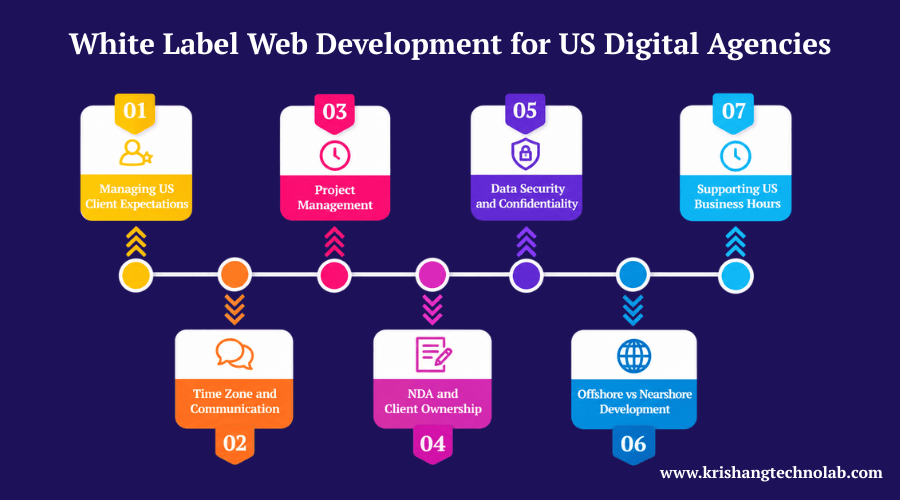
Managing US Client Expectations
US clients expect quick replies, clear updates and polished work. For white label web development for American agencies, set expectations in your proposal. Share a timeline, explain how revisions work, and choose a white label web development company USA buyers trust if you need local support.
Time Zone and Communication
A time zone gap can slow things down. Ask the partner to overlap with your working hours for at least a few hours each day. A white label web development agency USA may offer this by default, and a good offshore team can match it with shifted hours and white label web development services USA style support.
Project Management
Use a shared tracker and short weekly calls. Clear tasks and owners keep projects moving across time zones. This applies whether you choose white label website development USA or an offshore team, and whether your partner is a small white label website development company USA or a large studio.
Data Security and Confidentiality
Protect client data. Use secure file sharing, access controls and strong passwords, and ask partners about their security habits. This matters most for white label web development for US digital agencies that handle customer records, and for any white label website development services USA buyer who works with regulated clients.
NDA and Client Ownership
Your contract should say that your agency or your client owns the final code and design. It should also include a confidentiality clause. These terms are standard in white label website development for US agencies and in white label development for US agencies of every size, so do not skip them.
Offshore vs Nearshore Development
Offshore teams are far away and often cost less. Nearshore teams are closer in time zone and may cost more. For web development outsourcing for US agencies, pick based on budget, your need for live collaboration, and project size. A dedicated offshore development center can also work well for website development outsourcing for US agencies with steady needs.
Supporting US Business Hours
Ask if the partner can cover US business hours for urgent issues. This is a key factor when a client site goes down during the day. The right web development partner for US agencies or website development partner for US agencies will plan for this from day one. Teams like Krishang Technolab can work with US agencies through shared tools and overlap hours, while keeping the agency’s brand in front. Many white label development company USA options, white label developers USA teams, and any white label development company for US agencies can offer similar cover.
Final Thoughts
If your agency has the demand but lacks the development capacity, white label web development for agencies can help you grow your delivery power without growing your headcount right away. You maintain ownership of the client relationship, your brand presence, and the profit from each project. Your partner handles the build.
Start small. Pick a partner, sign an NDA, run a pilot, and measure the results. If it works, scale up.
Looking for a White Label Web Development Partner?
Krishang Technolab helps agencies deliver websites, stores and web apps under their own brand, with clear communication and quality checks at every step.
Frequently Asked Questions About White Label Web Development
What is white label web development?
White label web development for agencies is when an outside team builds websites for your agency, and you sell them under your own brand. The client only deals with you. The partner handles design and code in the background and delivers finished work for you to present to the client.
How much does white label web development cost?
White label web development cost depends on the project. A simple landing page may cost a few hundred dollars. A standard business website typically comes with a project budget in the range of a few thousand dollars. A custom web app can cost $10,000 or more. Hourly rates, project fees and monthly plans all exist, so always ask for a written quote.
Is white label web development profitable for agencies?
Yes, it can be very profitable. Agencies add a markup to the partner’s price, avoid fixed payroll and earn recurring income from maintenance. Pricing, scope and quality control are the function of profit. There’s no guaranteed margin, but white label web design for agencies often helps with cash flow. Results depend on the agency.
How do I choose a white label web development partner?
Check technical skills, portfolio, agency experience, communication, QA process, pricing and NDA terms. Start with a small pilot project. When you pick a partner for white label web development for agencies, look for one that is open about timelines, answers questions quickly, and respects your brand and your client relationships.
Can US agencies outsource web development?
Yes. Many US agencies outsource web development to offshore or nearshore teams. The key is to set clear rules for communication, time zone overlap, data security, and NDAs. Done well, outsourcing lowers cost and lets US agencies take on more projects without extra hiring.
Found this post helpful? Don't forget to share it with your network!