Quick Overview: Custom Shopify features automate orders, sync inventory, and connect ERP and CRM tools. Learn how Shopify store customization improves checkout, while Shopify app development adds automation. Compare costs, then choose a trusted Shopify development agency for your growing ecommerce store.
Often, standard tools are too basic for growing brands. Smart owners use custom Shopify features to reduce daily friction. But for custom workflows you need Shopify store customization rather than default settings. Let a reputable Shopify development agency build these upgrades to your exact specs.
Experienced Shopify developers first study your workflows before writing any code. Then, they build tools for inventory, orders, and reporting. Moreover, tailored custom Shopify solutions connect your storefront with ERP, CRM, and warehouse platforms. Consequently, data moves faster, and errors decrease.
Similarly, a Shopify development company tests each build before launch. Meanwhile, reliable Shopify development services keep the store stable after release. Businesses that need Shopify website design services can also introduce a modern look. Ultimately, good design and strong operations work together.
This guide explains ten practical upgrades for your store. First, you will see how Shopify app development solves gaps that standard Shopify apps leave open. Next, you will compare costs, risks, and trade-offs. Finally, you will learn how to select the right Shopify services partner.
Whether you want custom Shopify website design or advanced backend functionality, a clear plan saves time. Therefore, every tip focuses on measurable results. Read on to discover which upgrades best fit your store.
Why Do Ecommerce Stores Need Custom Shopify Features?
Every store is different, and the cookie-cutter tools don’t always work for everyone. Top e-commerce brands therefore put money into custom Shopify features at an early stage. A good Shopify development agency can spot the gaps fast. Custom Shopify Services for Smooth Growth Robust Shopify website design services also boost conversion rates.
Limitations of Standard Shopify Functionality
Standard Shopify does a good job with the basics. However, complex rules often need extra code. Many Shopify apps solve one task only. Meanwhile, Shopify product page customization hits theme limits fast. A Shopify custom theme removes many barriers, and Shopify custom templates add flexibility.
How Custom Features Improve Operational Efficiency
Smart Shopify customization does the work for you, again and again. For example, Shopify’s order management rules direct orders without manual checks. Consequently, your team handles far less manual data entry.
Strong Shopify analytics also shows where delays happen. Faster operations also improve Shopify customer service response times.
10 Custom Shopify Features That Streamline Ecommerce Operations
Below are ten custom Shopify features that deliver real results. Every feature targets one clear operational bottleneck. Furthermore, experienced Shopify developers can build them around your tools. Start with the feature that removes your biggest bottleneck.
1. Real-Time Inventory Synchronization Across Sales Channels
Real-time sync helps prevent overselling across channels. A connection to the Shopify API, for example, updates stock in seconds. A Shopify Instagram integration also ensures social listings are up to date. Teams also gain reliable Shopify inventory management across every warehouse. Custom sync rules, built by dedicated Shopify app development.
2. Automated Order Processing and Fulfillment Workflows
Automation moves orders from checkout to shipping with zero manual steps. First, rule the tag, route, and tag for each order. Then the Shopify app development adds triggers for edge cases. Which means quicker delivery and fewer errors.
3. Custom ERP, CRM, and Warehouse Management Integrations
Linked systems share a single, reliable source of data. For instance, Shopify integration with QuickBooks can sync invoices automatically. In the same way, a Shopify HubSpot integration hands off customer data to sales teams. Also, the Shopify ERP integration reconciles stock and finance records across your enterprise resource planning system.
4. Intelligent Order Routing and Multi-Location Fulfillment
Smart routing gets each order to the best place. Rules weigh stock, distance, and shipping cost. Skilled Shopify developers for hire can configure these routing rules. That’s why things like Flow in Shopify Plus work. A seasoned Shopify Plus agency executes multi-location rules right.
Shopify app development adds rules that defaults don’t have.
5. Advanced Product and Bulk Inventory Management
Bulk tools can cut hours from large catalogues. For instance, a Shopify product customizer allows customers to select options without having to create new SKUs. However, a Shopify product page builder lets you update many listings in one step. Shopify metafields also contain tons of information on products.
6. Custom Checkout Rules and Order Validation
Checkout rules for bad orders early. Stores can validate addresses and order limits with Shopify custom checkout logic. Checkout extensibility Shopify also replaces old scripts with safer extensions.
With Shopify Plus, brands can also change how checkouts work to have more control. This app is approved by the professional Shopify app developers.
7. Automated Returns, Refunds, and Exchange Management
Self-service returns cut inbox volume. Customers choose refunds or exchanges without waiting. It’s also better for Shopify’s customer service teams because self-service returns mean fewer tickets.
Shopify customer care scores and repeat sales also go up when you respond quickly. Setup of the return process is part of all Shopify services packages.
8. Custom Pricing, Discounts, and B2B Ordering Rules
B2B buyers have different expectations around pricing and quantities. Plus, the shopping feature on Shopify’s wishlist allows customers to save items they want to buy again. Recurring Payments with a Shopify Subscription App. Brands that run Shopify for subscription services enjoy steadier, more predictable revenue.
9. Centralized Ecommerce Operations Dashboard
One dashboard shows orders, stock, and returns together. Built-in Shopify reporting apps cover the basics. However, Shopify web developers are able to create a custom view that works for your exact metrics.
A Shopify website designer then shapes a clean interface. Precise Shopify app development ensures your dashboard shows correct figures.
10. Custom Analytics and Operational Performance Reports
Custom reports turn raw data into decisions. For instance, Shopify analytics feeds can track margin by channel. Furthermore, a Shopify app builder lets teams create reports without code.
Routine Shopify consulting reviews verify that your metrics stay trustworthy. Further Shopify app development also powers scheduled report exports.
How Custom Shopify Features Improve Ecommerce Operations
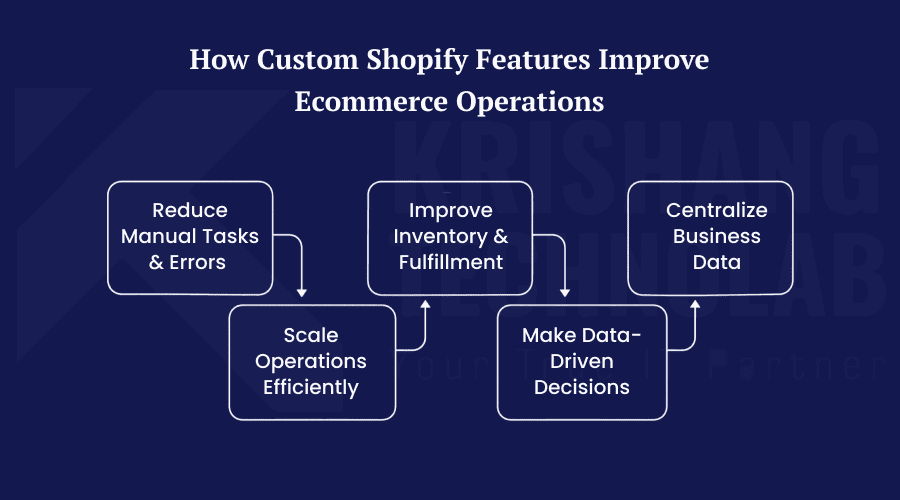
Custom Shopify features improve operations in five clear ways. They mechanize manual labor, improve accuracy, and connect systems. They scale with demand and improve reporting. Every Shopify e-commerce team can gain from these changes.
1. Reduce Manual Work and Operational Errors
Manual entry creates costly mistakes. Automation steals copy and paste jobs. For example, Shopify app development can ensure that data is validated before it reaches your warehouse. So teams fix fewer bugs. Top Shopify development services also means more timely delivery of orders.
2. Improve Inventory Accuracy and Order Fulfillment
“Right stock levels protect customer confidence. Real-time sync helps prevent over-selling during peak sales. In addition, multi-location inventory rules route orders to the nearest site.
These rules work round the year with the strong Shopify services. Accurate stock data means accurate delivery dates for Shopify customer service agents.
3. Connect Business Systems and Centralize Data
Central data removes guesswork. A Shopify headless setup can feed one storefront and many apps. Meanwhile, the Shopify Storefront API delivers product data to any channel. So all the teams get the same facts. Best Website Migration Services also clean the old records.
4. Scale Operations Without Increasing Complexity
Growth should not add chaos. Modular builds add features step by step. Shopify Website Design Services Responsive Shopify Design Services for Growing Demand.
Similarly, a good Shopify development company codes to accommodate peak traffic. Shopify Plus developers also gear stores up for international expansion. Experienced Shopify designers also prepare mobile layouts.
5. Improve Reporting and Decision-Making
Good decisions come from good information. Custom dashboards track your Shopify e-commerce KPIs in one place. Shopify SEO data also tells you which pages are making money. Managers then act on facts instead of guesses.
Custom Shopify Features vs. Standard Shopify Features
Both options have a place in e-commerce development services in 2026. Simple stores, standard tools for basic needs. Custom Shopify features are for complex processes with special rules. Compare them in the table below and then read the next two sections to make your decision.
| Factor | Standard Shopify | Custom Shopify |
| Setup time | Live in days with built-in tools | Takes weeks or months to plan, build, and test |
| Upfront cost | Low, with plan and app fees | Higher, due to development and testing |
| Flexibility | Limited to settings and theme options | Fully tailored to your workflows |
| Integrations | Prebuilt connectors for common tools | Direct ERP, CRM, and warehouse links through the Shopify API |
| Checkout control | Basic options on most plans | Deep rules through Shopify custom checkout logic |
| Scalability | Fits small to mid-sized catalogs | Handles complex, high-volume operations |
| Maintenance | Handled by Shopify and app vendors | Needs ongoing Shopify support from developers |
| Best for | Simple stores with basic needs | Complex stores with unique workflows |
When Built-In Shopify Tools Are Enough
For small catalogues, you seldom have to code. The built-in tools handle basic checkout, shipping, and reports adequately. Also, a polished Shopify landing page or Shopify form builder covers simple campaigns. Some owners also compare a WooCommerce development company with BigCommerce development services before choosing a platform.
In that case, spend your budget on Shopify SEO optimization services instead. Owners who design Shopify store pages themselves can use built-in sections. A Shopify website designer can still polish layouts. Owners choosing between platforms can read WooCommerce vs Shopify first.
When Custom Shopify Development Makes Sense
Custom work pays off when workflows get complex. For example, B2B pricing, or ERP sync, takes code. In these cases, Shopify development services deliver lasting value.
A Shopify custom development project also removes costly workarounds. A skilled Shopify website design company can pair redesigns with feature builds.
How to Choose the Right Custom Shopify Features for Your Store
Start with business goals, not tools. Write down your pain points and then rank them. How to Choose the Best Custom Shopify Features to Save You Money. Then go do these things. Look at the various Shopify service packages before you settle on one.
Identify Operational Bottlenecks
Track where work gets stuck. Check delays in orders, stock errors, and support tickets. Next, ask a Shopify development agency to review the data.
A leading design firm that partners with a Shopify design agency can also perform a checkout delay study. In Shopify help documentation, local fixes are often listed first.
Evaluate Integration and Automation Requirements
List all the systems your store needs to connect to. Include ERP, CRM, email, and shipping tools. Then, for the things that Shopify apps can’t do, go for Shopify app development. Also, review each Shopify API limit before you plan.
Prioritize Features by Cost, Impact, and Scalability
Sort each function by how much it costs and how much it brings back. Choose the custom Shopify features that will add the most value right away. For big builds, you should work with a Shopify development company that has good work behind them. Compare white label vs in-house Shopify development before you decide.
Before you hire a Shopify website design company, make sure you carefully compare their prices. The two approaches play very different roles in daily operations. Look through the portfolios of each Shopify web design agency to find projects that are like the one you want to work on.
What to Consider Before Implementing Custom Shopify Features
Planning ahead may help you avoid surprise costs. Before you start, talk about money, security, and restrictions of the platform. Where would you see yourself in the future? Optimize your custom Shopify features related to them. These are the great perils.
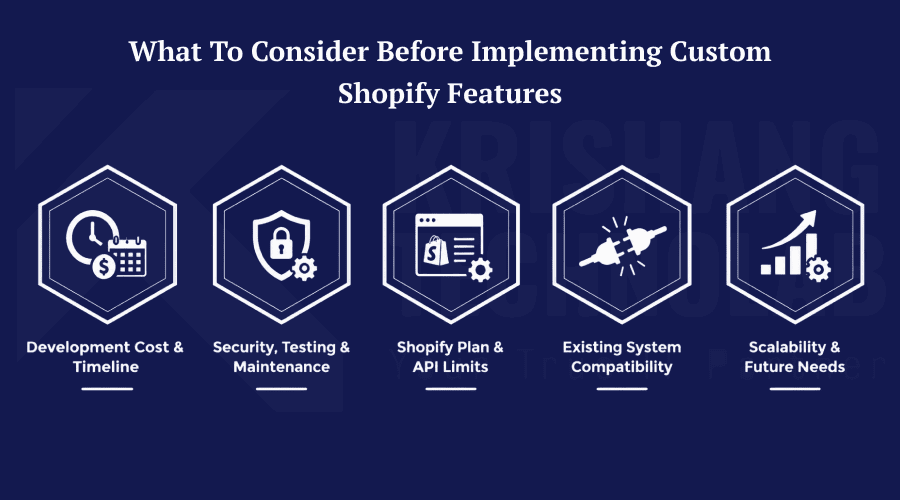
1. Development Costs and Implementation Time
Costs vary by scope and team size. Simple builds take weeks. Complex builds take months. Shopify website design services bundled may shorten timelines.Also, don’t forget to factor in the monthly cost of Shopify and the cost of apps.
Quotes from Shopify agencies can vary so you need to get detailed estimates. Get a phased roadmap from each Shopify development agency. Online ecommerce store cost in the USA also varies widely.
2. Data Security, Integration Testing, and Maintenance
Protect customer data at all levels. Test all integrations before going live. Support – Shopify support is ongoing and includes bug fixes and Shopify store maintenance after updates to the platform.
A Shopify design agency should also test page speed because slow pages hurt revenue. Shopify Website Design Services with Page Speed Testing.
3. Shopify Plan and API Limitations
Every plan has its limitations. Basic plans limit Shopify API calls and changes to checkout. Shopify payment fees and Shopify processing fees will also depend on your plan and gateway. Before you go custom on the payment logic, review these costs.
4. Compatibility With Existing Systems
Any new feature must fit smoothly into your current software stack. Test your changes to your Shopify theme development against apps installed. Also, Shopify migration services move legacy data securely.
Choose a Shopify web design agency that keeps a tab on all the changes. Ask your Shopify website designer and Shopify website design company to keep track of theme edits.
5. Scalability and Long-Term Business Needs
Choose the options you need. Modular code allows you to add features without having to rewrite Shopify Plus features, which also have greater constraints for larger shops.
Good Shopify services also make for smooth upgrades. All API changes are documented by certified Shopify developers.
Future Trends in Shopify Ecommerce Operations
Operations technology keeps changing fast. These are the changes that a forward-thinking Shopify development agency should expect. AI and automation are now a given in store management.
That’s why forward-looking brands are planning custom Shopify features that can adapt easily. Watch these two trends closely.
AI-Powered Inventory Forecasting and Workflow Automation
AI forecasts demand based on its sales history. So retailers buy up before they sell out. A Shopify headless build can also provide live data to AI tools. Expert Shopify App Development connects these models safely. Consequently, businesses can reduce stockouts, minimize excess inventory, and make smarter purchasing decisions.
Predictive Analytics and Intelligent Order Management
Predictive tools flag late orders and risky buyers. Likewise, smarter rules choose the cheapest carrier. Advanced Shopify analytics and order management Shopify workflows work together here. Early adopters gain a clear edge.
Conclusion
Growing stores need tools that fit their workflows. Custom Shopify features close the gaps that themes and apps leave behind. They help streamline orders, manage inventory, and improve reporting. The result is faster teams and better customer service. Hire Top Shopify Experts to build custom solutions tailored to your store’s needs.
To get started with success, you must have a definite plan. First, find your biggest bottleneck. After that, select the upgrade that removes the problem.
A skilled Shopify website design company can refresh Shopify store design while the back end improves. Meanwhile, Shopify website development should follow a tested roadmap.
Choose your partners wisely. Look at portfolios of each Shopify design agency and Shopify web design agency on your list. Ask about Shopify website design services and Shopify development services before you sign.
A good Shopify website designer will share clear mockups. Also, check that Shopify developers share clear timelines. Evaluate all the Shopify website design companies for new designs.
Clear goals make all upgrades work better. Remember that. Measure results month to month, then tweak each workflow. Minor, consistent upgrades add up to major results over time. Consequently, your team keeps momentum after launch.
Your next step is simple. Audit one workflow this week. Then, build the feature that removes the most friction. Strong Custom Shopify Features turn daily operations into a lasting advantage for your store.
Frequently Asked Questions
What Are Custom Shopify Features?
Custom Shopify features are customized tools coded outside Shopify’s default settings. Checkout, inventory, pricing, integrations, and reporting are all topics covered. Developers create them with Shopify Liquid, APIs, and apps. That means stores duplicate their exact workflows.
How Much Does Custom Shopify Development Cost?
Costs range from a few thousand dollars to six figures. Pricing is based on scope, integrations, and team location. For example, Shopify development services for a simple checkout rule cost far less than ERP projects. Always request itemized quotes.
Can Custom Shopify Features Automate Order Processing?
Yes. Custom Shopify features can automatically tag, route, and fulfill orders. Automated rules review inventory levels, fraud risks, and delivery regions. This leads to quicker order processing for teams. A Shopify web development team can set up these workflows in weeks.
Do Small Ecommerce Stores Need Custom Shopify Development?
Not always. Themes and Shopify apps help many small stores to succeed. But growth changes the picture. As orders increase, the Shopify store development project removes bottlenecks. Start small, and add custom work only when data supports it.
How Long Does It Take to Develop Custom Shopify Features?
Timeframes are from two weeks to six months. Simple tweaks are quick. ERP projects take longer in the meantime. Shopify website designer – You will need to allow extra time for a Shopify website designer to make visual changes. Share your designs early.
Is Custom Shopify Development Better Than Using Shopify Apps?
Neither wins every time. Shopify apps launch quickly and cost less upfront. Custom code is perfect for weird requirements. Start with Shopify apps, then move to custom code once workflows outgrow them. Many brands partner with a trusted Shopify development company to do both.
Can Custom Shopify Features Integrate With ERP and CRM Systems?
Of course. API Integration Brings Custom Shopify Functionality to ERP and CRM Systems. Popular ones include NetSuite, SAP, HubSpot, etc. Shopify Plus ERP integration also covers complex B2B requirements. Always test sync rules before launch.
Found this post helpful? Don't forget to share it with your network!