Quick Overview: AI agent development cost depends on complexity, features, integrations, and technology choices. Businesses should consider development, infrastructure, API usage, testing, and maintenance expenses. Choosing the right development approach helps control costs, improve scalability, and maximize long-term ROI.
AI agents have evolved from experiments to everyday business tools. Retailers use them to answer customers, banks use them to screen documents, and sales teams use them to qualify leads 24 hours a day. As adoption increases, one question comes up first: what is the AI agent development cost?
Knowing the price of developing an AI agent before you begin investing will protect your budget and help you set realistic expectations. However, the cost is influenced by several factors, such as complexity, the AI model you choose, the readiness of your data, integrations, security requirements, and the location of your development team.
This guide covers typical development costs, pricing based on agent type and approach, hidden and ongoing costs, how to save money, and how to judge ROI.
How Much Does It Cost to Develop an AI Agent?
There is no single price. Most business projects land between $5,000 and $150,000, while enterprise systems go well beyond that. More autonomy, more integrations, and higher reliability will drive up the AI agent development pricing.
| AI Agent Complexity | Estimated Development Cost |
| Basic AI Agent | 5,000–15,000 |
| Intermediate AI Agent | 15,000–50,000 |
| Advanced AI Agent | 50,000–150,000+ |
| Enterprise AI Agent | $150,000+ |
Note: These are indicative estimates and not set market rates. Actual AI development cost will depend on the requirements, integrations, infrastructure and development location.
- Basic agents deal with scripted tasks such as answering FAQ or simple data lookups.
- Intermediate agents use retrieval over your own data, several integrations, and basic reasoning.
- Advanced agents plan multi-step tasks, use tools, and make decisions with limited supervision.
- Enterprise agents add high availability, strict security, audit trails and many systems.
Custom builds are more expensive than configured products but are built for your workflows.
Key Factors That Affect AI Agent Development Cost
1. Complexity and Functionality of the AI Agent
A rule-based task automator is far cheaper than an agent that reasons, plans, and acts on its own. Single-agent systems are simpler; multi-agent systems need orchestration, memory, and more testing.
2. AI Model Selection and Integration
You can build on top of OpenAI, Claude, Gemini, or open-source models like Llama and Mistral. Open-source models do not charge licensing fees, but they do incur hosting and engineering costs. Proprietary models charge per token via APIs.
3. Data Collection, Preparation, and Training
Clean, accessible data reduces costs. Conversely, if your data is messy or scattered, a good chunk of your budget can go toward cleaning, labeling, structuring knowledge bases, and fine-tuning.
4. Technology Stack and Development Tools
Build and run costs are impacted by languages (Python, TypeScript), agent frameworks (LangChain, LlamaIndex, CrewAI, AutoGen), vector databases, and cloud infrastructure.
5. Third-Party API and Software Integrations
Integrating with CRM, ERP, payment gateways, help desks, and internal tools is hard work. Each integration requires authentication, error handling, and customization. Depending on the complexity, this often costs between 1,000 and 10,000 each.
6. Security, Testing, and Compliance
Finally, data privacy controls, access management, red-team testing, monitoring, and regulatory compliance (GDPR, HIPAA, SOC 2) all add costs, especially in finance, healthcare, and legal sectors.
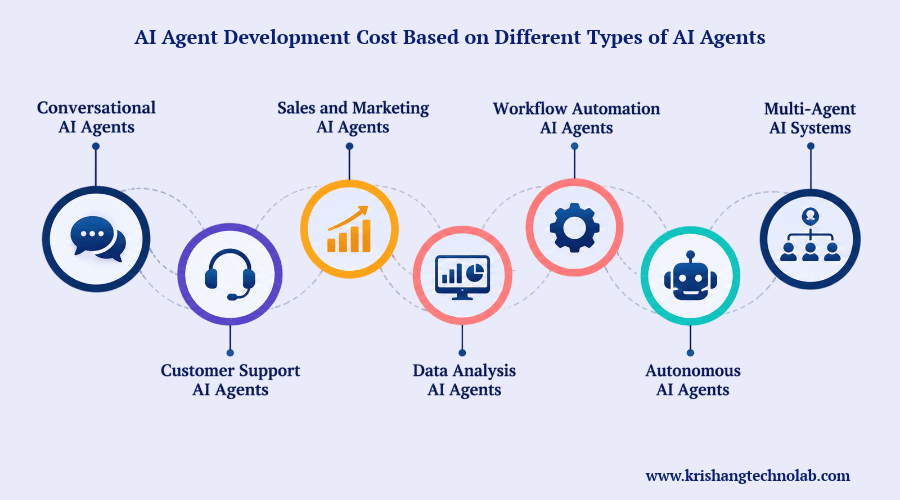
AI Agent Development Cost Based on Different Types of AI Agents
AI agent development costs vary based on the type of agent, its complexity, features, and integration requirements. Understanding the cost of different AI agents helps businesses plan their budgets and choose the right solution for their automation and business needs. Businesses exploring AI Development Cost in the USA should also consider development rates, project scope, and ongoing maintenance expenses to make informed investment decisions.
1. Conversational AI Agents
Conversational agents are chat or voice assistants that answer questions, guide users and hold natural dialogue. They are the most common entry point into AI agent development.
Estimated cost: $10,000 to $60,000 for most projects; $60,000 to $150,000 for multilingual, voice-enabled or highly branded assistants.
What affects the price:
- Text-only versus voice and multimodal input
- Number of languages supported
- Knowledge base size and retrieval quality (RAG setup)
- Memory of past conversations and personalization
- Channel deployment (website, WhatsApp, mobile app, smart speakers)
For example, a basic FAQ-style assistant built on an existing LLM sits at the low end. However, costs increase if the agent needs a distinct personality, deals with sensitive subjects, or requires a high degree of consistency across a large knowledge base.
2. Customer Support AI Agents
Support agents go beyond chat. They resolve tickets, look up orders, process refunds, escalate to humans and learn from past cases.
Estimated cost: $30,000 to $120,000 for a production-ready agent; $120,000 to $300,000 for enterprise-grade, omnichannel deployments.
What affects the price:
- Integration with helpdesk tools, order systems and billing platforms
- Ability to take actions (refunds, cancellations, account changes), not just answer
- Human handoff logic and agent-assist features
- Sentiment detection and priority routing
- Quality assurance, audit logs and compliance
Because support agents act on real customer accounts, testing and guardrails are a major cost. On the positive side, the payoff is also measurable: deflection rate, resolution time, and cost per ticket make ROI easier to track than for most agent types.
3. Sales and Marketing AI Agents
Agents can even qualify leads, personalize outreach, book meetings, create content and optimize campaigns.
Cost: $25,000-$100,000 for lead qualification and outreach agents and $100,000-$250,000 for agents that orchestrate across CRM, email, ads and analytics.
What influences the price:
- Integrations for CRM and marketing automation (Salesforce, HubSpot, etc.)
- Lead scoring & personalization logic
- Create content with brand voice controls and approval workflows
- Third-party data enrichment tools (often with separate licensing fees)
- Compliance with email, privacy and consent legislation.
Notably, agents that influence targeting or pricing decisions are more expensive because mistakes directly cost you money. In contrast, agents focused on content are cheaper to build.
4. Data Analysis AI Agents
Next, data agents let users ask questions in plain language. They then query databases, run analysis, build charts, and explain findings.
Estimated cost: $40,000 to $150,000 for a business intelligence assistant; $150,000 to $400,000 for enterprise analytics agents with strict governance.
What affects the price:
- Number and quality of data sources and the work needed to unify them
- Text-to-SQL accuracy, semantic layers and metric definitions
- Secure code execution for calculations and visualizations
- Role-based access so users only see data they are allowed to see
- Validation to prevent confident but wrong answers
Data preparation is usually the largest hidden cost here. An agent is only as reliable as the data and definitions underneath it.
5. Workflow Automation AI Agents
Workflow agents can be used to carry out multi-step business processes such as invoice processing, onboarding, document review, approvals and reporting. Custom AI Agent Development enables businesses to build tailored agents that automate these workflows according to their specific requirements.
Estimated cost: $30,000 to $120,000 for a focused workflow; $120,000 to $350,000 for cross-department automation.
What affects the price:
- Number of steps, systems and exception cases in the process
- Document understanding (OCR, extraction, classification)
- Integration with ERP, HRMS, email and internal tools
- Human-in-the-loop approvals for high-risk steps
- Error handling, retries and audit trails
These projects often start with process mapping, which is time well spent. automating a messy process simply makes the mess faster, so discovery can account for 10 to 20 percent of the budget.
6. Autonomous AI Agents
Going further, autonomous agents set sub-goals, plan, use tools, and execute long tasks with minimal supervision, such as research agents, coding agents, or operations agents.
Estimated cost: $100,000 to $300,000 for a bounded autonomous agent; $300,000 to $800,000 or more for complex, high-stakes use.
What affects the price:
- Planning and reasoning architecture, including memory and self-correction
- Tool use across many external systems and APIs
- Sandboxing, permission controls and kill switches
- Evaluation frameworks and long-running test scenarios
- Monitoring and observability for every decision the agent makes
Safety engineering is the main differentiator. The more freedom you give an agent, the more you spend on limiting and observing it. running costs are higher, since long reasoning chains consume many model calls per task.
7. Multi-Agent AI Systems
At the top end, multi-agent systems coordinate several specialized agents, such as a planner, researcher, writer, and reviewer, to solve problems no single agent handles well.
Estimated cost: $150,000 to $500,000 for a mid-scale system; $500,000 to $1,500,000 or more for enterprise platforms.
What affects the price:
- Orchestration logic: how agents communicate, delegate and resolve conflicts
- Shared memory and context management
- Debugging and testing, which grows quickly as agent interactions multiply
- Cost control, since each agent adds model calls
- Governance, logging and the ability to trace which agent made which decision
Multi-agent systems are powerful but easy to over-engineer. Many problems that look like they need several agents can be solved by one well-designed agent with good tools, at a fraction of the cost.
| Agent Type | Typical Build Cost (USD) | Typical Timeline | Complexity |
|---|---|---|---|
| Conversational | $10,000 – $150,000 | 4 – 12 weeks | Low to medium |
| Customer Support | $30,000 – $300,000 | 2 – 6 months | Medium to high |
| Sales and Marketing | $25,000 – $250,000 | 2 – 5 months | Medium to high |
| Data Analysis | $40,000 – $400,000 | 3 – 8 months | High |
| Workflow Automation | $30,000 – $350,000 | 2 – 7 months | Medium to high |
| Autonomous | $100,000 – $800,000+ | 4 – 10 months | Very high |
| Multi-Agent Systems | $150,000 – $1,500,000+ | 6 – 12+ months | Very high |
AI Agent Development Cost Breakdown by Development Stage
AI agent development costs vary across each stage, from planning and data preparation to model development, integration, testing, and deployment. Understanding these expenses helps businesses budget effectively and build reliable AI solutions. Choosing professional AI agent development services can help optimize development costs, streamline implementation, and ensure the solution meets business goals.
| Stage | Share of Budget |
| Requirement analysis and planning | 5–10% |
| UI/UX design and architecture | 8–15% |
| AI model development and integration | 25–35% |
| Backend and frontend development | 15–25% |
| Testing and quality assurance | 10–15% |
| Deployment and integration | 5–10% |
| Maintenance and optimization | 15–20% yearly |
These percentages are approximate estimates and may vary depending on project requirements. Maintenance and optimization costs are recurring annual expenses calculated separately from the initial development budget.
1. Requirement Analysis and Planning
“Define use cases, metrics for success, data sources and risks.”Good planning will prevent costly re-work.
2. UI/UX Design and Architecture
Design the interface, conversation flows, system architecture (memory, tools, guardrails).
3. AI Model Development and Integration
Largest part: prompt engineering, retrieval pipelines, tool calling, optional fine tuning.
4. Backend and Frontend Development
Alongside the AI layer, you will need databases, dashboards, and user-facing channels such as web, mobile, WhatsApp, or Slack, as well as APIs.
5. Testing and Quality Assurance
Because agents are stochastic, teams test not just for functionality but also for accuracy, hallucinations, edge cases, and safety.
6. Deployment and Integration
Once testing is complete, deployment brings its own costs, including cloud infrastructure, CI/CD, connection to live systems, and staff onboarding.
7. Maintenance and Optimization
Post-launch tuning, monitoring and improvements keep the quality high as data and models change.
AI Agent Development Cost Based on Development Approach
Custom AI Agent Development
“Built from the ground up for your processes. Custom AI agent development services are the priciest (30,000-250,000+), but they give you full control, deep integration, and a competitive edge. Good for complex or proprietary workflows.
Low-Code and No-Code AI Agent Development
In contrast, you can build agents visually with platforms like n8n, Zapier, or Voiceflow. Costs range from $500 to $15,000. While this approach is fast and cheap, it is limited in scope and flexibility.
Pre-Built AI Agent Solutions
Alternatively, subscription products ($50–$2,000+ per month) are a good fit for standard needs such as support or scheduling. However, customization is limited, and you rely on the vendor.
Open-Source AI Agent Development
Finally, open-source frameworks and models carry no license fees. Instead, your spending shifts to engineering, hosting, and maintenance. For this reason, this approach works well for teams with technical talent or data-residency needs.
AI Agent Development Cost Based on Location
AI agent development cost by country is a major budgeting factor, as developer hourly rates and project expenses vary widely across regions. Therefore, businesses looking to build AI-powered solutions should compare development costs, technical expertise, project complexity, and long-term support before selecting a development partner. Hiring an experienced AI agent development company can help businesses balance cost, quality, and scalability.
| Region | Developer Hourly Rate | Estimated Project Cost |
| USA | 100–250 | 50,000–250,000+ |
| UK | 80–180 | 40,000–200,000 |
| Europe | 60–150 | 30,000–180,000 |
| India | 25–60 | 8,000–80,000 |
Note: These figures are approximate estimates and may vary depending on AI agent complexity, features, integrations, development team experience, and project requirements.
AI Agent Development Cost in the USA
The USA offers deep talent pools and strong enterprise experience through any AI agent development company in USA. However, it also has the highest development rates.
AI Agent Development Cost in the UK
Competitive to the US and strong in the area of fintech and regulatory expertise.
AI Agent Development Cost in Europe
In comparison, Europe offers mid-range pricing, and most teams are GDPR-aware. Additionally, Eastern Europe is usually cheaper than Western Europe.
AI Agent Development Cost in India
Most cost-effective option with large engineering talent and mature delivery models.Many companies opt for an AI agent development company in India to reduce costs by (40-70)% without compromising on quality (with due diligence to the partner).
Hidden Costs of AI Agent Development You Should Know
Many budgets miss these hidden AI agent development costs:
- API & Token Consumption: Usage based billing scales with traffic and long prompts.
- Cloud hosting and infrastructure: Servers, GPUs, and vector databases come with monthly fees.
- Data storage and processing: Embeddings, logs, and document pipelines accumulate.
- Model updates and fine-tuning: providers retire models; prompts need re-testing.
- Security and compliance: audits, penetration tests, and certifications are recurring.
- monitoring and optimization: Observability tools and human review are expensive.
AI Agent Maintenance and Ongoing Costs
Plan for 15–25% of the initial build cost each year.
AI Agent Maintenance Cost
Bug fixes, prompt updates, and feature improvements typically run 1,000–10,000 monthly.
API and LLM Subscription Expenses
Small agents may spend $100–1,000 per month; high-volume agents can spend $5,000+.
Cloud Hosting and Server Costs
Typically 50-3,000 a month depending on traffic and architecture.
Monitoring of accuracy, latency, and cost per conversation with Pinecone can help you reduce waste and improve outcomes.
Security Updates and Technical Support
Patches, access reviews, and support retainers protect your data and your uptime.
How to Reduce AI Agent Development Costs Without Compromising Quality
- Start with an MVP: Start with 1 use case that will deliver a lot of value and grow from there.
- Choose the right model of AI. Use smaller, cheaper models for simple tasks. Use premium models only when necessary.
- Use pre-built frameworks and APIs: Don’t reinvent orchestration, memory, and connectors.
- Optimize token consumption: Shorten prompts, cache responses, fetch only relevant context.
- Leverage open-source technologies: whenever possible. Avoid vendor lock-in and licensing.
- Prioritize essential features: What’s needed versus what’s wanted.
- Work with an experienced partner: Experience avoids costly architectural mistakes.
These steps can be an affordable way for startups and small businesses to develop AI agents.
Is Investing in AI Agent Development Worth It?
Yes, for most businesses with repeatable high volume work. Pros:
- Productivity: Agents handle repetitive tasks as they come up, freeing teams up to focus on higher-value work.
- Lower operating costs. Support or data entry automation can really help to reduce manual workload.
- Better customer experience: 24/7 response times and faster resolutions lead to better customer experience and increase satisfaction.
- Scalability: Scale (without the proportional hire)
A $40,000 support agent who can handle the routine tasks of several full-time jobs can pay for itself in six to 18 months. ROI depends on use case, adoption, and quality. Set measurable targets before you build.
How to Choose the Right AI Agent Development Company
When you compare a custom AI agent development company or AI agent development agency, consider the following:
- Technical expertise: Experience with LLMs, retrieval, agent orchestration.
- Previous projects: Request case studies and references.
- Model and framework experience: Familiarity with open-source tools, OpenAI, Claude, and Gemini
- Pricing transparency. Clear estimates, milestones, and breakdown of running costs.
- Post-launch support: SLA, monitoring, maintenance, etc.
- Availability and security: Compliance and growth best practices.
Above all, choose a partner that is transparent about trade-offs, whether you are looking for AI agent development services in the USA, in India, or anywhere else.
Conclusion
In conclusion, the cost of building an AI agent depends on many factors, such as complexity, model choice, data quality, integrations, security, development location, and ongoing maintenance. Selecting the right approach—custom, low-code, off-the-shelf, or open-source technology—can be the difference between an overpriced project and a high-ROI investment. Krishang Technolab helps businesses build intelligent AI agent development solutions and integrate them into custom web app development projects for better automation, workflow optimization, and scalable digital experiences.
Before you commit, know your use case, budget, and success metrics, and watch out for hidden and recurring fees.
Ready to get building? Book a free consultation with our AI agent developers and get a custom quote and roadmap for your business.
Found this post helpful? Don't forget to share it with your network!