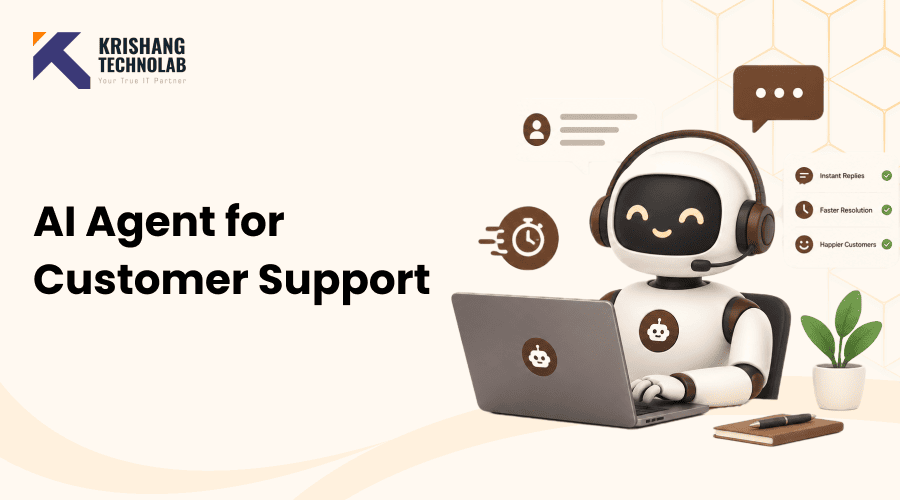
Quick Overview: AI Agent Development is transforming customer support through intelligent automation, faster response times, seamless integrations, lower costs, and personalised customer experiences. This guide covers AI agent use cases, development costs, technologies, benefits, and best practices for successful implementation.
Today’s customers expect immediate, 24/7 support, putting businesses under constant pressure to respond quickly. As ticket volumes grow, traditional support teams often struggle to keep pace, leading to longer response times and lower customer satisfaction. AI Agent Development for Customer Support helps businesses automate routine support tasks while managing growing customer demand more efficiently.
Where AI Agent Development makes a difference. AI agents are more than just basic chatbots, they understand intent, pull real data and take real action. Businesses can automate the repetitive bits of support and have human agents on hand for the harder conversations.
In this guide, we’ll break down what AI agents actually are, and how they differ from traditional chatbots. You’ll learn how AI Agent Development simplifies support, reduces response time, and cuts operational costs. At the conclusion, you’ll understand how collaborating with the right AI Agent Development Company can assist you in creating a system that combines automation and human judgement so your support team can work smarter, not harder.
What Is an AI Agent for Customer Support?
An AI agent is a software system that can understand customer requests and act on them. It understands context rather than relying on static scripts. Modern AI Agent Development uses Custom Machine Learning Solutions to build intelligent agents that connect with real business systems, retrieve relevant data, complete tasks, handle varied customer questions, and escalate complex issues to human agents when needed.
AI Agent for Customer Support vs. Traditional Chatbots
Rule-based bots rely on predefined scripts, so they often struggle when customers ask questions outside those rules. AI-powered systems use Natural Language Processing to understand different ways of expressing the same request and respond based on intent and context. This is one of the key AI vs Automation: Key Differences in customer support.
But real AI agents go further. They are reasoning, memory and access to tools. Meanwhile, human support agents are still needed to handle emotional or high-stakes conversations that require judgement.
How an AI Agent for Customer Support Works
The workflow is pretty straightforward. A customer posts a query. The AI agent understands intent with natural language understanding. Pulls relevant info from a knowledge base or CRM. Takes action ( such as updating a record ) and responds to the customer or escalates the case to a human.
What Makes an AI Agent “Intelligent”?
An intelligent agent has several capabilities: natural language understanding interprets different requests; context awareness and memory tracks conversations. Reasoning allows decisions beyond simple keyword matching and tool and API integration enable actions, enabling autonomous task execution without constant human input.
Why Businesses Need AI-Powered Customer Support
Customer expectations for fast, personalised, 24/7 support are higher than ever, making AI-powered customer support increasingly important for businesses. Traditional support teams often struggle with high ticket volumes, repetitive queries, rising costs, inconsistent responses, and burnout. AI agents help businesses respond faster, resolve issues efficiently, handle greater support volumes without increasing headcount, and deliver a more consistent customer experience.
How AI Agents Automate Customer Support
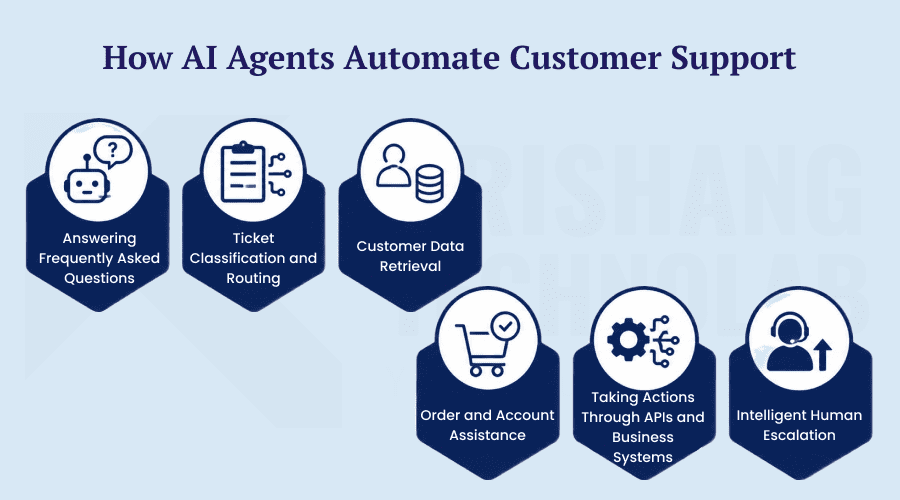
This section explores the core value of AI Agent Development. AI agents automate real support tasks; streamline workflows, improve response times and effectively handle customer interactions.
Answering Frequently Asked Questions
AI agents respond to pricing enquiries immediately. They also look at product details, shipping times and return policies. Get accurate, reliable answers to account and policy questions every time.
Ticket Classification and Routing
First, the agent identifies customer intent. It then classifies the ticket by topic. Thus it automatically gives priority to urgent requests. Finally, it routes conversations to the right department without delay.
Customer Data Retrieval
AI agents pull information from CRM systems, knowledge bases, order platforms, and internal documents. Data Science Development Services help them analyse this information and use relevant customer data to deliver accurate, context-aware responses.
Order and Account Assistance
Shopify AI for Solo Owners can handle common support tasks such as checking refund status, tracking orders, updating customer accounts, and managing subscriptions. This reduces repetitive manual work and gives solo store owners more time to focus on running and growing their business.
Taking Actions Through APIs and Business Systems
This is where true AI agents differ from simple chatbots. With Web Application Development Solutions, agents can connect with business systems to create support tickets, update customer records, check inventory, process requests, schedule appointments, and trigger workflows automatically, saving valuable time.
Intelligent Human Escalation
Complex problems still need human judgment. Handle high ticket customer accounts and sensitive complaints with kid gloves. Automatic escalation of judgment calls and payment disputes to trained personnel.
Key Benefits of an AI Agent for Customer Support
Get this right, and AI Agent Development can seriously cut down response times while taking repetitive work off your team’s hands. Round-the-clock support becomes realistic, not just aspirational. Costs come down, customer satisfaction climbs, and teams end up genuinely more productive.
Reduce Customer Response Time
Queued human answers are slow; AI agents are immediate. This allows customers to get answers in seconds, not hours. Additionally, quick responses help with frustration during busy times. Therefore, businesses build more powerful loyalty with faster service.
Provide 24/7 Customer Support
Support is truly round-the-clock because AI agents never sleep. This means customers in any time zone receive immediate support. And, queries done at nite and weekends no longer wait for the morning. So that means customers everywhere in the world get the same reliable experience, any time.
Handle High Volumes of Customer Queries
AI agents scale easily during traffic spikes. This means that businesses don’t have to deal with lines of people during sales or product launches. And thousands of conversations happen at the same time without any extra staff. This means that there is no longer the need to employ temporary staff during the high season.
Reduce Repetitive Work for Support Teams
Repetitive questions are fully automated. Meanwhile, real, complex conversations are handled by human agents. Plus, this change reduces the mental fatigue across the team. This can help keep agents motivated and performing better overall.
Improve Customer Experience
The faster and more consistent your answers, the more your customers will trust you. Plus, customised responses make the interaction feel more human. And customers like not having to repeat themselves between channels. The overall satisfaction scores therefore increase steadily.
Reduce Support Costs
Automation cuts the cost per interaction by a huge amount. Thus, companies grow support without growing headcount proportionally. Additionally, less escalation means less training and staffing costs. This means the savings can be reinvested into the product or service.
Improve Support Team Productivity
Agents have less time for routine work. This means they are able to tackle hard cases faster and more deliberately. Also, less context-switching is better for overall accuracy and speed. So no added pressure, just the team performance goes up.
Deliver More Consistent Responses
AI agents apply the same logic every time. This way, customers get the right, consistent answers, no matter who answers first. Moreover, this consistency reduces confusion caused by conflicting information. Therefore, the brand trust increases with each interaction.
AI Agent for Customer Support vs. Human Agents: What Is the Best Approach?
A good architecture does two things at once: it keeps sensitive data protected and allows the system to grow. Support automation that’s reliable and scalable down the line requires a secure infrastructure, strong control of access, and a design built for scale.
What AI Agents Should Handle
AI agents are good at answering repetitive questions and simple requests. They also perform well in information retrieval, basic troubleshooting and ticket categorization. Moreover, they manage these tasks without fatigue or delay. Therefore, they free human agents for more valuable work.
What Human Agents Should Handle
Humans should manage complex problems and emotional conversations. Negotiations, escalations and high risk decisions also need human empathy and judgment. And in these circumstances, subtle, thoughtful communication is often required. So, touch from people is still important for confidence and happiness.
The Hybrid Customer Support Model
In this model, AI deals with volume, and humans deal with complexity. The effect is that a business gets both speed and quality simultaneously. This balance is the best long term customer support strategy.
AI Agent for Customer Support Use Cases Across Different Industries
AI Agent Development brings real value across industries — eCommerce, SaaS, healthcare, finance, and travel among them. It automates customer interactions, streamlines workflows and takes repetitive tasks out of people’s hands – all the while speeding up response times and keeping support personal.
AI Agents for eCommerce Customer Support
An eCommerce Development Company can use Shopify Development Solutions to integrate AI agents into online stores for order tracking, returns, product queries, and personalised recommendations. These agents can also send shipping updates and resolve common customer issues with minimal manual effort, keeping support workflows running smoothly.
AI Agents for SaaS Businesses
SaaS Companies use AI agents for product support and tech FAQs. Besides, agents can help answer account-related questions, resolve common issues, assist with onboarding new users and improve customer service operations effectively.
AI Agents for Healthcare
The AI in Healthcare Guide covers how healthcare providers use AI agents for appointment scheduling, general information, administrative queries, reminders, and routine patient communications. These agents handle everyday support tasks while medical decisions and diagnoses remain with qualified healthcare professionals.
AI Agents for Financial Services
Banks & Fintechs | AI Agents | FAQ | Accounts Agents also help in detailing transactions, on-boarding customers, resolving support tickets, answering general queries and streamlining service workflows efficiently.
AI Agents for Travel and Hospitality
AI agents provide booking aid for travel companies. They also answer queries about reservations, requests to cancel, itinerary changes and general travel information and provide customers with faster, more convenient and personalised support.
How AI Agent Development Works
Building an AI agent for customer support isn’t a single step — it’s the layering of smart models, real business data, defined workflows, and system connections until you get something that can actually understand what a customer wants, decide what to do about it, take action, and get better over time.
Step 1: Map Out the Support Use Cases
Before writing a line of code or configuring a model, teams look at what’s actually clogging up their support queue — the repetitive questions, the recurring headaches, the tasks that eat up agent time. This groundwork is what keeps the whole project from sprawling; it gives the build a clear target instead of a vague “let’s automate support” mandate. For this planning stage, software development consultation can help teams define the right use cases, technical requirements, and implementation approach.
Step 2: Set Concrete Goals
Next we need to define what the agent is actually supposed to do – in measurable terms, not aspirational terms. It is important to narrow the scope here – an agent trying to do everything generally ends up doing nothing well. So teams pin down exactly what ‘success’ looks like before moving forward.
Step 3: Hook Up Business Data and Knowledge Sources
The agent needs something to draw from — FAQs, internal docs, product knowledge bases — and that information has to be accurate and current. An agent is only as trustworthy as the data behind it; feed it stale or inconsistent information and customers will notice fast.
Step 4: Wire In APIs and Business Systems
That’s when the agent stops being a chatbot and becomes useful. It can connect to CRMS, helpdesk software and other internal tools through APIs so it can pull up customer records, make updates, launch workflows and do real work instead of just talking about it.
Step 5: Build and Train the Agent
When you Hire AI Development Experts, they design the agent’s reasoning logic and conversational flows, then test it across a wide range of customer queries. They refine its behaviour based on edge cases, unexpected phrasing, accuracy, and consistency to ensure reliable performance.
Step 6: Build in Escalation Paths
No agent should be left to his own devices. Developers create clear policies on when a conversation should be handed off to a human, whether it is too sensitive, too complex, or just isn’t closing after a few tries. The system is trustworthy because of this safety net.
Step 7: Put It Through Real Testing
Before anything goes live, teams stress-test the agent against realistic customer scenarios — checking response accuracy, workflow reliability, and where things might break. Catching failures here is far cheaper than catching them after launch.
Step 8: Launch and Watch It Closely
Once deployed, the work is not done – teams monitor resolution rates, quality of responses, and how customers are actually engaging with the agent. In these first few weeks, problems can be caught small enough to be corrected with close monitoring.
Step 9: Keep Refining It
Finally, the agent evolves. Using real conversation logs, customer feedback, and performance data, teams continue tuning it — a process that never really has an endpoint, since customer needs and edge cases keep shifting.
Technologies Used in AI Agent for Customer Support Development
AI customer support agents leverage sophisticated technology to understand requests, retrieve business data, make decisions, and execute tasks. These technologies allow for intelligent, scalable, secure and personalised support automation.
Large Language Models (LLMs)
LLMs are at the heart of an AI agent’s language understanding, helping it interpret complex customer queries, recognise intent and context, and generate relevant, natural-sounding responses. RAG Explained: Retrieval-Augmented Generation adds relevant business information to the process, while Generative AI Development Services use these capabilities to create more conversational and responsive customer support experiences.
Natural Language Processing (NLP)
NLP allows an AI agent to understand what a customer actually means by interpreting intent and context, rather than simply matching the words they type. When businesses Hire Expert Prompt Engineers, they can refine how AI agents interpret and respond to different customer queries, resulting in more natural and relevant conversations.
Retrieval-Augmented Generation (RAG)
The agent can use RAG to retrieve relevant business data before generating an answer. That means answers remain grounded in current, accurate information rather than drifting into out-of-date or made-up territory – a big part of how reliable the support experience feels.
AI Agent for Customer Support Frameworks
Frameworks provide the basic scaffolding how the agent reasons, remembers past context, decides and uses tools. Once this structure is in place, development is faster and teams can build multi-step workflows that can be reused and scaled more easily.
APIs and Third-Party Integrations
APIs are the bridge between the agent and everything else — external platforms, tools, business systems. Without them, an agent could only talk; with them, it can actually pull data, update records, and trigger real workflows instead of just answering questions.
CRM and Helpdesk Integrations
When plugged into a CRM or helpdesk, the agent has immediate access to a customer’s history – past tickets, previous interactions, relevant details. It’s that context that makes a generic answer feel like it’s actually customised for the person asking.
Knowledge Bases and Vector Databases
Vector databases let agents search by meaning instead of just matching keywords. That’s a meaningful difference in practice — it means the agent can still find the right answer even when a customer phrases their question awkwardly or vaguely.
Analytics and Monitoring
Continuous analysis of agent performance: response quality, interaction patterns, key metrics… over time. That visibility enables teams to see weaknesses early and keep on improving the system, instead of letting problems pile up in the dark.
How to Integrate an AI Agent for Customer Support With Your Existing System
Integrating AI agents with your existing customer support system connects them with your CRM, helpdesk, website, messaging channels, e-commerce platforms, and internal knowledge base. This allows AI agents to access customer data, manage tickets, answer queries, track orders, and provide accurate, personalised support across channels. With seamless workflows and human escalation, AI agents become an integrated part of your support operations rather than just another chatbot. For complex integrations and scalable business systems, enterprise software development can help connect AI agents with existing applications, APIs, and data infrastructure.
How Much Does an AI Agent for Customer Support Cost?
There’s no single price point here — costs move up or down depending on how complex the build is, what it needs to connect to, how much data is involved, and the degree of customization required. Getting familiar with these variables upfront makes it much easier to set a realistic budget, land on the right solution, and get a sense of the likely return.
Factors That Affect AI Agent Development Cost
The AI Development Budget 2026 depends on factors such as agent complexity, the number of use cases, LLM or API costs, integrations, data preparation, custom workflows, and security requirements. Custom Software Outsourcing Services can also affect the overall cost based on the development scope, team structure, and ongoing maintenance needs.
Basic vs. Advanced AI Agent for Customer Support
A basic agent sticks to the fundamentals — fielding common FAQs and repetitive, low-stakes questions. An advanced one operates on a whole different level: running complex multi-step workflows, reaching into business systems, taking real action, tailoring responses to individual customers, and knowing when to hand a conversation off to a human intelligently.
| Solution | Complexity | Typical Capabilities |
| Basic AI chatbot | Low | FAQs |
| AI support assistant | Medium | FAQs + knowledge base |
| AI customer support agent | High | Reasoning + actions + integrations |
| Multi-agent support system | Very high | Multiple specialized agents |
Is an AI Agent for Customer Support Worth the Investment?
The real measure of AI investment is its return, not simply the initial cost. AI Solutions Consulting Services can turn customer support investments into measurable gains through faster resolutions, lower operational costs, improved customer satisfaction, and greater team productivity. Over time, these benefits can make AI customer support a worthwhile investment.
Challenges of Implementing an AI Agent for Customer Support
Rolling out an AI customer support agent isn’t something to rush into. Businesses need to think through accuracy, data security, integration complexity, keeping knowledge current, earning customer trust, escalation rules, and ongoing monitoring — all of it factors into whether the system actually performs reliably.
Accuracy and Hallucinations
Even well-built agents can occasionally get things wrong. That’s why grounding every response in verified data matters so much — and why regular testing is worth the effort, since it catches errors early, before they snowball. Accuracy tends to improve steadily as the agent matures and gets more real-world exposure.
Data Privacy and Security
Customer data is not something to be taken lightly; protection needs to be built in from day one, not added on later. Encryption and strong control over access are a big step to prevent unauthorised exposure. Compliance requirements should drive all integration decisions you make.
Integration Complexity
Wiring multiple systems together can get technically messy fast. Good planning cuts that complexity down considerably, and rolling integrations out in phases keeps risk contained during launch. With the right experience on the team, even a tangled system landscape becomes manageable.
Maintaining Up-to-Date Knowledge
Stale information equals wrong answers, period. So knowledge bases need to be updated regularly. Stale content can chew up customer trust pretty fast, so it’s worth putting in place regular reviews. It shouldn’t be a later addition, but a constant priority.
Building Customer Trust in an AI Agent for Customer Support
We recognise that not all customers want to jump into automated support immediately. Being open about when they’re speaking to an AI builds trust, and explaining what the system can and cannot do helps further reassure users. Trust, and adoption with it, takes time to build, not overnight.
Knowing When to Escalate to Humans
Vague or inconsistent escalation rules frustrate customers fast, so those boundaries need to be spelled out early and clearly. When handoff triggers are ambiguous, the experience feels inconsistent from one conversation to the next — well-defined rules protect both efficiency and customer satisfaction at once.
Ongoing Monitoring and Maintenance
The work doesn’t stop after the launch. “You have to keep an eye on agents all the time, or they can quietly go off the rails. Frequent audits can detect new issues before they affect your customers.” And so ongoing maintenance is a key part of long-term reliability.
Best Practices for Developing AI Customer Support Agents
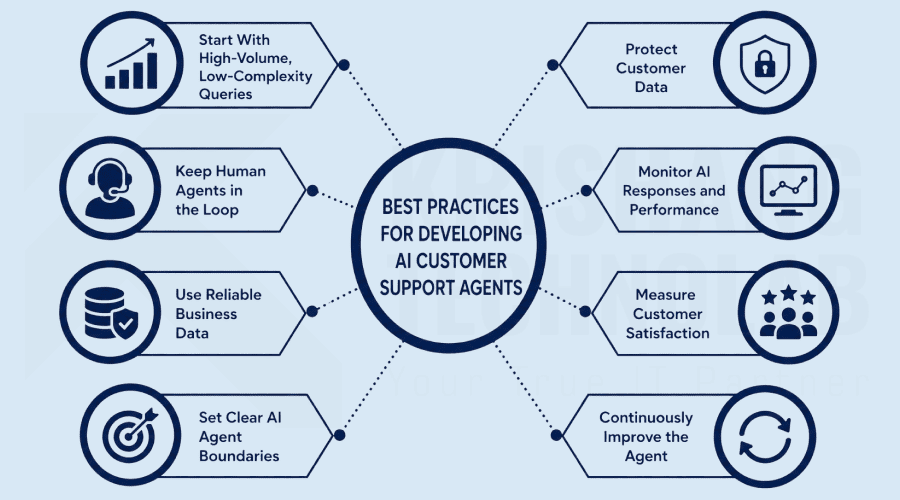
A good agent has clear goals, reliable data, supervision by humans, good security, constant testing, close monitoring, and a desire to keep improving.
Start With High-Volume, Low-Complexity Queries
High frequency wins helps build momentum and confidence early by going for the quick wins. It minimises the risk of implementation while teams are still learning how the system works. It also helps to increase complexity as performance and trust increase.
Keep Human Agents in the Loop
The edge cases are always caught by human supervision, not automation. You can catch small mistakes before they become big issues by letting people review the flagged conversations for accuracy.
Use Reliable Business Data
The accuracy of an agent’s answers is only as good as the data behind them — outdated or incomplete sources lead directly to poor responses. Regular audits of those data sources are worth building into the process from the start.
Set Clear AI Agent Boundaries
Rules that specify what the agent may do and what it may not do help to contain the agent in its intended role. Time spent documenting permissions and limits before launch is time well spent. Sharp boundaries reduce the number of wrong actions and make the whole system more reliable.
Protect Customer Data
Customer information is sensitive and needs real protection – encryption, control of access, active monitoring and regular security audits all play a part in catching vulnerabilities before they become problems. It’s not a one-off, it has to be a continuous priority.
Monitor AI Responses and Performance
Catching issues before they reach customers requires watching the system closely, and performance dashboards make emerging trends far easier to spot. That visibility lets teams respond quickly and keep performance on track.
Measure Customer Satisfaction
Satisfaction data tells you whether the agent is actually helping or just going through the motions — and it points directly to where improvements are needed. Collecting that feedback consistently, across every channel, matters more than one-off surveys.
Continuously Improve the Agent
Needs change over time so the agent needs to keep evolving too. Real conversation data is a gold mine for identifying where the biggest improvements can be made, and keeping up to date ensures the agent is both relevant and accurate.
How to Measure the Success of an AI Agent for Customer Support
Businesses can measure AI customer support success through response and resolution times, first-contact resolution, ticket deflection, and AI resolution rates. Customer-focused metrics like CSAT and customer effort score show whether the experience is improving, while human escalation rates highlight capability gaps. Tracking cost per interaction also helps measure efficiency, savings, and overall business impact.
AI Agent for Customer Support vs. AI Chatbots: What’s the Difference?
Chatbots are usually programmed to respond to predetermined or conversational prompts and nothing else. AI agents are a different animal. They can understand context, make decisions, plug into business systems, do things, manage multi-step workflows, mostly on their own.
| Feature | Traditional Chatbot | AI Agent |
| FAQ responses | Yes | Yes |
| Understand natural language | Limited/Moderate | Advanced |
| Context awareness | Limited | Stronger |
| Access business systems | Limited | Yes |
| Perform actions | Limited | Yes |
| Multi-step workflows | Limited | Yes |
| Autonomous decision-making | No/limited | Yes |
| Human escalation | Yes | Yes |
The Future of AI Agent for Customer Support
The future of AI customer support will be more autonomous, personalised, multimodal, and connected across channels. Businesses will increasingly use specialised AI agents, voice support, and unified systems to handle complex workflows and deliver faster, more tailored experiences. Rather than replacing people, AI agents will work alongside human teams, combining automation and scalability with human empathy and judgment.
How Businesses Can Get Started With an AI Agent for Customer Support
Businesses can start with AI customer support by identifying key bottlenecks, selecting simple use cases, and connecting essential systems. A focused pilot helps test performance and gather feedback, while tracking results provides the insights needed to refine the solution and scale confidently.
Why Choose an AI Agent Development Company?
Choosing an experienced Artificial Intelligence Development Company gives businesses access to custom, secure, and scalable AI agent solutions that fit smoothly into existing systems. Experienced teams can handle complex integrations, improve agent performance over time, and build solutions that adapt to changing customer demands while maintaining reliable and efficient support.
Frequently Asked Questions About AI Agent Development for Customer Support
What is an AI agent in customer support?
It’s a software system that doesn’t just provide pre-canned chatbot responses, but understands what a customer is asking, retrieves relevant information, accesses business systems when needed and gets things done instead of just answering questions with pre-written text.
Can AI agents replace customer support agents?
Not exactly. They’re meant to work alongside human teams, not take their place. AI does the grunt work, the repetitive, high-volume work, and people are left to deal with the complex problems, emotionally charged conversations, sensitive situations, and anything that requires real judgement.
How do AI agents reduce customer response time?
Because they respond instantly and can juggle several conversations at once, there’s no queue to wait in — customers typically get accurate answers within seconds instead of sitting on hold or waiting for a callback.
How much does AI agent development cost?
Much depends on the details – how complex the agent is, how many systems it needs to be integrated with, how much customisation is needed, data needs and security needs. The cost can be anything from a fairly simple build to a much more expensive multi-agent setup.
What is the difference between an AI agent and a chatbot?
A classic chatbot mostly follows a fixed script and can’t stray far from it. An AI agent, on the other hand, actually reasons through what’s being asked, understands context, taps into business tools, takes action, and can carry out workflows that span multiple steps.
Can AI agents integrate with CRM and helpdesk systems?
Yes – that is a big part of what makes them useful. They’re able to pull customer records, review previous ticket history, log new tickets, update information, and generally keep support workflows flowing without manual handoffs.
How long does it take to develop an AI Agent for Customer Support?
It really depends on how complex the project is – the integrations that are involved, how much customisation, and how much testing is needed. A simple one could be ready in a few weeks but a more sophisticated system could take months.
Are AI customer support agents secure?
They can be, provided security is built in from the start — things like encryption, access controls, proper authentication, ongoing monitoring, and solid data protection practices throughout the development process.
Can AI agents handle complex customer queries?
To some degree – they can manage fairly complex requests with context and logic + business data. “But for anything sensitive, emotional or high-stakes, a human agent is still better.”
Conclusion
AI agents are more than just faster chatbots. They understand customer intent, access business information and do real tasks. They automate routine processes and hand over complicated cases to human agents when needed.
The goal is not to replace humans with machines in customer support at the end of the day. This is about freeing up the human teams to focus on the conversations that really matter, and letting the AI do the repetitive work.
By investing in reliable AI Agent Development, businesses can reduce their response time and cost, while improving customer experience at the same time. If you are ready to take your support operations to Custom AI Agent Development, working with an experienced AI Agent Development Company can help you turn this strategy into a working, scalable system built around your customers’ needs.
Found this post helpful? Don't forget to share it with your network!