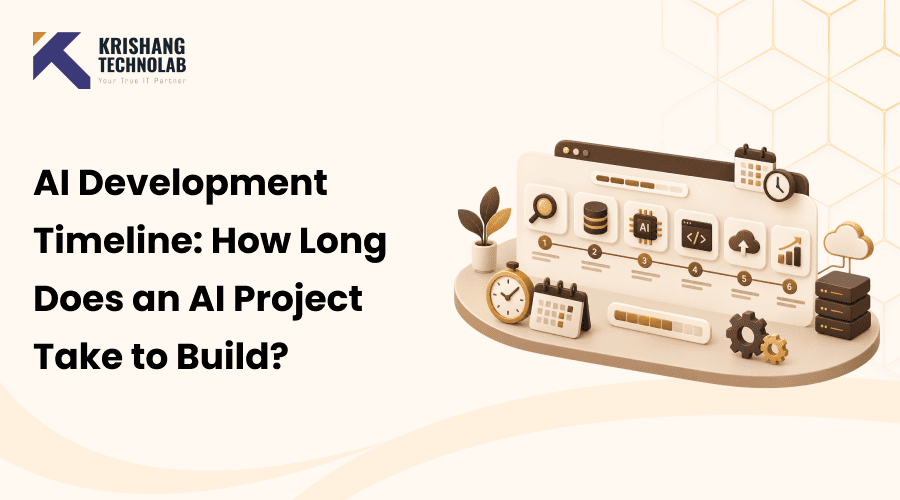
Quick Overview: An AI development timeline typically ranges from 2 – 6 weeks for a proof of concept to 6 – 12+ months for enterprise platforms. The timeline depends on data readiness, model complexity, integrations, and testing depth; this guide breaks down every phase and factor.
If you’re asking how long AI development takes, the short answer is: it depends on the scope. Most projects take anywhere from a few weeks to a year. A simple AI proof of concept or MVP can take 2 to 12 weeks. A complex, enterprise-grade AI platform can take 6 to 12+ months. The exact AI development timeline for your project depends on five key factors. These include the clarity of your use case, the quality and availability of your data, and the complexity of your model. Integration requirements also play a role. So do your testing and compliance requirements.
This guide walks you through the entire AI development process, stage by stage. It explains what can speed up or slow down an AI project. You’ll also get a practical framework for estimating your AI project duration. This applies whether you’re a startup building an MVP or an enterprise planning a full-scale rollout. Real-world AI development timelines can vary widely, even for similar projects. That’s why a stage-by-stage breakdown is more useful than a single number from a case study.
How Long Does an AI Project Take?
Here’s a quick reference table that most teams find useful for early planning, before getting into the details.
| AI Project Type Approx. | Timeline |
| AI Proof of Concept | 2 – 6 weeks |
| AI MVP | 6 – 12 weeks |
| AI Chatbot | 4 – 10 weeks |
| AI Recommendation System | 8 – 16 weeks |
| Custom Machine Learning Solution | 3 – 6 months |
| Generative AI Application | 2 – 5 months |
| Enterprise AI Platform | 6 – 12+ months |
These figures are typical ranges, not fixed guarantees. Depending on data quality, number of integrations, and internal approval cycles, two teams building the “same” chatbot could have entirely different timelines. An experienced AI development company can help streamline the process, but AI development timelines published by different agencies still vary by weeks simply because their definitions of “done” aren’t the same. Use this table to budget your time and resources, not as a contract.
AI Development Timeline by Project Stage
Every AI development lifecycle, regardless of industry or use case, moves through the same core stages. However, the actual AI development timeline varies depending on the effectiveness of the planning for each phase. Walk through each one and you see exactly where time is spent and where it is often wasted.
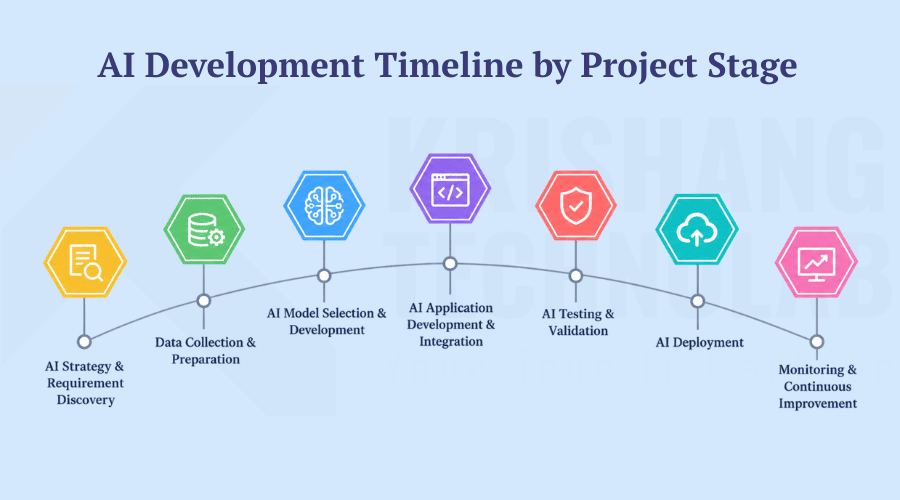
1. AI Strategy & Requirement Discovery
The first step is where you define what you’re actually building and why. The team identifies the business goals the AI system needs to support, the target users and their day-to-day workflows, and the specific AI use case: classification, generation, prediction, or automation. And the requirements get translated into functional specifications and measurable success metrics, and someone checks technical feasibility; can you actually build this with the data and budget you have? Many teams bring in an outside perspective at this stage. An experienced AI consulting partner usually finds feasibility gaps that internal teams miss simply because they’re too close to the problem.
Typical duration: 1 – 2 weeks. One of the most common reasons AI projects end up going over budget later is skipping or rushing this phase. In a recent study of over 2,400 business AI projects, it was found that 73% of failed AI projects did not have a clear definition of success before starting and projects that set specific success goals from the beginning were much more likely to succeed. Thus, the two weeks you spend here can save you months down the line.
2. Data Collection & Preparation
Data is the most unpredictable factor in any AI development timeline. In this phase, the raw data is extracted from internal systems, third-party datasets, or APIs and cleaned, and deduplicated so the model does not learn noise. Some of that data needs labelling and annotation before it’s usable depending on the use case, and it all has to be transformed into a model-ready format and checked for quality and bias before moving forward.
Typical duration: 2 – 8+ weeks. The range is intentionally wide. Having clean, structured, production-ready data can significantly reduce AI development time compared with starting from raw or fragmented data scattered across spreadsheets, legacy databases, and disconnected tools. For teams working with messy, high-volume datasets, it’s often faster to establish pipelines in shape before model work begins via a dedicated data science consulting engagement than to try to patch up data problems mid-build. Data readiness was the top risk factor for 2026, with analysts projecting that most AI initiatives without the AI-ready data foundations will falter or be abandoned altogether.
3. AI Model Selection & Development
Once the data pipeline is in place, the actual AI model development work begins. The big decision here is whether to use an existing or pre-trained model vs building something custom, and is it a traditional machine learning, deep learning, or large language model that you want to use directly through an API? If your team is building a predictive or classification system using your own data, collaborating with a team specializing in machine learning development services often significantly shortens this phase, as much of the foundational work feature engineering, model selection, validation pipelines is already in place. For text- and language-heavy use cases, a generative AI development company can fine-tune a base model or set up retrieval-augmented generation (RAG) to ground outputs in your knowledge base, rather than starting from scratch on model architecture.
Typical duration: 2 – 8+ weeks. Pre-trained models and APIs, including direct ChatGPT integration into an existing product, dramatically cut this phase down compared to training a custom model from scratch, which requires far more compute time, and specialized ML expertise.
4. AI Application Development & Integration
And that’s when the AI model becomes a real product that you can use. The backend architecture and business logic are built. The frontend and user interface are shaped. APIs, databases, and third-party systems; CRM, ERP, and payment gateways need to be wired together on top of cloud infrastructure. Given the complexity of this stage, many teams engage a custom web application development partner to ensure the AI model remains integrated with the rest of the product. The more systems an AI feature has to talk to, the longer this stage takes. A standalone chatbot with no CRM integration moves much faster than a recommendation engine syncing with an existing e-commerce backend in real time.
5. AI Testing & Validation
Artificial intelligence systems require a new, more rigorous form of testing than traditional software. This phase includes raw performance and accuracy checks but also load testing with real traffic, security scanning, and fairness testing across different user groups. Additionally, conduct user acceptance testing with real stakeholders before the system goes live. Pay special attention to generative AI applications because their outputs are non-deterministic. The same prompt can produce different results, so teams must conduct more extensive and iterative hallucination testing than they would for traditional code. This phase often corrects an overly optimistic AI development timeline because real-world testing reveals issues that discovery-stage estimates simply cannot predict.
6. AI Deployment
Once testing is completed, the system goes live. This includes cloud environment setup, production infrastructure setup, wiring up monitoring and logging, building CI/CD pipelines for future updates and security hardening before go-live. A well-prepared deployment phase is usually quick, since most of the real work has already been done in development and testing. Post-launch issues are often caused by rushed deployments without proper monitoring. These are one of the few things that can quietly extend an otherwise on-track AI development timeline at the very last step.
7. Monitoring & Continuous Improvement
Here’s something many roadmaps miss: AI development doesn’t end at launch. Unlike traditional software, AI models can degrade over time as real-world data changes. This gradual change in a model’s performance over time is referred to as model drift. This phase continues as the model is constantly monitored for accuracy drift, periodically retrained with new data, optimized for performance and improved features based on how people are actually using the product, and infrastructure scaled as use grows. This is the difference between artificial intelligence systems that stay useful for years, and artificial intelligence systems that just stop working quietly after a few months. Budgeting time and resources for this stage from day one is key.
What Factors Affect the AI Development Timeline?
Numerous variables influence the actual duration of a project. These variables also contribute to the difficulty of predicting AI development timelines from an external perspective. Knowing them beforehand makes it a lot easier to come up with a realistic estimate rather than guessing.
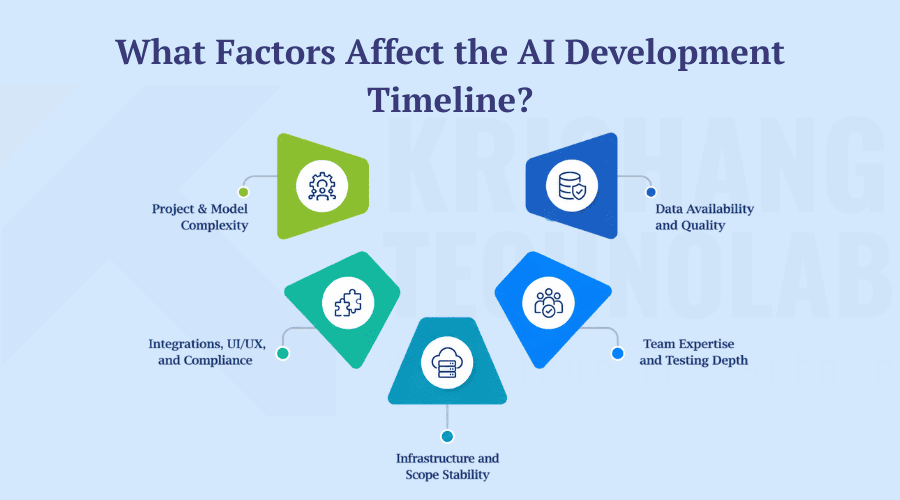
Project & Model Complexity
The obvious one is project complexity; a single-feature tool moves a lot faster than a multi-model platform. The same thing is true for model complexity. Simple classification tasks are quick; multi-modal generative systems are significantly slower. The decision between a custom model and a pre-trained one also adds or removes weeks depending on which way it goes, since custom training requires far more experimentation and validation than adapting something that already works.
Data Availability and Quality
Data availability and quality are just as important as model choice. Clean data speeds everything up; messy or missing data slows everything down. No matter how simple the rest of the project may appear on paper, teams almost always lose weeks here when they inherit fragmented data from legacy systems, spreadsheets or disconnected tools.
Integrations, UI/UX, and Compliance
Coordination time adds up in the number of integrations a project requires, the level of polish expected in the UI/UX, and security or compliance requirements, like HIPAA, SOC 2, GDPR, and other frameworks in healthcare, finance, or government work. Each additional system an AI feature needs to communicate with introduces its own testing surface, approval cycle, and potential point of failure.
Team Expertise and Testing Depth
The size of the team and its expertise are important factors. Experienced teams are able to move faster, and avoid expensive rework. The depth of testing needed is also important. More rigorous testing takes longer but produces a safer product.
Also Read About: What are the use cases and benefits of AI in software development in 2026?
Infrastructure and Scope Stability
Existing cloud infrastructure accelerates deployment, but building from scratch costs some extra time. Overall, scope changes during a project remain one of the most common causes of timeline slippage, often eclipsing all other reasons on this list combined.
Of all these factors, data readiness is worth repeating: teams that start with clean, structured, production-ready data consistently move through the AI development process faster than teams that start with raw, fragmented sources.
AI Development Timeline by Project Type
Different categories of AI products have different AI development timelines, as the underlying data, model complexity and integration needs are so different from use case to use case. Here’s what you can expect for typical project types.
AI Chatbot Development Timeline
A rules-based or FAQ-style AI chatbot can be launched in as little as 4 weeks. A more sophisticated conversational chatbot using an LLM with custom knowledge and CRM integration typically takes 6 – 10 weeks.
Generative AI Application Timeline
Generative AI applications, whether they’re content generation tools, AI copilots, or image or code generation features, typically take 2 – 5 months. The timeline depends a lot on whether you’re using an existing foundation model through API (faster) or fine-tuning your own model (slower).
AI Recommendation Engine Timeline
The AI recommendation engine needs to have solid historical user or behavior data before the model performs well. That’s why these systems usually run for 8 – 16 weeks, including a testing period to validate recommendation accuracy.
Computer Vision Solution Timeline
Solutions for computer vision, like finding defects, recognizing objects, and analyzing faces, usually need labeled visual datasets, which makes getting the data ready take longer. So, expect it to take from 3 to 6 months to get a production-ready system.
Predictive Analytics Platform Timeline
Predictive analytics platforms that use structured historical data for sales forecasting, churn prediction, and demand planning typically take 2–4 months to develop when teams already have organized data.
Machine Learning Application Timeline
A custom machine learning solution, including general-purpose applications, fraud detection, anomaly detection, and scoring models, typically fits into a 3 – 6 month timeframe.
AI-Powered SaaS Product Timeline
Search, summarization, and personalization are all AI features that you can add to an AI-powered SaaS product, and it can take 6 to 14 weeks per feature, depending on how deeply you want to weave it into the existing product. Teams building an AI-powered SaaS product from the ground up sometimes start with a focused SaaS MVP development engagement rather than trying to ship every AI feature at once.
Enterprise AI Solution Roadmap
Enterprise AI solutions, particularly for multi-department platforms at scale with strict compliance, multiple integrations, and large infrastructure, generally take 6 to 12+ months to deploy. At that size, working with an established AI development company rather than building everything in-house typically saves costly missteps along the way.
AI MVP vs. Full-Scale AI Product Timeline
A common question after seeing these ranges is, should we build an MVP first or go straight to a full product? Here’s how the two compare.
| Aspect | AI MVP | Full-Scale AI Product |
| Feature set | Limited, focused on one core outcome | Advanced, expanded across use cases |
| Model approach | Existing or pre-trained models | Often includes custom training and fine-tuning |
| User base | Tested with a small user group | Built for the full target market |
| Integrations | Basic, only what’s essential | Broader integrations across business systems |
| Security & compliance | Minimal, MVP-appropriate | Enterprise-grade, audited |
| Scalability | Not a priority at this stage | Built for scale from day one |
| Testing depth | Core functionality only | Extensive; accuracy, performance, edge cases |
| Post-launch | Light monitoring, fast iteration | Ongoing monitoring and production optimization |
| Typical timeline | 6 – 12 weeks | 3 – 12+ months |
Most businesses should build an AI MVP first before they spend months of engineering, and budget on a full build, as it validates their core idea with real users. Recent market data backs these findings up: AI-assisted teams are shipping working MVPs noticeably faster than traditional builds, with many reporting development-phase time savings of roughly 25% to 40% when AI tools are used well. That said, discovery, compliance, and quality assurance don’t shrink at the same rate, so an AI MVP development timeline of 6 to 12 weeks is still realistic, even with AI-assisted tooling.
Founders going through this phase often rely on teams that specialize in MVP development for startups, because the art of scoping to keep an MVP small is arguably more challenging than the build itself. That trade-off is usually clear long before any code gets written, when you compare AI development timelines side-by-side as in the table above.
How to Speed Up the AI Development Timeline
Regardless of whether you’re overseeing a single project or multiple AI development timelines across various teams, you can significantly reduce your AI implementation timeline without compromising quality. The following list is broken down into three buckets: scoping decisions you make before you start building, technical decisions you make as you build, and who you invite to help.
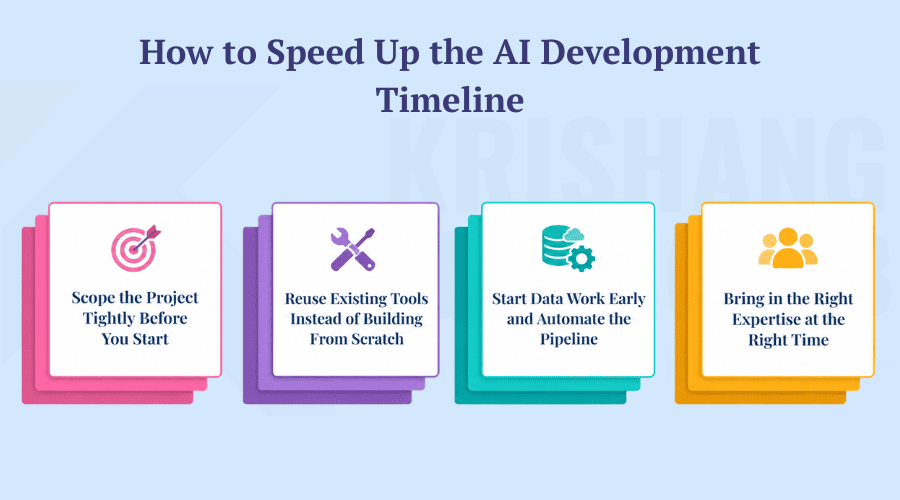
Scope the Project Tightly Before You Start
Rather than attempting to address all issues simultaneously, begin by identifying a single, concentrated AI application. Create an MVP to confirm the concept before expanding. Before you start building, set your requirements priorities so you don’t end up with scope creep halfway through your build. Anything you add that you didn’t plan for takes longer than if you’d planned for it from the start. And a locked scope is the single biggest lever you have to keep your AI development timeline true.
Reuse Existing Tools Instead of Building From Scratch
Make use of pre-trained AI models where possible, and use APIs rather than building AI infrastructure from the ground up. Teams also save real time by using existing AI components and internal libraries, ending up far less often resolving the same problems.
Start Data Work Early and Automate the Pipeline
Data preparation should start early, running in parallel with strategy work rather than after it. Automating testing and deployment pipelines from the start also prevents the kind of last-minute scrambling that tends to happen when CI/CD is bolted on right before launch.
Bring in the Right Expertise at the Right Time
For LLM-heavy products, getting prompt engineers involved early is a shortcut for a lot of trial-and-error that would otherwise happen during testing. For teams without profound AI experience in-house, working with AI developers who have already solved similar problems is generally faster and less expensive in the long run than learning those lessons on your project’s timeline.
How Much Does AI Development Cost?
Timeline and cost are closely linked, so it’s worth touching on. AI software development cost generally depends on total development hours across all phases, team size and seniority, and whether your team handles the work in-house or hires an outsourced agency. Then there are the costs of using AI models or APIs. This is especially true of LLM-based applications that have ongoing inference costs. There is also data preparation effort, cloud infrastructure, integration complexity, and security or compliance requirements, to name a few. Additionally, we have not yet discussed the ongoing maintenance required after the launch.
Published estimates for 2026 range from $30,000-$55,000 for a simple MVP, $55,000-$140,000 for a standard SaaS-style build, and AI-powered products with custom model work often exceeding $140,000-$300,000+, depending on complexity. Treat these as industry benchmarks, not as a quote. The actual cost will depend heavily on your particular needs, so it’s worth getting a scoped estimate from a dedicated MVP development team before you lock down your budget. Krishang Technolab is one option for teams that want that scoping conversation before committing to a number, since cost estimates and AI development timelines are really two sides of the same planning conversation.
How to Estimate Your AI Project Timeline
A simple mental framework works better than guessing:
Requirements → Complexity → Data → Model → Integrations → Testing → Deployment → MaintenanceYou can also use this as a rough formula:
Estimated AI Development Timeline = Discovery + Data Preparation + AI Development + Application Development + Testing + DeploymentNow, go through each phase with the ranges covered earlier in this guide, add them together, and you will have a realistic AI development timeline, not a general “a few months” answer. If your project involves sensitive data, multiple departments, or regulatory requirements, build in a buffer. These factors rarely shorten a timeline; they only lengthen it.
Common AI Development Timeline Mistakes
Even seasoned teams succumb to predictable pitfalls, which is why AI project development so often takes longer than expected and why so many published AI development timelines turn out to be more aspirational than accurate.
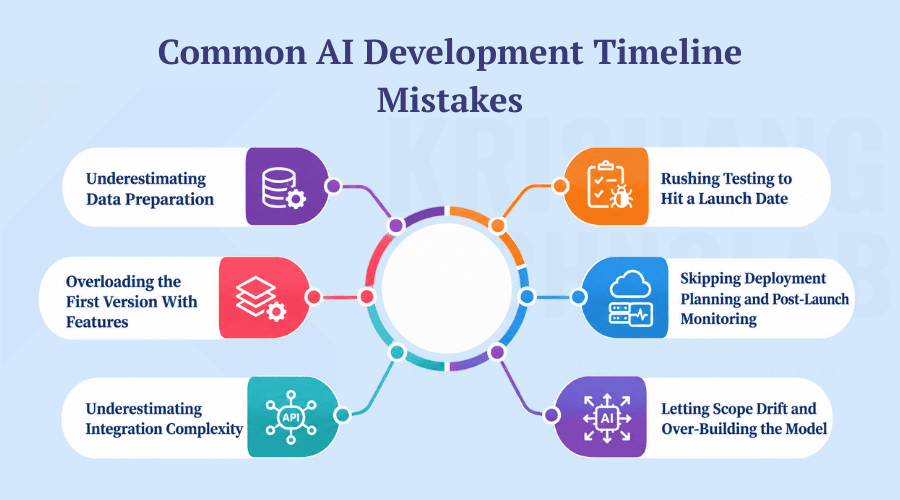
Underestimating Data Preparation
The most significant mistake is underestimating the time that data preparation actually takes. Teams outline the scope of model development but neglect to prioritize data cleaning. Six weeks into the project, they realize the dataset isn’t usable in its current form.
Overloading the First Version With Features
A related issue is trying to stuff too many features into the first version, rather than shipping something focused. The addition of each feature brings with it more testing surface, more integration points, and more edge cases. These compounds are far faster than most roadmaps would account for.
Underestimating Integration Complexity
Often, the complexity of integration is underestimated. Each connected system: CRM, ERP, and payment gateway; has its own quirks, rate limits, and failure modes that only become apparent once real data starts to flow through them.
Rushing Testing to Hit a Launch Date
Teams will frequently cut corners on testing to make a launch date more often than they’ll admit, a tradeoff that tends to cost way more time later than it saves up front, especially once bugs or hallucinations start showing up in production instead of QA.
Skipping Deployment Planning and Post-Launch Monitoring
Sometimes deployment infrastructure planning is left until the last minute and post-launch monitoring is skipped altogether, allowing model quality to degrade quietly without anyone noticing until users start complaining.
Letting Scope Drift and Over-Building the Model
Another common problem is the decision to build a custom model when a pre-trained model would have sufficed, along with changing requirements mid-project without adjusting the timeline. This last point is more important than it may seem; recent industry analysis of over 2,400 enterprise AI initiatives found that roughly 80% of AI projects fail to deliver their intended business value, and current AI adoption statistics for small businesses show similar patterns of unclear scope playing out even at a smaller scale.
Also Read About: How to choose the right AI software development partner?
Final Thoughts
There’s no single number that answers “how long does AI development take” for every business, but there is a reliable process for estimating it accurately. Divide your project into the seven stages outlined in this guide, be honest about your data readiness and plan for testing and post-launch monitoring rather than treating them as afterthoughts. Companies that plan phase-by-phase, rather than try to guess an end date, are the ones that continue to ship on time and get real value from their investment in AI, whether they’re scoping an AI MVP development timeline for a startup idea or planning an enterprise AI development timeline for a large-scale rollout.
This is precisely the sort of phase-based scoping that teams at Krishang Technolab work through with clients before any development work begins and it tends to be the difference between a timeline that holds and one that quietly slips by a few months. Ultimately, the best AI development timelines are built incrementally, not extrapolated from a single industry benchmark.
Frequently Asked Questions
How long does AI development take?
Most AI projects take between 2 weeks and 12+ months, depending on scope. A simple proof of concept can be ready in 2 – 6 weeks, while a full enterprise AI platform typically takes 6 – 12 months or more.
How long does an AI project take?
It depends on the type of project. Simple tools like a basic chatbot can launch in 4 – 10 weeks, while custom machine learning solutions or enterprise platforms usually take 3 – 12+ months.
What is the typical AI development timeline?
A typical AI development timeline includes discovery (1 – 2 weeks), data preparation (2 – 8+ weeks), model development (2 – 8+ weeks), application development and integration, testing, and deployment, often totaling 2 – 6 months for mid-sized projects.
How long does it take to build an AI application?
An AI application development project generally takes 6 – 16 weeks for an MVP-level app and 3 – 6 months or more for a fully featured, production-ready application with integrations and compliance requirements.
How long does it take to develop an AI chatbot?
An AI chatbot development timeline usually runs 4 – 10 weeks, depending on whether it’s a simple rules-based bot or an LLM-powered assistant with custom knowledge and system integrations.
How long does it take to build a generative AI application?
A generative AI development timeline typically spans 2 – 5 months, largely because testing generative outputs for accuracy, safety, and hallucinations takes longer than testing deterministic software.
What factors affect AI development time?
Data quality, model complexity, number of integrations, compliance requirements, team expertise, and how disciplined the scope stays throughout the project are the biggest factors affecting AI development time, which is precisely why AI development timeline estimates vary so much from one agency to the next.
Can an AI MVP be developed in a few weeks?
Yes. A narrowly scoped AI MVP built on pre-trained models or APIs can be developed in as little as 6 – 8 weeks, though very simple proofs of concept can go live in 2 – 4 weeks.
Does AI development require custom model training?
Not always. Many use cases can be solved with existing pre-trained models or fine-tuning, which is significantly faster than training a custom model from scratch. Custom training is usually only necessary for highly specialized or proprietary use cases.
How can I reduce my AI project development time?
Start with a focused use case, use pre-trained models and APIs where possible, prepare your data early, finalize requirements before building, and work with an experienced AI development team that can flag risks during discovery rather than mid-build.
Found this post helpful? Don't forget to share it with your network!