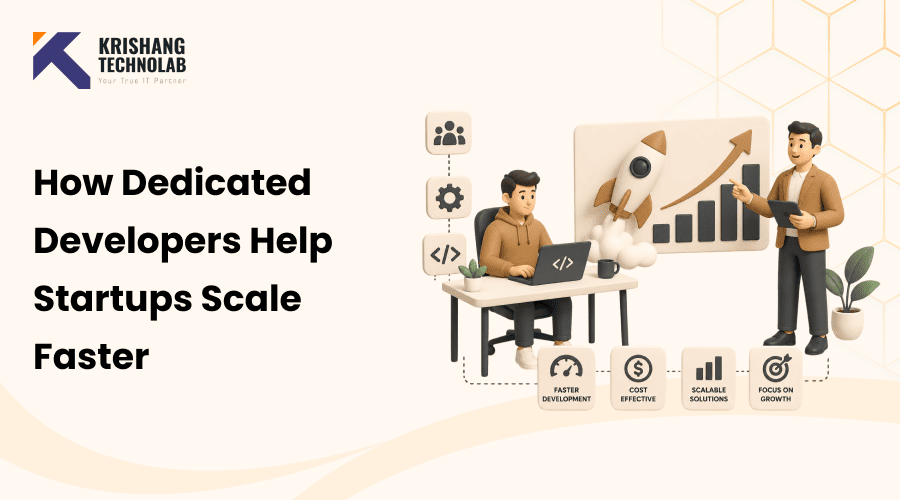
Quick Overview: Dedicated Developers for Startup Growth help startups scale faster by providing specialized expertise, flexible resources, and focused development support. From MVP development to product scaling, they accelerate delivery, reduce hiring challenges, improve code quality, and enable startups to adapt quickly to changing market demands.
Startups have to move fast, but building a robust in-house engineering team takes time and money most early-stage companies don’t have. Recruiting alone can take weeks: general software engineering roles in the U.S. take about 35 – 44 days to fill on average, and senior roles often stretch to 8 – 12 weeks. For a startup racing to product-market fit, that delay can cost a full round of funding.
That’s where dedicated developers for startup growth come in. Founders can plug specialized, pre-vetted technical talent directly into their roadmap, scaling capacity up or down as the business changes instead of going through a slow, expensive hiring process. Dedicated developers for startup growth give companies access to experienced engineers, flexible team sizing and faster shipping speed, all without the overhead of a full internal hiring function.
The stakes are real. Roughly 20–21% of new U.S. businesses fail within their first year, and close to half don’t make it past year five, according to Business Survival Statistics. Failure rates of venture-backed startups are much higher, and the most commonly cited cause, poor product-market fit, is directly tied to how fast and how well a team can build, test and iterate. It’s not about wanting to have the right development capacity in place early. It’s a survival issue.
Why Scaling Technology Is Difficult for Startups
Startups too often face the same challenge regarding achieving growth: technology that must scale faster than the team can.
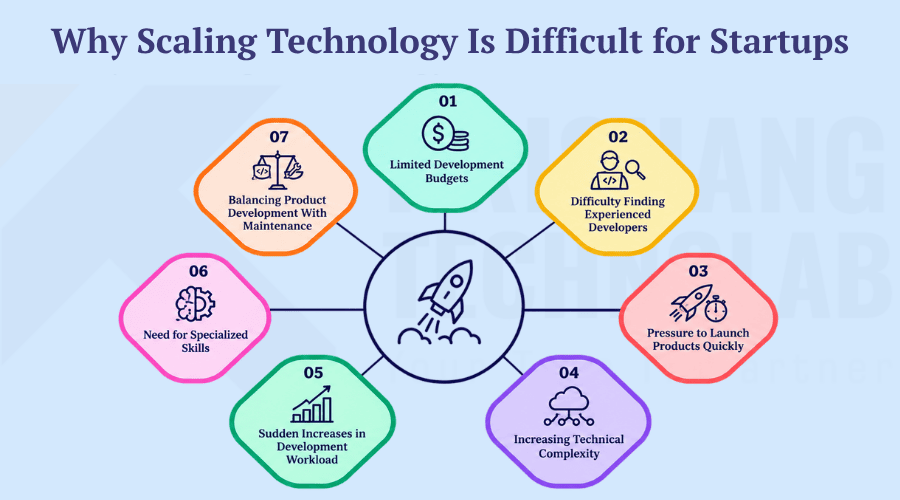
Limited Development Budgets
Early-stage companies don’t always have the runway to bring on a full engineering department before the revenue hits. Every new permanent headcount is a fixed monthly cost and most founders would rather spend that money on product validation and customer acquisition first.
Difficulty Finding Experienced Developers
Senior engineering talent is scarce and competition from larger, better-funded companies makes sourcing harder. Many founders actually recruit remote developers from outside their local hiring pool to get a search going again.
Pressure to Launch Products Quickly
Investors and early customers want rapid iteration, not a multi-quarter build cycle. Every week you spend recruiting instead of building, you push the launch out further.
Increasing Technical Complexity
As products mature, they require more specialized skills (cloud infrastructure, security and integrations) than a small generalist team can provide. This is often when founders start looking for AI and machine learning specialists to handle work a general-purpose team can’t take on alone.
Sudden Increases in Development Workload
A successful launch, a new contract or a funding round can spike demand for engineering hours, often faster than a small team can absorb without burning out.
Need for Specialized Skills
Typically, expertise in AI/ML, DevOps, mobile and cybersecurity is needed only in bursts, not full time, making it hard to justify a permanent hire for any single one of them.
Balancing Product Development With Maintenance
New features compete with bug fixes, security patches and performance work for the same hours and when the team is stretched thin, something often loses out.
These pressures are why so many founders are now looking to dedicated developers for startup growth as a practical way to add capacity without the delay of traditional hiring.
What Are Dedicated Developers?
A dedicated developer is a software engineer (or full engineering team) who works only on your product for an agreed period of time and who is integrated into your workflow the same way an in-house hire would be but who is sourced, managed and often replaced through an external partner. This model is the practical entry point for most founders into dedicated developers for startup growth without the need to commit to a full internal department.
How Dedicated Developers Differ From Freelancers
Freelancers are usually hired for particular tasks or projects and they typically don’t have a long-term commitment to your codebase or roadmap. On the flip side, dedicated developers work with your startup full-time, attend your standups and gain intimate product knowledge over time – more like a long-term team member than a contractor.
Read More About: Which Is Better for Your Project Dedicated Developers or Freelancers?
How Dedicated Developers Differ From Traditional Outsourcing
Traditional outsourcing usually means handing a complete project to an outside vendor with little day-to-day visibility. You have an experienced startup dev team, working with your own processes, with full visibility on progress and decisions.
How They Work With Your Existing Team
Your current product managers, tech leads, or founders have dedicated developers reporting to them. They fit into your sprint planning, your code reviews, and your communication channels; they augment your team, not replace it.
Individual Developers or a Full Team
Startups can hire a single dedicated developer to fill a skills gap or start with a small dedicated team and grow from there as the product and the workload expand. Most companies begin lean and add front-end developers, back-end, QA, and DevOps roles as priorities shift.
7 Ways Dedicated Developers Help Startups Scale Faster
Each of these benefits addresses a different growth bottleneck, from shipping speed to specialized skills to long-term product stability.
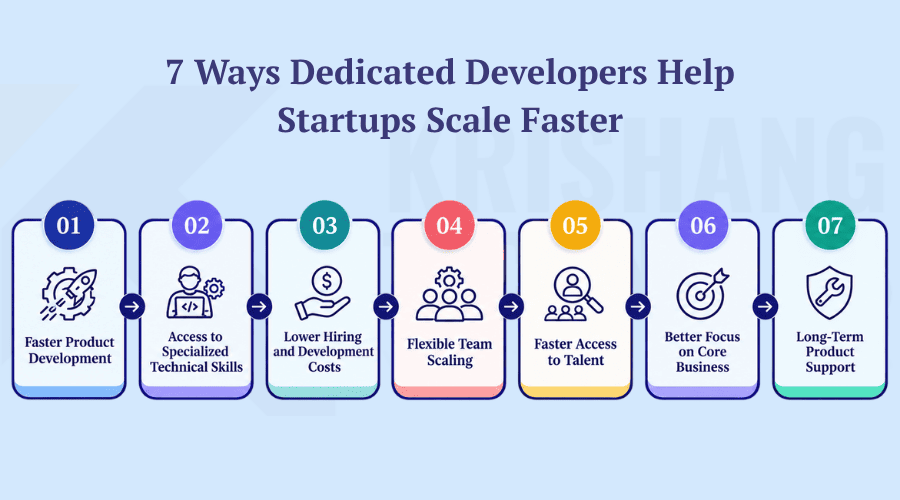
1. Faster Product Development
Each additional developer expands your available development capacity, which in turn reduces the time from idea to shipped feature. For an early-stage company, speed is paramount. First-to-market MVP startups are exponentially more likely to scale successfully, and agile, iterative teams have vastly higher project success rates than teams that rely on rigid, waterfall-style planning. This is one reason early-stage teams validating a first version of their product often bring in outside capacity rather than waiting on a full internal hire. Dedicated developers for startup growth allow founders to add capacity when they need it – for an MVP sprint, a feature push, or a critical integration – instead of waiting months for a new hire to onboard.
2. Access to Specialized Technical Skills
Startups rarely need every specialization full time, but they need every specialization at some point. Dedicated developers on demand for founders:
- Building and integrating AI/ML models into existing products
- Architecting and managing cloud infrastructure (AWS, Azure, GCP)
- Native and cross-platform mobile app development
- Setting up CI/CD pipelines and infrastructure automation (DevOps)
- Security audits, penetration testing, and regulatory compliance
- Interface design and user experience research
- Backend systems, API design, and third-party integrations
Rather than hiring a full-time specialist for a six-week project, startups can bring in dedicated software developers with the exact skill set the current sprint requires, then reallocate that capacity once the work is done, a flexibility that is central to how dedicated developers for startup growth operate day to day.
3. Lower Hiring and Development Costs
Building a full in-house team involves recruiting fees, onboarding time, benefits, equipment and the ongoing cost of retention before you’ve shipped a single feature. Several hiring benchmarks in 2026 indicate that the traditional in-house recruitment process for hiring a software developer takes an average of 5 to 9 weeks and often 8 to 12 weeks for senior roles. A week with a missing seat is a week of a roadmap that doesn’t move.
Dedicated developers alter this cost structure. Instead of paying for a full internal hiring pipeline, startups pay for engineering time that starts almost immediately, often through an external engineering partner rather than a from-scratch internal build. That doesn’t mean dedicated developers are always “less expensive.” The real comparison depends on the size of the team, the length of the project and the specialization required. It does mean that startups avoid the fixed overhead of recruiting, benefits administration and idle bench time between projects.
4. Flexible Team Scaling
Startup teams typically don’t need the same headcount for long. An example path of growth could be two developers during MVP development, five during product expansion, and hiring DevOps or QA specialists when the product reaches scale. A dedicated development team for a startup can scale up or down along that same curve, sometimes with a dedicated offshore setup that adds capacity in days instead of months. This flexibility is one of the biggest reasons dedicated developers for startup growth outperform rigid in-house hiring plans for early-stage companies.
5. Faster Access to Talent
Old school recruiting cycles are slow. The average time to fill a general software engineering role is 35–44 days. And even a standard internal hiring process, posting, screening, multiple rounds of interviews, and offer negotiations can take over four months when you factor in sourcing and onboarding. If founders hire dedicated developers for startups, they bypass most of that cycle. Several teams have documented the gains after making the switch, from faster onboarding to shorter time-to-first-commit. Onboarded in days, not months, are vetted, experienced engineers who matter enormously when a competitor, a customer deadline or a funding milestone is on the clock.
6. Better Focus on Core Business
An hour a founder spends on screening resumes or debugging a production issue is an hour not spent on customers, fundraising, sales or partnerships. The dedicated developers handle the technical execution for the founder, allowing leadership to focus on:
- Deepening relationships with existing customers and reducing churn
- Running investor updates and fundraising conversations
- Building out the sales pipeline and go-to-market approach
- Developing partnerships and business development opportunities
- Setting product direction and deciding what to prioritize next
This division of labor is especially valuable at the pre-seed and seed stage, where founder time is the most scarce resource in the company. It’s one of the clearest arguments for dedicated developers for startup growth over a founder trying to do both jobs at once.
7. Long-Term Product Support
Dedicated developers aren’t an MVP solution; they’re a long-term growth model. And it’s this ongoing role that makes dedicated developers for startup growth a lasting engineering strategy, not a short-term solution. Dedicated teams will handle the build, which is only the beginning of the process.
- Fixing bugs and handling day-to-day maintenance
- Tuning performance as traffic and usage climb
- Shipping new features based on user feedback
- Patching vulnerabilities and staying current on security
- Scaling infrastructure to handle a growing user base
Startups that need mobile engineers for iOS and Android builds, alongside web development, often keep that capacity on retainer well past launch, rather than re-hiring for each new release. Startups that treat dedicated developers as an extension of their engineering function and not a stopgap measure tend to build more stable, better-maintained products over time.
Dedicated Developers vs In-House Developers vs Freelancers
| Factor | Dedicated Developers | In-House Team | Freelancers |
| Hiring speed | High | Low – Medium | High |
| Flexibility | High | Medium | High |
| Long-term collaboration | High | High | Variable |
| Specialized skills | High | Depends on hiring | Variable |
| Recruitment effort | Low | High | Low |
| Team scalability | High | Medium | High |
| Startup suitability | High | Depends on budget | Medium |
That’s why many founders looking for “dedicated developers vs in-house developers” find themselves settling on a hybrid model: a small core in-house team for product ownership, supported by dedicated developers for execution capacity and specialized skills. Many growing companies weigh this exact tradeoff before deciding how to structure their engineering function long-term.
When Should a Startup Hire Dedicated Developers?
Dedicated developers make the most sense when:
- Your MVP needs to get out fast and internal hiring is going to slow you down.
- Your current team is lacking a specific technical skill (AI/ML, DevOps, mobile, security).
- Development work is moving faster than your current team can absorb.
- It would be beneficial to consider adding developers temporarily or incrementally, without long-term headcount commitments.
- You need ongoing product development beyond the initial launch, sometimes structured around a long-term capability hub abroad rather than a single short-term contract.
- A full internal engineering team is not yet feasible either in terms of cost or operations.
If two or more of these apply, it’s usually a sign that dedicated developers for startup growth are worth considering over a traditional hiring plan.
How to Build a Dedicated Development Team for Startup Growth
There’s no one formula for success, but most startups that do it right take a similar path. What that process really looks like when you break it down into steps, and why getting those steps right early is what makes dedicated developers for startup growth work in practice.
1. Define Your Product Requirements
Be specific about what you are building, in which order and by when. It’s usually vague requirements that cause projects to blow up in scope once a dedicated team becomes involved. If you can’t describe what ‘done’ looks like for a feature, neither can the people building it.
2. Identify the Skills You Need
Before you start looking at candidates or teams, match the expertise you really need, backend, mobile, DevOps, or AI/ML, to what’s on your roadmap. It’s easy to hire generalists and figure it out later, but that usually costs more time than it saves.
3. Determine the Team Size
Keep it lean for MVP work. At this point two developers are often enough. Build in checkpoints so you can scale the team up as the product starts proving itself, instead of guessing at headcount from the get-go.
4. Select Developers Based on Experience
Domain and startup experience count for more than a polished resume here. You want people who’ve been in rapid, resource-constrained environments, not just the right certifications. This is where it helps to hire software developers matched to your stack instead of settling for whoever’s available.
5. Establish Communication Processes
Don’t wait until something’s wrong to set up standups, sprint reviews and reporting rhythms. Get your development team up and running within the first week. Your dedicated team should be part of your company, not a vendor you consult from time to time.
6. Set Milestones and KPIs
Clearly outline the criteria for success in each phase to ensure that progress is measurable rather than assumed.
7. Continuously Evaluate and Scale the Team
Review velocity, and results regularly. As the product matures, so do your priorities and your team size should change accordingly.
Establish this structure right and you’ll scale your development team without the communication breakdowns and missed deadlines that trip up teams who jump straight to hiring.
How Much Do Dedicated Developers Cost for Startups?
There isn’t one number that applies to all startups since the cost of hiring dedicated developers for startup growth relies on a few factors.
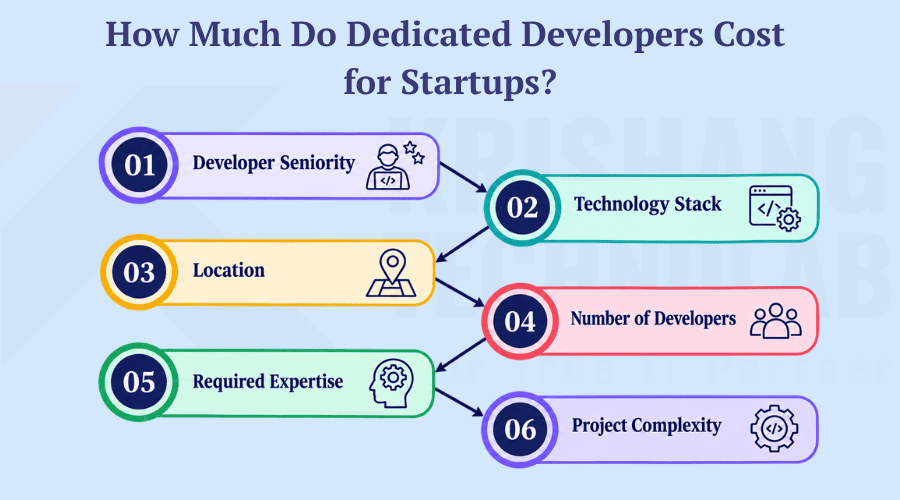
- Developer Seniority: Junior, mid-level, and senior engineers have different rates, so it is important to have a mix of these levels based on the project’s actual need for architectural decision-making.
- Technology Stack: Demand or niche stacks, AI/ML, blockchain, and advanced cloud are usually more expensive than common, well-supported frameworks.
- Location: Talent cost varies a lot by region and time zone and is one of the reasons many startups look at setting up a long-term offshore engineering base to balance cost with overlap with their own working hours.
- Number of Developers: Dedicated teams are bigger and the cost structure is different from a single hire, as the overhead of coordination increases with the number of people.
- Required Expertise: Specialized skills and security and compliance-heavy industries typically pay more than general-purpose development work.
- Project Complexity: Heavily custom, or integration-heavy work requires more senior attention. Reviewing past product launches from a potential partner is often the fastest way to gauge whether their experience matches your project’s complexity.
Rather than anchoring to a generic hourly figure, founders get a more accurate picture by requesting a scoped estimate based on their actual product requirements, timeline and skill needs.
How to Choose the Right Dedicated Developers for Your Startup
Not every dedicated developer or team is suitable for your needs. It is the selection process that really determines if dedicated developers for startup growth pay off.
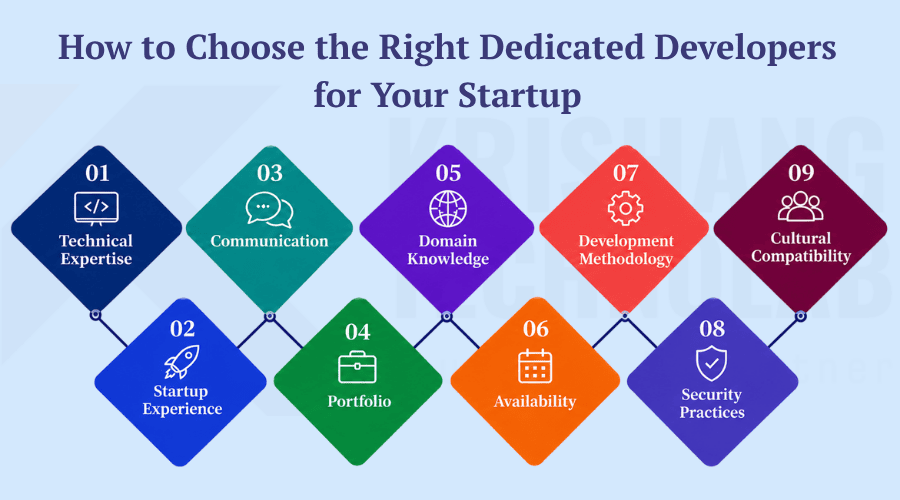
Technical Expertise
Seek out proven experience with your stack, including full-stack developers who can move across the stack as needed, rather than only working within a single narrow specialty.
Startup Experience
Experience at a large, slow-moving enterprise matters less than fast-paced, resource-limited environments.
Communication
Communication is less important than clear, proactive updates when the code is delivered on a deadline with no visibility into how it was achieved.
Portfolio
Past work in similar products or industries that is real and verifiable is one of the strongest signals of fit.
Domain Knowledge
Understanding the specific constraints of your industry, fintech, healthtech, marketplaces, and more, can save a lot of early back-and-forth.
Availability
There should be enough hours dedicated to actually moving your roadmap, rather than having a team that is spread too thin across many other clients.
Development Methodology
Agile practices that fit how your team is already working reduce friction from the beginning.
Security Practices
Proper handling of code, data and access should be a baseline requirement, not an afterthought.
Cultural Compatibility
And more than any one technical skill, over time a working style that matches the way your founders and team operate tends to matter.
It’s what makes a good hire and a team that really delivers dedicated developers for startup growth. A good fit in these areas is a better predictor of success than price alone.
Final Thoughts on Dedicated Developers for Startup Growth
Scaling isn’t about adding more people; it’s about adding the right technical expertise at the right time. Dedicated developers for startup growth offer a way for founders to add capacity, ship faster and support long-term growth without committing to a full in-house team until you’re ready for one.
Krishang Technolab partners with early-stage and growing companies to create dedicated development teams aligned with their roadmap. If you’re ready to explore a dedicated developer engagement, Krishang Technolab can help you scope the right team size and skill mix and talk through what your next sprint should actually look like.
Frequently Asked Questions
What are dedicated developers?
Dedicated developers are software engineers who work exclusively on one company’s product for an agreed period. They’re integrated into that company’s team, and workflows, not hired one task at a time like freelancers typically are.
How do dedicated developers help startups scale?
They provide you with specialized technical capacity on demand, they reduce hiring time from months to days, and they let your team size flex with the roadmap rather than being locked in by whoever you managed to hire in one round. That’s a big reason why dedicated developers for startup growth have become such a common model for early-stage companies.
Are dedicated developers better than freelancers for startups?
Yes, generally for ongoing product work. Dedicated developers develop continuity and profound product knowledge over time, something freelancers rarely do, because freelancers tend to work best on short self-contained tasks.
When should a startup hire dedicated developers instead of building an in-house team?
A startup should hire dedicated developers when speed, flexibility, or a specific skills gap is more important than maintaining a large permanent headcount at that time. This is most common during MVP development, sudden growth phases or when you encounter a skill gap that your team cannot fill.
Do dedicated developers only work on MVPs?
No, not in the least. Many startups retain dedicated developers well past launch for maintenance, adding new features and doing infrastructure work as the product scales.
Found this post helpful? Don't forget to share it with your network!