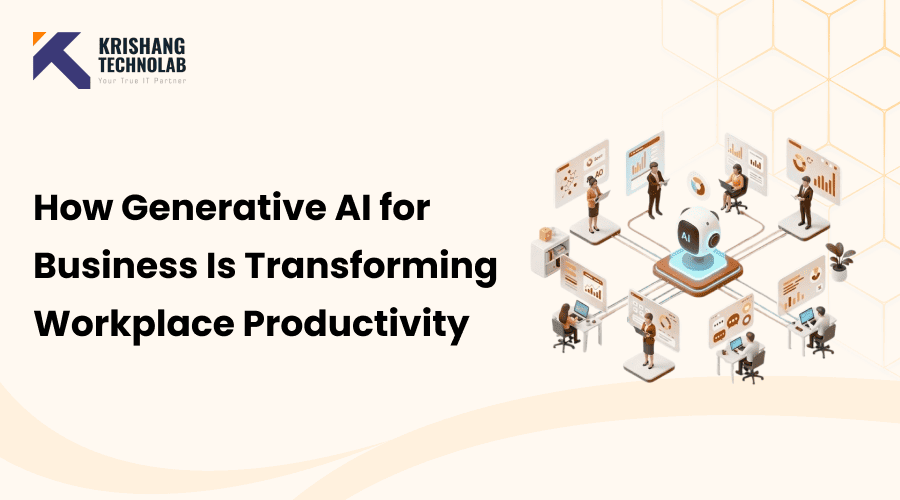
Quick Overview: Generative AI for Business is transforming modern workplaces by automating repetitive tasks, improving decision-making, and enhancing collaboration. This blog explores how generative AI improves workplace productivity, key business benefits, real-world applications, adoption challenges, and the future of AI-powered business operations.
Generative AI for Business is changing the way companies work. Businesses are using AI today to increase productivity, reduce costs and improve efficiencies. What started as a text, image and code generation tool has now become a game changing business solution.
AI is being quickly adopted by businesses in all fields. AI at work is no longer a trend of the future. But such use is becoming routine. Organizations are using AI-powered tools to automate tasks, support decision making and improve customer experiences.
In addition, organizations are looking for new ways to remain competitive. Hence, many companies are investing in generative AI for business solutions. These tools allow employees to work faster and focus on higher-value work.
Generative AI for Business is now a strategic spend for many organizations. Generative AI for Business is really assisting companies in improving productivity and reducing operational challenges.
This blog post talks about how generative AI for business is changing how productive people are at work. We also examine the benefits, challenges and future opportunities of AI-driven workplaces.
What Is Generative AI for Business?
Generative AI for Business is artificial intelligence systems that can create content, generate insights, automate tasks and support business operations.
Generative AI is not like the traditional AI systems that analyse information. It can create new things. It can write reports, create presentations, generate emails, write code, support AI-powered software development, and summarise documents.
Many generative AI business applications today are powered by large language models and machine learning technologies. These systems learn from large quantities of data. This enables them to produce human-like responses and valuable business content.
The need for generative AI for business continues to grow in all industries. Additionally, companies are exploring generative AI for business to increase efficiency, innovation, and customer experiences. A large number of companies partner with a proficient AI development company to build custom AI solutions as per their requirements.
An AI assistant is a common example. These assistants help employees write emails, summarise meetings, answer questions and handle workflows. They can also help organise information and generate reports. And organisations, in turn, are looking for new ways to boost productivity and collaboration. Employees will also have more time to work on strategic rather than routine work.
Also Read About: What Is the Difference Between LLM and Generative AI, and Why Does It Matter?
Why Businesses Are Rapidly Adopting Generative AI
AI is being used by businesses because they need to be better. They faced some stiff competition, too. Customer expectations are also increasing.
Hence, companies are investing in AI solutions. Such solutions increase efficiency and productivity. Businesses can do more with less help from them.
Businesses are interested in generative AI for business because it can help them automate tasks. Generative AI for businesses also helps organisations lower their operational costs. Additionally, generative AI for business enables quicker decision-making and fosters innovation.
Increasing Operational Efficiency
Efficiency is a primary reason companies invest in AI. “How does AI improve efficiency?” Many business leaders ask themselves this question.
The answer is easy. AI automates repetitive jobs. It also helps speed up daily work. For instance, generative AI can generate reports, synthesise data, and support AI in software development in a matter of seconds.
In the past, employees spent hours on these activities. Now they can get them done a lot quicker. That means teams are more productive. They also become more effective.
When businesses hire AI developers who specialise in making smart workplace apps, they often set up their own automation systems.
Reducing Manual Work
Many organisations struggle with repetitive administrative tasks. These repetitive administrative tasks often detract from more important work.
Generative AI makes manual work go away. Automated data entry, email drafting, scheduling and document creation are just a few examples.
This allows employees to focus on the creative side. Strategic work can also be the focus. Companies can generate more without working harder.
Supporting Faster Decision-Making
Businesses have to make decisions fast. They also need straightforward, accurate information.
Generative AI can deal with a lot of information. It can extract key insights. It can also spot trends and opportunities.
Consequently, leaders are able to decide more quickly. They can make better decisions, too. This allows organisations to quickly respond to market changes.
Also Read About: What Are the Latest Artificial Intelligence Statistics for Small Businesses?
Driving Innovation and Creativity
Innovation is another major reason companies adopt AI.
Teams can use AI to brainstorm ideas. They can create content and make new products. They can also test concepts faster.
This helps businesses innovate more quickly. They can also be competitive. AI doesn’t replace employees; it makes them more creative.
How Generative AI Improves Workplace Productivity
With generative AI in business, organisations can automate workflows. It also works better for teams to work together. This makes it more efficient. It also minimises manual labour. Such an approach allows teams to be more productive with less effort.
Organisations use generative AI for business in many departments. It makes the workflows easier. It also speeds up the work teams do. Work is more tolerable.
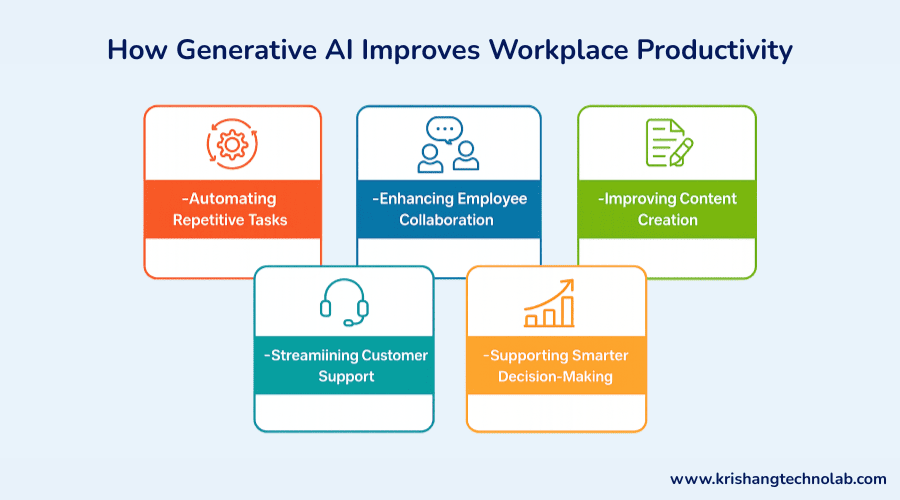
Automating Repetitive Tasks
One of the biggest impacts of generative AI on productivity is automation.
Employees often find themselves trapped in a cycle of repetitive tasks. These tasks include managing emails, creating reports, organising files, and updating documents.
Generative AI can do many of these things for them. It saves employees time on a daily basis. They also lessen manual work.
This allows teams to focus on work that requires thinking and creativity. This leads to increased productivity throughout the organisation.
To accelerate implementation, many companies prefer to hire dedicated developers who can focus on AI-powered automation initiatives.
Enhancing Employee Collaboration
Teamwork is very important at the workplace. AI makes it easier.
AI tools can summarise meetings. They can also produce action points. They are able to sort project data. And they make information easy to find.
This means that employees spend less time searching for information. Instead, they emphasise teamwork and shared goals.
Improving Content Creation
Content creation is a process. But AI does it faster.
Marketing teams are using AI to create blogs, social media posts, emails, and presentations. Sales teams also use it to write messages to customers.
Many companies hire software developers with AI expertise to develop systems that scale content creation, just like organisations scale digital work.
This technology allows organisations to create more content. They also are able to maintain high quality and consistency.
Streamlining Customer Support
AI also helps customer support teams.
AI chatbots and virtual assistants can give answers to common questions. They are also able to solve simple problems. Then human agents can handle more difficult issues.
This means faster support for customers. They also enhance their service. They also save money.
Supporting Smarter Decision-Making
Many organizations ask, “How does AI increase productivity?”
One key reason is better decisions.
In a short time, generative AI can sort through a lot of data. It can discover useful insights. It can also be presented to them in a simple way.
The software allows managers to see trends faster. They also make better choices. Such technologies allow organisations to be agile and efficient.
The adoption of generative AI for business is on the rise, continuing to drive productivity across every industry.
Key Benefits of Generative AI for Businesses
The increasing adoption of generative AI for business is delivering real results across many industries.
Generative AI for business success correlates with higher productivity, faster workflows, and better business outcomes. Many leaders also view generative AI for business as a way to gain a long-term competitive advantage.
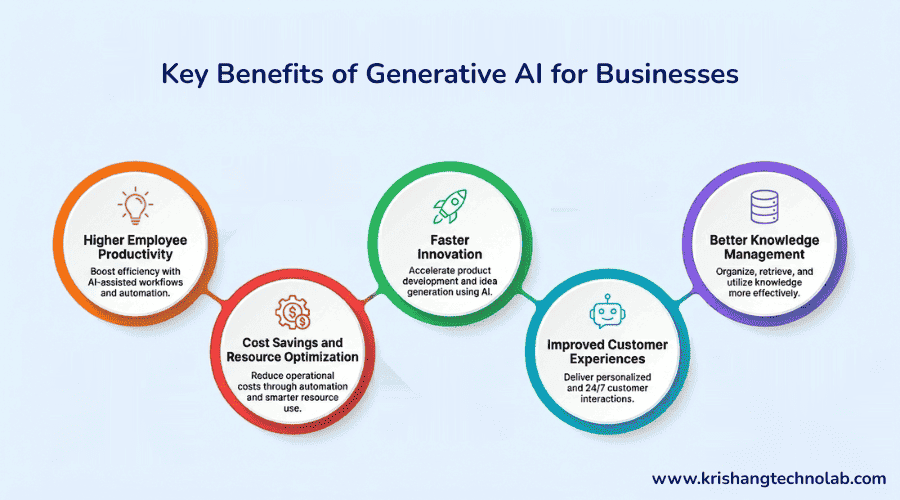
Higher Employee Productivity
One of the most important generative AI benefits is greater employee productivity. Employees can get tasks done faster. They can also operate with less effort.
They can devote more time to meaningful and high-value jobs. This leads to better outcomes for organisations with the same resources.
Cost Savings and Resource Optimization
The benefits of generative AI are more than productivity. Automation helps reduce costs. For example, companies can perform standard operations without adding extra staff.
As a result, companies can increase efficiency and manage costs. Before embarking on AI initiatives, organisations should evaluate the cost of generative AI development serivces. This helps to align spending with business goals and expected outcomes.
Faster Innovation
To innovate, you need to be creative and to test. With generative AI, teams can generate ideas more quickly. It also allows them to explore solutions and create prototypes.
It cuts down on the time it takes to try new ideas. This means businesses can get products and services to market quicker.
Improved Customer Experiences
The benefits of AI in business also include better customer experiences. AI systems support faster. They also offer personal recommendations.
They assist businesses in better understanding customer needs. This results in increased customer satisfaction and loyalty among organisations.
Better Knowledge Management
Companies produce huge amounts of information every day. Generative AI can make sense of this information. It can also share and summarise it in an easy way.
And this speeds up the way employees find answers. As a result, teams work better and avoid information silos.
Real-World Use Cases of Generative AI in Business
Generative AI for Business is being adopted by businesses across industries. It helps in improving efficiency and productivity. In fact, applications are growing rapidly.
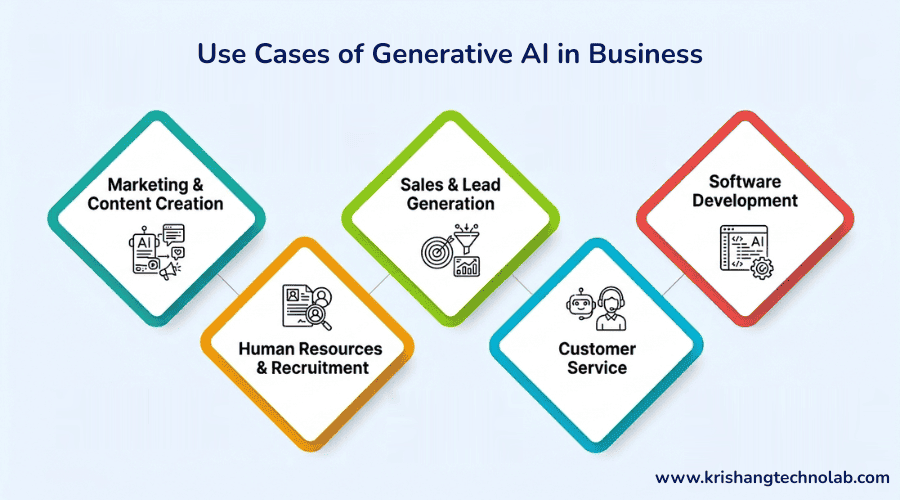
Marketing and Content Creation
Generative AI for Business is used by marketing teams to generate blogs, advertisements, email campaigns and social media content. This helps them to generate more content in less time. For instance, AI can recommend headlines. It can also enhance posts for more engagement.
Human Resources and Recruitment
AI helps HR teams to write job descriptions. It also scans resumes and prepares onboarding materials. As a result, recruitment becomes faster and more efficient. Additionally, AI helps identify the best candidates more accurately.
Sales and Lead Generation
Sales teams use AI to personalize outreach messages. They also look at customer interactions. Therefore, they can engage prospects in a better way. Plus, AI is able to track responses. This helps to optimize future campaigns.
Customer Service
Companies are deploying AI-enabled chatbots and virtual assistants to offer instant help. This lets us help people more quickly. Support teams handle fewer routine requests. This approach frees up staff to handle more complex problems.
Software Development
Software companies use Generative AI for Business to write code, find bugs, and make docs. Most companies hire AI developers. These developers are creating code assistants, automated test systems and AI-powered software engineering tools. And so the development teams move faster. For example, AI can suggest real-time code improvements.
Also Read About: What Are the Best AI Coding Assistants?
The Role of AI Assistants in the Modern Workplace
The AI assistant of today is quickly becoming an important tool for work.
These aides help employees process information, do things, and find knowledge. They don’t replace people; they support what they do every day.
As AI in the workplace continues to evolve, AI assistants will be more useful.
Also, generative AI for business can help organisations in boosting productivity, collaboration, and efficiency.
Challenges of Generative AI Adoption
Generative AI challenges that businesses must tackle with AI’s many benefits.
Organisations that adopt generative AI for business need to strike a balance between innovation and security, governance and compliance, while also evaluating the cost of hire AI consultant services to support successful implementation.
- Data Privacy and Security: Organisations will protect private data. Strong security is thus required.
- Accuracy and Hallucinations: Generative AI can get it wrong. Thus, outputs always require validation.
- Employee Training: The best way for AI to work is for employees to be taught. For instance, employees must learn to use tools gradually.
- Ethical and Compliance Concerns: Companies must be fair and honest. Also, they have to obey the laws carefully.
- Change Management: Organisations must manage change slowly. This means that workers can easily adapt to AI systems.
Best Practices for Implementing Generative AI in Business
Clear objectives should kick start a generative AI for a business plan. Decide what AI should do first. Then set simple goals. This allows teams to monitor results. It also demonstrates the value of artificial intelligence. Also, clear goals help keep work on track.
Start with High-Impact Use Cases
Choose tasks that produce fast results. For example, you can use AI for customer support, content writing, or automation. These tasks are effective. As a result, teams see results fast. They are also more sure of themselves. This makes people even more likely to use AI.
Launch Pilot Programs
Do a little pilot first. This enables teams to test AI safely. It also finds problems early on. Then teams can quickly resolve issues. Therefore, the risk is less. And it is easier to roll out in the future.
Establish Governance Policies
Lay out clear rules for how AI can be used. Add data privacy and security regulations. Also, add ethical guidelines. This approach keeps work secure. Also, teams are better at following rules. Such an approach builds confidence in AI.
Invest in Employee Training
Train employees in a step-by-step process. Show the basic tools first. Then display daily tasks. Also, provide short practice exercises. This means employees learn quicker. They are also comfortable with AI.
Measure Results
Track Generative AI Business Results Often Check the time saved, costs and quality of work. Then check progress regularly. And such information goes to better decisions, too.
Finally, an experienced AI development company can help in setting up, avoiding mistakes and increasing the results.
Also Read About: How to Choose the Right AI Software Development Partner?
The Future of Generative AI in the Workplace
The future of generative AI in business holds enormous promise.
Generative AI for Business is likely to be a common tool in the workplace. The future will include smarter AI assistants, better automation and improved decision support.
Organisations will increasingly seek out generative AI and specialised machine learning development services. That growth will come from companies investing more in AI-driven transformation.
Those who start using AI now will have a competitive advantage. They will be able to deal with problems better in the future.
Conclusion
Generative AI for businesses allows them to work faster and smarter. It also makes things more efficient. It also automates day-to-day tasks. They help teams save time and work.
It also helps to improve collaboration. It also helps the decision-making process. Companies can get more done because of this. They also have a competitive advantage.
But if you want to do well, you need to plan. It also requires employee training. Responsible use of AI is also required.
Many companies are using AI consulting services. This blog helps them identify the appropriate use cases. It also helps them make the correct decisions regarding the use of AI.
In addition, companies like Krishang Technolab support digital transformation. They offer AI solutions and professional advice. And so businesses grow faster. They also create a future-ready workplace.
FAQs on Generative AI for Business
What is Generative AI for Business?
Generative AI for Business is using AI to generate content and help with business tasks. It also assists in automating simple work. In addition, it enhances decision-making for day-to-day operations. Many companies use machine learning development services as well. This allows them to create tailor-made AI systems that fit their requirements.
How does Generative AI improve workplace productivity?
It automates repetitive tasks to minimize manual labor. It also helps speed up content creation and data work. This results in employees completing tasks faster. They are also less error-prone. It helps them make better decisions too. This enhances the work performance overall.
Which business functions benefit most from Generative AI for Business?
The most benefit goes to marketing, customer support, HR, sales, operations and software development. These teams also save time in daily work. They can then work on more important things. Overall, business efficiency improves.
Can Generative AI replace human employees?
No, it can’t displace human workers. It does not replace them but supports them in their daily work. It does simple, repetitive work. This enables the employees to concentrate on creative and planning work. They can also focus on making better decisions that create more value.
What challenges do companies face when adopting Generative AI?
Companies have problems with data privacy. They have system integration issues as well. Also, they need to train their staff properly. Occasionally AI can produce wrong answers. Regular inspections are therefore very important.
How can small businesses start using Generative AI for Business?
Small businesses can begin with simple AI tools. For instance, they may leverage content creation and customer support tools. Small businesses can then grow their AI capabilities incrementally by adding features one at a time. They can also explore generative AI development services. They can also review the cost of generative AI development for the more advanced solutions.
Found this post helpful? Don't forget to share it with your network!