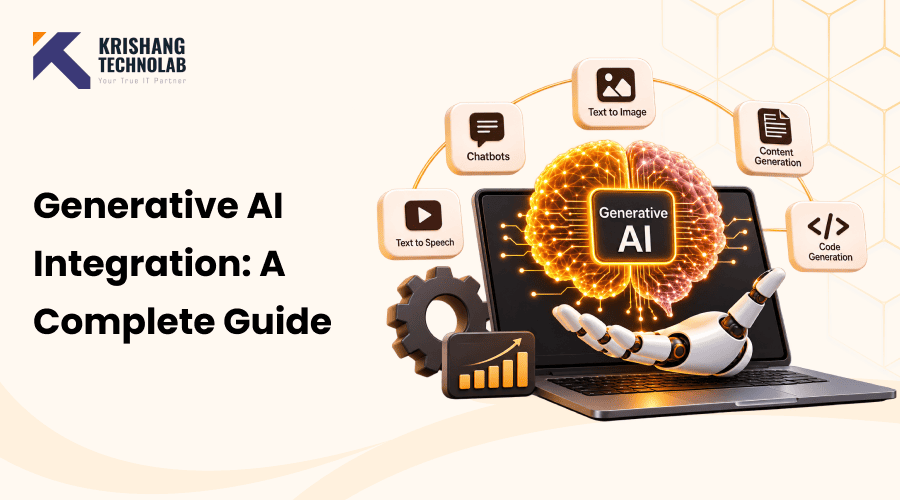
Quick Overview: Generative AI integration helps businesses connect AI models with existing applications and workflows to improve productivity, automate repetitive tasks, and enhance customer experiences. This guide explores its benefits, use cases, challenges, and implementation strategies for successful business adoption.
Generative AI integration has moved from a small experiment into a genuine business priority for organizations that want growth. Companies everywhere embed generative artificial intelligence into products, workflows, and decision systems to work faster, serve customers, and compete. Doing this well takes far more than simply plugging in a chatbot and hoping it delivers results for everyone.
Success needs clear objectives and clean data, the right technology, and strong governance to keep projects safe and accountable. This guide explains generative AI integration, its importance, where it creates value, what it costs, and how to succeed.
What Is Generative AI Integration?
Integration of generative AI Integration refers to the incorporation of generative artificial intelligence (AI) tools like large language models and image or code generators into an organization’s existing applications, data, and workflows. Unlike a standalone tool that employees open in a separate tab, a properly integrated system works inside the software people already use. It drafts, summarizes, analyzes, and answers using your business context. In short, AI business integration turns a general-purpose model into a practical business capability.
How Does Generative AI Integration Work?
Integration typically connects a foundation model to your systems through APIs. A prompt is sent to the model, enriched with AI Software development company data, triggered by the user request or system event. The model produces an output, which is validated, formatted, and returned to the workflow, e.g., a CRM record, support reply, or report.
Key Components of Generative AI Integration
Every integration rests on a few building blocks: a foundation model, a data layer (databases, knowledge bases, vector stores), an orchestration layer that manages prompts and logic, security controls, application interfaces, and monitoring tools. Weakness in any one component limits the whole system.
Generative AI Integration vs. Traditional AI Integration
Conventional AI integration typically uses predictive models trained for a single, narrow task (e.g., fraud scoring, demand forecasting). Generative artificial intelligence systems generate new content and solve open-ended language tasks, making them versatile across multiple functions. They are also less predictable and therefore require stronger guardrails, human review, and ongoing evaluation.
Why Is Generative AI Integration Important for Businesses?
The main driver is competitive pressure. Organizations that integrate AI into their core processes outperform competitors who still rely on manual labor in terms of cycle times, costs, and customer service speed. Adopting enterprise AI generative is central to AI-driven digital transformation—not a side project for the innovation team.
Growing Adoption of Generative AI Across Industries
Adoption has rapidly extended from Generative AI technology firms to healthcare, finance, retail, education, and manufacturing. Early pilots in content creation and customer support have grown into production deployments touching operations, analytics, and product development, and leadership teams now expect a clear AI roadmap.
How Generative AI Is Transforming Business Operations
Generative AI changes how routine knowledge work gets done. Staff spend less time drafting, searching, and summarizing and more time on judgment and relationships. Tasks that used to take multiple handoffs—writing proposals, triaging tickets—can be done in minutes.
The Future of AI-Powered Business Processes
AI is increasingly assisting and, in some cases, leading business processes. Look for workflows in which artificial intelligence systems gather data, make recommendations, and trigger actions across multiple applications, while people oversee exceptions instead of performing each step.
Read More: How Generative AI for Business Is Transforming Workplace Productivity
Key Benefits of Generative AI Integration
Artificial intelligence can bring benefits to businesses, including higher productivity, reduced costs, improved customer experience, and faster innovation. Outcomes will vary depending on the use case and how well it is executed, but these are the benefits most consistently reported by organizations.
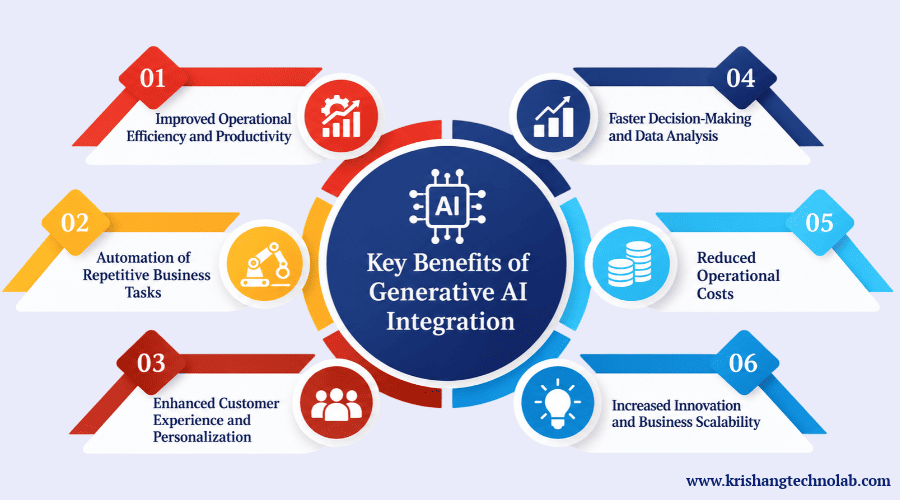
Improved Operational Efficiency and Productivity
Integrated AI removes the friction from daily work. Teams can generate first drafts, research internal knowledge, and summarize long documents in seconds, freeing skilled staff to focus on higher-value tasks and speeding up delivery across departments.
Automation of Repetitive Business Tasks
Generative artificial intelligence is able to perform data entry, email responses, report generation, document classification, and routine approvals. It handles unstructured inputs, like free-text messages, unlike rule-based automation, enabling automation where it was once too messy.
Enhanced Customer Experience and Personalization
AI is able to personalize messages, product suggestions, and support responses to each customer’s history and intent. Integrated assistants are available 24/7, speak multiple languages, and help resolve queries faster, thus providing a more relevant and human touch to interactions.
Faster Decision-Making and Data Analysis
They can ask their data questions in natural language and get quick summaries, explanations of trends, and comparisons of scenarios. This reduces the time from raw data to action, although people should still double-check important decisions.
Reduced Operational Costs
Generative artificial intelligence can decrease the cost of support, content creation, documentation, and back-office processing by automating labor-intensive tasks and reducing errors and rework. The biggest savings come when AI is tied to measurable workflows, not used on an ad hoc basis.
Increased Innovation and Business Scalability
AI makes it easier to test, prototype, and iterate, which means teams can try more. It also allows businesses to scale output, such as support volume or content production, without scaling headcount at the same rate.
Top Generative AI Integration Use Cases Across Industries
Generative AI applications are broad, but the strongest business use cases share one trait: they apply language or content generation to a high-volume, well-defined process. Here is how industry-specific AI solutions look in practice.
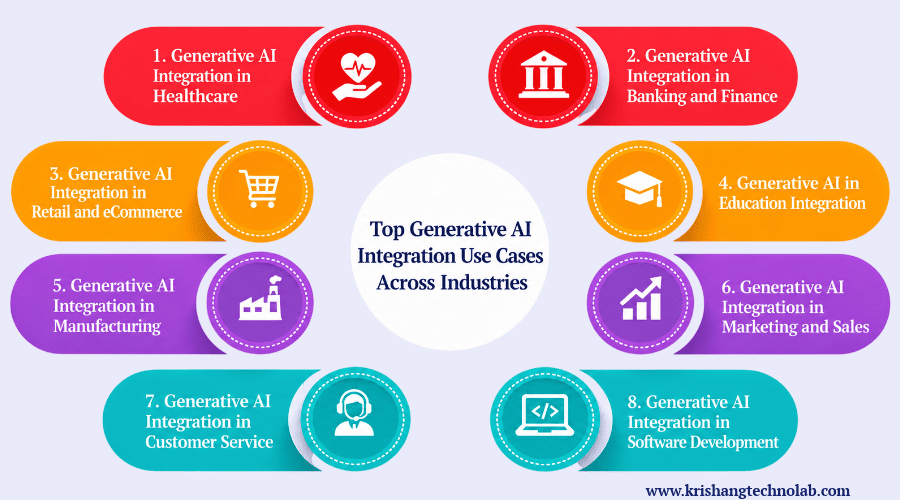
Generative AI Integration in Healthcare
AI in healthcare organizations are using gen AI for things like clinical documentation, patient communication, medical coding support, and research summarization. Ambient note-taking can reduce the administrative burden on clinicians. Outputs should remain subject to professional review and strict privacy controls.
Generative AI Integration in Banking and Finance
Banks use it for customer service, report writing, compliance document review, credit memo summarization, and fraud investigation support. Because of the regulatory scrutiny financial deployments are subject to, explainability, audit trails, and data protection are critical.
Generative AI Integration in Retail and eCommerce
Retailers use them to write product descriptions, make personalized recommendations, run shopping assistants, and analyze reviews on a large scale. AI also provides dynamic marketing content and inventory-related insights that boost conversion and reduce manual catalog work.
Generative AI in Education Integration
AI is used in schools to help teachers ensure each student is getting the most out of their lessons, plan lessons, and do routine tasks automatically. Used properly, it saves teachers time and allows kids to learn at their own pace.
Generative AI Integration in Manufacturing
Generative AI has been used by manufacturers to make maintenance documents, help technicians, talk to suppliers, look at different design options, and read quality reports. People who work there can naturally ask questions about instructions and logs. This reduces downtime and accelerates the process of fixing things.
Generative AI Integration in Marketing and Sales
Artificial intelligence can help sales teams find leads, write emails, summarize calls, and draft proposals. It can also help marketers to create campaign copy, ad variations, and SEO content at speed. quality consistent with brand guidelines edited by a human.
Generative AI Integration in Customer Service
AI assistants can answer FAQs, provide suggested responses to agents, summarize conversations, and route tickets. It speeds up response times and lets human agents concentrate on more complex or sensitive cases.
Generative AI Integration in Software Development
Developers use AI for code generation, debugging, test creation, documentation, and code review assistance. Productivity gains are real, but the code that is generated still needs to be reviewed for security, correctness, and licensing issues.
Key Technologies Used in Generative AI Integration
Successful generative AI integration depends on a stack of complementary AI integration tools and technologies rather than a single product.
Large Language Models (LLMs)
Large language model integration is the foundation of most projects. LLMs generate and understand text, code, and increasingly images and audio. Businesses choose between proprietary hosted models and open-source models based on cost, performance, privacy, and control.
Retrieval-Augmented Generation (RAG)
RAG connects a model to your documents and databases at query time. Instead of relying only on training data, the model retrieves relevant Ai development company information and grounds its answer in it, which improves accuracy and reduces hallucinations without costly retraining.
Natural Language Processing (NLP)
NLP techniques are about intent detection, entity extraction, classification, and summarization. They often work with LLMs to preprocess inputs, structure outputs, and make conversations with systems feel natural.
Machine Learning and Deep Learning
Underlying generative models are built with deep learning, and classical machine learning still plays a role in ranking, forecasting, and anomaly detection. Fine-tuning and evaluation also rely on machine learning practices.
AI APIs and Third-Party Integrations
APIs allow teams to embed generative capabilities into CRMs, ERPs, help desks, and internal tools without having to build models from scratch. These integrations are reliable and secure thanks to robust connectors, authentication, and rate limiting.
Cloud-Based AI Infrastructure
To build scalable AI infrastructure, you need the compute, storage, vector databases, and managed model services that cloud platforms provide. Some organizations meet data residency and security requirements with hybrid or on-premises solutions.
Step-by-Step Generative AI Integration Process
A structured process for deploying generative AI keeps projects measurable and on track. Use these seven steps as a how-to guide to bring AI into your enterprise.
Step 1: Identify Business Goals and AI Opportunities
Begin with business problems. Not tech. List of slow, text-heavy or repetitive processes. Sort by value. Sort by ease. Define success metrics like time saved, cost saved, or satisfaction improved.
Step 2: Assess Existing Systems and Infrastructure
We are assessing your applications, data sources, APIs, security posture, and your team’s skills. When you know where the data lives and how the systems connect, you can identify integration roadblocks early, before they become expensive surprises.
Step 3: Choose the Right Generative AI Model
Choose a model that satisfies your task needs, accuracy, latency, cost, privacy, and licensing. Different models are for various tasks. Please consider testing your options on your own test cases in addition to public benchmarks.
Step 4: Prepare and Integrate Business Data
Clean, label, and organize the data that the AI will use. Deduplicate, set access permissions, and build pipelines to keep knowledge bases current and to remove outdated content. Quality of output is a function of quality of data.
Step 5: Develop and Test AI Solutions
Build prompts. Iterate on prompts. Configure retrieval. Put guardrails around. Test the early model against real-world scenarios, including edge cases and adversarial inputs. Evaluate accuracy, safety, user satisfaction, and larger distribution.
Step 6: Deploy Generative AI Into Existing Workflows
Pilot the group and implement the tools that your employees are already familiar with. Train, provide feedback, and create clear escalation paths so you know when people should trust, verify, or override the AI.
Step 7: Monitor, Optimize, and Scale AI Performance
Post-launch: measure quality, cost, latency, and user adoption. Change requirements and update prompts, data, and models. Scale successful solutions to other teams and use cases.
Generative AI Integration Strategies and Best Practices
Proven generative AI integration best practices reduce risk and speed returns. These Custom AI integration strategies are relevant to both mid-sized companies and large enterprises.
Start With Small, High-Impact AI Projects
Start with small, focused pilots who solve a clear problem and can deliver results in weeks or months. “Small wins build executive sponsorship and organizational confidence for the bigger projects.”
Prioritize Data Quality and Security
Data is a valuable tool to be used. Find sensitive data. Ensure only authorized users can access it. Encrypt it. Prevent them from training external models. Prevent them from accessing sensitive data.
Choose Scalable AI Models and Infrastructure
Built for growth from day one. Opt for modular architectures. Don’t become locked into any one vendor, no matter what. Plan for growth in usage so that cost and performance remain manageable as adoption increases.
Ensure Human Oversight and AI Governance
Establish accountability for AI outcomes. Decide which decisions require a human signature. Establish incident procedures. Governance should incorporate ethics, transparency, bias testing, and regulatory requirements.
Integrate AI With Existing Business Applications
Embed AI where work occurs—email, CRM, help desk, or document tools. Adoption is far more likely when it is embedded in existing interfaces rather than simply another standalone platform.
Continuously Monitor and Improve AI Performance
Models go stale, data changes, and user needs change. Establish feedback loops and regular reviews and clear performance indicators so that quality improves over time, not slides slowly and quietly.
Common Challenges of Generative AI Integration
Knowing the pain points of AI implementation means teams can plan realistically. These are the generative AI adoption barriers enterprise deployments face.
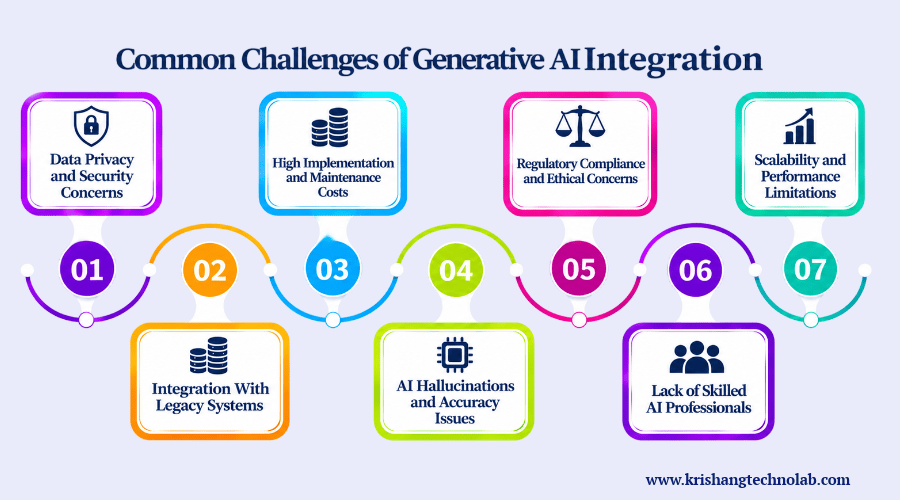
Data Privacy and Security Concerns
Sending sensitive data to outside models exposes it to risk. New issues such as prompt injection, data leakage, and unauthorized access require deliberate design for security.
Integration With Legacy Systems
Older systems might lack modern APIs, have inconsistent data formats, or have data siloed. Incorporating them into Generative AI development services may involve middleware, data migration, or partial modernization.
High Implementation and Maintenance Costs
Following the initial development, companies pay for the use of the model, infrastructure, monitoring, and skilled people. If usage is not managed and optimized, costs can spiral out of control.
AI Hallucinations and Accuracy Issues
Generative models can generate confident but wrong statements. Unmitigated errors can lead to financial, legal, or reputational damage in regulated or high-stakes environments.
Regulatory Compliance and Ethical Concerns
Laws about data security, openness, and computerized decision-making are changing from one area to the next. Also, groups need to deal with issues like bias, intellectual property, and the fair use of content made by other people.
Lack of Skilled AI Professionals
We don’t have enough AI engineers, data specialists, and governance experts. Companies can’t hire or upskill fast enough to keep up with ambitious roadmaps.
Scalability and Performance Limitations
Prototypes that work for ten users may not work for ten thousand users. If architecture wasn’t designed for scale, then latency, rate limits, and compute costs can limit performance.
Here is a table you can add above your title, “Generative AI Integration: A Complete Guide to Benefits, Use Cases, Challenges, and Implementation Strategies.”
Generative AI Integration Strategies
Generative AI integration strategies can help businesses to effectively implement integrating artificial intelligence (AI) technology and align it to their operational goals. To have a winning approach, it takes knowing the business needs, selecting the right AI models, curating quality data, and integrating Generative AI solutions into existing applications and workflows. Businesses also need to concentrate on data security, testing, and performance monitoring to ensure reliable results. A strong generative AI integration strategy can help organizations drive productivity and automate processes, improve customer experiences, and create scalable AI-powered solutions.
Generative AI Integration: Benefits, Use Cases, Challenges, Integration Strategies, Best Practices
Generative AI is assisting businesses to increase productivity, automate repetitive tasks, and create smarter digital experiences. Furthermore, Generative AI models can be added to existing business apps and workflows to help businesses run more efficiently, make better decisions, and give customers a better experience.
With knowledge of the advantages, use cases, and challenges of adopting generative AI integration, businesses can identify the right opportunities to adopt standard artificial intelligence (AI) technology the right way.
Here is a table with the main points for generative AI integration.
| Generative AI Integration | Description |
| What Is Generative AI Integration? | Connecting generative AI models with business applications, systems, and workflows. |
| Benefits of Generative AI Integration | Improving productivity, automating tasks, reducing manual work, and enhancing customer experiences. |
| Generative AI Integration Use Cases | Applications in customer support, content creation, software development, data analysis, and business automation. |
| Challenges of Generative AI Integration | Managing data privacy, security, accuracy, integration complexity, and implementation costs. |
| Generative AI Integration Strategies | Identifying business needs, selecting AI models, preparing data, integrating systems, and testing solutions. |
| Generative AI Integration Best Practices | Ensuring responsible AI use, monitoring performance, protecting data, and continuously improving AI systems. |
With Generative AI companies can embed sophisticated AI capabilities directly into their existing technology stack. Done well, organizations can build scalable AI solutions that are aligned to business goals, drive operational efficiencies, and bring long-term value.
Generative AI Integration Cost: What Should Businesses Expect?
The cost of integrating generative AI varies widely, from small API-driven pilot projects to multi-million-dollar enterprise programs. A budget is a budget, though, and it is essential to keep in mind that the right number depends on scope, complexity, and ambition, so treat any number as a range to validate with a detailed assessment.
Factors Affecting Generative AI Integration Costs
The main cost factors are number of use cases, model selection (hosted vs. self-hosted), data readiness, complexity of integration, security and compliance requirements, level of customization, and usage volume.
Infrastructure, Development, and Maintenance Expenses
Look at costs in three areas: infrastructure (compute, storage, licenses), development (engineering, prompt design, testing, integration), and ongoing maintenance (monitoring, updates, support, retraining). Maintenance is often overlooked during the planning phase.
How to Calculate the ROI of Generative AI Integration
Compare total costs to quantifiable benefits. Hours saved x labor cost. Lower error rates. Higher conversion. Faster resolution. New revenue. It’s a simple formula—benefits minus costs, divided by costs. Measure baseline performance before launch so improvements can be proven.
How to Choose the Right Generative AI Integration Partner?
If internal expertise is limited, a trustworthy generative AI development partner can speed up timelines and reduce risk. “Carefully assess any potential AI integration service provider.”
Evaluate Technical Expertise and Industry Experience
Search for proven experience with LLMs, RAG, data engineering, and cloud architecture, and an understanding of your industry’s workflows and regulations. Domain knowledge accelerates requirements and avoids expensive mistakes.
Check AI Integration Capabilities and Portfolio
Don’t just ask for demos. Request case studies, references, and examples of live production deployment. And they should be able to integrate with your existing Generative AI platforms and deliver measurable results.
Assess Data Security and Compliance Practices
Review certifications, security policies, data handling procedures, and the provider’s approach to intellectual property. Any legit company delivering AI solutions for business will be upfront about these things.
Consider Post-Deployment Support and Scalability
Integration doesn’t end at launch. Choose a partner that can offer monitoring, optimization, training, and a clear plan for scaling solutions as your needs change.
Future Trends in Generative AI Integration
Furthermore, models that understand and generate text, images, audio, and video together will allow richer applications. For example, visual inspection with spoken explanations becomes possible for teams working in busy factory environments. Similarly, voice-driven support that references screenshots helps customers resolve their problems much faster.
Rise of Agentic AI and Autonomous AI Agents
Little supervision is needed for AI agents to plan multi-step tasks, use tools, and act across applications. As they become more reliable, they will assume more end-to-end workflows—from procurement to customer onboarding.
Multimodal Generative AI Integration
Furthermore, models that can understand and generate text, images, audio, and video together will allow richer applications across industries.
For example, visual inspection with spoken explanations becomes possible, and voice-driven support that references screenshots helps customers solve problems.
Industry-Specific AI Models
Specialist models trained on legal, medical, financial, or engineering data will be more accurate for domain-specific tasks and will complement general-purpose foundation models.
AI-Powered Workflow Automation
Generative AI will be combined with workflow automation platforms, allowing processes to be dynamic and context-driven rather than rule-driven, making automation more resilient and intelligent.
Increasing Adoption of Private and Secure AI Models
Consequently, concerns about privacy and control are leading organizations to private deployments and smaller, more efficient models.
Moreover, on-premises or sovereign cloud offerings keep sensitive data within their borders. In addition, this shift gives companies stronger oversight over how their information is stored and used.
Conclusion
The business value of integrating generative AI is real overall: higher productivity, lower costs, better customer experiences, and faster innovation. But that value requires discipline, starting with clear goals and quality data. Then teams have to select the correct models and embed them into existing workflows. And, importantly, strong human governance and oversight should be preserved at each step of the project.
But with the right strategy and partners, businesses can overcome hallucinations, security, legacy systems, and skills gaps. So organizations that begin with targeted pilots, measure results, and thoughtfully iterate will build a lasting edge. Finally, a strong playbook for generative AI rollouts is critical for long-term enterprise AI adoption. It also ultimately supports long-term business change. Krishang Technolab is a web app development business that provides creative technological solutions that may help enterprises incorporate AI capabilities, optimize process, and accomplish their digital transformation goals.
Found this post helpful? Don't forget to share it with your network!