
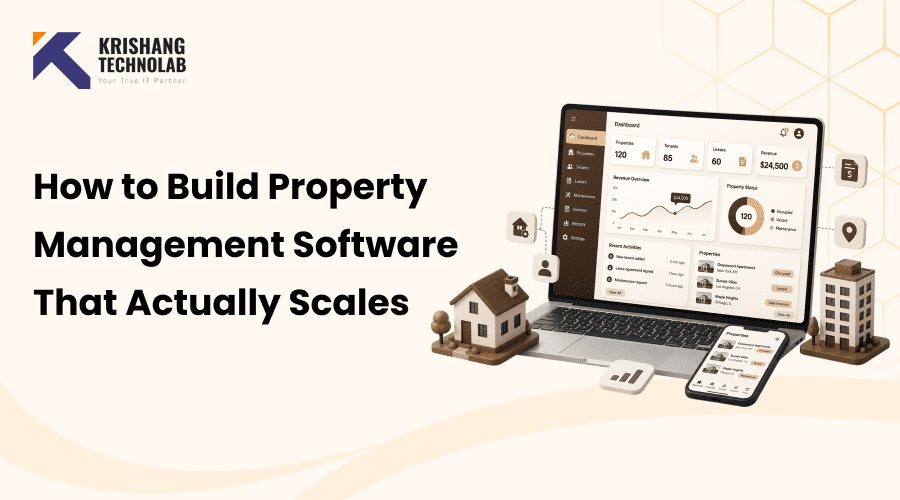
Quick Overview: This blog explains how to build Property Management Software that scales efficiently. It covers architecture, features, and development steps, including how to build scalable property management software from scratch, helping businesses create modern, cloud-ready real estate platforms.
A significant digital change is occurring in the real estate industry. As property management software becomes more widely adopted by property owners, landlords, real estate agencies, and property management companies, it is helping to streamline operations, improve tenant satisfaction, and increase profitability.
The global property management software market was valued at approximately $3.61 billion in 2025 and is projected to reach $5.89 billion by 2033, growing at a CAGR of 6.4%. According to industry reports, the global property management software market is expected to grow substantially in the next ten years due to the rising trend of companies shifting to digital property operations. This growth is fueled by demands for automation, remote control, cloud access and better data insights.
But creating software that works for a handful of properties is very different from creating a platform that can support thousands of units, users and transactions. That’s why it’s vital for modern real estate businesses to know how to build property management software that scales with the help of custom software development solutions.
In this blog you will find out about all the architecture, features, development cost and future trends.
What is Property Management Software?
Property management software is an application. It is helpful to landlords, property managers, and real estate companies. They manage properties from a single platform.
A modern property management system for real estate makes daily work easier. It helps in tenant communication. It also helps to collect the rent. They also support maintenance requests, lease tracking and money reports.
How Property Management Software Works
A rental property management system stores all the property information in a single database. It also automates a lot of the day’s tasks.
Property managers see key data on dashboards. That tells them how many people are there. They’re able to track rent payments. They can also handle maintenance requests. This way work gets done faster and easier.
Most modern platforms are cloud-based property management systems. This way, users can view data on any device. They can have it anywhere, too.
Transformation from Basic to AI-Powered PMS
The systems for managing properties have developed a lot in the last ten years.
Previous systems were about recordkeeping. They were also into accounting. But modern AI-powered systems developed through AI-powered software development do much more than that.
They can tell you when they need repair. They can automate tenant screening as well. Automatic financial forecasts are produced. Chatbots enhance customer service. Less work needs to be done by hand when processes are automated.
And they make managers’ jobs easier too. These automated workflows also assist managers in making better decisions.
Automata and AI are revolutionizing property management SaaS platforms. Thus, businesses work more efficiently. They also improve the tenant experience. The overall productivity increases.
Also Read About: What Is AI in Software Development and Why Does It Matter?
Evolution of Property Management Software
The real estate business has seen several phases of technology.
The property managers were using spreadsheets and manual filing systems. Small portfolios could benefit from these techniques, but as businesses expanded, they became less efficient. Hence, they became hard to handle at scale.
The second phase involved the development of digital desktop applications. These tools aided with organization but lacked flexibility and remote access. These limitations made it hard for users to work from anywhere.
The cloud-based property management software dominates the market today. Industry reports indicate that the adoption of cloud technology in real estate continues to grow at a rapid rate. Scalability, security and operational efficiency are also desired by businesses.
The next big thing in progress is artificial intelligence. Also, the AI-powered systems can automate lease management and improve tenant communication. They also offer predictive insights to help property managers make better decisions.
Types of Property Management Systems
Different solutions for different organisations. The choice depends on their size and the needs of their operations.
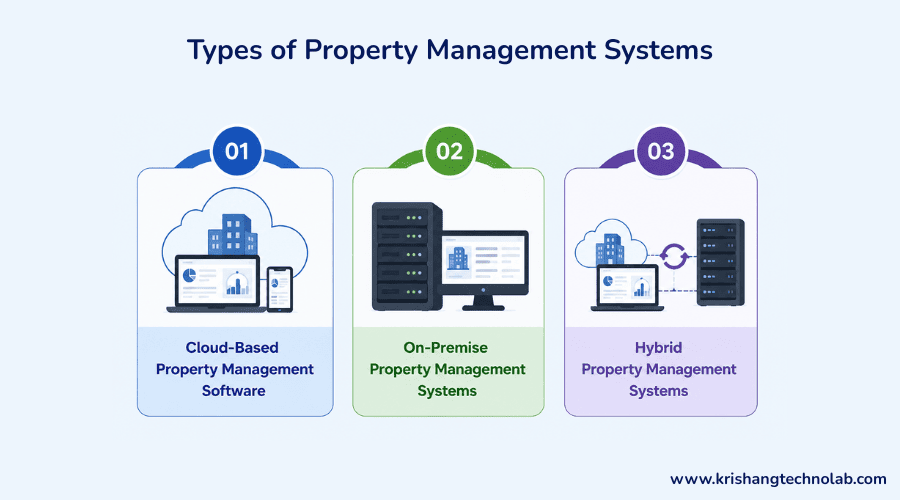
Cloud-Based Property Management Software
A cloud-based property management software solution stores data on servers that are not on site. It also has internet access.
This model provides good scalability. It also cuts down on maintenance costs. It also includes auto-updates and improved accessibility. Many companies therefore prefer it. Therefore, it is the best choice for companies that develop modern property management SaaS platforms.
On-Premise Property Management Systems
On-premise systems are hosted on company servers.
Some organisations use this route. It gives them more control of infrastructure and data. But it’s also more complex. Also, it calls for more upfront investment. It also needs constant management. Such an approach can lead to more expense in the long run.
Hybrid Property Management Systems
Hybrid systems combine features of the cloud and local infrastructure.
This is a common practice in enterprises. It allows for flexibility. They also support strict compliance requirements. It works well for organisations that need control and scalability.
Key Features of Property Management Software
Features are accountable for the success of any property management software. Businesses need to solve real-world problems. They should also make the user experience simple.
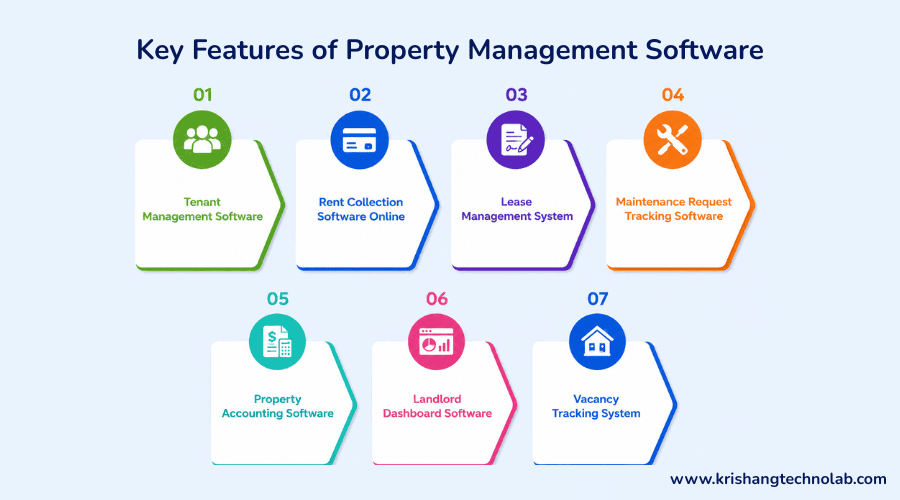
Tenant Management Software
A strong tenant management software module helps property managers to manage tenant onboarding. It also provides support for profile management, communication and documentation.
It consolidates tenant information. The amount of administrative work goes down.
Rent Collection Software Online
Modern tenants now expect digital payments.
The best rent collection software online feature promotes secure online payments. It also allows for automated invoicing and payment tracking. An automated rental reminder system also helps reduce late payments. This leads to increased cash flow.
Lease Management System
Creating leases is easy with a full-featured lease management system. It also helps with tracking renewals, storing documents and managing compliance.
Automated lease workflows reduce errors. It also saves precious time.
Maintenance Request Tracking Software
Many property management is about keeping things in good shape.
A maintenance request tracking software module enables tenants to submit requests online. It also enables property managers to monitor progress.
Property Accounting Software
One of the most important functions of any property management platform is financial management.
An integrated property accounting software system tracks expenses. It also keeps records of income and generates reports. Also, it helps when making financial statements.
Landlord Dashboard Software
Centralized landlord dashboard software for real-time property performance visibility. The occupancy rates, rental income and maintenance activity are also presented.
Vacancy Tracking System
Property managers utilize a modern vacancy tracking system to monitor the available units. It also monitors leasing opportunities. So it does help to increase the occupancy rates.
Advantages of Property Management Software Development
The business benefits of real estate software development are numerous, especially when companies consider software development outsourcing to reduce costs, access global talent, and accelerate product delivery.
Improved Operational Efficiency
Automation replaces repetitive work. It also reduces manual data entry.
This saves time for the property managers. They can spend more time on growing the business and tenant happiness and less admin work.
Significant Cost Savings
Many businesses view property management software as a cost-cutting measure. More efficient resources and automated workflow.
Research has shown that in some property management operations automation can cut administrative costs by as much as 30%. And that means companies save money over the long term.
Better Tenant Experience
Tenants today want comfort and convenience.
Features such as online payments, self-service portals, maintenance tracking, and automated messages are better for daily use, for example. What’s more, these tools create a faster, smoother experience for renters.
Data-Driven Decision Making
Modern systems give useful insights. They also help managers get a clear picture of the business’s performance.
Managers can look at occupancy rates, revenue trends, maintenance costs and tenant behavior. As a result, they can make better and faster business decisions.
Real-Time Applications of Property Management Software
A real estate property management system is flexible and can accommodate different types of property. It serves different real estate needs well. This means businesses can run operations more efficiently.
Residential Properties
Apartment management software and multi-property management software are a must for apartment complexes, housing societies and residential communities to run their day-to-day operations smoothly. For example, they use these tools to monitor rent, submit maintenance requests, and interact with residents. In addition, it decreases the manual work and increases the speed of service.
Commercial Buildings
Office complexes and retail properties need sophisticated lease administration, maintenance coordination and financial oversight. Moreover, a property management system helps organize lease agreements and track payments in real-time. It also helps to better plan for repairs and maintenance of the facility.
Vacation Rentals
Rental property management systems are used by vacation rental businesses to manage bookings, guest communication, pricing, and property maintenance. Additionally, these systems assist in updating the availability immediately and prevent double bookings. This allows property owners to enhance guest experience and boost efficiency.
Step-by-Step Property Management Software Development Process
Many businesses ask how to build scalable property management software from scratch. The answer is in having a structured development process.
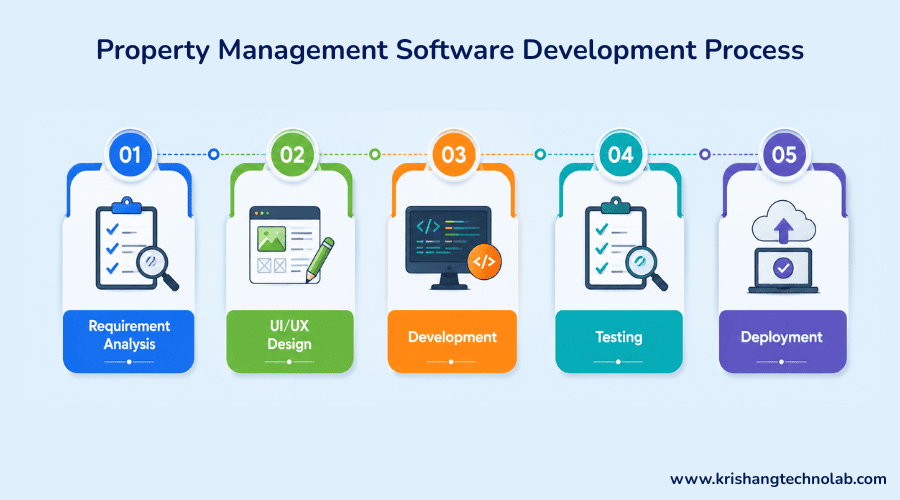
Requirement Analysis
First, the MVP development process begins with understanding business goals and user requirements. This step helps make the MVP more clear. It also helps in identifying the users to target. It helps teams to organise prioritisation of features.
UI/UX Design
A user experience that is easy to understand is a must. Users need to be able to accomplish tasks quickly. They should not require much training to use the system effectively. A good design increases the satisfaction of all users. That’s why many companies choose to hire UI/UX designers to create intuitive and user-friendly interfaces that improve overall product experience.
Development
This stage involves front-end development, backend development, API-first SaaS development and database implementation. When planning property management software development, developers should take an API-first approach to SaaS development. That makes integrations easier. It also enables future growth and scalability.
Testing
Testing proves the platform to be secure, reliable and free of critical issues. Performance testing is very important for property management software with scalability. It protects the system to cope with growth and heavy use.
Deployment
After successful testing, the platform is deployed in production environments on cloud infrastructure. We also use continuous deployment pipelines. This means that updates can be more frequent and releases simpler.
Best Architecture for Property Management SaaS
For long-term success, picking the right architecture is very important.
Multi-Tenant SaaS Architecture
A multi-tenant property management system design is one of the most important things to consider.
Multi-tenant SaaS architecture allows a shared application infrastructure to be used by multiple customers. But data for each customer is siloed and secure.
This means that the method reduces infrastructure costs. It also increases the overall system scalability and efficiency.
Microservices for SaaS Applications
Many organizations adopt microservices for SaaS applications for increased flexibility.
Microservices enable us to deploy components of the system independently. Each service can also scale independently of others based on demand.
Consequently, development is faster and more controllable. It also enhances system-wide fault isolation.
Also Read About: What Are the Best Practices for Microservice Architecture?
Database Design for Property Management System
A well-designed database for a property management system helps to store tenant records, leases, payments, maintenance requests and property data efficiently.
Moreover, normalization helps to minimize data duplication. It also increases query performance and data consistency.
So the system becomes easier to maintain and scale in the long run.
Scalable Backend Architecture SaaS
A robust, scalable backend architecture SaaS model should be able to handle thousands of concurrent users without any performance issues.
To achieve this, the system needs to use load balancing and caching. Horizontal scaling also helps with traffic spikes.
As a result, its performance is still stable under high load.
AWS Property Management Application Architecture
Many businesses prefer the architecture of the AWS property management application due to its automatic scaling, high availability, security controls, and global infrastructure.
For example, AWS services help distribute workloads. They also cut down on operational overhead.
That’s why it is often considered the best architecture for property management SaaS platforms.
Best Tips and Tricks to Implement in Property Management Software
A full property management software development guide for businesses should focus on future-ready technologies. They should also plan for scalability. They should also consider ease of use. Therefore, it becomes easier to achieve long-term growth. It also becomes steadier.
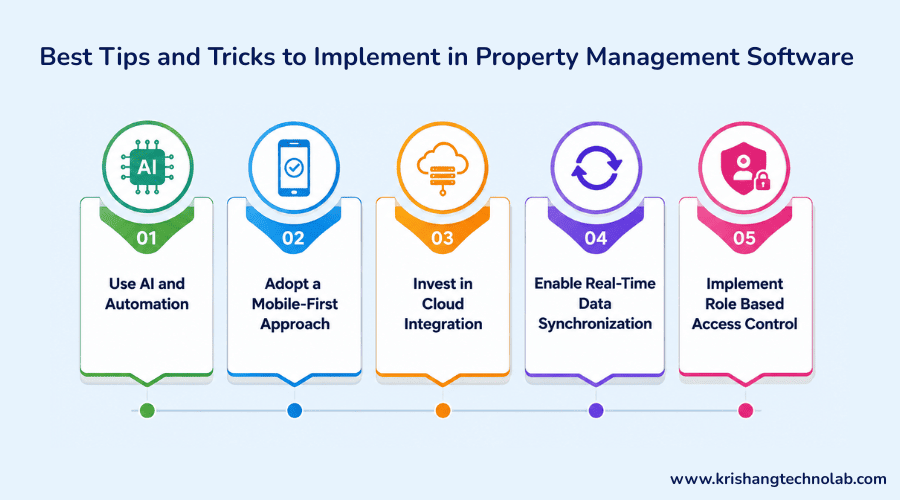
Use AI and Automation
AI can be used for tenant screening, maintenance scheduling, customer support, and financial forecasting.
Also, it reduces the manual work. It saves you time. Also it makes speed better. It also enhances precision. Thus, daily work is more efficient.
Also Read About: What Are the Key Differences Between AI and Automation?
Adopt a Mobile-First Approach
Mobile applications make tenants and property managers more approachable.
Also, features are accessible to users at any time. They can use them anywhere. That, in turn, drives engagement. Also, satisfaction increases. Mobile Application Development helps deliver these convenient and accessible experiences across devices.
Invest in Cloud Integration
A robust cloud architecture for a property management system provides flexibility, security and scalability.
Besides, cloud systems are easy to update. They also make backups of data. Recovery is simpler. So businesses can grow with less work.
Enable Real-Time Data Synchronization
Features such as real-time data sync and property management software capabilities improve operational accuracy and user experience.
Besides, real-time updates reduce chances of errors. Teams can also act more quickly. They can make better choices. Hence, the workflows are smooth. They also become more dependable.
Implement Role Based Access Control
RBAC, or role-based access control SaaS frameworks, restrict access to sensitive data to users based on their roles.
Also, users see only what they need. This increases safety. It also adds control. This makes it easier to manage compliance.
Property Management Software Development Cost
Many businesses are thinking about the cost to build property management software.
There are several factors that typically affect pricing. These include complexity, feature set, integrations and development location and infrastructure requirements. Therefore, costs can be wildly different.
MVP Development Cost
An MVP for property management software would typically include tenant management, rent collection, lease tracking, and basic reporting, making it a practical approach to MVP development for startups entering the real estate technology market.
Typically, it focuses solely on core features. This makes the development faster and easier.
Estimated cost: $20,000 to $60,000
Mid-Level Solution Cost
Platforms that range from $80,000 to $150,000 generally have more advanced automation, accounting, mobile applications and integration capabilities.
Also, these systems have got more features and better scalability. As a result, both the development time and cost increase.
Enterprise-Level Property Management SaaS Platform
A full-scale property management SaaS platform with AI features, multi-tenancy, advanced analytics, and enterprise security can cost anywhere from $150,000 to $500,000 or more.
Moreover, these platforms need a strong infrastructure. They also require higher security and advanced architecture. Therefore, the total cost becomes much higher.
Conclusion
To conclude, building scalable property management software needs the perfect combination of technology, automation, security, and user-centric design. A well-designed solution can also make operations easier. It can also enhance tenant experiences. Many businesses choose to hire dedicated software developers to ensure their property management platform is built for scalability, performance, and long-term success. And so it helps long-term businesses grow. Furthermore, the real estate industry is still adopting digital transformation. So, investing in a future-ready platform is important. Finally, collaborate with an experienced software development company like Krishang Technolab to develop a reliable, scalable and high-performing property management solution as per your business needs.
Frequently Asked Questions
What is Property Management Software?
Property management software is a digital instrument. It helps with managing rental properties, tenants, rent collection, maintenance requests and leases. You can complete all of these tasks within a single system.
How does property management software work?
It operates by centrally managing property data. The system is cloud- or server-based. It also automates rent payments and other tasks. And it manages tenant communication and maintenance tracking with a simple dashboard.
What features should property management software have?
It should include management of the tenant. It should also facilitate rent collection and lease tracking. They also have to deal with maintenance requests. It also includes key features such as reporting dashboards and accounting tools.
How do you build scalable property management software?
You need a multi-tenant SaaS architecture to build scalable property management software. Cloud hosting is also something you should use. Microservices also improve performance. A good database design is also essential for future growth.
How much does it cost to develop property management software?
The price depends on the complexity. For example, an MVP can be in the $20,000 price range. On the other hand, a full property management SaaS platform can cost $150,000+. Depends on the features and the scale.
What is the best software for property management?
The best software is based on business needs. For example, popular choices include Buildium and AppFolio. Plus, a lot of the popular rental property management software systems are cloud-based. They are more automated and scalable.
Found this post helpful? Don't forget to share it with your network!