Quick Overview: RAG and MCP are the two building blocks behind modern AI agents, but they solve different problems. This guide breaks down what each does, how they work, when to use them, and why most production AI systems in 2026 combine both for deeper knowledge and live action-taking capability.
If you’ve spent any time around AI development recently, you’ve probably run into two acronyms that keep showing up everywhere: RAG and MCP. They’re often mentioned in the same breath, sometimes treated as competitors, and frequently misunderstood.
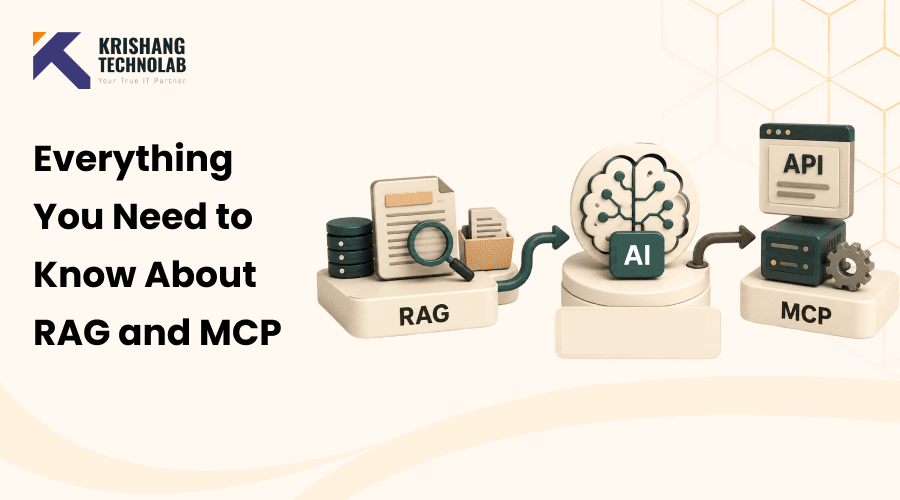
Here’s the short version: Retrieval-Augmented Generation (RAG) and the Model Context Protocol (MCP) solve two different problems. RAG helps an AI model learn more. MCP helps an AI model do more. Together, RAG and MCP power agentic AI systems that retrieve real information, take real actions, and answer questions intelligently.
As businesses look to develop generative AI to stay competitive, understanding the difference between RAG and MCP and how they work together is becoming essential knowledge not just for engineers but for anyone making decisions about AI strategy.
In this guide we’ll explain what RAG and MCP are, how they work, when to use them, and where the ecosystem is headed in 2026.
What is RAG (Retrieval-Augmented Generation)?
We call this Retrieval Augmented Generation, or RAG. Instead of relying on what it learned during training, an LLM can get relevant information from an external knowledge source before it generates a response.
How RAG Operates
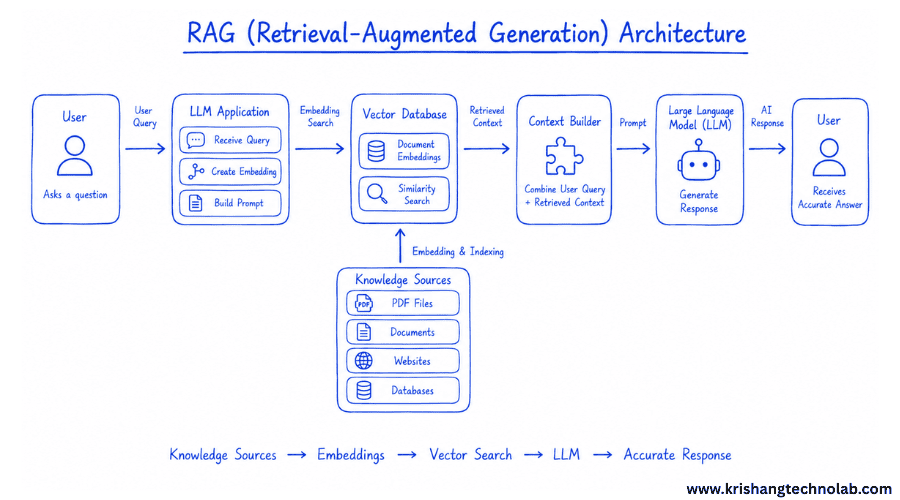
A typical RAG pipeline will have the following steps:
- Chunking: Is the process of breaking up documents (PDFs, wikis, manuals, and support tickets) into smaller pieces.
- Embedding: The embedding model generates a vector embedding for each chunk.
- Storage: This is where the vectors are stored, in a vector database.
- Retrieval: When a user submits a query, it is also translated into an embedding and compared using semantic search with stored vectors.
- Augmentation: Take the most relevant portions and add them to the first prompt.
- Generation: The LLM generates a response based on the query and retrieved context.
What Problem RAG Solves
RAG exists because LLMs have two core limitations: a fixed knowledge cutoff and a tendency to hallucinate when they don’t actually know something. RAG grounds responses in real, retrieved documents, reducing hallucinations and enabling developers to update a model’s knowledge without expensive retraining or fine-tuning.
This makes RAG particularly effective for large, unstructured document sets, think internal wikis, product documentation, or customer support knowledge bases where the underlying content doesn’t change every minute but is too large to fit into a single prompt.
Semantic Search vs. Keyword Search in RAG
Most people associate RAG with semantic search using vector embeddings to find content that’s conceptually related to a query, even if it doesn’t share exact wording. This is a powerful tool for natural language questions, but it doesn’t encompass the entire picture.
Keyword search (often using an algorithm like BM25) still matters inside a RAG pipeline. If a customer searches for an exact order number, product SKU, or error code, semantic search can actually underperform, because these identifiers don’t carry “meaning” in the way natural language does. That’s why most production-grade RAG systems use hybrid search combining semantic similarity with keyword/exact-match retrieval to achieve both conceptual understanding and precision.
Choosing an Embedding Model and Vector Database
Two key decisions determine how well a RAG system performs:
- Embedding model: How well the system models the meaning and nuance in your specific domain. A general-purpose embedding model may not perform well on highly technical or industry-specific language.
- Vector database: determines how efficiently the system searches at scale. Popular choices support different index types (like HNSW for fast approximate search or FLAT indexes for exact nearest-neighbor search when accuracy matters more than speed).
Getting these choices right along with a sensible chunking strategy is often the difference between a RAG system that feels magical and one that quietly retrieves the wrong context half the time. This is exactly why many teams turn to dedicated RAG implementation services rather than building the pipeline entirely in-house, getting chunking, embeddings, and retrieval tuning right the first time saves months of trial and error.
What is MCP (Model Context Protocol)?
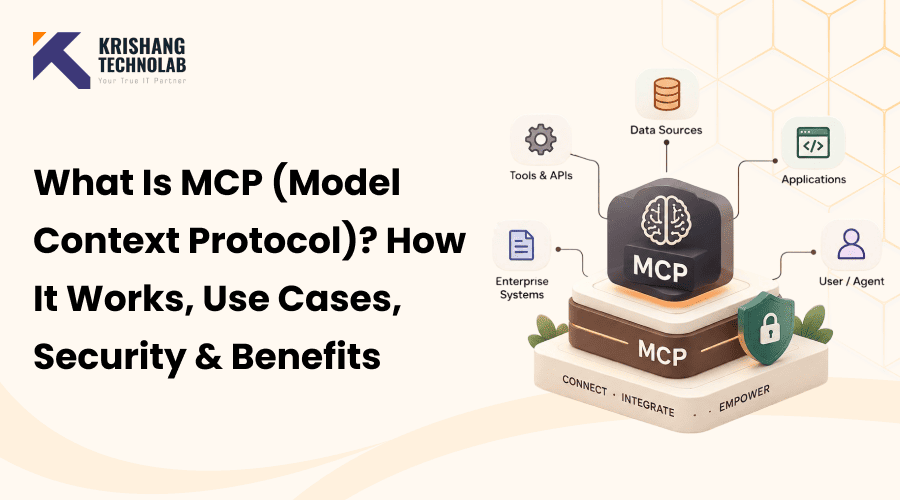
The Model Context Protocol (MCP) is an open standard, introduced by Anthropic in November 2024, that standardizes how AI applications connect to external tools, data sources, and services.
It’s often described as “USB-C for AI”; before MCP, every AI model needed a custom integration for every tool it connected to. Connecting three different models (say, Claude, GPT, and Gemini) to four different systems (a CRM, a ticketing tool, a database, and a code repo) meant building and maintaining 12 separate, brittle integrations. People sometimes call this the N×M integration problem.
MCP collapses this into N+M: each AI client implements the MCP protocol once, and each tool implements an MCP server once. Any compatible client can then talk to any compatible server, with no custom glue code required.
MCP’s Core Architecture
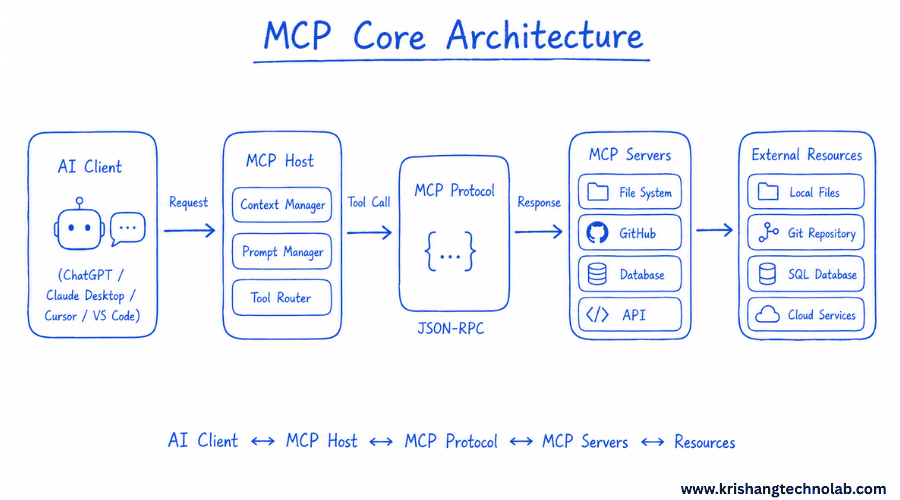
MCP defines three roles:
- Host: the AI application the user interacts with (e.g., Claude Desktop, an IDE, a custom app)
- Client: a component inside the host that maintains a connection to one MCP server
- Server: a lightweight service that exposes tools, resources, or prompts to the client
What Problem MCP Solves
RAG is about retrieving knowledge. MCP is about giving a model live access and the ability to act. Query a database, check a support ticket, update a record, or trigger a workflow all through a standardised interface. It’s what turns a model from a text generator into an agent that can actually work with your system.
MCP’s Core Primitives: Tools, Resources, and Prompts
The MCP servers expose capabilities under the host/client/server architecture through three core types:
- Tools: callable functions the model may call to perform some action or to get some dynamic information, e.g., search_web(query) or get_customer(customer_id). The model determines that it wants to call a tool. The host routes the call. The server returns a result.
- Resources: structured context objects referenced by a URI and pulled into the model’s context window when needed, similar to attaching a file rather than calling a function.
- Prompts: predefined templates a server can expose to guide how a client interacts with it for common tasks.
MCP also supports multiple transport layers, including stdio for local connections and HTTP/SSE for remote servers, which is part of why it works whether a tool lives on your laptop or in the cloud.
Why MCP Adoption Took Off So Quickly
MCP launched in late 2024 as a fairly narrow developer tool for AI-assisted coding. Within about a year, OpenAI, Google DeepMind, Microsoft, and AWS had adopted it, and in December 2025. Anthropic donated governance of the protocol to the Agentic AI Foundation, a directed fund under the Linux Foundation. That shift from a single-vendor project to an independently governed, vendor-neutral standard is a big part of why enterprises have felt comfortable building on top of it.
It’s also why teams increasingly look for a proper MCP integration platform rather than hand-rolling server connections for every tool, especially once an organization is managing more than a handful of integrations.
Read About: What Is AI Agent Development?
Benefits of RAG and MCP
RAG Benefits
- Reduces hallucinations by grounding answers in real, retrievable data
- No retraining required update the knowledge base instead of fine-tuning the model
- Handles large, unstructured content well (PDFs, wikis, manuals, support archives)
- Improves trust and accuracy, since responses can be traced back to source documents
Benefits of MCP
- Solves the N×M integration problem build a connector once, use it across any MCP-compatible model
- Gives models live, real-time data instead of a static snapshot
- Enables actions, not just answers writing, updating, and executing tasks on a user’s behalf
- Vendor-agnostic works across Claude, GPT, Gemini, and other MCP-supporting models
The Combined Benefit
Used together, RAG and MCP give an AI system both deep knowledge (through retrieval) and live capability (through standardised tool access), which is exactly the combination that powers modern agentic AI. Businesses evaluating this stack often bring in AI consulting services to figure out the right balance of retrieval versus live integration for their specific use case.
Do You Need Both? How RAG and MCP Work Together
Most production AI agents today use both RAG and MCP not as competing choices but as complementary layers.
A useful way to frame it is this: for any piece of data your AI system needs, you have two choices either index the data ahead of time and search it later (RAG), or fetch it live the moment you need it (MCP). The right choice depends on how large the data is, how often it changes, whether the AI needs to write to it, and who’s allowed to access it.
Example workflow: A refund request could require a customer support agent to have all of the following three things in one conversation:
- RAG fetches the corresponding refund policy from the knowledge base.
- MCP fetches the customer’s live order status from the order management system.
- MCP executes the actual refund once it’s approved.
There’s also a hybrid pattern worth knowing: instead of putting an MCP tool directly on top of a source API, some teams wrap their own RAG index behind an MCP server. The AI agent calls a standard tool (like search_knowledge), and behind that interface, the system runs vector similarity search. This gives you MCP’s clean, standardized interface with RAG’s retrieval quality underneath.
Architecting this correctly is often where teams bring in outside expertise, whether that’s a broader AI development company to build the full pipeline or more targeted help getting a knowledge base production-ready.
Learn About: How Generative AI for Business Is Transforming Workplace Productivity
Use Cases of RAG and MCP
RAG Use Cases
- Internal documentation and knowledge base search
- Customer support chatbots grounded in product manuals
- Legal or compliance document review
- Research assistants working across large document sets
MCP Use Cases
- AI coding assistants that read repos, run tests, and open pull requests
- Agents that query live CRM or database records
- Multi-tool workflows (e.g., pulling data from one system, processing it, and updating another)
- Customer-facing assistants that need both stored knowledge and live account data a common ask for teams building ChatGPT integration services into their existing products
Security & Governance Considerations
Neither RAG nor MCP is a “set it and forget it”
For RAG: knowledge bases go stale. Embedding models evolve over time. If you don’t refresh and monitor your retrieval layer, your AI will confidently cite outdated information.
For MCP: because MCP lets models take real actions, governance matters more than it might first appear. Earlier AI integrations often relied on broad, system-level credentials, which created exposure risk and made it hard to trace who or what did what. MCP is designed so that actions are performed in the context of the current user. This improves traceability but brings its own governance requirements.
The kind of risks you should plan for:
- Over-permissioned tools: an MCP server given more access than the task actually requires
- Untrusted third-party servers: community-built servers that haven’t been security-reviewed
- Prompt injection: malicious instructions embedded in retrieved content or tool outputs that try to hijack the behavior of the agent
- Weak audit trails: not logging which session made a request, which tool was called, and what was returned
Best practices include running untrusted servers in sandboxed or containerized environments, treating every third-party MCP server as zero-trust until verified, logging every tool invocation with timestamps and arguments, and scoping permissions as tightly as possible rather than granting broad, standing access.
As the adoption of MCP accelerates in 2026, with the protocol now being governed by the Agentic AI Foundation under the Linux Foundation, security questions have now moved from being purely a technical issue to a governance and risk management conversation at the executive level. sent conversation at the executive level. The same scrutiny applies on the retrieval side: enterprise RAG solutions need equally rigorous access controls, since a knowledge base is only as secure as the permissions governing who and which agents can query it.

The Future of RAG and MCP in Agentic AI
By 2026, MCP has gone from a niche developer tool to a widely adopted standard, with support from OpenAI, Google DeepMind, Microsoft, and AWS and tens of thousands of active public MCP servers. RAG, meanwhile, remains the backbone of how AI systems ground themselves in an organization’s actual knowledge; it hasn’t been displaced by MCP and isn’t likely to be, because the two solve fundamentally different problems.
Looking ahead, a few trends are already visible:
- More first-party MCP servers shipped directly by major SaaS platforms, rather than community-built wrappers around a public API
- Asynchronous, long-running operations: Early MCP interactions were request/response only; newer proposals introduce the ability for an agent to kick off a long job and poll for completion later.
- Centralized discovery and trust layer registries that let hosts search, install, and verify MCP servers the way developers search npm or PyPI today, instead of manually configuring server paths
- Tighter security and governance tooling as enterprise adoption grows and compliance requirements catch up with agentic capabilities
- RAG and MCP are increasingly bundled into unified “agent context” architectures, rather than treated as two separate systems a team has to wire together manually.
The practical takeaway: this isn’t a “pick one” decision. The businesses getting the most value from generative AI right now are the ones combining retrieval and live tool access into a single, well-governed system and treating both the knowledge layer and the action layer as first-class parts of their AI architecture, not afterthoughts.
Read More About: How to Choose the Right AI Software Development Partner
Conclusion
RAG and MCP aren’t competitors; they’re two halves of the same picture. RAG gives your AI system deep, grounded knowledge. MCP gives it the ability to reach out, fetch live data, and take action. Understanding both and knowing when to use each is quickly becoming a baseline requirement for anyone building serious AI applications. custom generative AI solution tailored to your business, or hire AI developers to build and maintain your RAG and MCP architecture end to end.
Need help implementing RAG or MCP in your product? Get a Free Consultation about building a custom generative AI solution tailored to your business.
Found this post helpful? Don't forget to share it with your network!