The right path for your mobile project will determine your budget, timeline and growth outlook. There’s a reason why so many founders are agonising over the React Native vs native app development decision. Both routes produce strong results, but differ in cost, speed and performance.
With React Native you write once and can run on iOS and Android. But native apps require you to write separate code for each platform. So the React Native vs native argument tends to be one of priorities. Budget, timeline and long term scalability all play a role. Learn more about each major factor in this guide so you can confidently choose for 2026 and beyond.
Both approaches have their adherents within the field of development. So, it is essential to know the react native vs native app development comparison in detail before you invest your resources. We will look at real differences in cost, speed, and everyday performance. By the end, you should feel confident about which direction fits your project.
What Is React Native?
React Native is an open-source cross-platform app development framework built by Meta. It allows developers to write JavaScript once and run it on several platforms, helping teams save time without losing much functionality. Working with a React Native solutions company can make this approach even more effective for startups looking to balance development speed, cost, and app quality. This makes the React Native vs native app debate especially relevant for start-ups.
How React Native Works
React Native links your JavaScript code to native components. “The apps feel and look native, but the code is in JavaScript.” This structure speeds up the process of sharing ideas and making updates. Also, it reduces the requirement of separate iOS and Android teams.
Popular Apps Built with React Native
Instagram, Discord, and Shopify are some of the popular apps that use React Native. These companies wanted speed but not at the expense of too much quality. React Native has been proven in high traffic, high demand environments. This track record is a strong argument in the react native vs native app development debate.
What Is Native App Development?
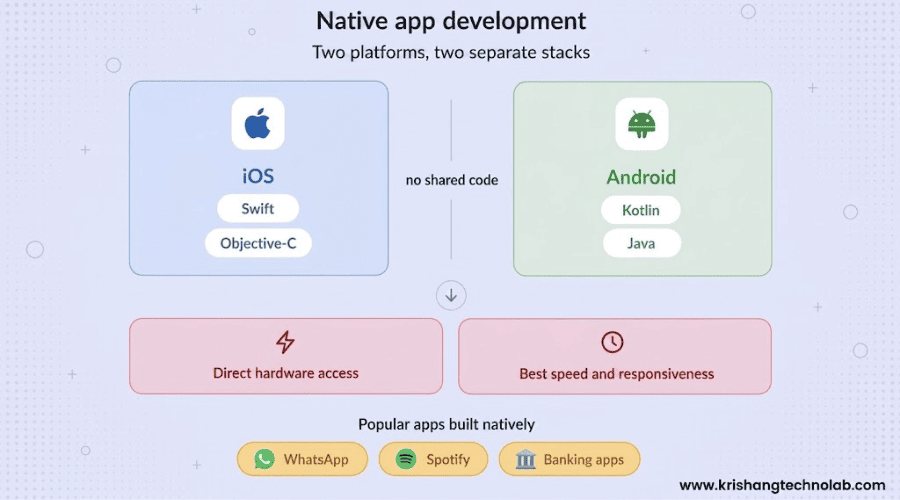
Native app development is the creation of separate apps using platform-specific languages. Swift and Objective-C power iOS apps, while Kotlin and Java are used for Android. This separation allows native apps to deliver high performance and direct access to platform features, but it can also mean more development time and a bigger budget. For businesses looking for a cross-platform approach, React Native app development services can help build applications for both iOS and Android using a shared codebase.
How Native Development Works
Native developers use official tools and software development kits (SDKs) of each platform. It gives the apps full access to the device’s hardware and capabilities. This tight integration often leads to better speed and responsiveness. But teams have to sustain two completely separate codebases.
Popular Apps Built Natively
Many banking platforms, WhatsApp, Spotify and others are native development. These apps require top notch performance and rock solid security. Therefore, native development is still the preferred choice for complex resource-heavy applications. This is important context when considering react native vs native iOS development for your product.
React Native vs Native App Development: Key Differences at a Glance
It is helpful to see the basic differences side by side to get the details. This snapshot compares react native vs native app development options on most common decision parameters.
| Factor | React Native | Native Development |
| Codebase | Single, shared | Separate per platform |
| Cost | Lower | Higher |
| Development Time | Faster | Slower |
| Performance | Very good | Best possible |
| Maintenance | Easier | More demanding |
In general, React Native is all about speed and budget and native development is about raw performance. But the final factor should be your own goals. The following sections describe each factor in more detail.
Notably, the react native vs native development comparison differs according to the complexity of the app. It’s not the same to run a simple booking app as a graphics-heavy game. Hence, it is more important to match your app requirements with the suitable framework than following the trends blindly.
Performance Comparison
Performance often decides the react native vs native performance comparison for many teams. Native apps generally run slightly faster because they use platform-specific code directly. Still, React Native has closed much of that performance gap in recent years. For most business apps, users rarely notice the difference.
Rendering Speed and Responsiveness
The UI elements in native apps are generally rendered faster than React Native. This is because native code talks directly to the operating system. At the same time, the performance differences between react native and native app are less for less graphics-heavy, simpler apps. Native development remains the preferred method for games and animation-heavy apps.
Access to Native APIs and Device Features
With native development you have full and immediate access to all new device features and APIs. In contrast, React Native sometimes requires third-party libraries to support newer features. Consequently, react native performance vs native access can lag slightly behind on launch day. Most standard business features, though, work smoothly on both platforms.
For teams deciding between react native vs native android development alone, the complexity of Android’s fractured device landscape complicates things either way. Similarly, react native vs native ios development tends to favor whichever framework the team knows best. Ultimately, most apps never push hardware limits enough to notice a real difference.
Cost of React Native App Development
Budget is one of the major factors when comparing React Native vs Native App Development Cost. Cost of React Native App Development is generally lower than building two separate native apps because a single team can develop for both iOS and Android using a shared codebase. This reduces development hours and resources, making React Native an attractive option for startups and small businesses looking to control their budget while launching quickly.
Upfront Development Cost
Building with React Native usually costs less upfront than native development. One shared codebase means fewer developer hours overall. Therefore, the react native vs native app development cost gap can be significant for smaller projects. Native development, by contrast, requires two separate teams working in parallel.
Long-Term Cost of Ownership
In most common use cases, long-term costs also favour React Native. Updates and bug fixes are applied to one codebase, not two. Eventually, highly complex apps may need native modules anyway. This can slightly reduce the cost advantage of react native over native app over several years.
Even companies that are planning roadmaps for multiple years should still budget for some native work. Still, the overall React Native app development cost is lower throughout the product lifecycle. This makes it a good option for teams that are watching every dollar.
React Native Development Time
As it pertains to the React Native vs Native development time debate, speed to market is often the deciding factor. React native development time is usually shorter with shared logic and shared components. In the meantime, native development takes longer, because teams have to build everything twice. This difference matters a great deal for time-sensitive launches.
Time to Build an MVP
Startups usually require a working product quickly to test their idea. The development time for an MVP in React Native is usually shorter than in native. For their first launch many early-stage founders choose React Native over native app development as a product validation method. Native development still works, but it requires a bit more patience.
Time to Build a Full-Scale App
Doesn’t matter what framework you use. Complex apps with a lot of features take longer. Even at scale, react native vs native app development time gaps tend to stay. Shared code saves hours on both platforms. Native teams can catch up when apps need deep hardware integration.
This time edge is often valued by companies in a race against competitors. When you build with React Native faster you get feedback from users faster and can iterate faster. That head start can outweigh small differences in performance for many products.
User Experience (UX) Comparison
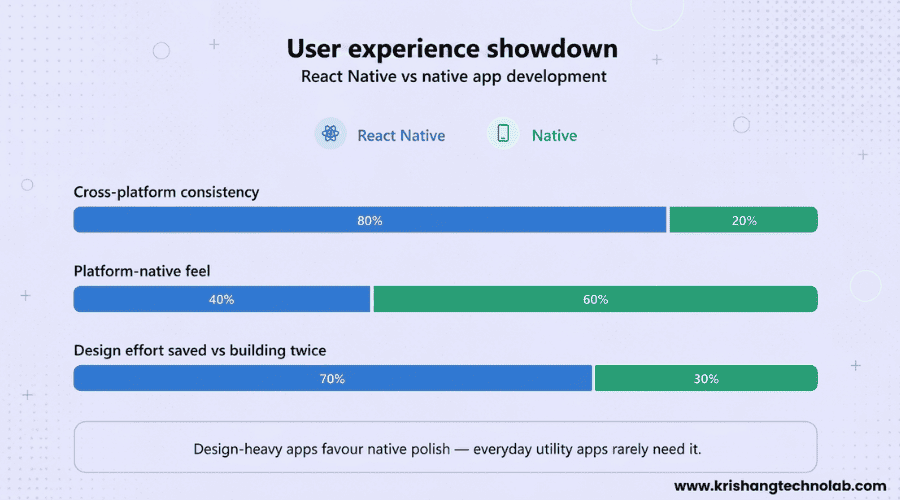
User experience is the key to retention and it is a big part of the talk around react native vs native mobile apps. Native apps have a more polished look, as they adhere closely to the platform design guidelines. React Native apps have come a long way, but in complex interfaces, gaps may still arise.
UI Consistency Across Platforms
React Native provides a better UI consistency for both iOS and Android. This is because most of the components are derived from a common codebase. In contrast, with native development, manual effort is needed to ensure both versions look the same. Teams spend more time to bring designs together across platforms.
Platform-Specific Look and Feel
“Native apps are naturally built to the design language and behaviour patterns of each platform.” Therefore, they tend to be more “at home” on their own devices. This can also be done in React Native but needs some additional customisation. This trade-off is important for apps with very specific design goals.
However, if you are developing a design-heavy product, react native vs native app development has a lot to do with your users. In fashion, media, and entertainment, apps often argue for the native polish. But for everyday utility apps, that level of platform-specific polish is rarely needed.
Scalability Comparison
Growth plans are important when considering react native vs native mobile development options. Native development is generally more scalable for very complex feature rich applications. React Native, tho, scales easily enough for most average business and consumer apps. Your estimated user base and feature roadmap should dictate this decision.
Scaling for a Growing User Base
With proper architecture both frameworks can scale to accommodate more and more users. But, native apps do sometimes handle very high traffic more efficiently. So the considerations on react native vs native android development become important for apps expecting massive scale. Most growing startups, however, never reach this ceiling early on.
Handling Complex Features Long-Term
Advanced AR or heavy background processing are very specialised features that are better suited to native development. Many advanced features can be supported in React Native using native modules. But that brings complexity back to your originally simple codebase. This trade off is important for long term product planning.
Many fast growing companies start with React Native, and add native modules later. This dual approach offers flexibility without an early, expensive commitment. As your app grows you can selectively add native code where it counts.
Maintenance and Updates Comparison
Ongoing maintenance affects total cost of ownership significantly over time. React Native is generally more maintainable than separate native code bases. This benefit is another plus point in the react native vs native app development benefits for long-term products. Both these approaches require occasional attention and updating.
Code Reusability and Updates
React Native’s shared codebase means updates can be applied to both platforms at the same time. This saves a lot of developer time compared to updating two separate apps. This means teams get fixes and new features out faster with React Native. This work needs to be copied separately for iOS and Android for native development.
Bug Fixing and Platform Upgrades
Most of the time bug fixes in React Native fix the issue for both platforms at the same time. In contrast, the native development needs separate fixes for bugs on iOS and Android. Also, operating system upgrades can sometimes have different effects on native apps across platforms. Maintenance burden is a big part of the react native vs native development pros and cons discussion.
Over a multi-year life span these small maintenance savings add up significantly. This reduction in effort is especially beneficial to teams with small engineering departments. So long-term maintenance often tips the scale in favour of React Native for lean teams.
Why React Native for Mobile Apps? Pros and Cons
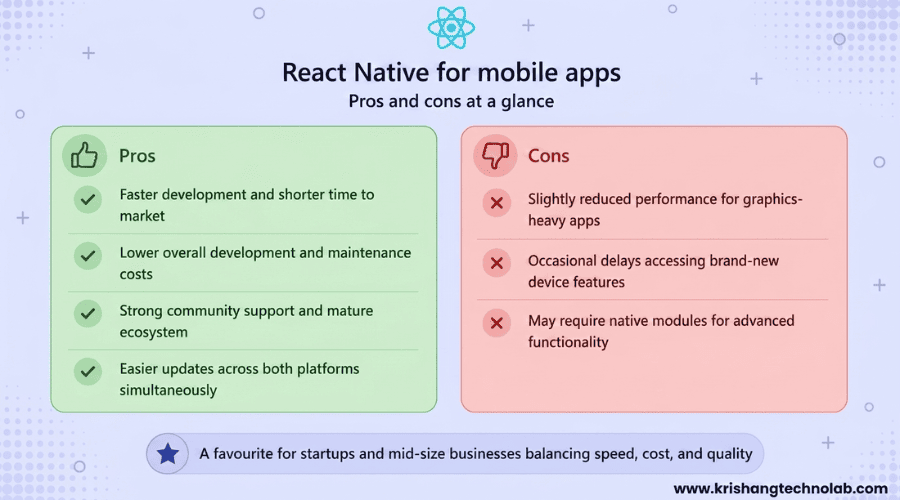
React Native offers businesses a practical way to save time, reduce development costs, and reach both iOS and Android users with a single codebase. This efficiency makes it particularly attractive to startups and growing businesses that need to launch quickly while making the most of limited resources. Why React Native for Mobile Apps? The framework provides a balance between development speed, cost-effectiveness, and cross-platform compatibility. However, React Native is not the right solution for every type of app, and the best choice ultimately depends on your project’s performance, feature, and scalability requirements.
Pros:
- Faster development and shorter time to market
- Lower overall development and maintenance costs
- Strong community support and mature ecosystem
- Easier updates across both platforms simultaneously
Cons:
- Slightly reduced performance for graphics-heavy apps
- Occasional delays accessing brand-new device features
- May require native modules for advanced functionality
That’s also why React Native for mobile apps continues to be a favourite for startups and mid-size businesses.
Pros and Cons of Native App Development
The native app development still has a strong position for some use cases. This is often most useful for performance-critical hardware-dependent apps. Native development is also well suited to apps that require advanced device capabilities and highly responsive performance.
Pros:
- Best possible performance and responsiveness
- Immediate access to newest platform features
- Ideal for graphics-intensive or complex apps
Cons:
- Higher development and maintenance costs
- Longer development timelines for dual platforms
- Requires separate, specialized development teams
Your company objectives should be the first item on your list of advantages and disadvantages of developing native versus React Native apps.
React Native Trends Shaping 2026
Here are some of the React Native Trends Shaping 2026 that business owners should know about. These ongoing developments are improving performance, strengthening native integrations, and gradually reducing the gap between React Native and native apps. Keeping up with these trends can help businesses make better technology decisions and plan a more effective long-term mobile app strategy.
- New Architecture improvements — Ongoing upgrades boost performance and native module integration
- AI-assisted development tools — These tools are speeding up React Native workflows significantly
- Expansion into desktop and wearables — Cross-platform frameworks now reach beyond mobile devices
- Growing enterprise adoption — Large companies increasingly trust React Native for mission-critical apps
All of these React Native trends for 2026 will lead to wider and more confident use. This momentum means the picture for react native versus native app development 2026 appears more promising and more encouraging for React Native.
Which Is Better: React Native or Native App Development in 2026?
Your final choice is based on your budget, timeline and app complexity. If you are a startup and you need to start fast and cheap, React Native is usually a good choice. But if you’re a large company and you need high performing apps, native development is usually the way to go.
If your app needs deep hardware access, then native development makes more sense. React Native vs native which is better is usually in favour of React Native for standard business apps.
So should I go with react native or native for my startup? Most of the time, React Native’s speed is the most important for limited-runway startups, while well-funded enterprises with complex platforms may still justify native development.
React Native vs Native App Development: Choosing the Right Partner
Half the job is picking the right framework; the other half is choosing the right team to build it well. Many companies Hire Skilled React Native Developers with proven experience or Hire React Native Development Experts to reduce development risks, improve product quality, and speed up delivery.
You can hire dedicated React Native developers for focused support, partner with a full React Native development agency for end-to-end delivery, or use React Native app development services for a specific feature or sprint, depending on your needs.
A dependable React Native solutions company also ensures your app stays trendy and updated with best practices, thus protecting your long term investment.
FAQs
Is React Native still relevant compared with Native App Development in 2026?
Will React Native Still Be Relevant in 2026? Yes. It is always competitive because of its huge and lively developer community and because it is constantly updated. Performance and tooling are not slowing down, another React Native trend impacting 2026. It’s very platform agnostic and is still popular with a lot of businesses.
React Native vs Native App Development: Which Is Faster?
Complex or heavy graphics apps may be a little slower with React Native. But the react native vs native performance comparison shows little difference for most standard apps. Everyday business applications show little sign of lag. With each release, React Native updates are closing performance gaps further.
Which is cheaper: React Native or native development?
React Native is generally cheaper as it uses one codebase. React Native app development cost is low in the short run as well as in the long run. Native development requires separate teams which further increases the overall cost of the project. This is why React Native is often the go-to for budget-conscious businesses’ projects.
React Native or Native Development: Which Approach Is More Effective?
Neither is strictly better, each is better for different goals. React Native wins on speed, cost and easier maintenance. Native wins on raw performance and close hardware access. Which approach to use should be determined by the specific needs of your app.
Can a React Native app be converted to native later?
“Yes, teams can move some features into native code over time.” A lot of apps start out with React Native and gradually add native modules. This hybrid model allows companies to scale without the costly initial rebuild Plus it allows for flexibility in development as your product changes.
Conclusion
Ultimately, the choice between React Native and native app development depends on your app’s requirements. React Native offers faster development, lower costs, and easier long-term maintenance, while native development delivers the best performance for complex and demanding applications. You can hire dedicated React Native developers to work directly on your app and its features.
Neither is universally “better” than the other. The right answer is the one that fits your budget, timeline and feature needs. Startups and growing businesses prefer it for its efficiency and speed.
Companies building performance-critical products may still prefer native development. No matter which path you take, it is most important to work with seasoned professionals. So, hire a good React Native development agency and make your vision come true successfully.
It also makes sense to revisit the react native vs native app development question from time to time. Technology changes fast and the trade-offs you make today may be different in a year or two. Keep your business agile by staying up to date with the news.
And in the end, good planning beats going with the flow. Now, compare your goals with the react native vs native app development factors we discussed above. This will help you to determine what technology investment is right for your business.
Found this post helpful? Don't forget to share it with your network!