Quick Overview: React Native App Development Cost in 2026 range from $10,000 for a simple MVP to $250,000+ for complex apps. This guide breaks down pricing by country, hiring model, and app type, plus hidden costs, maintenance expenses, business benefits, and key risks, helping you budget accurately before starting your project.
Planning a mobile app in 2026? One of the first questions every founder, product manager, or business owner asks is simple: how much does React Native app development cost? The honest answer is that it depends. A simple MVP can cost as little as $10,000, while an enterprise-level product with many features can cost more than $250,000 or more.
This guide will explore the costs of React Native App Development including factors that affect costs, hourly rates in different countries, pricing based on app type, hidden costs, maintenance and how React Native compares to native and other cross-platform frameworks so you can accurately budget your project.
Why Do Businesses Still Choose React Native in 2026?
React Native remains one of the most popular frameworks for cross-platform app development because it enables teams to write one codebase for both iOS and Android, dramatically reducing the development time and cost when compared to building two native apps.
Fast-forward to 2026, and React Native apps are behaving more like native apps than ever. The framework’s new architecture (Fabric and TurboModules) is now mature and stable, but the React Native tech stack cost is still lower than fully native development. The biggest reasons why startups and enterprises alike keep choosing it are a large developer community, a mature third-party library ecosystem, and a faster time to market.
Why Invest in React Native for Your Business?
Businesses are looking to invest in the framework in 2026 not just to reduce the cost of React Native app development.
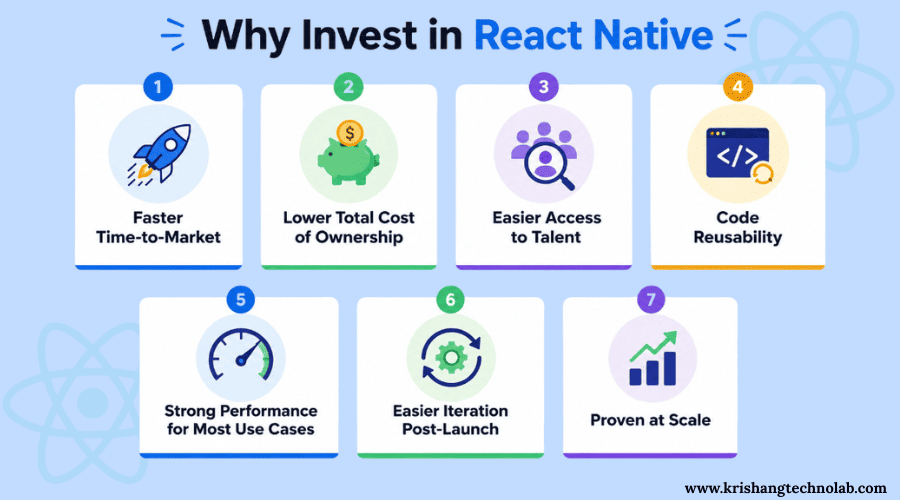
1. Faster Time-to-Market
You have one codebase that works on iOS and Android, so you can get your product into both app stores at the same time instead of waiting for two separate native builds. It’s the speed advantage that matters most for startups racing to validate an idea or win a market window.
2. Lower Total Cost of Ownership
Beyond the initial build, maintaining one codebase instead of two cuts long-term React Native app maintenance costs roughly in half compared to running parallel native teams where you’d need to hire iOS developer and Android talent separately.
3. Easier Access to Talent
The increasing popularity of React Native gives us a larger pool of developers around the world. This, in turn, provides companies with more flexibility around hiring and the ability to build and scale teams as needed. Moreover, companies can get an idea of the cost of React Native development per hour without depending on a specific, more difficult skill set, where you’d otherwise need to hire iOS developer or hire Android developer talent separately for native builds.
4. Code Reusability
Roughly 80–95% of code can be shared across platforms, and often teams can even reuse logic between the mobile app and a web app built with React, stretching the same investment further.
5. Strong Performance for Most Use Cases
With the new architecture (Fabric and TurboModules) now mature, React Native apps handle animations, navigation, and most business logic with near-native performance good enough for the vast majority of commercial apps, from e-commerce to on-demand services.
6. Easier Iteration Post-Launch
Features such as CodePush/OTA updates enable teams to deploy certain JavaScript-level updates without undergoing a full app store review process, thereby accelerating bug fixes and the release of minor features, a clear business benefit in responding to user feedback or market changes.
7. Proven at Scale
If you see large companies with large budgets still running production apps with React Native in 2026, then it’s a good indicator for the health of React Native.
How Much Does React Native App Development Cost in 2026?
The average price to develop a React Native app goes up from $10 000 to above $250 000. It depends on complexity, features, design, and the development team you hire.
| App Complexity | Estimated Cost (USD) | Timeline |
| Simple app (MVP) | $10,000 – $40,000 | 6–10 weeks |
| Medium complexity app | $40,000 – $90,000 | 3–5 months |
| Complex/enterprise app | $90,000 – $250,000+ | 6–12+ months |
These are the costs of React Native app development for a typical project. The cost to build a React Native app development will vary depending on the factors mentioned below. So, take this table as a benchmark to start with and not an actual cost estimate.
Also Read: Why should you opt to react native for mobile app development?
What Factors Affect React Native App Development Cost?
The first step to a correct budget is to know what affects the cost of React Native app development. These are the biggest drivers of cost:
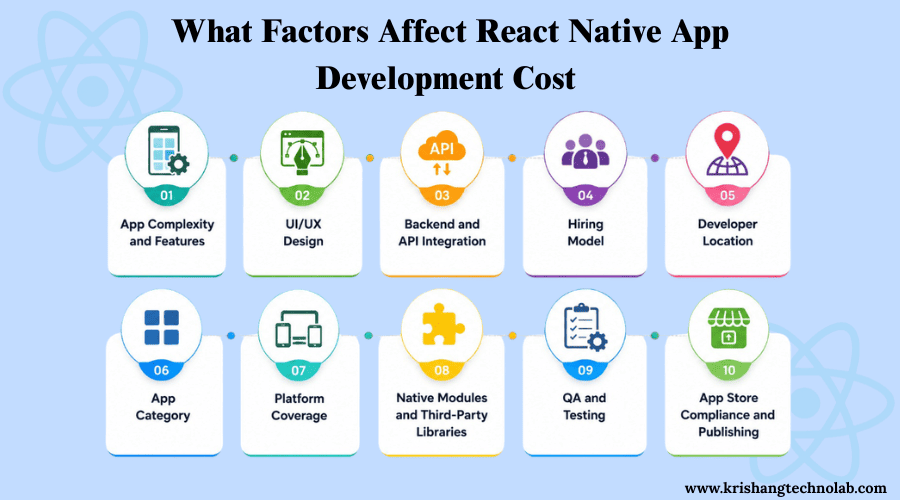
1. App Complexity and Features
Basic apps with login, profile pages, and static content will never cost what a real-time chat feature, AI functionality, or offline sync will. Every added screen, every extra bit of logic, every new integration, it all stacks up in development hours.
2. UI/UX Design
Going with a template or a pre-built UI kit keeps costs down compared to a fully custom design built around bespoke animations and micro-interactions. Custom UI/UX design work usually tacks on another 15–25% to the overall budget.
3. Backend and API Integration
Apps running on backend service platforms like Firebase or Supabase come in cheaper than those needing a fully custom backend. And each third-party integration, payment gateway, maps, social login, and analytics brings its own development time plus ongoing subscription fees.
4. Hiring Model
Freelancers, an agency, an in-house team, or an outsourced offshore team; whichever route you pick changes your React Native development cost per hour quite a bit (more on this below).
5. Developer Location
Rates swing wildly depending on where your developers are based, which makes location one of the strongest levers you have for controlling cost.
6. App Category
An e-commerce app, an on-demand service app, and a social networking app each start from a completely different baseline feature set, so naturally, the price tags differ too.
7. Platform Coverage
Building for iOS and Android at the same time, React Native’s whole selling point still works out cheaper than two separate native builds, though it’ll cost more than sticking to just one platform.
8. Native Modules and Third-Party Libraries
Most React Native apps lean on pre-built libraries, but the moment a feature needs custom native code, say, deep hardware integration, you’re looking at extra developer hours for native bridging.
9. QA and Testing
Testing across multiple devices and OS versions, whether manual or automated, isn’t optional for quality, but it does add to the overall React Native app development pricing.
10. App Store Compliance and Publishing
Apple and Google both charge developer fees and run their own review processes. Fall short on compliance, and you’re looking at rework costs nobody budgeted for.
Read About: How to Choose the Right Mobile App Development Agency
How Much Do React Native Developers Charge Per Hour?
The hourly cost of React Native development highly depends on the hiring model you choose.
| Hiring Model | Hourly Rate (USD) | Best For |
| Freelancers | $15 – $60/hr | Small projects, MVPs |
| Development Agency | $40 – $150/hr | Full-scale, managed projects |
| In-house Team | Salary-based | Long-term, ongoing products |
| Outsourced Offshore Team | $15 – $50/hr | Budget-conscious projects |
Freelancers have the lowest hire React Native developers, but you’ll usually be managing more of the project yourself. Agencies, for their part, charge more but provide accountability and a process.
That higher price tag usually makes sense too, as a React Native app development company rolls project management, design, and QA into their rate, which is exactly why agency quotes come in above a single freelancer’s hourly number, even as they tend to deliver more predictable results.
React Native Developer Hourly Rate by Country
Developer location is one of the strongest levers on your total budget. Here’s a general breakdown of React Native developer hourly rate by country:
| Country/Region | Hourly Rate (USD) |
| USA | $80 – $180 |
| UK | $70 – $150 |
| Western Europe | $60 – $120 |
| Eastern Europe | $30 – $70 |
| India | $15 – $40 |
| Southeast Asia | $15 – $35 |
React Native App Development Cost Breakdown by Country and App Size
| Country | MVP Cost | Medium App | Complex App |
| USA | $25,000+ | $70,000+ | $150,000+ |
| UK | $20,000+ | $60,000+ | $130,000+ |
| India | $8,000+ | $25,000+ | $60,000+ |
React Native App Development Cost in USA
Costs here sit at the top of the global range, and it comes down to higher labor costs plus a mature, competitive tech market. A US-based team building a simple MVP will usually start you around $25,000, while medium and complex apps climb to $70,000–$150,000+ without much trouble.
React Native App Development Cost in UK
The UK tracks pretty closely with the US, just a notch lower on average. MVP pricing tends to start near $20,000, then scales up from there depending on how complex things get.
React Native App Development Cost in India
Here’s where the numbers drop considerably, which is exactly why India has become such a go-to outsourcing destination. MVPs can cost as little as $8,000, and even complex apps tend to stay under $60,000, about a third of what you’d pay in the US for the same scope.
React Native App Development Cost by App Type
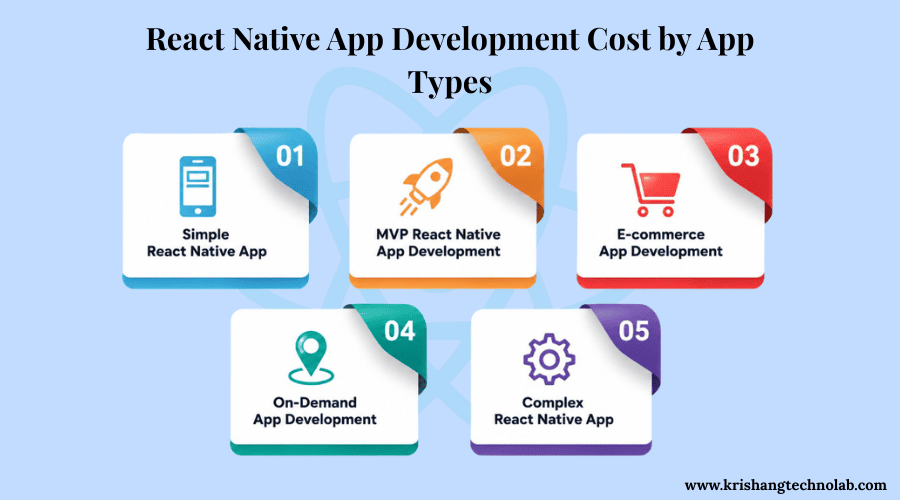
Cost to Build a Simple React Native App
A simple app, think authentication, a user profile, static content, and basic navigation, usually runs $10,000 to $25,000 and takes about 6–10 weeks to put together.
MVP React Native App Development Cost
An MVP should stick to only the core features you need to validate your idea: one or two key user flows, a basic backend, and the essential screens, nothing more. MVP React Native app development cost typically lands between $10,000 and $40,000. Keeping things lean at the MVP stage is one of the smarter moves for controlling your initial React Native app development cost estimate while still getting to market quickly.
E-commerce App Development Cost (React Native)
An e-commerce app needs a product catalog, shopping cart, payment gateway integration, order tracking, and often a recommendation engine on top of all that. E-commerce app development cost with React Native generally falls between $35,000 and $120,000, depending on how large the catalog is and how complex the payment setup becomes.
On-Demand App Development Cost (React Native)
On-demand apps for food delivery, ride-hailing, and service booking, that kind of thing, need real-time location tracking, separate apps for users and providers, and, plus, an admin dashboard to tie it all together. And On-demand app development cost for React Native usually runs $45,000 to $150,000, which makes sense given how many interconnected apps are involved.
Cost to Build a Complex React Native App
Once you’re talking AI/ML features, real-time video or chat, large-scale backends, and heavy third-party integrations, you’re in $90,000 to $250,000+ territory, with timelines stretching to 6–12 months or longer.
React Native vs Other Development Approaches: Cost Comparison
In general, the answer is yes. React Native vs. native app development costs React Native usually wins here, and for good reason. Native development (Kotlin for Android, Swift for iOS) involves maintaining two separate codebases. When it comes to feature parity, native development doubles the effort.
| Approach | Time to Market | Performance |
| React Native | Fast | High |
| Flutter | Fast | High |
| Native (iOS + Android) | Slow | Highest |
| Hybrid (Ionic/Cordova) | Fastest | Lower |
React Native vs. Flutter Development Cost
When comparing the cost of React Native vs. Flutter development, both frameworks are in the same cost bracket. Where things really start to diverge is in developer availability. For graphics heavy apps, React Native generally has a larger talent pool and performance in most regions (something that Flutter beats occasionally).
React Native vs. Swift Development Cost
When you look at React Native vs. Swift development cost, React Native wins out if you need coverage on both platforms, since Swift only handles iOS. That said, if you’re building iOS-only with deep native integrations, paying the Swift premium might genuinely be worth it.
React Native vs. Kotlin Development Cost
Much the same story with React Native vs. Kotlin development cost: React Native comes out ahead for cross-platform projects, while Kotlin still holds its ground as the stronger (if pricier for multi-platform work) option when you need serious native performance on Android alone.
React Native vs. Hybrid App Cost
Looking at React Native vs. hybrid app costs against tools like Ionic or Cordova, hybrid apps often win on upfront price but tend to fall short on native feel and performance once an app gets complex, a trade-off that shows up again and again in any cross-platform vs. native app cost comparison.
Also Read: Why React Native with Expo Is The Best for Building Mobile Application
What Are the Hidden Costs of React Native App Development?
Budgeting only for developer hours is a common mistake. The hidden costs of React Native app development include:
- Third-party API and service subscription fees (maps, payments, SMS/OTP services)
- Apple App Store and Google Play Store developer and publishing fees
- Push notification services at scale
- Native module debugging and bridging work
- Design revisions beyond the original scope
- Cloud hosting and data storage costs
- Security audits and regulatory compliance (GDPR, HIPAA, PCI-DSS)
Factoring in a 10–15% buffer for these items will make your overall App development cost factors analysis far more realistic.
React Native App Maintenance Cost
Launching the app isn’t the end of the spending, not by a long shot. React Native app maintenance cost typically runs 15–20% of the original development cost every year, and that covers things like:
- OS and device compatibility updates
- Bug fixes and crash resolution
- Dependency and library updates
- Security patches
- New feature rollouts and iterative improvements
| App Size | Estimated Annual Maintenance Cost |
| Simple app | $2,000 – $6,000 |
| Medium app | $6,000 – $15,000 |
| Complex app | $15,000 – $40,000+ |
How Do You Estimate Your React Native App Development Cost
Here’s a simple framework you can use to build your own React Native app development cost estimate:
- List core features: separate the must-haves from the nice-to-haves
- Choose your platforms: iOS, Android, or both
- Decide on design complexity: template vs custom
- Choose a hiring model: freelancer, agency, in-house, or offshore team
- Add backend and API costs: BaaS vs custom backend, third-party integrations
- Add a QA and post-launch buffer: usually 10–20% of the total build cost
A lot of agencies also run a React Native app development cost calculator on their site, where you plug in your features and get an instant ballpark figure, a decent starting point before you go asking for formal quotes.
How to Reduce React Native App Development Costs Without Sacrificing Quality
- Start with an MVP instead of building every feature at launch
- Use pre-built UI kits and libraries instead of custom-coding every component
- Choose a Backend-as-a-Service platform over a fully custom backend where possible
- Outsource strategically mix onshore project management with offshore development
- Prioritize features using the MoSCoW method (Must have, Should have, Could have, Won’t have)
- Plan for scalability early to avoid expensive rebuilds later
Outsourcing React Native App Development: Cost Considerations
Outsourcing React Native app development is a cost-effective solution for startups and SMBs, which is 40-60% less than hiring in-house developers in high-cost regions. That said, outsourcing is not a decision to be taken lightly.
- Review portfolio and specifically past React Native projects (not just general mobile work)
- Read third-party reviews and request client references
- Watch for quotes that are significantly below market rate; they usually mean scope cutting or hidden fees later.
- Be explicit about the pricing model: fixed price (best for well-defined MVPs), time & material (best for evolving projects), or dedicated development team (best for long-term product development).
Challenges and Risks of React Native App Development
There are genuine cost advantages to using React Native, but it’s not all upside, and there are downsides to be aware of. Knowing these risks ahead of time will help you budget more realistically and avoid unpleasant surprises in the middle of the project.
1. Performance Limitations for Heavy Graphics or Animations
Apps that are very graphics heavy, have complex animations, or require heavy real-time processing (gaming, AR/VR, advanced camera work) can still do better with fully native code. In these cases, React Native often needs extra native module work, which eats into some of the cost savings you’d otherwise be banking.
2. Dependency on Third-Party Libraries
A big chunk of React Native’s speed comes down to its library ecosystem, but maintenance quality isn’t consistent across the board. An outdated or abandoned library can bring bugs, security gaps, or compatibility problems once OS updates roll out, and that drives up long-term React Native app maintenance costs if nobody’s keeping an eye on it.
3. Native Module and Bridging Complexity
Sometimes a feature just isn’t available in JavaScript and needs native code, certain hardware sensors, background processing, or deep OS-level integrations. That means writing native bridges, which calls for native iOS/Android expertise on top of React Native skills, and that specialized work can push up your costs to hire React Native developers.
4. Frequent Framework and Dependency Updates
React Native and everything around it moves fast. Keeping an app current with the latest framework version, third-party libraries, and OS requirements takes ongoing work, a hidden cost that plenty of teams overlook when they budget only for the initial build.
5. App Store Approval Risks
Same as any mobile app, React Native apps still have to clear Apple’s and Google’s review processes. Certain OTA/CodePush update practices tend to draw extra scrutiny from Apple, especially, so it’s worth staying well within store guidelines to sidestep delays or rejections.
6. Talent Quality Varies Widely
React Native’s talent pool is large and easy to access, but that also means skill levels vary widely from developers who can build basic screens to experienced engineers capable of architecting scalable, native-bridged systems. Going with an inexperienced team just to save on React Native development costs per hour tends to backfire later in costly rework, especially on complex or on-demand apps.
7. Security and Compliance Considerations
Applications that handle sensitive data, such as financial, healthcare, or personal data, should be handled with extra caution to ensure encryption, secure storage, and compliance efforts like GDPR, HIPAA, or PCI-DSS. This whole time is included in the development time and the hidden costs of React Native app development mentioned above.
8. Long-Term Vendor/Framework Risk
Like any tech choice, there’s some risk tied to the framework’s long-term roadmap and community support. React Native has a solid track record and continued backing, but it’s still worth weighing general platform risk into your long-term product planning, particularly for apps you expect to keep running for 5+ years.
Final Thoughts: Planning Your React Native App Development Budget
React Native App Development Costs vary widely, and that’s simply because no two projects look alike; complexity, design, team location, and app category, all of it plays a part. Treat the benchmarks in this guide as a starting point, not a final number, and always get a detailed quote based on your actual feature list before locking in a budget. Start lean with an MVP, pick the hiring model that fits, and plan for post-launch maintenance from day one. Do that, and you’ll sidestep most of the budget surprises that catch other teams off guard.
Found this post helpful? Don't forget to share it with your network!