Quick Overview: Not sure how to choose the right mobile app development agency? This blog covers everything from evaluating tech expertise and UI/UX quality to understanding pricing models, red flags, and post-launch support. Use our expert checklist to hire a mobile app development partner with confidence in 2026.
Building a mobile app is one of the most consequential technology investments a business will make. But with thousands of options available, choosing the right mobile app development agency is harder than it looks, and getting it wrong is dangerously easy. Every agency promises fast delivery, award-winning design, and scalable architecture. Very few consistently deliver all three.
The difference between a successful app and a product that never takes off is usually one decision: who builds it. This guide walks you through a practical, no-fluff framework for evaluating and hiring the right mobile app development agency covering everything from the first RFP to signing the final contract.
Why the Right Mobile App Development Company Changes Everything
Most businesses focus their search on budget and timeline. Those matter, but they’re the last filters to apply, not the first. The best mobile app development company for your project is one that understands your industry, asks smart questions about your users before quoting a price, and has demonstrable experience shipping products that are actually used.
Consider the numbers: global app downloads exceed 270 billion annually. Mobile apps are projected to generate over $600 billion in revenue by 2026. Enterprise mobile app development alone is a $193.9 billion market. Yet 68% of mobile app projects still fail to meet their original goals. That gap isn’t primarily a technology problem; it’s a partnership problem.
The right mobile app development agency blends product strategy, UI/UX design, backend engineering, quality assurance, and post-launch optimization into one process. The wrong one is running tasks in isolation and delivering you a product that works technically but doesn’t keep users past the first week.
Define Your Requirements Before You Search
Before evaluating any agency, you need clarity on your own project. Agencies price, scope, and staff work based on what you bring to the conversation. Vague requirements produce vague proposals and unpredictable budgets.
Work through these questions before your first vendor call:
1. What problem does the app solve, and for whom?
A web store app for customers, a business tool, a platform for health care, and a SaaS product all have very different technical needs, compliance issues, and user experience (UX) standards.
2. What kinds of tools do we need?
iOS only, Android only, or both? Do you need a web version too? Platform choices have a big impact on the tech stack choices and budget.
3. What does your MVP include versus phase 2?
Agencies that can help you define an MVP scope concisely are the ones who understand product development, not just code delivery.
4. What is your realistic budget range and launch timeline?
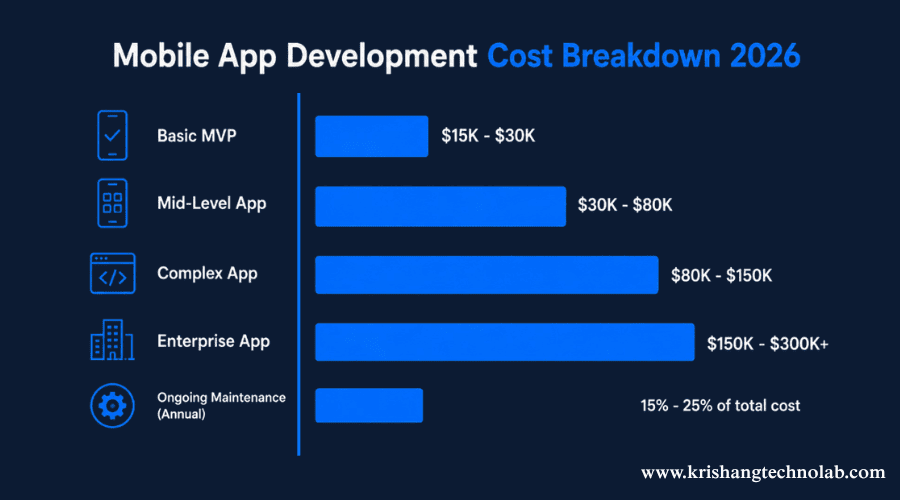
Custom mobile app development agencies range from $15,000 for a lean MVP to $300,000+ for complex, multi-integration enterprise platforms. You know a realistic range ahead of time so that you don’t waste time calling agencies that are mismatched.
5. What does success look like at 6 months post-launch?
Clear KPIs like early user retention rate, transaction volume, crash rate and DAU are set to help agencies do their work right, and to give you the power to hold them accountable.
Read More About: How to Choose the Right Tech Stack for Mobile Apps
Key Factors to Evaluate When You Hire a Mobile App Development Agency
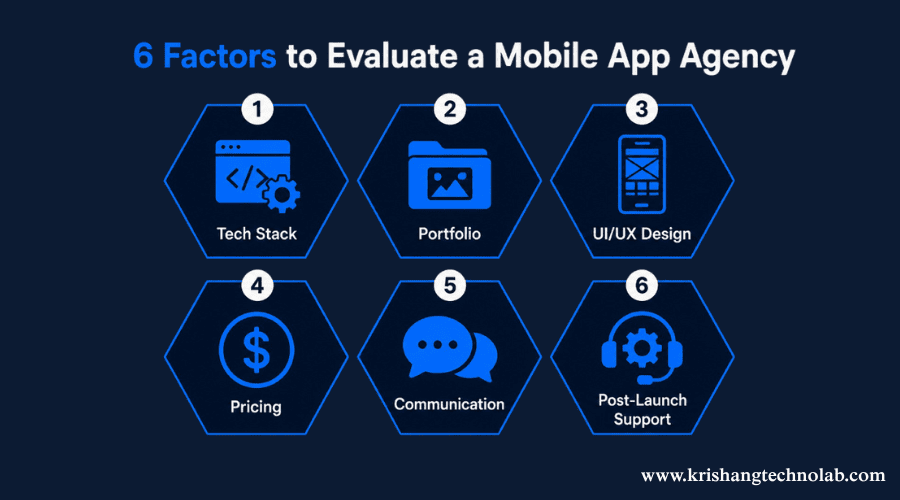
1. Technical Expertise and Mobile App Development Services Offered
The tech stack is what your product is built on. A company should be able to easily explain the technology they suggest and explain why a certain approach is best for your needs, not just what works best for them.
Make sure the person you hire has experience with both Swift (for iOS app development) and Kotlin (for Android app development). Modern cross-platform frameworks like Flutter app development and React Native development make it cheaper and easier to get apps to market quickly for companies and products that need to save money.
Backend design is just as important. An app is only as effective as the servers that run it. Look for companies that have built scalable REST or GraphQL APIs before and have a clear plan for how to work with cloud infrastructure (AWS, GCP, or Azure), create databases, and connect to third-party systems. If you want to add AI-powered features, knowing how AI is changing software development today will help you figure out if the agency is building for today’s standards or yesterday’s.
2. Portfolio, Case Studies and Industry Experience
The best way to see what you’ll get is to look at a collection. Don’t just look at images; download and use the real apps that an agency has made. The user reviews in the App Store or Play Store, how easy it is to get started, and how quick the navigation is will tell you more than any sales deck.
Having knowledge in a certain industry adds value over time. Generalist agencies don’t usually know as much about data encryption, legal compliance, and transaction security as agencies that have built fintech apps. The same is true for healthcare (HIPAA), logistics (real-time tracking and offline features), and eCommerce (ability to handle high loads and connect to payment gateways).
“Reduced checkout drop-off by 30%,” “scaled to 500,000 MAU within the first year,” or “achieved a 4.8 App Store rating at launch” are all examples of results that can be measured. ” Metrics show that an agency cares more about business results than checking off boxes.
For a more general look at which platforms top companies use most often right now, this detailed look at the best mobile app development platforms spans the entire technical spectrum.
3. UI/UX Design Quality
Great apps are not only about what they do but also how they feel. The apps that people come back to every day are the ones that have removed friction so well that users don’t notice the interface anymore. This type of design is deliberate, and it takes a team that commits to user research, information architecture, and prototype testing before one line of code is ever written.
When evaluating an agency, separate the UI/UX design skills from the development skills. Request examples of Figma wireframes, user flow diagrams, and onboarding screens from previous projects. Ask whether they do any usability testing or a/b testing as part of their design process. Those results are dramatically more cohesive than agencies that outsource design to a third party. An in-house design team works in the same building as the developers.
4. Mobile App Development Pricing and Cost Transparency
Mobile app development cost is one of the highest-volume commercial search terms in this industry, and the reason is that pricing varies wildly and is often opaque. A trustworthy agency will walk you through an itemised breakdown: discovery phase, UI/UX design hours, development sprints by feature, QA cycles, project management, and post-launch maintenance.
The three most common pricing models are the following:
- Fixed price: good for projects with clear goals and a stable scope. Keeps your cash safe, but it limits your options if your needs change.
- Time and Materials: This method works well for goods whose features will be improved based on what users say. Allows for flexibility, but needs active budget management.
- Dedicated team or retainer: best for long-term partnerships in product creation with ongoing iteration. Offers clear monthly costs and strong team unity.
Always get a detailed Statement of Work (SOW) before signing a contract. If an agency isn’t willing to work to this level of detail, or only offers high-level milestone payments dependent on vague deliverables, it’s setting the stage for scope disputes and budget overruns.
5. Communication, Agile Process and Project Management
How an agency communicates during the sales process is a good indicator of how they’ll communicate during development. Do they ask good questions before racing to solutions? And Do they respond to you in between meetings? Do they challenge assumptions constructively?
A well-structured agency uses Agile sprint cycles with weekly progress reviews, demo sessions at the end of each sprint, and a shared project management tool (Jira, Linear, or Asana) where you can see work in progress in real time. You should have a named project manager as your single point of contact, not a rotating cast of whoever is available that week.
For teams operating across time zones, especially when working with an offshore development center, confirm the minimum overlap hours and expected response SLA in writing before engagement begins.
6. Post-Launch Support and Maintenance
The launch of the app is the starting gun, not the finish line. Updates to the operating system after release, fragmentation of devices, security patches, performance degradation under increasing load, and user requests for features all need constant attention.
Ask every agency you talk to about their post-launch model. Is the cost of maintenance included in the project cost, or is it billed separately? What is the response time SLA for bug fixes? Do they provide performance monitoring and crash reporting? Do they offer a maintenance retainer? A capable agency will have clear answers to all of these. Agencies that deflect the question are telling you something important about their long-term commitment.
iOS vs Android vs Cross-Platform App Development Services — What to Choose?
| Factor | Native iOS | Native Android | Cross-Platform (Flutter / React Native) |
| Language | Swift / Objective-C | Kotlin / Java | Dart (Flutter) · JavaScript (React Native) |
| Performance | Highest — full access to Apple hardware APIs | High — but varies across device fragmentation | Near-native for most use cases |
| UI/UX Quality | Pixel-perfect native Apple components | Full Material Design compliance | Customizable; Flutter renders its own widgets |
| Development Cost | Higher — dedicated iOS codebase | Higher — dedicated Android codebase | Lower — single codebase covers both platforms |
| Time to Market | Slower | Slower | Faster — 30–40% reduction vs dual native builds |
| Third-Party Integration | Excellent iOS ecosystem support | Excellent Google ecosystem support | Strong; some native modules still needed |
| Ideal For | Premium consumer apps, fintech, healthcare, enterprise | Emerging markets, broad consumer reach, hardware-heavy apps | MVPs, startups, eCommerce, SaaS tools, budget-conscious builds |
| Popular Examples | Instagram (iOS), Robinhood, Cal | Google Maps, Spotify (Android), Samsung Pay | Google Ads app (Flutter), Facebook (React Native) |
Should You Outsource Mobile App Development Agency or Hire In-House?
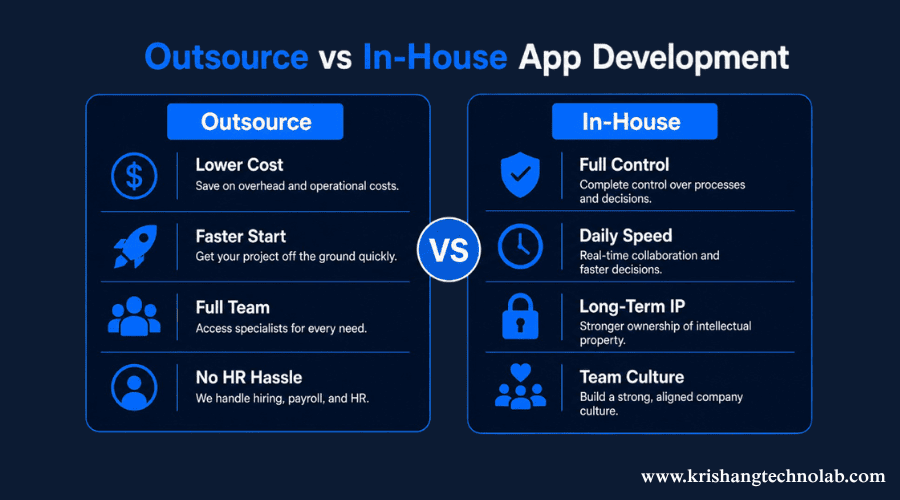
For most businesses outside of large enterprises, outsourcing to a qualified agency is the more strategic choice, and the financial case is straightforward. A full-stack in-house team (developer, designer, QA engineer, and project manager) costs $500,000 to $1 million or more per year in salary, benefits, and recruitment overhead. A top-tier agency delivers that same capability for 20–30% of the cost, with no HR complexity and immediate access to specialists.
There are scenarios where building dedicated mobile app developers into your team makes sense: when your app is your core product, when you need daily iteration speed, or when your roadmap requires sustained, multi-year development. Even in these cases, many businesses use a hybrid model, an agency for the initial build, with a smaller internal team taking over maintenance and feature expansion after launch.
When evaluating software development outsourcing partners, the key factors are communication quality, IP ownership terms, time zone compatibility, and the agency’s ability to act as a strategic partner rather than just a code vendor.
The decision between outsourcing and hiring varies based on individual circumstances. A practical breakdown of what to look for when you hire dedicated developers for mobile apps can help you evaluate both paths with the right criteria.
How to Evaluate a Mobile App Development Agency Proposal
Most businesses receive proposals and compare them on price alone. That’s the fastest path to a bad decision. Here’s how to evaluate a proposal properly:
- Scope specificity: A good proposal is not a high-level list of features; a good proposal is a discrete list of deliverables broken down into phases of the project. Vague scope causes scope creep.
- Technology justification: The proposal must justify why the proposed tech stack is a good fit for your project, not just list technologies the agency is familiar with.
- Team composition: Who specifically will work on your project? Look for named roles (project manager, lead developer, designer, QA engineer) with experience summaries, not just headcount.
- Risk and assumption documentation: Professional agencies document assumptions in their proposals. If it is not explicitly scoped, it usually is not included. Know this, and you will have no surprises.
- Payment structure tied to deliverables: Link milestone payments to tangible outputs, approved designs, working feature sets, and UAT sign off. Don’t accept proposals that are rigidly tied to calendar dates for payment.
Top Questions to Ask a Mobile App Development Company Before Signing
These questions separate partners with genuine depth from agencies with polished sales processes:
- Can you share 2–3 live apps in a similar vertical? — Download and use them before the next call.
- What tech stack would you recommend for our project, and why? — The reasoning reveals expertise.
- Who are the specific people who will build our app? — Confirm actual team composition, not org chart placeholders.
- How do you handle scope changes mid-project? — Process maturity shows here.
- Walk me through your QA and testing approach. — You want to hear device testing, regression testing, and performance testing mentioned.
- Who owns the source code and intellectual property after delivery? — This is non-negotiable.
- How do you handle app security and sensitive user data? — Look for references to OWASP, data encryption, and any applicable compliance (GDPR, HIPAA).
- What does post-launch support look like in practice? — Get SLA terms in writing, not just verbal commitment.
Know About: Why should you opt to react native for mobile app development?
Red Flags to Avoid When Choosing an Mobile App Development Agency
Quote in 24 hours. No discovery call. Proper scoping is knowing your domain, knowing your users and knowing your technical constraints. If they can give you a same day quote, it either means they use templates or they are just trying to win on price.
No verifiable public reviews. We have independent validation from Clutch, GoodFirms, and Google. Any agency with no reviews or reviews that look uniform and recent should be looked at more closely.
Ambiguity about code ownership. You must own 100% of your source code, design assets, and data. Anything less is a structural risk to your business.
Single-platform expertise pushed as universal. An agency that builds exclusively in one framework and recommends it for every project is letting capability drive decisions rather than fit.
Suspiciously low pricing. Quality mobile app development has a real cost. A pitch to build a feature-rich app for $3,000–$5,000 is either misrepresenting scope, using offshore teams with no oversight, or setting up for a change-order-heavy engagement that will cost far more in the end.
No post-launch plan. If an agency’s conversation ends at “delivery,” they’ve never thought about what happens next. That’s a problem for any product expected to operate and grow.
Final Checklist Before You Hire
Run through this checklist before signing anything:
- Downloaded and tested 2+ live apps from the agency’s portfolio
- Confirmed 100% IP and source code ownership in the contract
- Received an itemized cost breakdown by phase and deliverable
- Verified the specific development team composition
- Confirmed post-launch support terms and SLA in writing
- Checked independent reviews on Clutch or GoodFirms
- Agreed on sprint cadence, communication tool, and reporting format
- Confirmed security standards, data handling, and compliance awareness
- Payment milestones tied to tangible deliverables, not calendar dates
- Both parties have signed an NDA before sharing sensitive information
Conclusion
Selecting the right mobile app development agency is a strategic decision with long-term consequences for your product, your brand, and your users. The agency you hire will shape not just the technology you launch with but also the foundation you iterate and scale from.
The businesses that make the best decisions in this process are the ones who start with clarity about their own goals, evaluate agencies on demonstrated outcomes rather than promises, ask hard questions about team composition and post-launch commitment, and treat the engagement as a partnership, not a procurement transaction.
Use this guide as your evaluation framework, apply the checklist before every contract, and invest time upfront to get this decision right. That investment will pay dividends every day your product is live.
Found this post helpful? Don't forget to share it with your network!