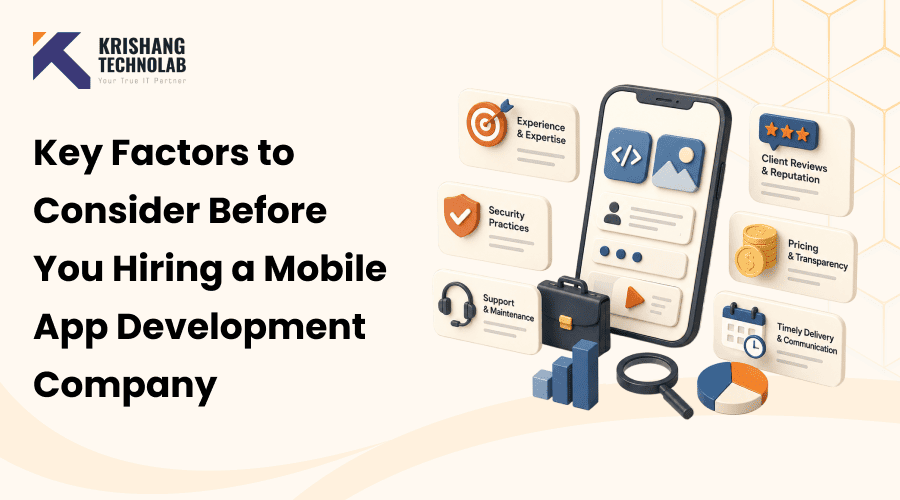
Quick Overview: Choosing the right technology partner can make or break your app’s success. This guide breaks down 15 essential factors to evaluate before you hiring a mobile app development company from technical expertise and pricing models to portfolio review, communication quality, and post-launch support helping you avoid costly mistakes and choose a partner built for long-term success.
Planning to hiring mobile app development company for your next project? It’s one of the most important decisions you’ll make for your business, since mobile apps have become the primary way companies connect with customers, streamline operations, and generate revenue.
Behind every successful app is a development partner who got the fundamentals right, and behind every failed or delayed project, there’s usually a mismatch between the business and the team it hired. This guide walks through exactly what to check before you hiring mobile app development company, so you can make a confident, informed decision instead of a rushed one.
1. Define Your App Requirements Clearly
Before reaching out to any agency, get internal clarity first. Vague briefs lead to vague quotes and mismatched expectations, one of the biggest reasons projects run over budget since scope quietly expands when nothing is written down clearly at the start.
Separate “must-have” features from “nice-to-have” ones rather than trying to build everything into version one. If you’re building your first version, it helps to understand what MVP architecture actually looks like before writing requirements, since it shapes how your app is scoped and scaled from day one.
Ask yourself:
- What core problem does the app solve, and for whom?
- Do you need native apps, or is a cross-platform app development company a better fit?
- Is it an engagement of a startup app development company with MVP focus or a corporate mobile app development services?
- What is your realistic budget and your target launch date?
- Which features are essential for launch, and which can reasonably wait for a version 2?
The clearer your requirements, the more accurate the proposals you’ll receive and the fewer surprises later once development is underway. Agencies can only quote accurately against what you give them; a one-line brief like “build me an app like Uber” almost guarantees a mismatched estimate, because the real cost lives in the details of matching, payments, and real-time tracking, not the idea itself. If you’re not sure how to turn a rough idea into a proper brief, you can request a free consultation to walk through it with an expert first.
2. In-House Team vs. Outsourcing
Before comparing vendors, decide on your engagement approach; it affects cost, speed, and how much management overhead you take on.
An in-house team gives you full control, but it’s slow to assemble, and you carry salaries and benefits regardless of workload. Outsourcing lets you plug into an already-tested team almost immediately and scale up or down as needed, which is why many companies set up an offshore development center instead of hiring locally from scratch.
| Factor | In-House Team | Outsource App Development |
| Cost | Higher (salaries, benefits) | Generally lower, especially offshore |
| Hiring time | Weeks to months | Days to a couple weeks |
| Scalability | Harder to scale quickly | Easy to scale with a dedicated team |
| Best for | Long-term core products | MVPs, one-off apps |
Most startups choose to hiring mobile app development company through an agency rather than build in-house, simply because it’s faster and more cost-effective. Agencies that need extra hands beyond their core skills often turn to software development outsourcing for the same reason.
3. Platform and Technology Considerations
Which platform and tech stack you need directly affects which type of developer you should hire. Getting this wrong early can mean an expensive rebuild later.
- If you’re looking to hire iOS app developers, ensure they have Swift/SwiftUI expertise and experience with Apple’s more stringent App Store review process.
- Hire Android app developers with good experience of Kotlin on a wide range of device sizes and OS versions.
- Want both? A cross-platform app development company using Flutter or React Native can build for iOS and Android from one codebase, generally decreasing both cost and time frame.
- If you already know what framework you want,hire Flutter developers or hire React Native developers instead of a generalist team.
There’s no one “best” choice; it depends on your budget, timeline, and how far you want to go with platform-specific features like AR or advanced camera controls.
Also Read: Top 11 Mobile App Development Platforms
4. Check Their Portfolio and Case Studies
A slick pitch is nowhere near as predictive of what a company can actually deliver as what they have done in the past. Check before you buy:
- Apps built in your industry or a comparable niche
- Live App Store / Google Play links with real ratings, not just screenshots
- Case studies covering the problem, solution, and measurable results
- Consistent design quality across projects, not just one “hero” example
A comprehensive portfolio of previous projects reveals a lot about how open an agency will be once your project is up and running. If a company claiming to be a top mobile app development company won’t share real client work, treat that as a caution flag.
It’s also worth asking who specifically worked on the projects in the portfolio. Some agencies show off work built by a senior team that has since moved on, while newer or junior staff handle current client projects. A quick question like “will the people who built the project be the ones working on mine?” usually surfaces the answer quickly.
5. Evaluate Technical Expertise and Tech Stack
Not every team is equally skilled in every technology, and technical debt from a poorly chosen stack tends to surface 12–18 months after launch, right when you’re trying to scale. Dig into:
- Native experience: Swift/SwiftUI, Kotlin
- Cross-platform: Flutter, React Native
- Backend/cloud: Node.js, Python, AWS, Firebase
- Security practices: encryption, secure auth, GDPR/HIPAA compliance if relevant
A genuine custom mobile app development agency tailors its stack to your product, not a one-size-fits-all template. If your app leans on AI features, it’s worth reading how to build an AI-powered mobile app with a scalable backend so you know the right questions to ask.
Related to Read: How to Choose the Right Tech Stack for Mobile Apps
6. Understand Their Development Process
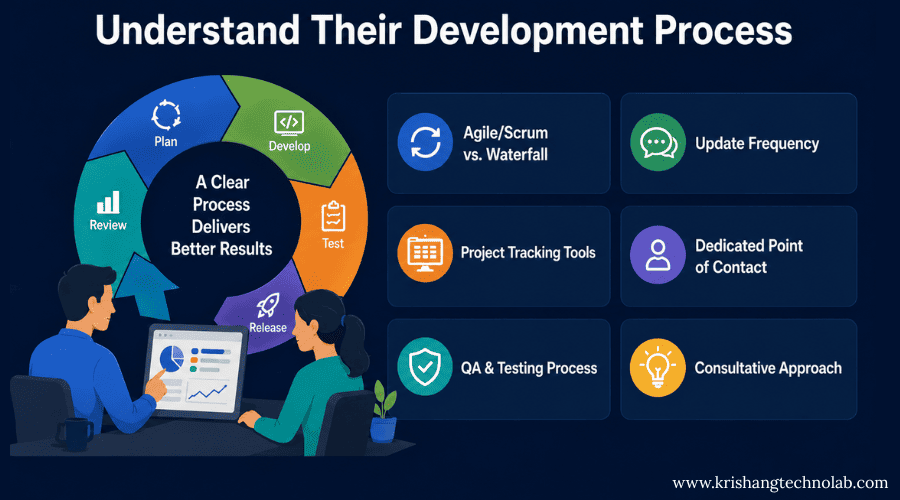
A reliable partner has a clear, repeatable process rather than an ad hoc approach that changes from project to project. A messy process is one of the most common causes of missed deadlines. Ask about:
- Agile/Scrum vs. Waterfall
- Update frequency daily stand-ups or only major milestones?
- Project tracking tools (Jira, Trello, Asana)
- Whether you get one dedicated point of contact
- How QA and testing are handled before release
This is where you’ll sense their broader consulting approach. Do they just execute the brief or push back with better ideas when something doesn’t make technical sense? You’ll feel the difference clearly once you actually hire dedicated developers and start working day to day. A well-run process should also make it easy for you to pause and review progress at natural checkpoints, rather than only finding out something went off track once the whole build is finished.
7. Ask About Pricing and Engagement Models
Mobile app development cost matters, but the pricing model matters just as much; the wrong model can cost more even at a lower headline rate.
- Fixed price: best for small, well-defined scopes
- Time & Material: best for evolving or complex builds
- Dedicated team: best for long-term, extended engagements
Typical app development company pricing:
- Simple MVP: $8,000 – $25,000
- Mid-complexity app: $25,000 – $80,000
- Complex/enterprise app: $80,000+
If your app has an AI angle, it’s worth checking this breakdown of AI business ideas with realistic MVP development costs to benchmark your own numbers. An affordable app development company in a lower-cost region, comparing India versus the USA or the UK, for example, can significantly cut costs, which is part of why an offshore development center in India often delivers similar quality at a fraction of Western rates. Just confirm quality and communication won’t suffer, and clarify what’s excluded from the quote (App Store fees, third-party tools, and maintenance).
It also helps to ask for a line-item breakdown rather than a single lump sum. A quote broken down by design, development, QA, and project management lets you see exactly where your money is going and makes it much easier to negotiate or trim scope later without renegotiating the entire contract from scratch. Be wary of quotes that come back suspiciously fast without any real discovery conversation; thorough estimates usually take a few days because they involve actually thinking through your requirements.
8. Read Client Reviews and Testimonials
Don’t just take a company’s word for how it is. Reverify the suggestions on Clutch, GoodFirms, Google Reviews, and LinkedIn. Don’t just look for “great app, happy with the result” but also comments about communication and how problems were handled. This is even more crucial if you find an agency through a simple “app development company near me” search, because local proximity does not guarantee quality.
9. Check Communication and Support Quality
Poor communication is one of the most common reasons projects run late, more common than genuine technical failure. Evaluate:
- Time zone overlap and response times
- Clarity explaining technical trade-offs in plain language
- Whether they push back on unrealistic requests instead of just agreeing
How a company communicates before you’ve signed anything is usually a preview of how they’ll communicate afterward. If getting a straight answer during the sales process already feels like pulling teeth, that dynamic rarely improves once you’re a paying client and their attention has moved on to closing the next deal.
10. Ask the Right Questions During the Interview
Use the same question set across every shortlisted company so you can compare fairly:
- Can you share 2–3 references we can speak to directly?
- Who exactly will work on our project, the same team from the pitch?
- What happens if scope changes mid-project, and how is that priced?
- Any warranty period for bugs after launch?
- What is your realistic time frame for a project of this size?
- Do we get full source code and documentation at completion?
- Do you also offer UI/UX Design or prototyping, if we need it later?
11. Confirm Post-Launch Maintenance and Support
Launch is the beginning of the app’s lifecycle, not the end of the relationship. Ask about warranty coverage for bug fixes, ongoing app maintenance and support costs, App Store Optimization help, and how they handle scaling infrastructure as your user base grows. A company that treats launch as the finish line usually isn’t the right long-term partner.
This matters more than most founders expect going in. OS updates from Apple and Google roll out every year, third-party SDKs get deprecated, and security patches need applying regularly, none of which stop just because the initial contract ended. Budgeting for ongoing support from day one, rather than being surprised by it later, keeps your app stable and avoids a scramble when something breaks unexpectedly.
12. Look for NDA and IP Protection Policies
Your app idea, your code, and your data are all assets. Make sure the company signs an NDA before you go into detail. Have your contract state that you own the source code and IP. Have documented policies in place for data security and confidentiality. Never skip this step, no matter how much you trust the team on first impression.
13. Industry-Specific Considerations
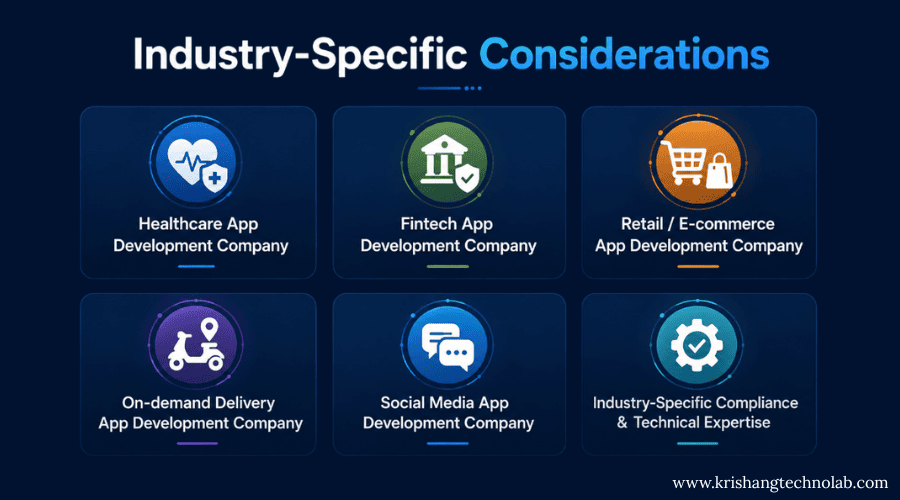
Compliance and technical needs vary a lot by sector, and choosing a generalist team for a highly regulated industry is one of the more expensive mistakes founders make. The rework to bolt on compliance after the fact is rarely cheap:
- Healthcare app development company: HIPAA compliance, secure patient data handling
- Fintech app development company: PCI-DSS compliance, fraud detection, secure payments
- Retail/e-commerce app development company: inventory syncing, high-traffic scalability
- On-demand delivery app development: real-time GPS tracking, driver/rider apps
- Social media app development company: real-time messaging, high concurrency
Confirm any agency you’re considering has actually shipped apps with your industry’s specific compliance and technical requirements, ideally with a reference you can speak to directly about how that experience played out in practice.
14. Common Mistakes to Avoid
- Choosing based on price alone without checking quality or process
- Skipping reference checks with past clients
- Not defining a clear scope of work before signing
- Ignoring communication style during initial conversations
- Not clarifying code/IP ownership after completion
- Not budgeting for maintenance after launch
- Picking a generic tech stack instead of asking what the best MVP tech stack actually looks like for your product
15. Red Flags to Watch Out For
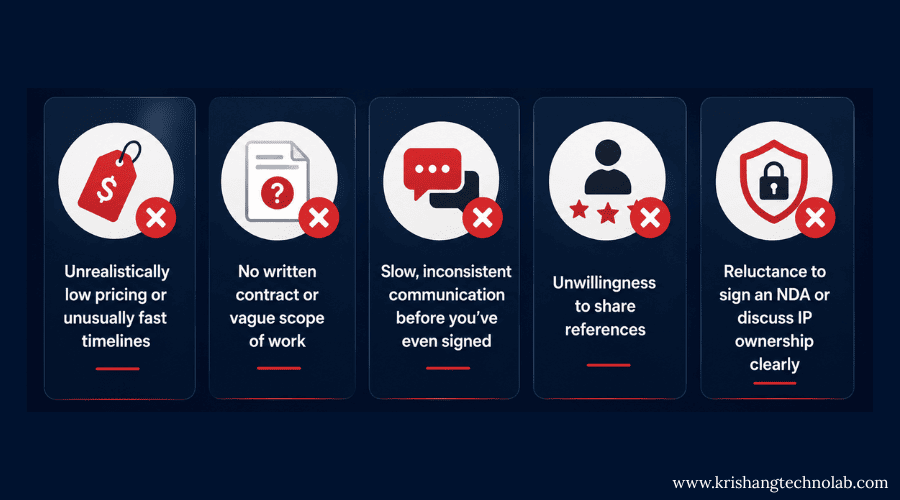
If you notice even one or two of these, it’s worth pausing before you commit.
Final Thoughts
One of the most important decisions you’ll make for the success of the app is choosing the right tech partner. Whether you are looking for a custom hiring mobile app development consulting to build a complex app or you are looking to hiring mobile app development company for a smaller project, the basics are the same: review the portfolio, check technical expertise, understand pricing, confirm communication quality, and protect your IP.
Found this post helpful? Don't forget to share it with your network!