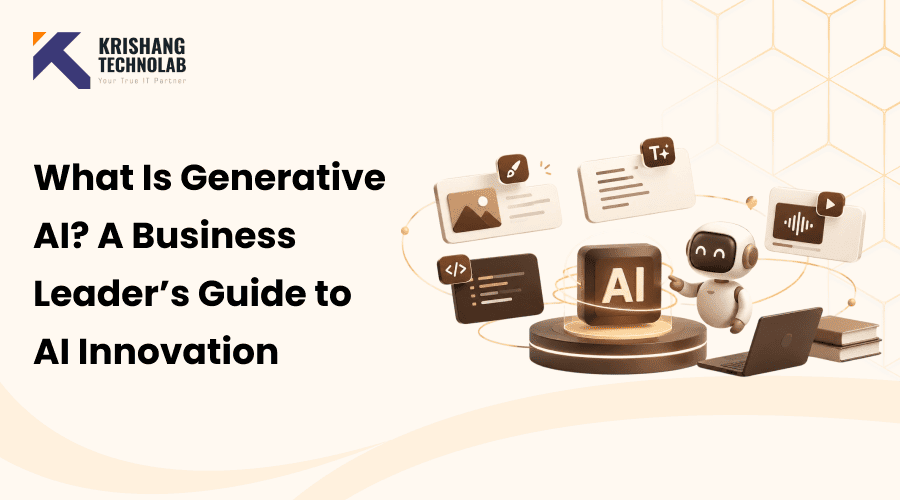
Generative AI is changing how companies write, design, code, sell, and support their customers. Just a few years ago, most people had never heard of genai. Today, teams in every industry use it to save time and try new ideas. If you want to understand what is generative AI, what is Gen AI, or what is generative artificial intelligence, this guide explains everything in simple and easy-to-understand language.
You will learn the meaning, how it works, real examples, the best tools, the benefits, the risks and how to choose the right partner. Whether you plan to build in-house or work with an outside team, this guide helps you take the next step with confidence.
Key takeaways:
- Generative AI creates new content, such as text, images, audio, video and code, from a simple prompt.
- It is a subset of artificial intelligence and it differs from older AI that only sorts or predicts.
- The biggest business wins come from clear use cases, clean data and human review.
- A proof of concept is the safest way to start.
- A good partner can speed up delivery, but you should check security, pricing and experience first.
What Is Generative AI? Definition, Meaning, and Key Concepts
Let us start with the basics. This section gives a plain generative AI definition, and clears up common terms.
What is generative artificial intelligence?
Generative artificial intelligence is a type of AI that makes new things. You type a request and the system writes a paragraph, draws a picture, builds a song or writes code. It does not copy and paste from a database. It learns patterns from huge amounts of data and then creates something fresh that fits those patterns.
Here is a simple way to think about it. A student who reads thousands of books can later write an essay in their words. Generative AI works in a similar way, but at a much larger scale, and speed. This short idea is the heart of generative AI explained for beginners.
Gen AI meaning: What does GenAI stand for?
Many people search for gen AI meaning because the short name looks confusing. Gen AI means “generative AI.” It is simply a short form. The meaning of generative AI and gen AI is essentially the same. If you wonder what does GenAI stand for?, the answer is “generative artificial intelligence.”
You may also see phrases like AI gen or AI generative online. People use them as casual, or reversed ways to say the same idea. In this guide, we use the standard terms so they are easy to follow. Generative AI refers to artificial intelligence that produces new content based on user prompts or instructions.
AI vs generative AI: what is the difference?
The question of AI vs generative AI comes up often. Artificial intelligence is the big umbrella. It covers any machine that can do tasks that seem smart, such as spotting spam, recommending movies or steering a car. Generative AI is one branch under that umbrella. Its special skill is making new content.
Every generative AI tool falls under AI, but not all AI tools are designed to generate new content. A spam filter is AI, yet it only labels emails. It does not write new ones. The table below puts the two side by side so the difference is easy to see.
| Point | AI (in general) | Generative AI |
| Meaning | Any machine that does tasks that seem smart | A branch of AI that creates new content |
| Main goal | Understand, decide, predict, or automate | Create text, images, audio, video, or code |
| Typical output | A decision, label, score, or action | A new draft, picture, song, or piece of code |
| How you use it | Often runs quietly in the background | You give it a prompt and review the result |
| Everyday example | A spam filter or a route planner | A chatbot that creates an email based on your instructions |
| Relationship | The big umbrella | One part under that umbrella |
Generative AI vs traditional AI
Another common comparison is generative AI vs traditional AI. Traditional AI follows set rules or learns from labeled examples to do one job well, such as flagging a risky payment. Generative AI learns from much larger sets of data, and can handle many different tasks from a single prompt.
| Feature | Traditional AI | Generative AI |
| Main job | Classify, predict, or detect | Create new content |
| Typical output | A label, score, or forecast | Text, images, audio, video, or code |
| Data needs | Often needs labeled, structured data | Learns from huge amounts of unlabeled data |
| Flexibility | Built for one narrow task | Can handle many tasks with prompts |
| Example | Fraud alert on a card payment | Drafting a customer email |
Traditional AI is still very useful. Many companies use both types together.
How Generative AI Works: From Training Data to New Content
You do not need a science degree to understand how generative AI works. Here is the simple version.
How does generative AI work? A step-by-step view
If you’re wondering how does generative AI work?, here’s the short version. It studies a huge number of examples, picks up the patterns in them, and then uses those patterns to create something new when you ask. There are three main stages, and each one builds on the last.
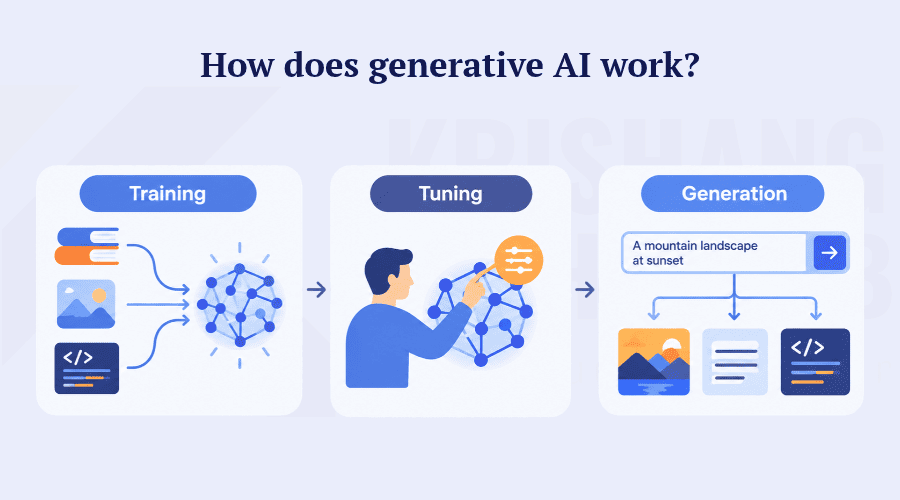
- Training: The model studies a very large set of examples, such as books, websites, images, or code. It learns how words, shapes and ideas connect.
- Tuning: Teams then adjust the model for a certain job, like customer support, or legal writing. They use extra examples and human feedback.
- Generation: You type a prompt and the model predicts the best next word, pixel, or sound, one small step at a time, until the answer is complete.
The role of machine learning and neural networks
Machine learning is simply how computers learn from data instead of following fixed rules. Deep learning is one kind of machine learning and it relies on neural networks, which are layers of math loosely modeled on how the brain works. These networks can spot hidden patterns that people would easily miss.
Foundation models and large language models
A foundation model is a large-scale, versatile model that can be customized for different tasks and applications. A large language model, or LLM, is a foundation model focused on language. LLMs power chatbots, writing helpers, and coding assistants. Image and video models follow the same big idea but work with pictures and motion.
Retrieval-augmented generation (RAG)
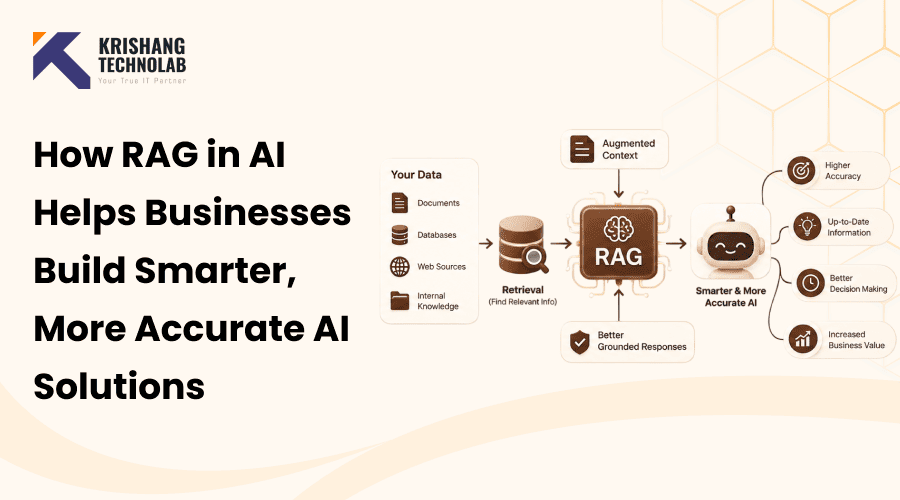
Models can be wrong when they lack fresh facts. RAG fixes this. Before the model answers, the system searches your trusted documents and gives the best results to the model. This makes answers more accurate and easier to check. RAG is a key part of safe business use.
Types of Generative AI Models and Technologies
Different models fit different jobs. Here are the main ones.
Large language models for text and code
LLMs read and write language. They can summarize a report, answer questions, translate, and write software code. They use an approach called the transformer, which helps the model focus on the most important words in a sentence.
Diffusion models for images and video
Diffusion models start with random noise, and slowly clean it up until a clear picture appears. Many popular image and video tools use this method because it gives sharp, detailed results. The step-by-step cleanup also gives users more control over style, color and detail in the final image.
Generative adversarial networks (GANs)
A GAN uses two networks that compete. One creates fake samples and the other tries to spot the fakes. Over time, the creator gets better because the checker keeps getting harder to fool. GANs are good for realistic faces, style changes and extra training data.
Multimodal AI
Multimodal models can process and generate multiple types of data, such as text, images, audio, and video. For example, you can upload a photo and ask for a written description, or write a script and get a short video back. This makes them valuable for teams that manage and create different types of content simultaneously.
What Can Generative AI Do? Real-World Examples
In short, it can write, design, code, summarize, translate, answer questions, and help you analyze information. Let us look at what is generative AI used for in daily work and see a few clear examples.
A simple generative AI example
Here is one easy generative AI example. A store manager types, “Write three short product descriptions for a blue yoga mat.” Within seconds, the tool gives three versions. The manager picks one, edits a few words, and publishes it. A process that once required twenty minutes can now be completed in just two.
Popular generative AI applications and use cases
The range of generative AI applications is wide, and it grows every month as tools improve. Most teams start with simple tasks that save time and carry little risk, then move to bigger projects after they see results. Below are some of the most widely used applications of generative AI:
- Writing emails, blogs, ads and reports
- Creating images, logos and social media graphics
- Answering customer questions through chatbots
- Writing, checking and fixing software code
- Summarizing long documents, and meeting notes
- Searching company files in plain language
Generative AI for marketing
Generative AI for marketing helps teams plan faster and test more ideas. It can draft blog outlines, write email subject lines, suggest ad copy, and tailor messages to different groups. It also supports on-page SEO by suggesting topics, and improving page summaries. A human editor should always review the final copy for accuracy and brand voice.
Generative AI for software development
Generative AI for software development speeds up coding. Developers use it to write first drafts of code, create tests, explain old code and find bugs. It does not replace skilled engineers. Instead, it removes boring work so they can focus on design and problem solving across any software development project.
Customer support and virtual assistants
AI assistants answer common questions at any hour. They can read a customer’s question, search for help articles and write a clear reply. When a case is hard, they pass it to a human agent with a short summary.
Data analysis and document processing
Teams read contracts, invoices and forms with AI. It can pull out key facts, highlight anomalies, and summarize lengthy documents. This takes hours of manual review off your plate and helps staff find the details that matter without reading every page.
Product design and research
Designers use AI to explore many concepts quickly, which lets them compare more options before they choose one. Researchers use it to scan papers, and suggest new ideas, such as new materials, or drug candidates. People still make the final call on what moves forward.
How Generative AI Is Transforming Different Industries
Every industry finds its own way to use this technology.
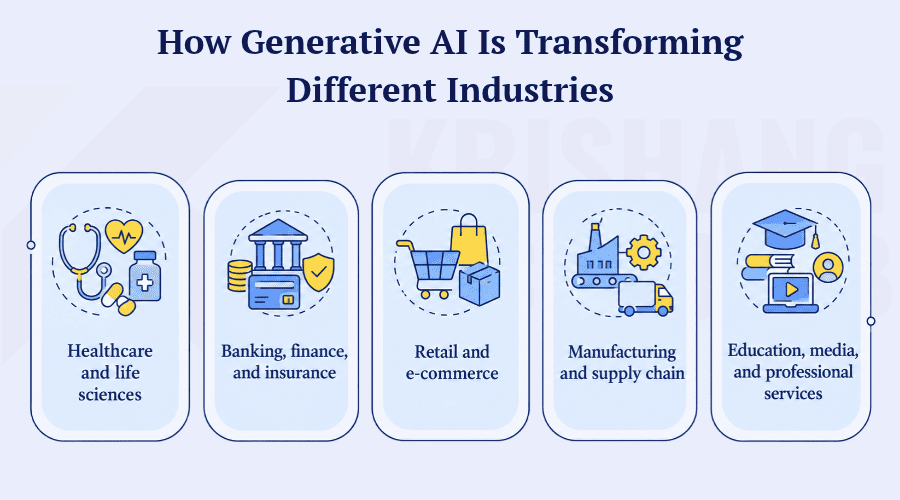
Healthcare and life sciences
Hospitals use AI inside their healthcare software to draft clinical notes so doctors spend less time on paperwork. Researchers use it to explore new drug ideas and create safe, synthetic data for training models. Patient privacy rules stay very strict.
Banking, finance, and insurance
Banks use AI assistants to answer customer questions and summarize reports. Insurers use it to read claims, and spot unusual patterns, which helps staff review cases faster. Strong privacy controls, and clear audit trails are a must in this field.
Retail and e-commerce
Retailers use AI in their e-commerce stores to write product pages, personalize offers and power shopping assistants that suggest items in plain language. These tools help shoppers find what they want sooner and help store owners keep large catalogs up to date.
Manufacturing and supply chain
Factories use AI to test product designs, write maintenance guides and predict problems in supply routes. Planners can ask simple questions about stock, or delays and get clear answers, which helps teams react faster when plans change.
Education, media, and professional services
Teachers create lesson plans, and practice questions. Media teams draft scripts and captions. Law and consulting firms summarize research and prepare first drafts. In each case, the best results come when an expert reviews the work before it reaches a student, reader, or client.
Generative AI Tools for Business Productivity and Creative Work
The market for tools is large, so choosing can feel hard. A generative AI tool is any app or service that uses these models to create content. Let us look at the main groups.
Best generative AI tools by category
When people search for the best generative AI tools, the right pick depends on the job. Many leading tools come from a well-known artificial intelligence maker, and new ones appear each month. Instead of chasing every new release, match each tool to a clear task. Here are the main groups:
- AI writing tools help with blogs, emails, summaries, and research. Many work as chat assistants, such as ChatGPT.
- AI content generation tools create blog posts, product pages, social posts and ad copy at scale.
- An AI image generator turns a text prompt into a picture, logo or product mockup.
- AI video generation tools make short clips, explainers and social videos from text, or images.
- Generative AI automation tools connect AI to your apps so tasks like sorting tickets, or drafting replies run on their own.
Generative AI tools for business
For generative AI tools for business, look beyond features. Check how the tool handles your data, whether it connects to your systems, how it manages user access, and what it costs per user or per use. A tool that is great for personal use may not be safe for company files.
Generative AI in creative software
Many design, video, and office apps now have AI built in. Generative AI in creative software lets you remove objects from a photo, extend a background, write captions, or turn a sketch into a layout with a few clicks. This makes advanced work easier for beginners and faster for experts.
How to choose the right tool
The best tool is the one your team will actually use, so start with the problem rather than the product. Try a small test with real work, then ask the people who do that work for honest feedback before you buy more seats. Use this simple checklist:
- Define the task you want to improve.
- Test two or three tools with real examples.
- Check privacy, security and data rules.
- Count the full cost, including training your team.
- Ask a few users which tool they prefer.
What Are the Benefits of Generative AI for Business?
Here are the biggest ones.
Saves time on repeat tasks
AI for initial drafts, summaries, repetitive responses. And then your people can do more objective and caring work. If you shave a little time off each task, over a month the time savings add up to many hours that teams can spend on projects that add more value.
Improves customer experience
AI is able to personalize messages and responses for each person. Customers get answers faster, and support teams can take more requests without working longer hours. If the system is asked a challenging question, it can hand it over to a human with the full background.
Speeds up product development
Teams can get ideas tested, code written, and prototypes built more quickly. That means products get to market faster, and companies get to learn faster from real users. The faster you can go from idea to feedback, the better the final product will probably be.
Supports better decisions
AI can scan large piles of data and explain the key points in plain language. Leaders then see trends sooner, and act with more clarity. Even so, people should check the numbers behind any big decision before they act.
Opens new revenue ideas
New services, such as AI assistants, or personalized content, can bring in new customers, and income. Some companies also add AI features to existing products, which gives buyers a clear reason to upgrade, or stay.
What Are the Limitations of Generative AI? Risks and Responsible Use
Great tools also have limits. Knowing them helps you stay safe.
Hallucinations and wrong answers
Sometimes AI gives an answer that sounds right but is false. This is called a hallucination. Always check important facts, and use RAG with trusted sources to lower the risk. Clear review steps matter most when the answer will reach a customer.
Data privacy and security
Do not paste private data into public tools, because you may not control where it goes next. Choose secure generative AI solutions that protect your files, control who can see what, and follow your industry rules.
Bias and fairness
AI learns from human data and is therefore able to reproduce unfair patterns in that data. Test often, use different examples, and have people from different backgrounds review results. Regular checks don’t make small problems worse.
Copyright and ownership
Rules about who owns AI-made content are still changing, and they differ from country to country. Check the terms of each tool before you publish anything and ask a lawyer for important cases such as logos, books or paid campaigns.
Human oversight
Keep a person in the loop for anything that affects customers, money, health, or safety. Set clear review steps before anything goes live, and decide who is responsible when something goes wrong. Good oversight builds trust inside and outside your company.
How to Implement Generative AI in Your Business
Many leaders ask how to implement generative AI in business without wasting money. Follow these steps.
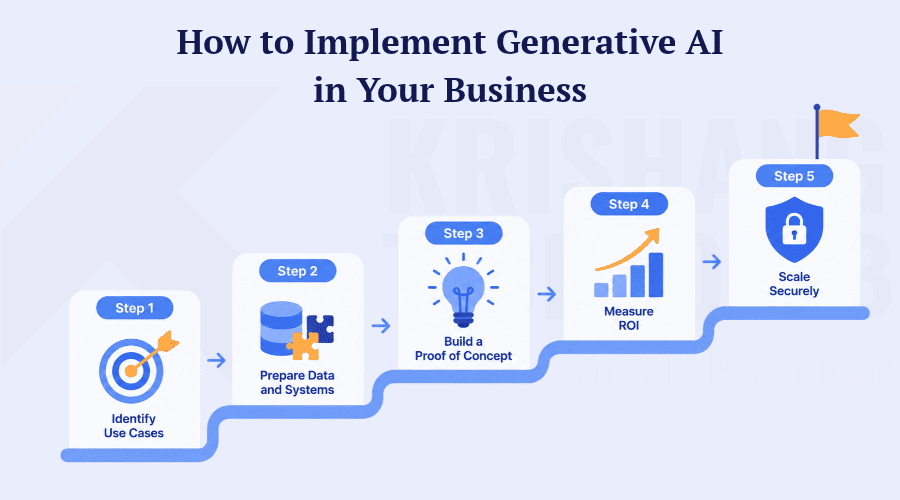
Step 1: Pick high-value use cases
Pick a task that comes up often, eats up a lot of time, and is easy to measure, like support replies or report drafts. Start small so you can learn quickly and fix mistakes before they get costly. A narrow first project also gives you clear results to show your leaders.
Step 2: Check your data and systems
The quality of an AI tool’s results depends largely on the information and instructions you provide. So look at where your data actually lives, who owns it, and whether it’s clean enough to use. Then think through generative AI integration with existing software, like your CRM, help desk, or document tools, so people can use the AI right where they already work.
Step 3: Build a proof of concept
Before you spend big, try the idea on a small scale. Generative AI proof of concept development lets you do exactly that without a huge budget. Decide what success looks like first, maybe hours saved or fewer errors. Then run the pilot for a few weeks and ask the people using it what they really think.
Step 4: Measure return on investment
Now evaluate the pilot’s results by comparing them with your initial starting point. Look at time saved, cost per task, quality , and what your users are telling you. Don’t rush to scale if the numbers aren’t there yet. If the pilot misses your goals, it’s perfectly fine to pause or change direction.
Step 5: Scale with security and rules
If the pilot works, don’t switch everything on overnight. Roll it out in stages, and put monitoring, access controls and clear policies in place as you go. This phase is often called enterprise LLM implementation, and it needs careful planning around security, cost and support. Bigger companies usually look for generative AI solutions for enterprises and enterprise generative AI solutions that meet their compliance rules, and can handle thousands of users.
Choosing a Generative AI Company, Agency, or Development Partner
Not every team wants to build everything alone. Many choose to work with experts. This section allows you to assess and compare the available options.
Build, buy, or hire: what is best?
Your best path depends on speed, cost, and control. Some teams choose to outsource part of the work so they can move faster, while others keep everything in-house to stay in full control. Use the quick rules below to decide.
- Buy a ready-made tool when your need is common and simple.
- Build with an outside team when you need custom features, private data, or deep system links.
- Hire your own staff when AI is core to your long-term plan.
What to look for in a generative AI company
A strong generative AI company should show real projects, clear processes and honest talk about limits. When you review generative AI companies, ask for case studies, client references, and examples of live products. A reliable generative AI development company will clearly outline its data management practices, testing procedures, and post-launch support services.
An AI development company USA with strong engineering, and design skills can take you from idea to launch. For large businesses, choosing an enterprise generative AI company with expertise in security, scalability, and regulatory compliance is essential. A custom generative AI solutions company can then tailor the system to your data, your tools, and your goals. Some firms also work as a generative AI consulting company, which means they help you plan before they build.
Generative AI consulting and development services
Services usually fall into a few groups, from early planning to full delivery, and support. Knowing the names helps you ask for the right help, and compare offers fairly. The following outlines what each type typically includes:
- Generative AI consulting services help you find the best use cases, plan the roadmap and avoid costly mistakes. Many firms offer generative AI consulting for enterprises with a focus on risk and return.
- Generative AI development services cover design, model setup, testing and launch.
- Custom generative AI development focuses on creating solutions tailored to your specific data and business workflows.
- Many teams also offer custom GenAI solutions for business that match your brand and process.
- Generative AI integration services connect AI to your current apps, and databases.
- Generative AI implementation services take a plan from pilot to full rollout.
- Enterprise AI development services handle large, complex projects with strict security.
- LLM development services focus on language models, fine-tuning and RAG systems.
- AI chatbot development services build smart assistants for support, sales, and internal help desks.
- AI automation services link AI to your workflows so repeat tasks run with less manual work.
- Generative AI application development creates full apps, such as writing helpers, search tools or content platforms.
A generative AI company specializing in enterprise automation can integrate multiple services into a unified solution.
Agency options: what is the difference?
You will see many labels, so here is a quick guide. A generative AI agency often focuses on fast delivery and creative use cases. A generative AI development agency USA builds the product end to end. An AI development agency may also cover mobile, web, and cloud work. An enterprise AI agency is built for large, regulated companies. An AI consulting agency gives strategy, and training advice. A custom AI agency tailors every part to your needs. A generative AI solutions provider may offer a mix of tools, services and support. Pick the model that matches your size, speed, and budget.
When to hire generative AI developers
You may want to hire generative AI developers when AI will be part of your product or daily operations for years. You can also hire GenAI developers for a short project and then reassess. If your needs are broader, you can hire AI developers who also know data, and cloud tools. For language-heavy work, you can hire LLM developers who understand prompts, RAG and model tuning.
Think about the team shape too. A balanced generative AI development team usually includes an AI engineer, a data specialist, a backend developer, a designer and a project lead. If you want a long-term fit without the cost of full-time staff, dedicated generative AI developers work only on your project. Some firms offer AI engineer hiring services to help you find and screen talent. If you only need advice, you can hire AI consultants for a clear plan and a review of your risks.
Teams like Krishang Technolab can support businesses at this stage by helping them compare in-house hiring with a dedicated outside team.
Choosing a generative AI development partner
Treat the choice of a generative AI development partner like hiring a key team member, because you will work closely for months. Look for clear answers, steady communication, and a team that admits what it does not know. Ask these questions before you sign:
- Can you show similar projects and real results?
- How do you protect our data and code?
- Who owns the final solution and the models we tune?
- How do you test for accuracy, and bias?
- What support do you give after launch?
- Can we talk to a past client?
Strong partners answer in plain words and are open about trade-offs. If you plan a long-term setup, it also helps to know how to hire a dedicated development team before you commit. Krishang Technolab is one example of a technology company that works on custom software and AI-driven solutions, and you should compare any partner using the same checklist.
Generative AI development cost and project pricing
Many buyers ask about generative AI development cost. The honest answer is that it depends on your scope, and a good partner will explain how they reach their numbers. These are the main factors that shape generative AI project pricing:
- The size and clarity of the use case
- The amount and quality of your data
- Whether you use an existing model or need custom tuning
- The number of systems to connect
- Security and legal needs
- Team size and project length
- Running costs, such as cloud use and model fees after launch
A short pilot costs far less than a full enterprise rollout. Ask every partner for a clear scope, a timeline with milestones, and a list of what you will receive, such as working software, documents, test results, and training.
The Future of Generative AI in Business Innovation
The next stage of AI will likely feel more helpful and more independent.
AI agents and smart automation
AI agents go beyond writing. They can plan steps, use tools and finish tasks, such as booking a meeting, or updating a record. Businesses will use them to handle longer, multi-step work with human approval at key points.
Multimodal creative workflows
Tools will mix text, voice, images, and video in one flow. A marketer might describe a campaign and get a draft script, images, and a short video in one session. Editors will then spend their time on taste and quality rather than on routine setup.
Stronger rules and trust
Companies will invest more in testing, security, and clear policies as the technology becomes part of daily work. Teams that build good habits now, such as logging, reviews and clear ownership, will have an advantage later when rules become stricter.
Conclusion
Generative AI has evolved from a future concept into a practical technology used today. It is a practical tool that helps teams write, design, code and serve customers faster. The best results come from clear goals, good data, careful testing, and human review.
Start small, see the results, and build from there. If you need further assistance, check out generative AI development services USA, or hire generative AI developers that meet your needs. When you are ready to build, a team like Krishang Technolab can help transform a first idea into a working solution. Given the right plan, generative artificial intelligence can be a lasting benefit to your business.
Frequently Asked Questions About Generative AI
What is generative AI in simple words?
Generative AI is AI that creates something new when you ask it to, whether that’s a piece of writing, an image, a song, a video, or some code. It studies a huge number of examples first, then builds fresh content that follows the same patterns rather than copying anything that already exists.
What is Gen AI, and what does it mean?
Gen AI is just another way of saying generative AI. It refers to AI that can produce original writing, pictures, audio or code from a simple, plain request. So whenever you see Gen AI, GenAI or generative AI they all mean the same thing.
What is the difference between AI and generative AI?
AI is the broad field of smart machines that can sort, predict, decide or act. Generative AI is a branch of this field focused on producing new and original content. Other AI types mainly sort, predict or detect patterns without making anything new.
What are five examples of generative AI?
Five common examples are chatbots that write text, AI image generators, AI video tools, code assistants, and voice or music generators. Each one takes a short request from a user and turns it into a new piece of content in seconds.
Is ChatGPT a generative AI tool?
Yes. ChatGPT is a chat-based generative AI tool that creates text answers from prompts. It can write, summarize, translate, and explain ideas in simple language. Many other tools do similar work, and some can also make images, audio, or code.
Can businesses build their own generative AI solutions?
Yes. A company can build on existing models, add its own data and connect the system to its software. Many businesses do this with an in-house team, or an outside partner, and most start with a small pilot to test the idea before a full launch.
How much does generative AI development cost?
Costs vary by scope, data, security needs and team size. A small proof of concept costs much less than a full enterprise rollout. Ask for a scoped estimate with clear milestones before you commit, so you know what you will pay, and what you will get.
How do I choose a generative AI development company?
Check past projects, security practices, support terms and ownership rules. Ask for references and start with a small pilot to test the working style. A good company explains its process in plain words and is honest about what AI can and cannot do.
Found this post helpful? Don't forget to share it with your network!