Quick Overview: Shopify dropshipping lets you sell products online without holding inventory. This guide covers how the model works, real profit margins, pros and cons, best platforms, reliable suppliers, and a clear 7-step roadmap to launch your first store in 2026.
You have probably seen the phrase “Shopify dropshipping” thrown around everywhere: YouTube tutorials, Reddit threads, and TikTok videos. Some people call it the easiest way to start an online business. Others say the model is dead.
The truth is somewhere in the middle.
This guide explains exactly what Shopify dropshipping is, how the business model works step by step, who it is for, and whether it is still worth starting in 2026 with no hype and no fluff.
What Is Shopify Dropshipping?
With Shopify dropshipping, the seller has a Shopify store where they sell items but never actually has any in stock.
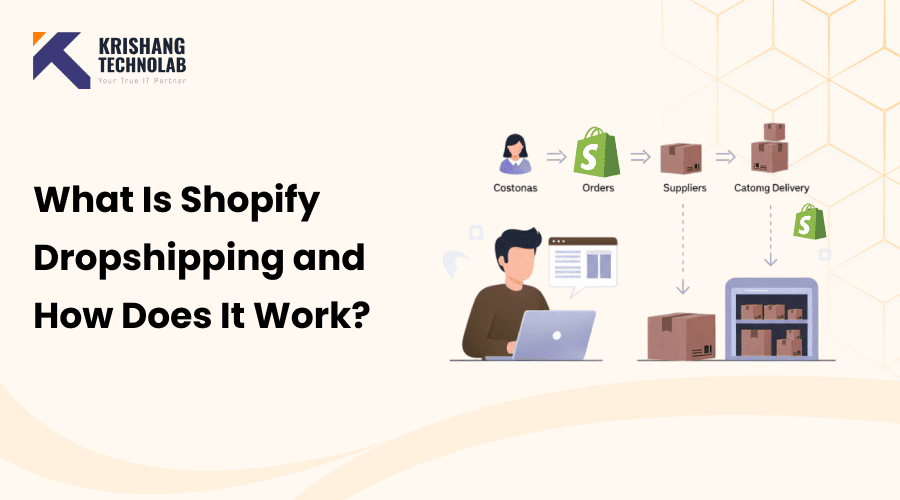
Connecting your Shopify store to a supplier saves you from buying stock and storing it. So when a customer orders something, the supplier sends it to the customer for you. You never touch the product.
What the customer pays minus what the supplier charges is your profit. That margin is your profit.
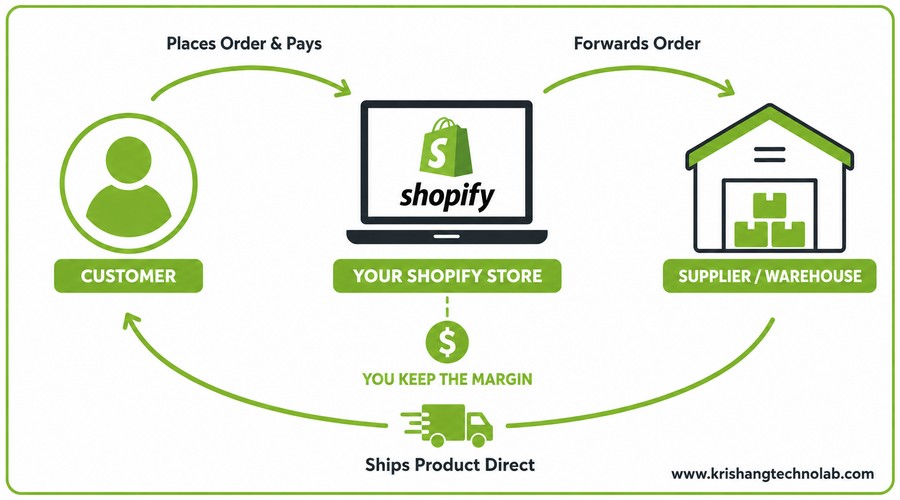
Simple analogy: You’re a manager of the storefront. You run the Shopify store, handle the marketing, and manage the customer relationship. Your supplier handles the warehouse and shipping. You both reap the rewards: the supplier increases the volume of products sold, and you establish a business without maintaining any inventory.
Shopify is the most widely used platform for dropshipping globally because it was built with ecommerce in mind from day one. It has a clean dashboard, integrations built for the top dropshipping apps like DSers, Spocket and AutoDS, and a massive library of Shopify themes optimized for conversions. If you want a full walkthrough of the setup process from scratch, there’s a complete guide to Shopify ecommerce store development, which is a great place to start.
How Does Shopify Dropshipping Work? (Step by Step)
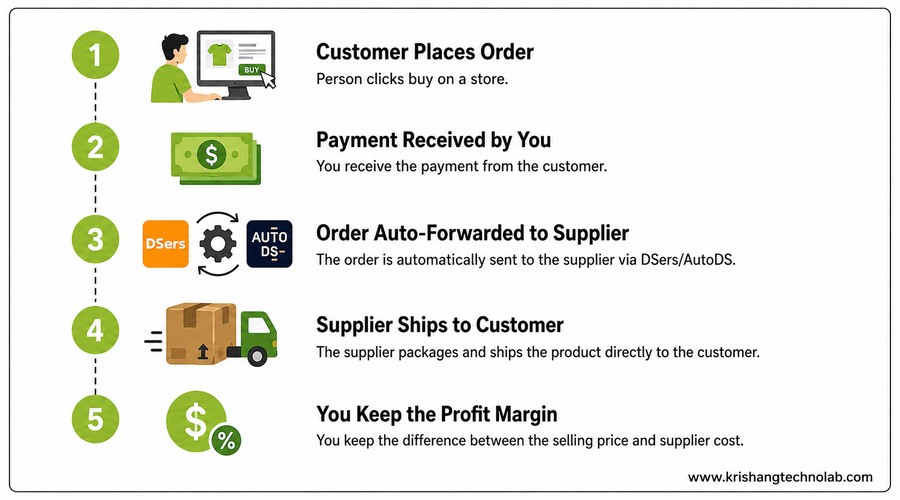
A Shopify dropshipping transaction goes like this:
Step 1: The Customer visits your Shopify store and places an order
Visitors to your Shopify dropshipping store browse and buy products. Your gateway or Shopify Payments sends the money.
Step 2: Your Shopify store forwards the order to your supplier
Once the order is placed, you purchase the same item from your supplier at a lower wholesale price. Apps for Shopify dropshipping like DSers and AutoDS can make this step fully automated; you won’t have to do anything; the order will just be sent to the supplier.
Step 3: Supplier packs and ships the product
Your supplier packs and ships the product directly to your customer, often in neutral packaging or with your branding if you have a private label agreement.
Step 4: The Customer receives the order
The product is delivered to the customer. It feels to them as if they just ordered from your Shopify store. They don’t see your supplier relationship.
Step 5: You keep the profit margin
Your profit is what the customer paid you minus what you paid your supplier minus your Shopify subscription fees minus any apps you use minus whatever you spent on marketing.
Dropshipping profit margin on Shopify is normally between 10% and 30% per order. Margins depend on the niche; beauty gadgets, tech accessories, and wellness products tend to have better margins than commodity items.
Shopify Dropshipping vs Traditional Ecommerce vs Print-on-Demand
| Terms | Shopify Dropshipping | Traditional Ecommerce | Print-on-Demand |
| Upfront inventory cost | None | High | None |
| Storage needed | No | Yes | No |
| Profit margins | 10–30% typically | 30–60% | 10–30% |
| Customisation | Limited | Full | Full (design only) |
| Shipping control | Supplier-dependent | Full control | Supplier-dependent |
| Shopify app support | Excellent (DSers, Spocket, AutoDS) | Good | Good (Printful, Printify) |
| Best for | Beginners, product testing | Established brands | Creators, merchandise |
A Shopify dropshipping store sits in a sweet spot for beginners: minimal upfront risk and fast setup while still providing access to Shopify’s full suite of marketing and analytics tools.
Is Shopify Dropshipping Still Worth It in 2026?
Short answer: Yes — but the rules have changed.
The worldwide dropshipping industry was valued at over $366 billion in 2024, and it keeps expanding as more people shop online. Globally, Shopify alone powers over 4.6 million stores. When you build on Shopify, you gain access to the platform’s infrastructure, trust signals and checkout experience.
However, Shopify dropshipping is also more competitive than it was five years ago. Buying products from AliExpress and running Facebook ads on a basic Shopify store isn’t a business anymore.
What consistently works for Shopify dropshipping in 2026:
- Niche Shopify stores: Focused stores targeting a specific audience consistently outperform general product catalogues. A well-defined niche also makes your Shopify store navigation cleaner and easier for customers to use, which directly improves conversions.
- Fast, well-designed Shopify stores: Slow-loading stores lose sales. Shopify speed optimisation is one of the highest-impact improvements you can make to any dropshipping store, especially on mobile.
- Content-driven organic traffic: Relying only on paid ads is expensive. Shopify dropshipping stores that invest in SEO and blog content build sustainable, long-term traffic without paying for every click. Pairing this with Shopify AI SEO techniques gives your store an edge in an increasingly AI-driven search landscape.
- Smart Shopify dropshipping apps: Tools like DSers for AliExpress automation, Spocket for US/EU suppliers, and Loox for reviews give your store a real competitive edge.
- Strong conversion focus: Getting traffic is only half the job. A proper Shopify conversion rate optimisation strategy ensures your visitors actually become buyers.
Shopify dropshipping is not a get-rich-quick scheme. If you run it like an actual ecommerce business it can be very profitable.
How Much Can You Make with a Shopify Dropshipping Store?
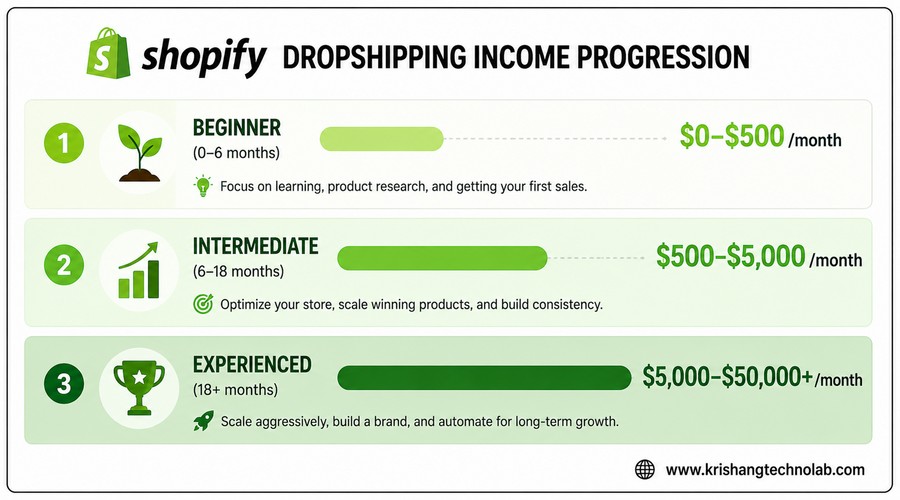
Shopify dropshipping earnings vary widely depending on your niche, traffic source, and profit margins. Here is a realistic breakdown:
- Beginner (0–6 months): $0–$500/month while testing products and learning the platform
- Intermediate (6–18 months): $500–$5,000/month with a working store, some organic traffic, and a few winning products
- Experienced (18+ months): $5,000–$50,000+/month with a scaled, branded Shopify dropshipping operation
The biggest factor is not which Shopify theme you use or how many products you list; it is how consistently you market your store and how efficiently you manage your cost per acquisition.
Pros and Cons of Shopify Dropshipping (Honest Breakdown)
Advantages
1. Low startup cost
You do not need to invest thousands in inventory before making your first Shopify sale. A basic Shopify dropshipping store costs as little as the monthly Shopify plan fee plus any app subscriptions.
2. Fast Shopify store setup
Shopify’s drag-and-drop builder, pre-built themes, and one-click app integrations help you get a functional Shopify dropshipping store up and running in days. The theme you choose matters, so check out the best free Shopify themes guide for the top options for speed, design and dropshipping compatibility.
3. No warehouse or logistics headaches
Your supplier handles all the storage, packing and shipping. This frees you up to focus on marketing, customer experience and scaling.
4. Easy to test Shopify dropshipping products
Since you’re not purchasing inventory upfront you can add new products to your Shopify store and test if they convert with zero financial risk on unsold stock.
5. Shopify’s built-in tools
Shopify gives you built-in analytics, abandoned cart recovery, discount codes, email marketing integrations, and a mobile app to manage your store from anywhere.
6. Scalable
Once a product or niche is working on your Shopify store, scaling is largely a matter of increasing your marketing budget or expanding your product range, not renting more warehouse space.
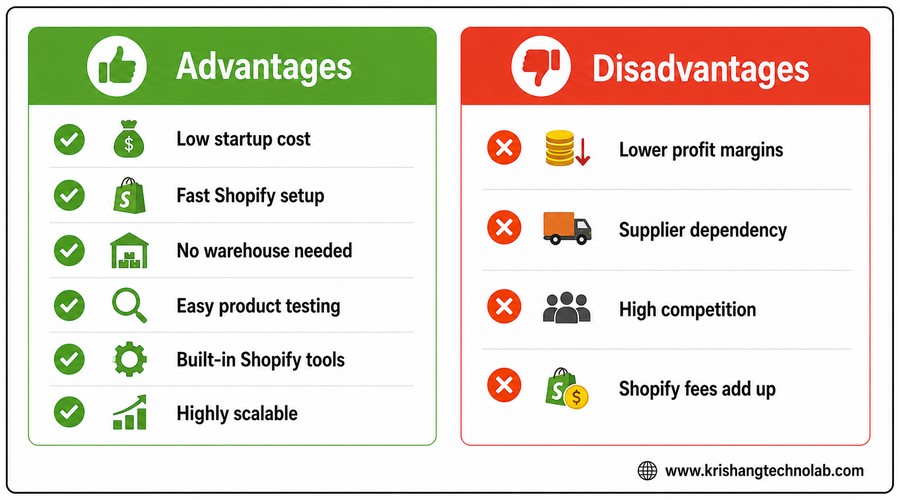
Disadvantages
1. Lower profit margins than private label
Because you are buying single units rather than bulk, your cost per item is higher. Shopify dropshipping margins of 10–30% are thinner than what you would get owning your own inventory.
2. You depend on your supplier
If a supplier runs out of stock, ships slowly, or sends poor-quality items, your Shopify store’s reviews suffer and you are the one handling unhappy customers.
3. Competition across Shopify stores
Popular Shopify dropshipping niches attract many sellers listing the same products. Standing out requires unique product descriptions, stronger branding, and a better customer experience.
4. Shopify fees add up
Beyond the base subscription, Shopify charges transaction fees unless you use Shopify Payments, and popular dropshipping apps carry their own monthly costs. Understanding the full Shopify website development cost breakdown before you start helps you budget accurately and avoid surprises.
Is Shopify Dropshipping Legal?
Yes, Shopify dropshipping is 100% legal. It’s a mainstream retail fulfilment model used by businesses all over the world, including many established brands that don’t promote their fulfilment outsourcing.
Things to keep in mind:
- Do not sell fake or trademarked products unless you have the proper licensing.
- If you’re selling products that are shipped from overseas, be upfront about shipping times in your policy pages on your Shopify store.
- Follow consumer protection laws in the countries where your Shopify store sells.
- You have to declare your income for tax purposes and your business needs to be registered.
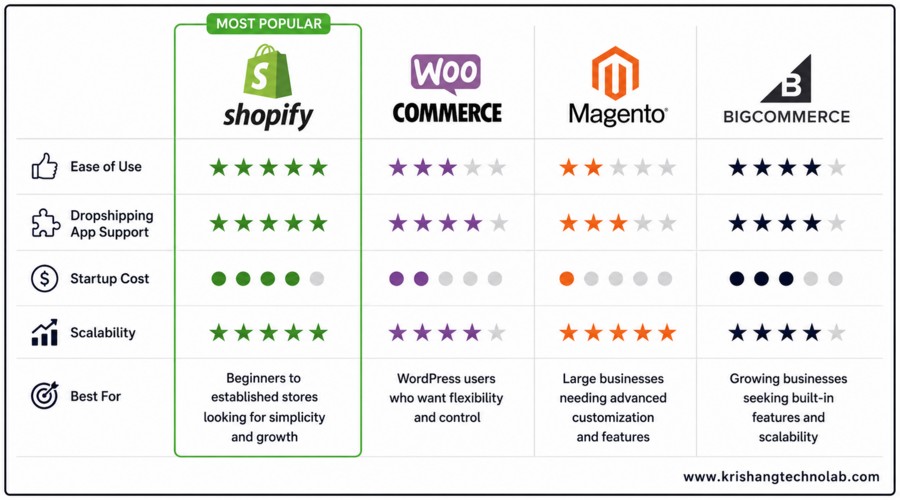
Which Platform Is Best for Dropshipping? Shopify vs the Alternatives
The platform you build your dropshipping store on makes a huge difference on how quickly you can setup, your monthly costs and how scalable it is long-term.
1. Shopify
It is the most widely used platform for dropshipping globally. It offers custom integrations with the best Shopify dropshipping apps, an easy to use interface, reliable hosting and a checkout that converts well.For businesses that want a professionally built Shopify dropshipping store optimised for performance from day one, working with an experienced Shopify development company saves significant time and avoids costly early mistakes. If you are planning to sell in the US market specifically, this guide to how to start a Shopify store in the USA walks through the local setup requirements in detail.
2. WooCommerce
WooCommerce is a strong alternative for dropshipping if you prefer working within WordPress. It is free to install and highly customisable, though it requires more technical management than Shopify. If you require a custom dropshipping solution,WooCommerce development services can create a store tailored to your requirements.
3. Magento and BigCommerce
Magento and BigCommerce are better suited for high-volume or enterprise dropshipping operations where the limitations of Shopify’s standard plan come into play. If you are unsure which platform fits your dropshipping goals, an ecommerce development specialist can help you make the right call before you invest time building in the wrong direction.
Agencies and developers who want to build dropshipping stores for their clients can also consider white label Shopify development.
How to Start a Shopify Dropshipping Store (Step-by-Step Overview)
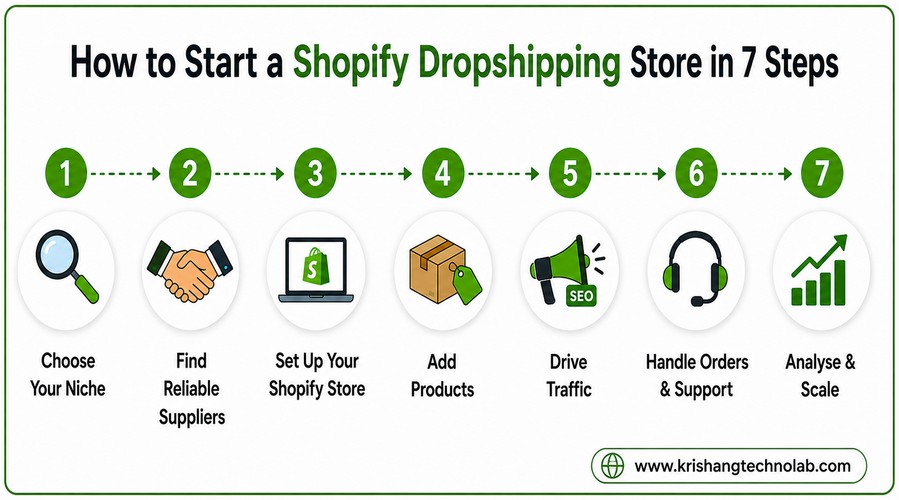
Here’s a simple roadmap to get your first Shopify dropshipping business up and running:
1. Choose your Shopify dropshipping niche
Pick a product category that actually has demand and acceptable competition. Once you’ve decided on your subject you can utilize Google Trends and keyword research tools to assist you verify interest.
2. Find reliable Shopify dropshipping suppliers
Link your Shopify store to a reliable supplier platform. Popular Shopify dropshipping apps for supplier management include DSers (AliExpress), Spocket (US/EU suppliers) and Zendrop. Always order test samples before you list products on your shop.
3. Set up your Shopify store
Create your Shopify account, pick a conversion-optimised theme the best free Shopify themes are a solid starting point, configure your payment gateway, and write clear shipping and return policies. If you want a fully custom build rather than a theme-based setup, a Shopify store redesign or custom development from scratch gives you far more control over performance and branding.
4. Add products to your Shopify store
Import products from your supplier app. Write your own product descriptions, don’t copy-paste supplier listings. Price items with a healthy margin, taking into account all costs.
5. Drive traffic to your Shopify dropshipping store
This is where most beginners fail. Paid ads (Facebook Ads, Google Shopping, TikTok Ads) are fast but costly to test. Sustainable long term business is generated by producing SEO driven organic traffic from blog content and optimized product pages. When you have products that convert, PPC management and search engine marketing are great for stores ready to scale paid traffic profitably.
6. Fulfil Shopify orders and handle customer support
Quickly process orders and answer customer questions. Good customer service is a genuine competitive advantage in Shopify dropshipping, where many stores offer an identical product but a very different experience.
7. Review Shopify analytics and scale what works
Use Shopify’s own analytics to see what’s selling, where your traffic is coming from and where customers are dropping off. If you are using an advanced architecture for your store, Shopify headless commerce is worth understanding as a future scaling option that gives you greater frontend flexibility without changing your backend.
Final Thoughts
Shopify dropshipping is still one of the easiest ways to start an ecommerce business in 2026. There’s a low barrier to entry, low risk, and Shopify’s platform gives you the tools to build and scale them. But success is always reserved for people who treat it like a real business. Who invest in store quality and continue improving based on real data.
Pick a niche. Build a Shopify store that looks trustworthy and loads fast. Find reliable suppliers. Drive traffic through both organic content and paid channels. And use your analytics to make smarter decisions every month. The opportunity is real. The work is also real.
Found this post helpful? Don't forget to share it with your network!