Quick Overview: LLM vs Generative AI explains the key differences between language models and broader generative systems. This blog helps businesses understand how LLM vs Generative AI impacts content creation, automation, and strategy using the difference between LLM and Generative AI for business.
Artificial intelligence is moving fast and so is the confusion surrounding it. If you’ve spent any time reading about AI tools, you’ve almost certainly seen the terms “LLM” and “generative AI” used interchangeably. They don’t.
Understanding the difference between LLM vs Generative AI is more than a technical exercise. It’s the basis for every smart AI decision you’ll make as a business owner, marketer, or developer, from picking the right tool to creating the right strategy to avoiding expensive mistakes.
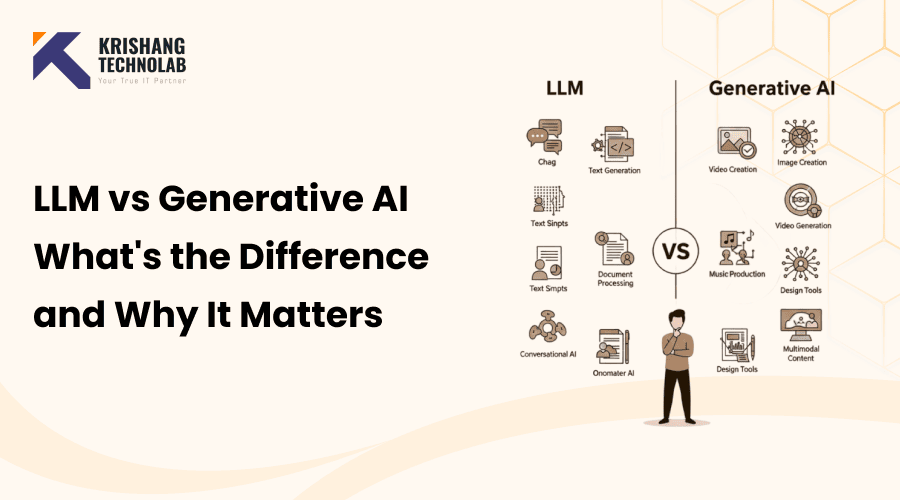
Here’s the short answer before we dive deeper: Generative AI is a generic term for a class of artificial intelligence that produces new content. Large Language Models (LLMs) are a specific, powerful type of generative AI that is built for language and text. All LLMs are generative AI, but generative AI is much more than just large language models.
By the end of this blog, you’ll know exactly what each one means, how they stack up, and which one your business actually needs.
What Are Large Language Models and Generative AI?
Before we can compare them, let’s clearly define both terms.
What is an LLM?
A Large Language Model (LLM) is an AI system trained on huge amounts of text data – books, websites, code and articles to – interpret and produce human-like language. Large language models are built on a neural network architecture called the transformer model that allows them to understand context, meaning and relationships between words at an extraordinary scale.
When you ask ChatGPT a question or ask Claude to write an email, a large language model is predicting the most relevant, coherent response based on everything it learned during training. This is why prompt engineering plays a crucial role in getting accurate, relevant, and high-quality responses from AI systems. It doesn’t pull an answer from a database; it produces one word at a time.
Popular large language models include GPT-4 from OpenAI, Claude from Anthropic, and Gemini from Google.
Large language models are for language. Their core strength is natural language processing: they understand what you write or say and can generate relevant, coherent text back. That makes them the right tool for the following, especially when businesses leverage ChatGPT integration services to build chatbots, automate customer support, and enhance content generation workflows.
- Customer support chatbots and virtual assistants
- Search, document summarisation, and Q&A systems
- Code generation, review, and debugging
- Content drafting, editing, and translation
- Data extraction and classification from unstructured text
Also Read About: What Are the Best AI Coding Assistants?
Tools like Claude, GPT-4, and Gemini are really just big language models, even when they are sold to consumers.
What is Generative AI?
Generative AI is an umbrella term for artificial intelligence that describes any AI system that can generate new content: text, images, audio, video or code. There’s a wide variety of models, but they all do the same thing – they create something new; they don’t just retrieve or classify what is already there. As a result, generative AI development services are becoming increasingly popular among businesses looking to automate content creation, enhance customer experiences, and build innovative AI-powered solutions.
Generative AI tools include DALL-E and Midjourney for images, Sora for video, GitHub Copilot for code, and ChatGPT and Claude for text. Generative AI is the tent. Below this are the large language models.
Generative AI models that aren’t large language models use different structures to create content that isn’t text, especially diffusion models and generative adversarial networks (GANs). These models power:
- DALL-E and Midjourney are examples of AI image generation tools
- AI video generation platforms like Sora
- Music and audio synthesis tools
- 3D model and design generation software
They are generative AI systems – but they are not large language models. They do not use language as their main input. Instead, they work with pixels and waveforms and visual data.
Generative AI vs. Large Language Models: Key Differences
Let’s look at how generative AI vs. large language models actually differ and where they meet now that the categories have been established.
1. All LLMs Are Generative AI, But Not All Generative AI Is an LLM
This is the main difference you need to know. Large language models are a specific type within the generative AI category, not a synonym. Generative AI is the parent discipline. One powerful branch of generative AI is large language models (LLMs).
For some idea of how big the field is, the global generative AI market was worth $67.18 billion in 2024 and is expected to keep growing at a rate of 39.6% per year until 2030. Large language models account for a significant portion of that, but image generation, audio synthesis, and video AI are growing just as fast alongside them. LLMs and generative AI are different and conflating the two misses the full potential of what AI can do for your business.
2. LLMs Specialize in Language and Text-Based Tasks
Large language models are about language. Their core strength is natural language processing: they understand what you write or say and can generate relevant, coherent text back. That makes them the right tool for the following:
- Chatbots and virtual supporters for customer service
- Systems for search, document summary, and Q&A
- Generate code, look over code, and fix bugs
- Content writing, editing and translation
- Extracting and Classifying Data from Unstructured Text
The business impact of this specialization is already quantifiable. McKinsey estimates generative AI could add $2.6 trillion to $4.4 trillion a year to the global economy, and a large portion of that value is directly tied to LLM-led language tasks such as customer operations, marketing and software development. Consumer products such as Claude, GPT-4, and Gemini are all powered by large language models.
3. Generative AI Extends Beyond Text
Generative AI models that are not large language models use different architectures, most notably diffusion models and generative adversarial networks (GANs) to produce non-text content. These models power:
- DALL-E and Midjourney are two AI image generation tools
- AI video generation platforms like Sora
- Music and audio synthesis tools
- 3D model and design generation software
To quantify the growth, here’s an overview of the size of the non-LLM generative AI space. The AI image generation market alone is predicted to reach $1.81 billion by 2030, growing at a CAGR of over 17%. Meanwhile, AI-generated video is forecast to be a $1.8 trillion opportunity in the creative economy by the end of the decade. These are generative AI systems, not large language models. They work with pixels, waveforms and visual data rather than language.
4. Modern AI Systems Are Becoming Multimodal
The most exciting frontier right now is multimodal AI, systems that combine the strengths of large language models with other generative AI capabilities. A generative LLM like GPT-4o can read images, transcribe audio, and generate text, all in one interaction. LLMs and generative AI are not competing in these cases. They are converging.
This convergence is happening quickly. The clear industry trend is to move away from single-modality tools. By 2024, over 60% of investment in generative AI will go towards multimodal model development. Gartner also predicts that by 2027 over 40% of enterprise AI deployments will involve multimodal models, combining the language intelligence of large language models with the visual and audio capabilities of wider generative AI systems. The question for businesses is increasingly not LLM or generative AI but how to combine the two, often by choosing to hire AI developer expertise.
| Feature | LLM | Generative AI |
| Output type | Text & code | Text, images, audio, video |
| Examples | GPT-4, Claude, Gemini | DALL-E, Midjourney, Sora |
| Primary strength | Language understanding | Creative content generation |
| Typical use case | Chatbots, search, coding | Design, art, multimedia |
| Is it generative? | Yes (subset) | Yes (broader category) |
| Training data | Text corpora | Text, images, audio & more |
5. Both Technologies Are Rapidly Evolving
If the past two years have taught us anything, it’s that both large language models and generative AI are advancing faster than just about any other technology in history. Every month, new models, new capabilities and new benchmarks are being released; the gap between what was cutting edge 12 months ago and what is available today is huge.
In 2020, GPT-3 came out, with 175 billion parameters. Today’s most advanced large language models are believed to have more than a trillion parameters. In the meantime, the quality of image generation has improved so much that 82% of creative professionals say that AI-generated visuals are now indistinguishable from art created by humans. Business adoption is also on the rise, with 77% of companies globally now using or exploring AI in 2025 vs. only 20% in 2017. Large language models and generative AI are not nascent technologies anymore. They’re the fabric of business today, and the first step to using them well is understanding how they differ.
Also Read About: What Is AI-Powered Software Development?
Real-World Use Cases: LLM vs Generative AI for Business
Abstract definitions are useful, but real decisions are made on actual use cases. Here’s how to think about LLMs vs. generative AI for business in practical terms.
Where LLMs shine: customer support, search, and coding
If your business goal is to be able to process, understand or generate language, then a large language model is your go-to place to start. What’s the difference between LLMs for enterprise and generative AI tools? Large Language Models excel at the following:
- E-commerce: AI-driven product descriptions and customer chat
- Legal and Finance: Contract review, summarization, compliance questions and answers
- Healthcare: Clinical note summarization & patient communication
- Software development: Code reviews, documentation and auto-completion
- Marketing: Email copy, blog drafts and SEO content at scale
Where Generative AI leads: creative, visual, and multimedia content
If your business develops visual assets, multimedia campaigns or creative content, then broader generative AI tools are imperative. The AI content generation revolution:
- Advertising & brand design: Quick Concept Visualization
- Entertainment and media: AI-assisted video making
- Architecture and product design: 3D rendering and prototyping
- Social Media: Automated Image and Short-Video Generation
Generative AI vs LLM use cases: side by side
| Use Case | LLM | Generative AI |
| Customer Support Chatbots | Yes | Limited |
| Content Writing & SEO | Yes | Limited |
| Code Generation | Yes | No |
| Document Summarization | Yes | No |
| Image Creation | No | Yes |
| Video Production | No | Yes |
| Graphic Design | No | Yes |
| Audio Generation | No | Yes |
| Marketing Campaigns | Yes | Yes |
| Multimedia Content Creation | Limited | Yes |
The best way to think about generative AI vs LLM use cases is to think about the output. If you want text, code, search, or document processing, an LLM is the way to go. If you’re looking for images, videos, audio or creative assets, then generative AI tools are better. Most companies get the best results from combining both technologies.
Also Read About: What Is the Difference Between AI and Automation?
How to Choose and Implement the Right AI for Your Business
The first step is to acquire knowledge of the theory. Here’s a handy five-step framework.
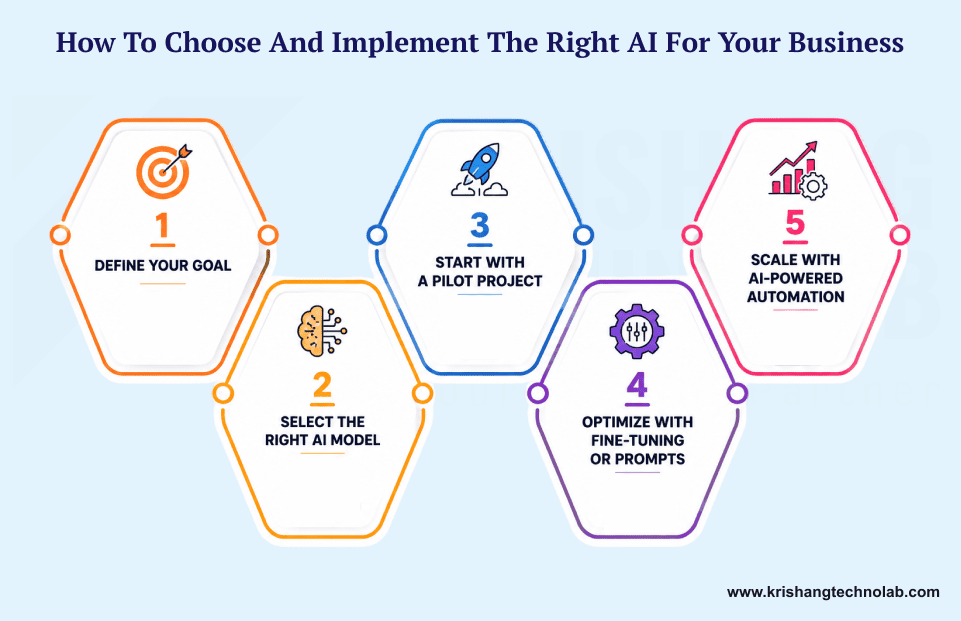
Define your goal: text-based or multimodal output?
First, be clear about what you want to produce. List all the results that your AI project needs to produce. And this one step immediately narrows your choice to either LLM-focused tools or broader generative AI platforms. Usually, when AI implementations fail, it is because the goals were not clear at this point.
Choose the right model type: LLM or Generative AI tool
Once you have a clear goal, match it to the right tool. For text needs: Evaluate large language models for context window size, cost and task accuracy. Compare types of generative AI models for output quality and creative control if you need visual or multimedia output. Don’t default to the most popular tool. Defaults to the most appropriate tool. And that’s where the LLM vs generative AI clarity pays off directly.
Start with a pilot use case and measure results
Run a focused pilot on one workflow, a customer email response system, a product description generator or a social image creator before scaling. Benchmark your AI tool against targets: time saved, quality scores, and cost per output. A well-scoped pilot provides real-world data before you spend a lot of budget.
Fine-tune or prompt-engineer for your specific needs
Out-of-the-box models are beneficial. Customized models are awesome. Prompt engineering is key for large language models – writing system instructions and examples that help the model get to your brand voice and needs. For more advanced use cases, consider fine-tuning LLM models on your proprietary data to get a decisive competitive advantage.
Scale: combine LLMs and Generative AI for full impact
Not just one plan produces the biggest payoffs. They are building the workflows that make LLMs and generative AI smart. A content team might use a large language model to write a blog post, then a generative AI tool to create the featured image and social graphics. This integrated approach forms the foundation of an effective AI tech stack for startups, helping teams automate tasks, improve productivity, and scale content creation. Think in terms of systems, not just individual tools.
Also Read About: How to Choose the Right AI Software Development Partner?
Key Benefits of Understanding the Difference Between LLM vs Generative AI
Knowing the difference between LLM and generative AI has real-world benefits.
Make smarter AI investment decisions
Understanding the purpose of each category allows you to evaluate tools based on their suitability rather than their hype. You’ll avoid paying for features you don’t use and prioritize the right investments first. When AI in business means real budget allocation, clarity around large language models vs. broader generative AI is a measurable competitive advantage.
Build the right AI stack for your team
Developers, designers and marketers all have different AI needs. A developer needs a large language model that has good coding ability. If you’re a designer, you’ve got to be able to create high-quality visuals with generative AI tools. A marketer probably needs both. If you know the scene, you can build a stack that works for your team’s process. It’s not a one-size-fits-all tool that underperforms across the board.
Stay competitive as Generative AI and LLMs evolve
The AI landscape is changing faster than any other technology space. Organizations that have a basic understanding of how generative AI and LLMs relate will be much better placed to evaluate and roll out new tools at speed. AI writing tools, multimodal models and AI agents will continue to blur the lines, and the companies that keep pace will be those with strong mental frameworks, not just access to the latest product.
Final Thought
The difference between LLM vs generative AI comes down to scope. Generative AI is the wider category. Includes text, images, audio and video. It includes large language models (LLMs). They are only trained on language tasks.
That is why the difference matters. It helps businesses make the right tool selection. Also helps them to invest in the right technology. This will help teams build better AI workflows.
Krishang Technolab makes AI simple. We help businesses implement AI effectively. We aim to deliver real results.
Ready to build your AI strategy? Contact Krishang Technolab today.
Frequently Asked Questions
What is the difference between LLM and Generative AI?
In the LLM vs. generative AI comparison, an LLM is designed to understand and generate text. Generative AI, however, is a more general category that produces text, images, audio and videos.
Is Generative AI the same as an LLM?
No. Plain and simple, LLMs vs generative AI are not the same. In particular, LLMs refer to a subset of generative AI that is mainly concerned with language tasks.
Can LLMs generate images or only text?
Most LLMs produce text and code. But in the case of LLM vs generative AI, image generation typically starts with specialized generative AI models such as DALL-E and Midjourney.
Which is better for my business: an LLM or a Generative AI tool?
It depends on what you need. Both tools are used for different purposes in the decision of LLM vs generative AI. For instance, LLMs are excellent at text-based tasks. In the meantime, generative AI tools are making images, videos and other content.
Found this post helpful? Don't forget to share it with your network!