
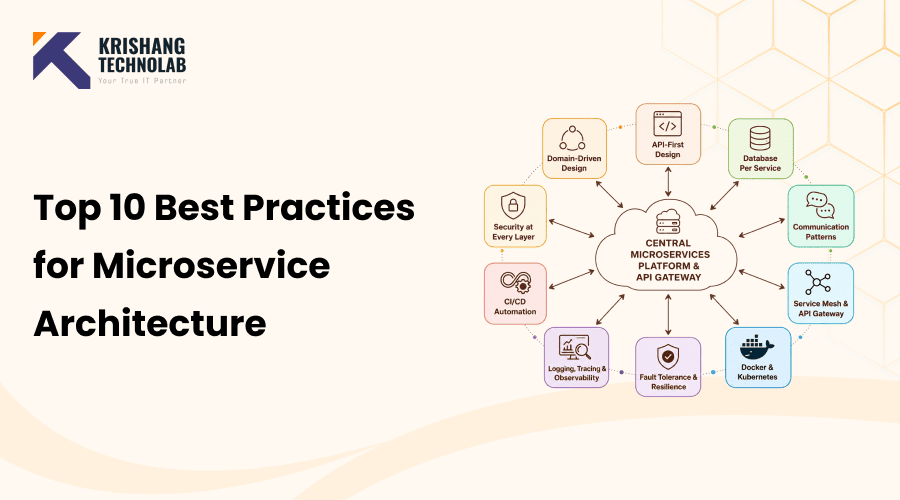
Quick Overview: Discover the Top 10 Best Practices for Microservice Architecture to build scalable, secure and resilient apps. In this blog, we look at proven design principles, deployment approaches and operational practices. Businesses that know how to set up microservices systems are more likely to be successful and grow over time.
Microservice architecture is chosen by many organizations for faster development, better scalability and more flexibility. But success is not guaranteed. Serious problems can arise from poor planning. Teams can be plagued by service sprawl, communication issues, security risks and operational complexity.
The outcome is that many organizations struggle to realize the anticipated benefits. Sometimes microservices turn into a distributed monolith. It makes the system more difficult to maintain than a regular application.
So what is microservice architecture? Microservice architecture is a software architectural style that develops a software application as a set of small services. Each service is encapsulated in a business capability. And each service can run, scale and deploy independently.
In this blog, you will discover the top 10 microservices architecture best practices to build scalable, secure and maintainable systems for organizations. These strategies will help you build successful distributed applications, whether you are exploring microservice architecture for beginners, planning a cloud-native microservices architecture, or implementing enterprise microservices architecture best practices. They are especially valuable for teams offering scalable web application development services, ensuring robust and efficient solutions for complex projects.
What Is Microservice Architecture?
Microservice architecture is a software design approach. It breaks a single application into small services. Each service has a clear job to do. It works on a specific business task. Each service runs alone. Its implementation does not affect other services. An API lets two or more services talk to each other. Often, teams use HTTP/REST, gRPC, or message queues for this communication.
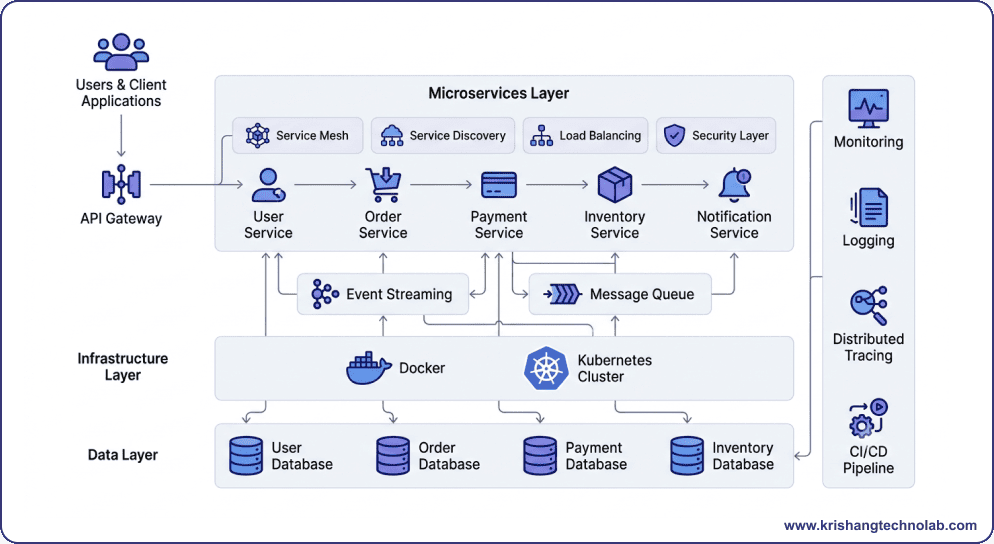
Microservices vs Monolithic Architecture
Understanding microservices vs monolithic architecture helps organisations to opt for the right development approach. Monolithic applications are easier to build and manage at the beginning. Microservices provide you with flexibility and scalability.
| Architecture | Monolithic | Microservices |
| Deployment | Deploy the entire app at once | Deploy each service on its own |
| Scaling | Scale the entire app | Scale only the services that need it |
| Tech stack | Use one technology stack | Each service can use its own stack |
| Failure impact | One bug can affect the whole app | Problems stay within a single service |
| Team ownership | Teams share one codebase | Each team owns a service |
The benefits of microservice architecture are clear. Teams can release updates quicker. They can ramp up services as needed. They can also pick and choose technologies for different services. Another advantage is improved fault isolation. Trouble with one service is less likely to affect others. But good design is important. The benefits only appear when teams do architecture planning correctly. This scenario is where the following best practices for microservices become relevant.
Essential Best Practices for Microservice Architecture Success
Accidentally building successful microservices is not an option. Sound architectural decisions and operational practices must also support the microservices architecture. These microservices architecture best practices help improve scalability, resilience, security and maintainability in the long run.
1. Design Around Business Domains (Domain-Driven Design)
Designing microservices based on business requirements is an important principle of Domain-Driven Design (DDD).
In domain-driven design microservices teams divide systems into bounded contexts. Every context has its own purpose. And so each service remains in its own boundary.
For example, in an e-commerce system:
- Order Service takes care of buying.
- The payment service takes care of business.
- The service keeps track of stock.
Each service is dedicated to one task. But where needed, services can still work together.
This approach reduces dependencies. Thus, it improves scalability. It also makes it easier for teams to update and deploy services.
This approach is one of the best practices for microservices architecture, according to many experts. This helps in keeping services small, focused and independent.
Also Read About: What Is Custom Software Development?
2. API-First Design & Contract Management
APIs are the main way that services talk to each other in modern microservices development. So, API-first design is one of the most important microservices design best practices. In an API-first design, teams define the API specifications before they begin coding. The developers write a contract. This contract shows the interaction of services. It also defines requests, responses and the error handling.
For instance, teams frequently create and document these contracts using OpenAPI and Swagger. These tools help everyone to understand the API before starting to develop. This allows the frontend and backend teams to work better together. They also suffer less misunderstanding.
This method works well for the API gateway in microservices architecture as well. The API gateway serves as a single entry point for the users. Then it forwards requests to the right service. The gateway can handle data, identification, and version control better if the API is well designed. Thus, the system becomes more manageable.
API versioning matters, too. APIs change with time. Therefore, teams need to plan for updates. If there isn’t versioning, changes could break apps that are already in use. But teams can avoid this problem. They ought to be backwards compatible. This allows older clients to continue working. Another key practice is automated API testing. It checks the behavior of the service and API contracts. It helps the teams find issues quickly. They also enhance reliability.
API-first design improves communication. This approach reduces development risk. Also, it supports long-term system stability. For many teams, it is one of the most important best practices for microservices architecture because of these advantages.
Also Read About: What Are the Most Popular Backend Frameworks for Web Development?
3. Database Per Service Pattern
One common mistake in building microservices is that multiple services share a database. This sounds easier at first. However, it introduces a strong coupling between services. This makes it less versatile. A better solution is the microservices database per service pattern. In this pattern, each service has its own data store.
Each microservice in this model manages its data. Its database is not directly accessible to other services. Thus, the services are loosely coupled. And they can evolve alone as well without interfering with other evolutions.
Key characteristics of this pattern:
- Every microservice manages its own dedicated database
- No direct database access from service to service
- APIs or events allow services to communicate
- Each service can be developed, tested, and put into production independently
This design improves scalability. For example, if the order service has high traffic, its database can scale on its own. Therefore, payment and inventory services are unaffected. It also improves the isolation of the faults. The system continues to run even if one database fails.
Another benefit is polyglot persistence. Each service is free to choose the database type that best suits its needs. For example, NoSQL might be used for flexibility by a product catalog service. A financial service, on the other hand, might use a relational database for strong consistency.
But this pattern introduces data consistency issues. Systems communicate through events, because data is distributed across services. They also use eventual consistency models. But it remains a foundational principle in scalable microservices design against these odds.
4. Choose the Right Communication Pattern
Communication is the spine of distributed systems. Thus, the selection of a pattern dictates the performance and scalability. In microservices, communication is divided into synchronous and asynchronous models.
Synchronous communication uses REST APIs or gRPC. In this case, one service waits for a response from another service. The process is simple. And it’s easy to build. It is good for real-time operations. But tight coupling may result. It may also add latency if services are slow or fail.
Asynchronous communication uses event-driven systems like Kafka or RabbitMQ. The events are published by the services in this way. Other services consume the events. Services do not require an immediate response. This approach thus improves the scalability. And it increases resilience. Moreover, services are loosely coupled.
Main communication patterns:
- Synchronous (REST/gRPC) for real-time requests
- Asynchronous (Kafka/RabbitMQ) for event-driven work flows
- Balanced systems hybrid approach
For example, a user makes an order. First, the order service issues an event. Then other services respond. The payment, inventory and notification services each handle the event separately. This makes the system more scalable. It increases fault tolerance.
It depends on the use case. Hence, most modern systems use both patterns together, especially in systems built with node.js development services, where event-driven and scalable architectures are commonly implemented.
5. Implement Service Mesh & API Gateway
Services grow and communication between services becomes complex. Thus, a service mesh assists in managing internal service-to-service communication. It doesn’t need any changes to the application code. It handles routing traffic, security rules, retries & observability. Istio, Linkerd, etc. are widely used.
At the same time, an API gateway works as the single entry point for external requests in a microservices architecture. It deals with authentication, routing, rate limits and aggregation of requests. This makes for easy and safe communication from outside.
Key responsibilities:
- API Gateway: External traffic and authentication
- Service Mesh: Manages internal communication, traffic and observability
Using them together is a proven microservices architecture pattern. Besides, it enhances security. It also helps with management. It also allows us to scale services independently.
6. Containerize with Docker & Use Kubernetes
Containers are an important part of modern cloud native architecture. For example, Docker helps developers to package applications and their dependencies into containers. These are small containers. Docker containers are easy to get around and use. They also allow applications to run in the same way in different environments.
In fact, each Docker microservices is running inside a container. So that makes it more portable. It also simplifies deployment. This approach is particularly beneficial for teams working on mobile app development, as it ensures consistent performance across different environments and devices.
Managing many containers by hand is time consuming. So, Kubernetes is commonly used. Kubernetes is a container management tool. It handles deployment, scaling and updates.
Kubernetes allows microservices to scale up or down with the traffic demand. It also provides load-balancing. It also provides rolling updates and self-healing. This allows teams to better manage their applications.
In short, Docker and Kubernetes are complementary. They help to build reliable microservices. As the demand increases, they also help them grow.
Also Read About: What Are the Top Game-Changing E-Commerce Technology Trends in 2026?
7. Build Fault Tolerance & Resilience
Failures can occur at any time in a distributed system architecture. Networks go down. Services don’t work. No warning that latency will increase. Thus, fault tolerance is an important microservice best practice.
Developers use resilience patterns to address these issues. The patterns are circuit breakers, retries, timeouts, and bulkhead isolation. For instance, the circuit breaker pattern prevents calls to a failing service. Thus, the system saves an additional load. Retry logic is useful if the problem is temporary. And timeouts keep systems from waiting too long. Bulkhead isolation keeps one failure from affecting other services. Therefore, we keep problems in check.
Tools like Resilience4j help teams to add these patterns to modern applications.
As a result, systems can still run even if some services are not working. This is an important aspect of a reliable and scalable microservice architecture.
8. Centralized Logging, Tracing & Observability
The interactions between multiple services complicate debugging in microservices systems. So monitoring and observability are very important for microservices.
A strong observability system is built on logs, metrics, and traces. For example, developers generally use the ELK stack, comprised of Elasticsearch, Logstash, and Kibana, to handle logs. Prometheus scrapes metrics to help teams monitor their systems’ performance. OpenTelemetry does the tracing; it tracks requests as they traverse multiple services.
Therefore, microservices observability enables developers to understand how requests travel through the system. This helps them to quickly spot bottlenecks, errors and performance issues.
Even the best-designed systems quickly become challenging to maintain without proper observability. Hence, early use of those tools enhances reliability and reduces maintenance effort.
Also Read About: How Is AI Used in Software Development and What Are Its Benefits?
9. Automate CI/CD Pipelines
Automation is a key part of microservices deployment strategies. Teams should build, test and deploy each microservice independently. As a result, they can introduce features faster and manage risk.
CI/CD pipelines do this work for you automatically. For example, developers use GitHub Actions, Jenkins, or ArgoCD for CI/CD microservices deployment.
Use up and down arrow keys to resize the meta box pane.
Automation allows developers to verify each code change prior to deployment. It also reduces human mistakes and makes the system a lot more reliable. Hence, independent deployment is a strong advantage for microservices. It’s also a core part of modern microservice architecture best practices. This approach also helps teams build production-ready React applications more efficiently by ensuring consistent and reliable deployment workflows.
10. Prioritize Security at Every Layer
Security is a key component of any enterprise microservices architecture best practices strategy. Microservices consist of many services communicating over the network, increasing the number of potential attack points.
For the authentication, developers use OAuth2 and JWT in order to fix these issues. Mutual TLS secures service-to-service communication. API gateways also verify and enforce security policies for inbound requests. Teams also manage secrets with tools like Vault or AWS Secrets Manager.
The approach is built on a zero-trust model. It’s got to be checked before it gets in, everything here. Hence, the microservices security best practices make sure that the system is protected at all levels.
Common Microservices Pitfalls to Avoid for a Scalable Microservice Architecture
The absence of a well-defined API versioning implementation. Typical problems are as follows:
- Creating a distributed monolith
- Designing services that communicate too frequently
- Missing observability setup
- Not defining a clear API versioning approach
- Over-complicating system design in early stages
Here are the main microservices pitfalls to avoid. They should be avoided for better performance and maintainability of the system.
Conclusion
Following microservices architecture best practices is the key to building scalable, secure and reliable systems. These best practices aim to improve the design of microservices architecture with clearly defined service boundaries, API-first development, deployment on Kubernetes and robust observability and security. Microservices design best practices, if properly applied, enable building a scalable microservice architecture that facilitates faster growth and independent deployment. At Krishang Technolab, we follow proven microservice best practices to build modern cloud-native solutions that enable businesses to scale with confidence and stability.
Frequently Asked Questions
What is Microservice Architecture?
Microservice architecture is a style of software design. It splits an application into small services. They are all independent. Each one does one task. Teams can independently build, deploy, and scale services.
What are the best practices for microservices architecture?
Best practice is to design services around business domains. The developers also practice API-first development. A database per service pattern is common. CI/CD also takes care of the deployment. Monitoring tracks performance. Security is still important.
Why is Kubernetes important for microservices?
Container management is good with Kubernetes. It also provides service discovery and auto-scaling. Deployment management is easier as well. This capability is why applications run well in cloud environments.
How can organizations improve fault tolerance in microservices?
Organizations rely on resilience patterns. Circuit breakers provide protection from repeated failures. Retries address short term issues. No long wait with timeouts. Problems in the bulkheads. Fallbacks keep systems operational. Overall, these strategies improve the reliability.
Found this post helpful? Don't forget to share it with your network!