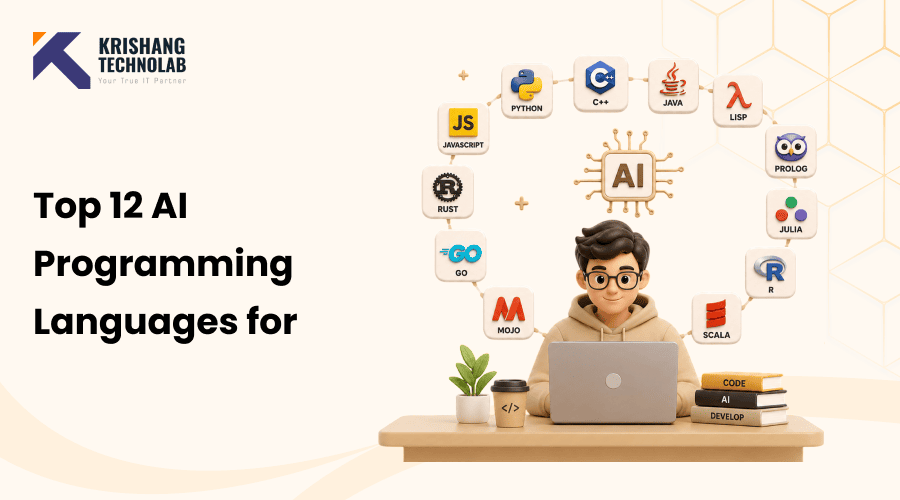
Quick Overview: This blog on AI Programming Languages explores the top 12 languages used in artificial intelligence development. It explains use cases, strengths, and tools to help you choose the best programming language for AI in 2026 for machine learning, deep learning, and AI applications.
Artificial intelligence is revolutionising every industry, from healthcare and finance to manufacturing and entertainment. As AI adoption accelerates, developers and businesses are asking the same question: Which programming language is best for AI?
Depending on what your goals are, some AI programming languages are good for deep learning and machine learning, while others are for enterprise applications, data science, robotics or cloud-native AI infrastructure.
In this blog, we will look at the top 12 AI programming languages for 2026, their strengths, use cases, and key libraries (and which companies use them). So, if you are a beginner, a data scientist, a software engineer, or an AI researcher, this blog will help you choose the best programming language for AI and artificial intelligence development.
What Are AI Programming Languages?
AI programming languages are programming languages that are used to develop artificial intelligence systems, machine learning models, neural networks, natural language processing applications, computer vision tools, robotics software, and AI agents.
The top AI programming languages help developers:
- Train machine learning models
- Build deep learning systems
- Management of Big Data
- Develop intelligent applications
- Deploy AI models at scale
- Optimise AI infrastructure
It’s rare today to build AI in just one language. Instead, developers typically use a combination of programming languages for artificial intelligence, depending on the performance and deployment needs.
Also Read About: What is AI in software development, and what are its use cases and benefits?
AI Programming Languages at a Glance
| Language | Best For | Strengths | Weaknesses | Popular AI Use Cases |
| Python | Machine learning, deep learning | Huge AI ecosystem, easy syntax, best libraries (PyTorch, TensorFlow) | Slower performance | ML, NLP, LLMs, generative AI, computer vision |
| C++ | High-performance AI systems | Very fast, low-level control, efficient memory use | Complex syntax, hard to learn | Robotics, real-time AI, autonomous vehicles, edge AI |
| Java | Enterprise AI systems | Scalable, stable, platform-independent | Verbose, slower experimentation | Banking AI, enterprise systems, big data AI |
| JavaScript | Web-based AI | Runs in browser, easy deployment | Limited for heavy AI training | Browser AI, chatbots, web ML apps |
| R | Data science & statistics | Strong stats tools, great visualization | Not ideal for production systems | Predictive analytics, statistical ML |
| Julia | Scientific AI computing | High performance + Python-like syntax | Smaller ecosystem | Scientific ML, simulations, research AI |
| Scala | Big data AI | Works with Apache Spark, scalable | Steep learning curve | Big data pipelines, distributed AI |
| Rust | AI infrastructure | Memory-safe, fast, secure | Limited AI libraries | AI systems, inference engines, backend AI |
| Go (Golang) | Cloud AI systems | Simple, fast, great concurrency | Weak ML ecosystem | AI microservices, cloud AI APIs |
| Lisp | Symbolic AI | Code-as-data, flexible | Outdated ecosystem | Expert systems, symbolic reasoning |
| Prolog | Logic-based AI | Strong rule-based reasoning | Limited modern usage | Expert systems, theorem proving |
| Mojo | Future AI development | Extremely fast, Python-like | Very new, immature ecosystem | AI acceleration, LLM optimization |
Best programming languages for AI
The top AI programming languages are listed below, along with examples of how they are used in real-world situations.
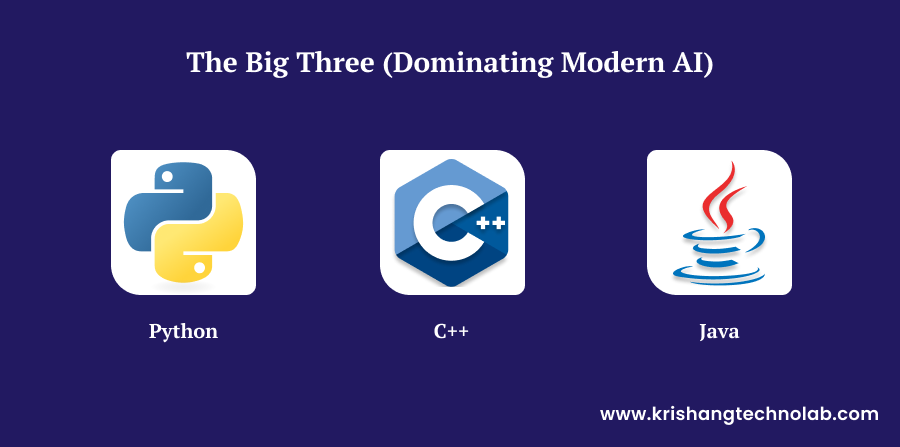
The Big Three: Dominating Modern AI
These three programming languages continue to lead artificial intelligence development. The power machine learning solutions, enterprise systems and high-performance AI applications globally. They’re also used by developers across industries because they offer robust ecosystems and dependable performance. Hence, they are the go-to choice for many AI projects.
1. Python
When it comes to AI programming languages, Python is always on the list. Modern machine learning, deep learning, natural language processing, and creative AI are all built on it.
The syntax of Python is very simple. So developers concentrate on solving AI problems. They can’t handle complicated code structures. Because of this, Python is an important part of AI development right now.
Furthermore, Python has a big ecosystem of AI frameworks. Hence, it is the first choice for startups, enterprises, researchers and AI engineers. It also has great community support so it’s easier to develop. Many teams also leverage AI coding assistants to accelerate development, improve productivity, and streamline AI workflows.
In addition, businesses often rely on professional python development services to build scalable AI applications, integrate machine learning models, and deploy intelligent solutions efficiently.
Python AI Libraries You Should Know
- TensorFlow: One of the most well-known deep learning tools is TensorFlow. It is used to train neural networks by programmers. They use it to deploy models on real systems also supporting scalable AI applications.
- PyTorch: PyTorch is very popular in AI research areas. And when developers build models, they have a lot of freedom and power. This is why many researchers prefer it for experiments.
- Scikit-learn: Scikit-learn provides lots of machine learning algorithms. For example, it supports classification, regression, clustering and prediction analytics. Besides, it is easy to learn.
- Keras: Keras makes deep learning development easier. Also, it provides an easy and clear interface to developers. So it is easy for the beginners to use.
- Hugging Face Transformers: A lot of the new large language models use this package. Natural language processing tasks are also supported by it. It also helps to develop sophisticated AI systems.
- LangChain: LangChain is a framework to develop AI agents. It also supports retrieval systems and generative AI applications. It also helps with workflow integration.
Also Read About: What Makes LLMs Different from Generative AI?
Who Uses Python for AI Development?
- Machine learning engineers building and training models
- Data scientists analyzing patterns in large datasets
- NLP engineers working on language understanding systems
- AI researchers prototyping new algorithms
- Computer vision developers creating image recognition systems
Best AI Use Cases for Python
- Artificial intelligence
- Generative AI Deep Learning
- Natural language processing
- Smart AI Agents
- Computer vision
- Predictive Analysis
2. C++
Python is the go-to language for AI development, but many AI systems are still built on C++ under the hood.
C++ provides direct hardware access. It also provides improved memory management. It also offers very fast execution speeds. This makes it one of the best languages for artificial intelligence applications that require real-time performance.
Plus many machine learning frameworks use C++ in the background. It helps you get the most out of it. It also makes function better overall.
C++ AI Libraries You Should Know
- OpenCV: OpenCV is the most popular open-source computer vision library in the world. It is widely used in image and video processing. Thus, it is an important tool in AI development.
- TensorRT: TensorRT is a deep learning inference optimizer for NVIDIA GPUs. Which means faster deployment on hardware.
- mlpack: mlpack is a machine learning library (highly efficient). It is also designed for speed and scalability.
- Shark: Shark is a machine learning library developed for optimization and predictive modeling. Moreover, it is conducive to innovative research and development work.
Who Uses C++ for AI Development?
- Robotics engineers designing autonomous machines
- Embedded systems developers deploying AI on the hardware
- Computer vision engineers developing real-time applications
- Self-driving car manufacturers tune AI performance
- AI infrastructure engineers Inference engine
- Edge AI developer’s low-latency solutions
Best AI Use Cases for C++
- Robotics
- Autonomous vehicles
- Real-time inference
- Edge AI
- Computer vision
- Embedded AI systems
3. Java
Java is still a solid choice for enterprise AI development. And it is used widely in enterprise systems today.
Java is the choice of large organisations, as it is stable, scalable and platform-independent. This allows companies to more easily integrate AI capabilities into existing enterprise software ecosystems.
Also, Java is particularly useful to businesses that require stable production environments. Hence, it ensures long-term maintainability and uniformity in the performance of the system.
Java AI Libraries You Should Know
- Deeplearning4j: For use in production settings, a deep learning system for Java and Scala.
- Weka: Weka has data mining tools and machine learning algorithms.
- MOA: MOA is a framework for large scale data mining of data streams and online learning.
Who Uses Java for AI Development?
- Enterprise software makers embedding AI into business systems
- Backend engineers building large-scale AI platforms
- Intelligent Application Teams for Financial Technology
- AI pipeline engineers and big data
- Cloud architects for enterprise AI solutions
- Organisations need long-term production stability
Best AI Use Cases for Java
- Enterprise AI use cases
- Fraud detection software.
- Automating customer service
- Business Intelligence Systems
- Financial AI solutions
Symbolic AI & Logical Reasoning
Intelligent systems are constructed with symbolic AI and logical reasoning languages. These are rule-based, knowledge-based and decision-based systems.
4. Lisp
Long before there was modern machine learning, Lisp was already famous as the language of artificial intelligence.
Lisp helped pioneer many ideas still used in AI today. Some of these are recursion, dynamic typing, symbolic processing, and automatic reasoning.
It can treat codes as data in a way no other language can. This capability means developers can develop very flexible AI systems.
Lisp is still useful today, although newer AI programming languages are more popular. It is used in research on symbolic AI and knowledge-based systems.
Lisp AI Tools and Frameworks
- Common Lisp
- Clojure
- Allegro CL
- CLIPS Integration Tools
Who Uses Lisp for AI Development?
- AI researchers studying symbolic reasoning
- Knowledge engineering specialists building expert systems
- Academic institutions conducting AI research
- Developers creating logic-based AI applications
- Teams working on automated reasoning systems
Best AI Use Cases for Lisp
- Symbolic AI
- Expert systems
- Knowledge representation
- Automated reasoning
- Logic-based AI systems
5. Prolog
Prolog is one of the most unique programming languages of artificial intelligence. It is not concerned with step-by-step instructions like procedural languages. It deals rather with facts, rules and logical relations.
Developers build a knowledge base. They define a set of logical rules as well. The Prologue engine then uses inference to find solutions. This means that it can automatically solve problems.
It’s still a good choice for symbolic AI because it tells you what to do. It is also widely used in expert systems and rule-based decision-making applications.
Prolog AI Tools and Platforms
- SWI-Prolog: A very popular open-source implementation of Prolog.
- GNU Prolog: A lightweight Prolog compiler for logical programming applications.
- Visual Prologue: An object-oriented implementation for enterprise logic applications.
Who Uses Prolog for AI Development?
- Expert system developers creating rule-based applications
- Researchers working on logical reasoning systems
- Legal technology teams building decision engines
- Knowledge representation specialists
- Developers creating automated theorem-proving systems
- Academic researchers exploring symbolic AI
Best AI Use Cases for Prolog
- Expert systems
- Legal reasoning applications
- Knowledge graphs
- Decision support systems
- Automated theorem proving
- Rule-based AI engines
Data Science & High-Performance Computing
Large datasets are processed using high-performance computing and data science languages. They also accelerate AI workloads. Additionally, they allow efficient performance of state-of-the-art research applications. And so they are widely used in modern AI systems.
6. Julia
One of the most potential AI programming languages is Julia, which has quickly gained popularity. It has the simplicity of Python. At the same time, it has execution speeds close to C++.
The language was made for numerical computing. It was also for scientific research. This versatility makes it a good candidate for high-performance machine learning workloads. In fact, it is used regularly in research settings.
There are many researchers who opt for Julia because it is excellent at dealing with complex mathematical operations. But it also keeps developer productivity high. It is therefore good for both speed and usability.
Julia AI Libraries You Should Know
- Flux: There is a full machine learning library written in Julia. It’s very popular for deep learning.
- MLJ: An end-to-end ecosystem for machine learning. It supports many models and algorithms.
- Knet: A deep learning library for flexible neural network development. It works and it is simple.
- JuliaAI: Machine learning and Artificial Intelligence projects are growing in importance.
Who Uses Julia for AI Development?
- Data scientists who work with complex mathematical models
- Scientists doing scientific computing projects
- Quantitative analyst predictive systems building
- AI engineers creating simulation-based models
- High-performance computing academic teams
- Researchers in machine learning testing advanced algorithms
Best AI Use Cases for Julia
- Scientific machine learning
- Computational research
- Mathematical modeling
- AI simulations
- Optimization problems
- Numerical computing
7. R
R is one of the best AI programming languages for statistics, analytics and data science.
It is good at statistical work. They are also widely used in data analysis. It is very popular for visualising data.
Python leads in machine learning development. But R is still very important. It is used by statisticians. Analysts use it too. This is due to the fact that it allows for strong statistical models.
Its large collection of statistical packages makes it very useful for AI projects. It is therefore often used for research work. It is also used for data-driven tasks.
R AI Libraries You Should Know
- CareT: A popular package for training machine learning models. It is also used for assessment.
- RandomForest: Used for classification problems. It’s also used for regression tasks.
- XGBoost: Scalable tree boosting system. It is commonly used to increase the model’s accuracy.
- Keras: Provides deep learning capabilities to R. It also supports neural nets.
Who Uses R for AI Development?
- Data analysts are working with big data
- Statisticians build predictive models
- Data-driven Researcher
- Business intelligence professionals who build reports
- Statistical machine learning for data scientists
Best AI Use Cases for R
- Statistical machine learning
- Predictive analysis
- Data Analytics
- Business intelligence
- Research projects
- Data visualisation
8. Scala
Scala has become a more important language for AI systems. These systems deal with large data sets. Besides, it is popular in modern data platforms.
Scala is built on the Java Virtual Machine (JVM) and mixes functional and object-oriented programming concepts. This is why it has a strong performance. It provides high scalability. It also works well for complicated data workloads.
The biggest advantage is the close integration with Apache Spark. Therefore, it is a good option for distributed machine learning. It is also used extensively for big data analytics.
Scala AI Libraries You Should Know
- Apache Spark MLlib: The most popular open source framework for large-scale data processing and machine learning it also allows for scalable machine learning workflows.
- Breeze: A fast library for numerical computing. Also, it is good to do efficient mathematical calculations.
- PredictionIO: On top of Spark, an open-source machine learning platform.
Who Uses Scala for AI Development?
- Big data engineers working with huge-scale data sets
- Developers of distributed AI systems with Apache Spark
- Data platform architects for analytics infrastructure
- Machine learning teams with big data pipelines
- Enterprise-scale AI workload organisations
- Cloud analytics engineers working with real-time data
Best AI Use Cases for Scala
- Big data analytics
- Distributed machine learning
- Data engineering pipelines
- Recommendation systems
- Real-time analytics
- Enterprise AI infrastructure
Web, Cloud & Edge Infrastructure
Modern AI applications are increasingly built on cloud platforms, web technologies and edge computing. This helps to deliver scalable experiences. It also increases efficiency. It also supports real-time systems. That means users get smooth performance everywhere.
9. JavaScript
JavaScript has grown well beyond the web. It now plays a vital role in machine learning in browsers. It is also used in AI-enabled web applications.
Client-side AI is on the rise, allowing developers to run machine learning models in web browsers. Hence, they often don’t require server infrastructure. So apps are getting simpler. They are also easier to deploy. Developers also frequently use react developer tools to debug and optimize AI-powered interfaces built with React-based applications.
In addition, this approach improves the user experience. It reduces the latency. It also reduces the cloud cost. This is the main reason why JavaScript is so common in modern AI systems.
JavaScript AI Libraries You Should Know
- TensorFlow.js: Developers can train models directly in the browser. It helps to run them over there too.
- Brain.js: There is a simple neural network library for JavaScript. It is easy to use.
- Synaptic.js: A JavaScript neural network that can be used for many different things. It is also light in weight.
- ml5.js: Simple machine learning for the web developers. It is beginner friendly.
Who Uses JavaScript for AI Development?
- Front-end developers building AI web apps
- Full-stack developers linking AI to website
- Web developers making browser-based AI tools
- AI images dashboard creators
- Teams deploying client-side machine learning models
Best AI Use Cases for JavaScript
- AI Chatbots in the Browser
- Interactive dashboards
- Image recognition web app
- Machine learning on the client side
- AI-driven sites
10. Rust
Rust is one of the fastest-growing programming languages used in artificial intelligence infrastructure. Also getting good adoption in modern AI systems.
While Python remains the reigning champion of model development, Rust is gaining traction in the construction of systems that deploy, manage, and scale AI applications. Python still rules in research and prototyping.
The language was built to ensure memory safety without sacrificing performance. That makes it very attractive to AI platforms. These platforms need high throughput, low latency and reliable execution.
With AI systems growing larger and more complex, Rust is emerging as a powerful alternative to C++ for building infrastructure. Furthermore, many teams are looking into it for performance-critical components. So adoption continues to increase.
Rust AI Libraries You Should Know
- Burn: A deep learning framework in Rust from the ground up.
- Candle: a lightweight machine learning framework for efficient model inference.
- Linfa: A machine learning ecosystem inspired by Python’s Scikit-learn.
- tch-rs: Rust add-ons for PyTorch.
Who Uses Rust for AI Development?
- Systems programmers developing AI infrastructure
- Backend engineers need memory-safe performance
- Developers of AI platforms optimizing inference workloads
- Edge computing for the trustworthy AI services teams
- Developers constructing secure, concurrent AI applications
- Organizations deploying large AI systems
Best AI Use Cases for Rust
- AI infrastructure
- Model deployment platforms
- Edge AI systems
- Inference engines
- High-performance back-end services
- Safe AI applications
11. Go (Golang)
Golang or Go is a popular language for backend services. It is also used for AI platforms that are cloud-native.
It’s really simple and easy to learn. They compile very fast too. Moreover, it has a strong concurrency model. This simplifies the process for developers to create AI applications.
Many AI systems are microservices. They also use cloud infrastructure. So Go is a good choice for AI engineering teams. It also helps teams build dependable systems. Therefore, many organizations use Go for AI projects.
Also Read About: What Are the Best Practices for Microservice Architecture?
Go AI Libraries You Should Know
- Gorgonia: A tensorflow-based tensor graph computation library for machine learning. Helping Go developers to build AI models.
- GoLearn: An open-source machine learning framework for Go. It also lets you look at info with tools. In addition, it supports model training.
- Gomlx: An expanding ecosystem for machine learning development. It also supports modern AI workflows. It also accelerates development.
- Fuego: A simple framework for building AI-enabled APIs. This means developers will be able to build AI services faster. Which makes deployment easier.
Who Uses Go for AI Development?
- Cloud engineers who deploy AI services at scale
- Backend developers who build AI microservices
- DevOps teams that manage AI infrastructure
- Platform engineers who handle distributed systems
- Organizations that build cloud-native AI applications
- Teams that create scalable AI APIs
Best AI Use Cases for Go
- AI microservices
- Cloud AI infrastructure
- Model deployment platforms
- AI APIs
- Distributed AI systems
- Backend AI applications
Specialized & Emerging AI Languages
New programming languages are emerging due to the rise of artificial intelligence. They are good at handling issues of performance, scalability and hardware optimization.
12. Mojo
Mojo is a fairly new programming language. It’s purpose-built for high-performance computing and artificial intelligence.
The goal is to bring together Python’s ease of use and the speed of lower-level languages like C++ and Rust. Mojo has attracted a lot of interest because it addresses one of the biggest limitations of Python: slow execution.
Mojo AI Tools and Ecosystem
Mojo’s ecosystem is still evolving. But it is strongly focused in its development on:
- AI acceleration
- High-performance computing
- Machine learning optimization
- GPU utilization
- Hardware-aware AI programming
Who Uses Mojo for AI Development?
Mojo is popular with:
- AI engineers seeking Python-like simplicity with higher performance
- Deep learning developers optimizing hardware acceleration
- Researchers exploring next-generation AI frameworks
- Performance-focused teams working on AI infrastructure
- Developers building AI applications for specialized hardware
- Engineers experimenting with future AI technologies
Best AI Use Cases for Mojo
- AI hardware acceleration
- Deep learning optimization
- High-performance AI computing
- Future AI infrastructure
- Large-scale model execution
How to Choose the Best Language for AI Programming
The best AI programming language for you will depend on your purpose. Some languages, for example, put a premium on speed. Some are about simplicity more. Therefore, your purpose is very important. Many companies also choose to hire AI developers to ensure they select the right language, build efficient models, and implement solutions that align with their goals.
Choose Python If…
Python remains the easiest and most flexible language for AI.
- You are getting started with AI or programming.
- Your other goal is to create machine learning models.
- You want to use generative AI.
- And you want to build AI agents or chat bots.
Choose C++ If…
C++ provides the best performance and control for demanding AI applications.
- Your first concern is real-time performance.
- Also, you want to develop robotics applications.
- You have integrated AI systems on your projects.
Choose Java If…
Java offers stability and scalability to enterprise AI solutions.
- You work in an enterprise environment.
- Also, for example, you need scalable business applications.
- You have to have long-term stability in production.
Choose Julia If…
Julia is a high-performance language for scientific computing with easy syntax.
- Your focus is on scientific computing.
- You need high-level mathematical modeling.
- And you want the Python-like simplicity with better performance.
Choose Rust If…
With Rust you can build AI infrastructure that is secure, reliable, and fast.
- You want to build AI infrastructure.
- Your biggest concern is security.
- Another important factor is reliability.
- You want memory-safe performance.
Choose Go If…
Go simplifies the deployment of scalable, cloud-native AI services.
- You develop cloud-native AI systems.
- And you want scalable backend services.
- You use many distributed systems in your projects.
Choose Mojo If…
Mojo is the future of fast, AI-first programming languages.
- You want next-generation AI development tools.
- Your workloads are important for hardware acceleration.
- You also want to explore future AI programming.
Future of AI Programming Languages in 2026 and Beyond
The AI landscape is changing rapidly. Python is expected to remain the most popular programming language for AI, for example. It has a big ecosystem. It’s used by many developers too.
But there are some new trends that are influencing the future of AI programming languages.
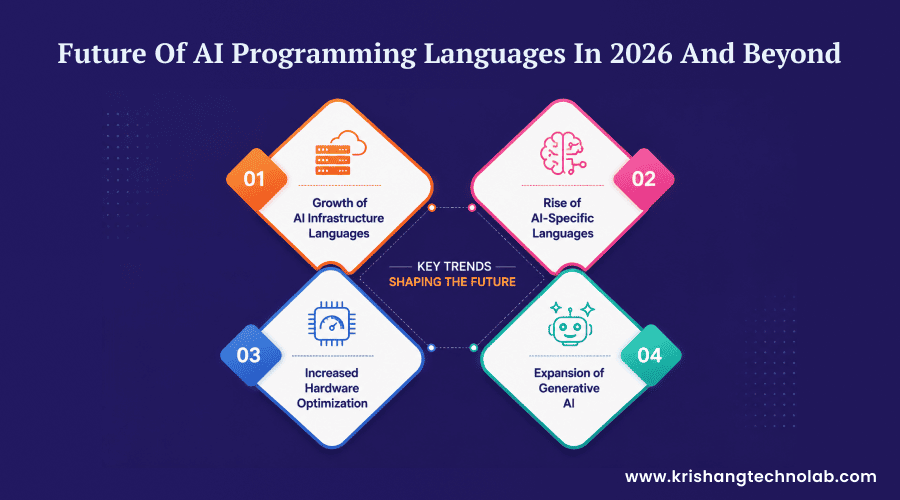
Growth of AI Infrastructure Languages
Rust and Go are becoming important for AI systems in production. Also many companies choose them for speed. They choose them for reliability as well.
Rise of AI-Specific Languages
Languages such as Mojo are built for AI workloads. And they’re high performers too. Also more efficient on hardware.
Increased Hardware Optimization
In the future, we will see more AI applications with GPU acceleration. They will also use special chips. Plus, they will be running optimized software. So, developers can write code that runs faster with hardware.
Expansion of Generative AI
Large language models are getting more powerful. This is why the demand for scalable AI systems is increasing. So developers have to come up with AI solutions that are efficient and rapid.
Also Read About: What is AI-powered software development for startups and enterprises?
Conclusion
Artificial intelligence is changing so fast. The best language to write codes in is dependent on what you want to do. It depends on your project requirements as well.
It is crucial to understand modern AI programming languages. They help you pick the right tech stack. This is true for machine learning, deep learning, generative AI, robotics and enterprise AI solutions.
Python is the most popular choice for most of the applications in AI. But there are also other languages that are very useful. Some of them are C++, Java, Rust, Go, Julia, and more. There are some things that every language is good for.
When developers know the strengths of these AI programming languages, they can build better systems. Businesses can build AI solutions that are more scalable and efficient. These solutions are also more future-proof.
If you are seeking to develop AI-powered applications, you can collaborate with an experienced AI development company. Krishang Technolab can help speed up the development. Also, it can help to choose the right technology stack. It also enables smooth roll-out of advanced AI solutions.
FAQs
Which programming language is best for AI?
Python is the best language for AI. It has many useful tools, such as TensorFlow and PyTorch. It’s also simple to read and write. Furthermore, it has strong community support. This support helps developers in machine learning and deep learning work.
What are AI programming languages used for?
Languages for AI programming build machine learning models. They also build deep learning systems. Developers, for example, employ them to construct chatbots. They also use them with automation tools. They also support computer vision systems. These languages can be used to build intelligent applications. These apps can analyze data and make decisions.
What computer language is used for artificial intelligence?
There are various programming languages used in AI. Among them are JavaScript, R, Java, C++ and Python. Each language has its function. Some, for example, favor research work. Some have systems for production. Others, on the other hand, focus on statistical analysis. Some operate AI applications on the web.
Is Python still the best AI programming language in 2026?
Yes, Python is the best AI programming language in 2026. It is easy to use and that is why it is still the leader. A lot of tools are also built into it. It is also supported with strong libraries. This is why it is widely used by developers for machine learning, generative AI and research.
Which programming language should beginners learn for AI?
Python for the new AI user. It’s simple and easy to understand. There are also many tutorials for new learners. Also, there are nice libraries in the language. Thus, these libraries make the development of machine learning and AI easier.
Found this post helpful? Don't forget to share it with your network!