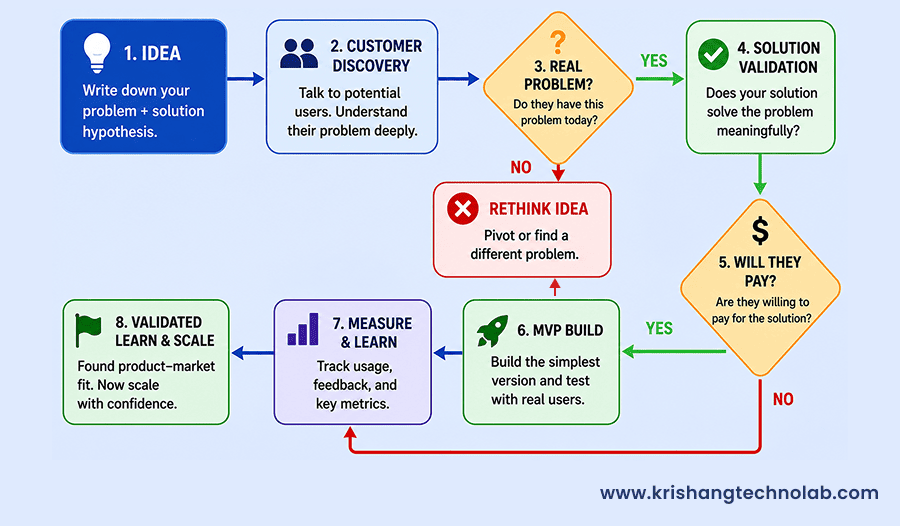
Quick Overview: Most startups don’t fail due to poor execution. They skip Validate startup idea entirely and miss out. This blog takes you through the process step-by-step. First of all, state your problem clearly. Then look into the market to validate the demand. Don’t build anything until you’ve talked to 15-20 real users. Run low experiments (smoke tests, landing pages, clickable prototypes) to get real signals. Search for trends in the feedback. Make a short MVP checklist. Define clear metrics. Make a decision before you build anything. Last but not least, choose the right development team to bring your validated idea to life.
Launching a startup is exciting. But excitement does not guarantee success.
Most founders never stop to validate their startup idea before they start building. That’s the most costly mistake in the startup playbook. They invest real money and real effort. Then they start and nobody shows up.
The problem is almost never the execution. It is skipping validation. According to CB Insights, 42% of startups fail due to no market need not poor execution, not bad timing. Simply building something nobody wanted.
Knowing how to validate a startup idea before building an MVP saves you time, money, and heartbreak. It means making decisions based on real signals not assumptions. For first-time founders, skipping this step is one of the most expensive mistakes you can make.
This guide walks you through of every startup idea validation step. And you do not need to write a single line of code to follow it.
Why Must Validate Startup Idea Before Building MVP
Most failed startups had a decent idea. What they lacked was proof. Research by Harvard Business School on why most startups fail found that many overlook a crucial step researching customer needs before testing their product.
Validation answers a simple question: does anyone actually want this?
It confirms that your problem is real. It demonstrates that genuine individuals have experienced it. And it confirms that they are willing to do something about it. Without that confirmation, even the best development team is building in the dark.
Ask yourself honestly: how do I know if my startup idea is worth building? The answer is never gut feeling. It is evidence gathered before you commit to development.
Validation also shows you what your MVP for startups actually needs. You stop guessing about features. You start building on facts.
Steps to Validate Business Idea With MVP
Step 1: Define the Problem Precisely
Vague ideas lead to vague products. First, clearly define what is the specific problem you are trying to solve.
Ask yourself three questions:
- What is the specific pain point I am solving?
- Who feels this pain most often and most deeply?
- How are people dealing with it today and why does that fall short?
“We are developing a productivity app” does not constitute a problem statement. ” “Freelance designers waste 3–5 hours every week chasing late invoices” is.
That specificity gives you something real to test. It also tells you whether people feel the pain badly enough to pay for a fix or whether they can live with it.
Step 2: Conduct Genuine Market Research for Your Startup Idea
The first step is to clearly define a problem statement . The next step in validating your startup idea is to gain a better understanding of the market.. Find out how common the problem is and who else is trying to solve it.
Thorough market research for a startup idea encompasses three key areas.
Analyze the competition
Find your direct and indirect competitors. Look at their features, prices and reviews from customers. Pay close attention to the negative reviews. Those complaints are your opportunity.
Study search trends
Use Google Trends and keyword tools. They show you whether people are actively searching for a solution. Rising search volume means a growing market.
Explore online communities
Reddit threads, Quora, niche forums, and LinkedIn groups reveal real user frustration. Look for the same complaints appearing again and again. Those recurring problems are worth solving.
Market research does more than confirm demand. It influences the way you present your product. It also tells you what to prioritize in your MVP. If you are building a custom web application or mobile product, understanding the competitive landscape early saves significant rework later.
Step 3: Talk to Real Users to Validate Your Startup Idea
This is where most founders cut corners. And it is where most MVPs go wrong.
User interviews are the fastest way to test your assumptions. They are also the best method of validating a startup idea without building a product first.
Aim for 15 to 20 conversations. Talk to people who match your target audience closely.
Keep these principles in mind:
- Do not pitch. Listen. Ask open-ended questions. Avoid leading the witness.
- Ask about behavior, not opinions. “Tell me about the last time this happened to you” beats “Would you use something like this?”
- Talk to the right people. Friends and family give friendly feedback. That is not the same as market feedback.
Listen for patterns. If the same frustrations come up across many conversations, that is a real signal.
This works for every type of founder. Whether you are a non-technical founder validating a SaaS idea or a developer testing a mobile app the insight comes from listening, not building.
Step 4: Test the Idea with Low-Cost Experiments
You do not need a finished product to test if people will pay for your product . These experiments help you validate your startup idea without writing a single line of code. They give you real data before you spend anything on development.
Landing Pages and Waitlists
Build a simple page. Describe your product’s core value. Ask visitors to join a waitlist.
Track signups. Monitor the duration of time individuals spend on the page. Real waitlist numbers with no product behind them are strong demand signals. A landing page test to validate your startup idea costs almost nothing to set up. You can have data within days.
Clickable Prototypes
Create a realistic prototype in Figma or a similar tool. Simulate your core user flow. Put it in front of real users and watch what they do.
Where do they hesitate? Where do they click with confidence? That behavior shapes your MVP development scope before you write a line of code. If you are thinking about how to validate a mobile app idea before building , a clickable prototype is usually the smartest first step.
Wizard of Oz Testing
Run your product manually behind the scenes. Let users think it is automated.
This works well for complex features AI tools, multi-step workflows, anything expensive to build. If users love the manual version, build the real one. If they do not, you saved yourself months of work.
Smoke Tests and PreSales
Pre-selling your product is the strongest validation signal of all. Offer it for sale before it exists.
If people hand over money for something you have not built yet, the demand is real. Even a signed letter of intent carries serious weight.
Most of these methods cost little to nothing. That makes this stage the most practical approach to startup idea validation without spending money.
Step 5: Analyze Feedback and Refine Your Concept
Collecting data is only half the work. Drawing the right conclusions is the other half.
After your experiments, look for patterns:
- Are multiple users describing the same problem the same way?
- Are they anticipating features that you did not plan?
- Did anything in your concept confuse them?
Do not explain away confusion. If users struggled, that is product feedback not a user error.
This stage may lead to small tweaks. Or it may reveal a bigger pivot. Either outcome is good. Pivoting after validation costs you days. Pivoting after six months of development costs you much more.
Step 6: Build Your MVP Validation Checklist
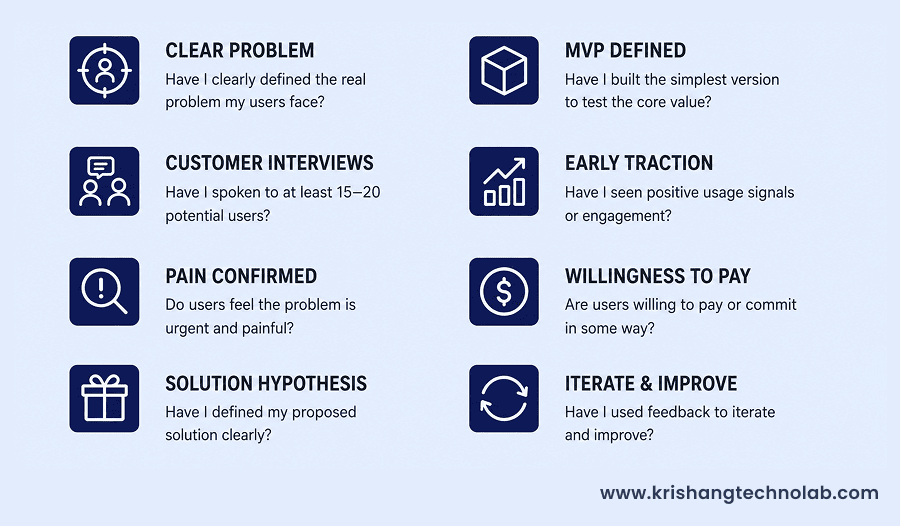
Once you validate your startup idea, scope becomes much easier to define. Now decide what goes into your first release and what to leave out.
Run every potential feature through this MVP validation checklist :
- Does it directly solve the validated pain point?
- Will it influence whether someone adopts the product?
- Can it ship fast enough to gather feedback?
- Does removing it break the core experience?
If the answer to any of these is no, leave it out. Every extra feature delays learning.
Keep the scope tight. Whether you are building a mobile application or a web platform, your choices at this stage should prioritize speed not perfection. Understanding how to build an MVP for a startup step by step means saying no to complexity until the market asks for it. For a deeper breakdown of what happens after validation, our guide on the MVP development process covers wireframing, agile sprints, and feature prioritization in detail.
Step 7: Set Clear Validation Metrics
Guesswork is validation without the numbers. Set your thresholds before you start, not after.
Decide in advance what success looks like. Some handy metrics:
- Waitlist signups: How many in how many days?
- Prototype engagement: How far do users get before dropping off?
- Willingness to pay: Do users commit to a price, even hypothetically?
- Pre-sale conversions: Did anyone actually pay?
Having these benchmarks in place at the start makes your decision honest. It distinguishes a real minimum viable product validation process from one that only validates what you thought in the first place. Once you have these numbers, it also becomes easier to plan your MVP development cost realistically, since you know exactly which features are worth funding first.
Step 8: Choose the Right Team to Build Your MVP
Validation is done. Now someone has to build it.
Your options are an in-house team, freelancers, or a dedicated development team . Each has unique cost, speed, and control trade-offs. Understanding how the hiring models compare will help you to choose the right structure for your stage and budget.
For many early-stage startups, an experienced development partner is the fastest path. You get frontend, backend, and mobile skills without building a full team from scratch. If you want to grow your own team over time, start with how to hire dedicated developers .
Building AI features into your MVP? Access to AI development expertise from day one can speed up your build and set you apart in the market.
Common Mistakes When You Validate a Startup Idea
The biggest mistake founders make is failing to validate their startup idea early enough. Even experienced founders may fall into these pitfalls. Watch out for all of them.
Skipping validation because you believe in the idea. Belief is not evidence. Many failed startups had very confident founders.
Only talking to people who agree with you. Supportive feedback feels good. Critical feedback is what you actually need.
Treating validation as a one-time task. It is not. Every product version is a new hypothesis. Keep testing, keep learning.
Building features before validating assumptions. Every feature built on an unvalidated assumption is a risk. Validate first. Build second.
Confusing activity with insight. A survey with 200 responses that confirms your bias is not validation. Ten honest conversations that challenge it are.
From Startup Idea Validation to MVP: What Comes Next
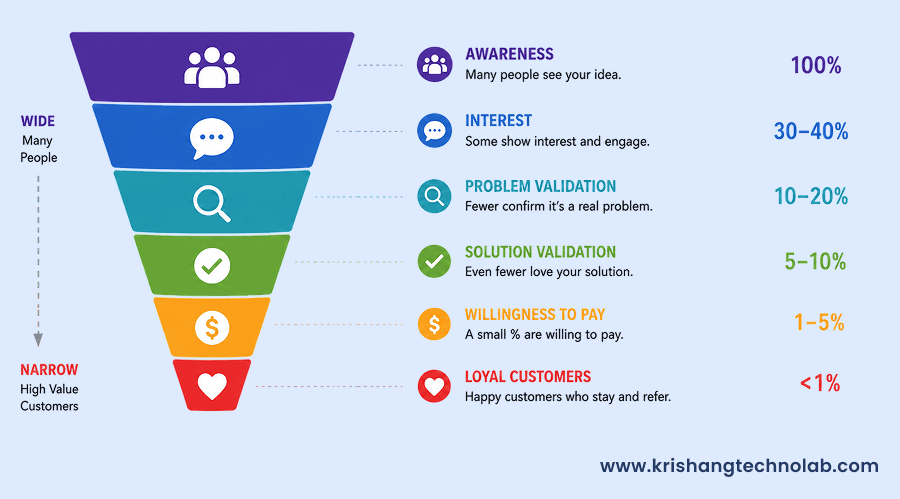
You have validated your idea. You have defined your scope. Now you are ready to build with real confidence.
Your validated learning drives every decision from here.
- Which features come first.
- Which workflows to design.
- Which technical choices support fast iteration.
The stakes are real at this stage. Whether you are building a consumer app, a B2B SaaS tool, or an ecommerce product early decisions have long-term consequences. If you are still unsure how minimal your first release should be, our comparison of MVP vs full product breaks down exactly what founders should build first. A team that understands software development outsourcing and early-stage products helps you move from insight to working software efficiently.
Also think about your digital presence. Your website, landing pages, and branding all matter at launch. A clear website design strategy means you are prepared to capture the interest your product generates.
Final Thoughts
Validating a startup idea before building an MVP is not optional. It is the difference between building something people want and building something they ignore.
The process is simple. Define the problem. Research the market. Talk to real users. Run low-cost experiments. Measure the results. Make a decision based on evidence not excitement.
None of this requires code. All of it improves what you build when you eventually do write code. Take the time to validate your startup idea before a single line of code is written.
Validation is also never truly finished. Every product version is a hypothesis. Every user is a data point. The fastest-moving startups keep learning long after launch. That is what separates them from those who build once, ship once, and wonder what went wrong.
Found this post helpful? Don't forget to share it with your network!