Quick Overview: Choosing between an MVP vs POC vs prototype confuses most founders. This guide breaks down what each approach actually means, when to use them, real cost and timeline differences, and how to match the right one to your idea’s stage before you waste time or money building the wrong thing.
You have an idea, and now you’re stuck on the same question every founder eventually hits: should you build an MVP vs POC vs prototype first? Maybe your idea is an app, a new feature, or a whole new business. You’re excited. You want to start building right now.
But here’s a question that trips up almost every founder, product manager, and developer at some point: what should you actually build first?
Should you write code to test if something even works? Should you make a clickable design so people can see what you mean? Or do you create a real working version that customers can actually use?
These three options have names: Proof of Concept (POC), Prototype, and Minimum Viable Product (MVP). They sound similar. All the time people confuse them, even in big companies. But they are not the same thing, and picking the wrong one can waste months of time and a lot of money.
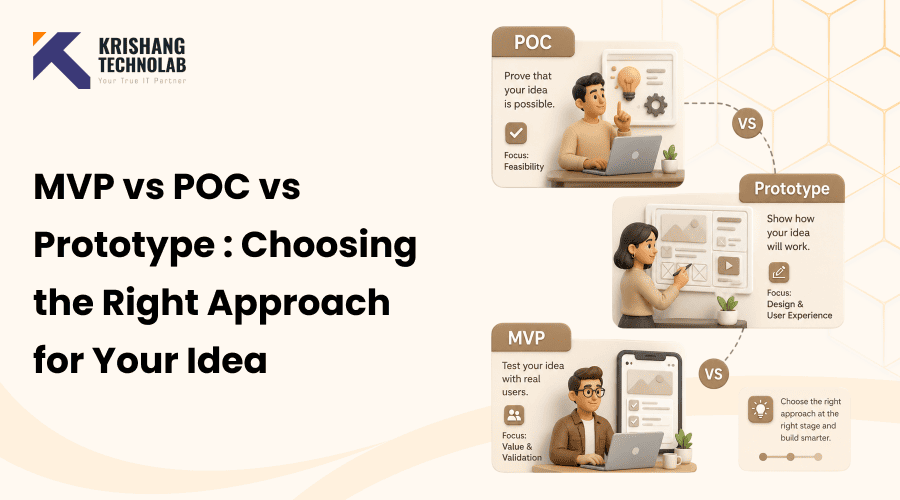
Short Version of POC, MVP & Protoype
- A POC responds to one question: “Can this even be done? It’s not pretty. It’s not for customers. It’s just to prove the idea is technically feasible.
- A prototype is an answer to a different question. “What would that feel like? What would that resemble? No, it is not the engineering; it is the experience.
- An MVP answers the biggest question: “Will people actually want this?“ An actual, live replica of your product that live users can interact with.
Think of it like building a home. The POC is checking if the ground can hold a foundation. The prototype is a 3D model you walk through before construction starts. The MVP is the smallest livable version of the house; maybe it only has one bedroom, but you can actually move in.
Confusing these three steps is one of the most common (and most expensive) mistakes in product development. Teams sometimes spend MVP-level money proving something a quick POC could have tested in a week. Other times, they skip straight to an MVP without checking if the core idea even works and find out the hard way that it doesn’t.
By the end of this guide, you’ll know exactly what separates these three approaches, when to use each one, and most importantly, which one your idea actually needs right now.
What Is a Proof of Concept (POC)?
A Proof of Concept is the smallest possible test of a single idea. It’s not built for users. It’s not built to look good. It exists for one reason only: to answer the question, “Is this technically possible?”
Definition and Purpose of a POC
A POC is usually internal-only. Nobody outside your team sees it, and that’s by design. The goal isn’t to impress anyone; it’s to remove doubt. If your idea depends on something risky (a new piece of technology, an unusual integration, a tricky algorithm), a POC tells you, fast and cheap, whether that risky piece actually works.
POCs are often messy on purpose. The code might be thrown away afterward. The design might not exist at all. What matters is the answer to one narrow technical question.
When to Use a Proof of Concept in Product Development
When to build a POC?
- You are uncertain if a certain technology, API, or method will actually work for your use case.
- The biggest risk in your idea is technical, not whether people will want it.
- You need to convince an internal team or technical stakeholder that something is feasible before investing further.
- You want to test one risky assumption in isolation, without building anything around it.
If you already know the technology works and your real question is about user behavior, skip the POC; it won’t tell you anything useful.
POC Examples in Software and AI Products
- For example, see if a machine learning model can classify a certain type of image accurately before building a whole app around it. It’s often an early step in machine learning development.
- Checking if a third-party payment API suits your specific transaction flow
- Making sure a hardware sensor can collect sufficiently accurate data to make your product work
- Running a little script to see if two systems can talk to each other the way your idea needs
What Is a Prototype?
A prototype is about the experience, not the engine underneath it. It’s the stage where you stop asking “can we build this?” and start asking “what should this feel like to use?”
Definition and Purpose of a Prototype
A prototype is typically a visual or interactive model of your product. It might be clickable. It might just be static screens stitched together. In most cases, very little (or none) of the actual underlying code works; buttons might be fake, data might be hardcoded, and “saving” something might not actually save anything.
The purpose is to let people see and react to the design before you spend real engineering time building it. Prototypes are cheap to change. A line of code is expensive to rewrite; a screen in a design tool is not.
Low-Fidelity vs. High-Fidelity Prototypes
Not all prototypes look the same. There is a range.
- Low-fidelity prototypes are rough sketches or wireframes. Think boxes and arrows on paper or whiteboard. They’re quick to make and easy to throw away, so they’re good for early feedback.
- High-fidelity prototypes look and feel almost like the real thing, full color, real fonts, and smooth interactions. They take longer to build but give a much more accurate sense of the final product.
Start low-fidelity when you’re still exploring ideas. When you’ve narrowed things down and need realistic feedback or buy-in from stakeholders, move to high fidelity.
When to Use Rapid Prototyping
- You have to see how users react to a design, flow, or feature before you write any actual code.
- People who need to see your idea in order to get it are funders, leaders, or partners.
- There are two distinct design directions that your team needs to compare right away.
- “You want fast, cheap feedback loops before you commit engineering resources.”
What Is a Minimum Viable Product (MVP)?
An MVP is the real deal, just the smallest version of it. In this phase, you stop pretending and start delivering something real users can use, even if it only does one or two things well.
Definition and Purpose of an MVP
An MVP is a working product, not a mockup. The code is real. The features are limited, but they function. The point of an MVP is to get your product into the hands of real users as fast as possible, with as little built as possible, so you can learn whether people genuinely want it. Many founders bring in a dedicated MVP development partner at this stage specifically to keep scope tight and timelines realistic.
This is the stage where market validation happens. A POC tells you something is technically possible. A prototype tells you what it might feel like. An MVP tells you whether anyone actually cares.
MVP vs. Full Product: Where the Line Is
The line is simple, even if it’s difficult to follow in practice: an MVP includes only the features absolutely necessary to deliver value and test your core hypothesis. Everything else nice-to-haves, edge cases, polish, and scaling for millions of users come later, after you’ve confirmed people want the core thing in the first place. For a deeper look at exactly where that line sits, see our breakdown of MVP vs full product development.
A common trap is “scope creep,” where a team keeps adding “just one more feature” before launch. Every feature added before validation is a bet made without evidence. The whole point of an MVP is to make that bet as small as possible.
MVP Examples for Startups and SaaS
- A food delivery startup that calls restaurants manually, by phone, before they even have any logistics software, to see if there is demand for their delivery service
- A SaaS product that starts with one core feature and a basic dashboard, with advanced reporting deliberately deferred to a later version
- A subscription box service that uses a basic landing page to test the waters of demand and fulfills orders by hand before automating anything
- An app that starts on one platform (say, iOS only) and then builds for Android to test the idea on a shoestring budge
MVP vs POC vs Prototype: Key Differences
These three approaches differ across four major dimensions: what they’re trying to prove, who sees them, how much they cost, and what you walk away with.
Goal: Feasibility vs. Usability vs. Market Validation
- POC proves feasibility: can the product be built at all?
- Prototype proves usability and design direction: what should the product look and feel like?
- MVP proves market validation: do real people want the product enough to use it?
Each one answers a different kind of risk. Confusing the goals is usually what causes teams to build the wrong thing at the wrong time.
Audience: Internal Team vs Investors vs Real Users
- A POC’s audience is almost always internal engineers and technical leads, sometimes a CTO who needs convincing.
- A prototype’s audience expands to include investors, designers, and potential users giving early feedback, but it’s still typically a curated, smaller group.
- An MVP’s audience is the real market’s actual paying or sign-up customers, in real-world conditions.
Cost and Time Investment Compared
Generally, cost and time increase in this order: POC is cheapest and fastest, prototype costs more but is still relatively quick, and MVP requires the most investment because it involves real, functioning code.
A POC might take days. A prototype might take up to a few weeks. An MVP often takes one to several months, depending on complexity. These are rough patterns, not fixed rules, but the relative ordering holds almost universally.
Output: What You’re Left With After Each
- After a POC, you’re left with an answer (yes or no) and often a throwaway code.
- After a prototype, you’re left with a tested design direction and user feedback on the experience.
- After an MVP, you’re left with a real, usable product and actual usage data, retention numbers, and customer feedback.
The table below summarizes MVP vs. POC vs. Prototype side by side so you can see all four dimensions at a glance.
| Dimension | POC | Prototype | MVP |
| Goal | Prove technical feasibility | Test design and user experience | Validate market demand |
| Audience | Internal team | Investors, designers, select users | Real customers |
| Cost/Time | Lowest, fastest | Moderate | Highest, slowest |
| Output | Yes/no technical answer | Validated design direction | Working product + real usage data |
POC vs Prototype vs MVP: Which Comes First?
The Typical Product Development Lifecycle Order
In most cases, the order looks like this: POC first, prototype second, MVP third. You confirm something is technically possible, then you figure out what it should look like, then you build a real, minimal version for actual users. If you want to see how this plays out week by week once you reach the MVP stage, our MVP development timeline breaks down a realistic phase-by-phase roadmap.
This order exists because each stage removes a different kind of risk before you spend more money on the next one. It would be backwards to spend months building an MVP only to discover the core technology never actually worked.
When It Makes Sense to Skip a Stage
Not every idea needs all three stages. Skip the POC if you’re using well-established, proven technology with no real technical risk. Skip the prototype if your product is simple enough, or similar enough to existing products, that the design risk is low.
You should almost never skip straight to an MVP if there’s meaningful uncertainty about either feasibility or user experience; that’s the combination that leads to expensive surprises.
Iterative Development Looping Back Between Stages
In practice, this process isn’t always a straight line. Teams often loop back, building a small POC mid-MVP development when a new technical question comes up or returning to prototyping when user feedback reveals the design isn’t working. Iterative development means treating these stages as tools you return to, not boxes you check once and never open again.
How to Choose Between MVP, POC, and Prototype for Your Idea
Questions to Ask Before You Start Building
- Is there real uncertainty about whether this can be built at all? (If yes, lean POC.)
- Is there real uncertainty about how this should look, feel, or flow? (If yes, lean prototype.)
- Is there real uncertainty about whether anyone wants the product? (If yes, you eventually need an MVP, but it’s worth reading how to validate a startup idea before building an MVP first.)
- How much money and time can I afford to lose if I’m wrong?
- Who should we focus on convincing next: an engineer, an investor, or the market?
Decision Framework
A simple way to decide between MVP, POC, and prototype: identify your biggest unanswered question, then match it to the approach built to answer it.
- The biggest question is “Can this work?” → Build a POC
- Biggest question is “What should this feel like?” → Build a prototype
- The biggest question is “Will people use this?” → Build an MVP
If you have more than one big question, address them in that order: feasibility, then experience, then market, rather than trying to answer all three at once.
Common Mistakes When Choosing an Approach
- Building a full MVP when a cheap POC would have answered the real question
- Treating a prototype like it’s a finished product and showing it to real customers as if it works
- Skipping validation entirely and building a “full” product based on assumptions
- Letting an MVP quietly grow into a full product before any real validation happens, due to scope creep, our guide on how to build an MVP covers practical ways to keep scope in check.
MVP vs POC vs Prototype by Industry
Mobile App Development
A POC might test whether a specific phone sensor or camera feature works as needed. A prototype shows the screen flow and navigation. An MVP ships with core functionality on one platform before expanding further, a pattern common across the mobile app development projects we see, where iOS or Android often launches first before the other platform follows.
SaaS Products
A POC might confirm that a complex integration with another platform is possible. A prototype shows the dashboard and core workflow. An MVP launches with one primary feature, often with manual processes behind the scenes that get automated later.
AI and Machine Learning Products
A POC is especially important here, since model performance is often the biggest unknown. Teams typically test whether a model can hit acceptable accuracy on real data before designing any interface around it. The prototype then shows how users would interact with the AI’s output, and the MVP delivers a working version with a real (if limited) model in production. Because the technical risk is usually highest in these projects, many teams bring in dedicated AI development expertise from the POC stage onward rather than waiting until the MVP.
In Agile Development Teams
Agile teams often treat POCs and prototypes as part of a sprint’s “spike” or research work, separate from the main backlog. The MVP becomes the first few sprints’ actual shippable output, refined through ongoing iteration based on real user feedback.
Cost Comparison: Building a POC vs Prototype vs MVP
Typical Budget Ranges
Exact costs vary widely by industry, team rates, and complexity, but the relative pattern tends to hold:
- POC: The smallest budget is often a few days to a couple of weeks of one or two people’s time.
- Prototype: Moderate budget, typically a few weeks of design (and sometimes light development) time.
- MVP: The largest budget, usually one to several months of a small cross-functional team’s time.
Rather than fixating on dollar figures (which change constantly), it’s more useful to think in terms of relative investment: a POC should feel “cheap enough to be disposable,” while an MVP is a real commitment. For actual current pricing ranges once you reach that stage, our breakdown of MVP development cost walks through what drives the budget up or down.
Hidden Costs to Watch For
- Scope creep during MVP development, where “minimum” quietly disappears
- Over-polishing a prototype until it costs nearly as much as building the real thing
- Skipping a POC and discovering a fatal technical issue halfway through MVP development, after most of the budget is already spent
- Maintenance costs for MVPs that succeed and need to keep running and improving
Real-World Examples of MVP, POC, and Prototype
A POC That Led to a Funded MVP
A small team had an idea for a tool that used computer vision to detect product defects on a manufacturing line. Before writing a single line of production code, they ran a focused POC: feeding sample images into an existing vision model to see if it could reliably catch the defects they cared about. It worked well enough to justify moving forward. That cheap, quick test became the evidence they needed to secure funding and build a full MVP, and skipping it would have meant raising money on a guess instead of a result.
A Prototype That Saved a Team from a Bad Pivot
A SaaS team was convinced their users wanted a complex, multi-step onboarding flow with lots of customization options. Instead of building it, they created a clickable prototype and tested it with a handful of target users. The feedback was clear. People want to get started in under a minute, not configure ten settings. The team eliminated the complicated flow before writing a single line of real code, saving weeks of development time and avoiding a frustrating MVP for its first users.
What’s the cheapest way to validate a startup idea?
In most cases, a low-fidelity prototype or a small, focused POC is far cheaper than building an MVP. Validate the riskiest assumption first, with the smallest, fastest test possible, before committing real development budget.
Conclusion: Matching the Right Approach to Your Idea’s Stage
There’s no universal “right” answer between MVP vs POC vs prototype, only the right tool for the question you’re actually trying to answer. If you’re not sure something can be built, prove it with a POC. And you’re not sure what it should look or feel like, test it with a prototype. If you’re not sure anyone wants it, put a real MVP in front of real users.
The biggest, most expensive mistakes in product development usually come from skipping a stage that mattered or over-investing in a stage that didn’t. Match the approach to your idea’s actual stage of uncertainty, and you’ll spend your time and money on the risks that are actually worth resolving.
Found this post helpful? Don't forget to share it with your network!