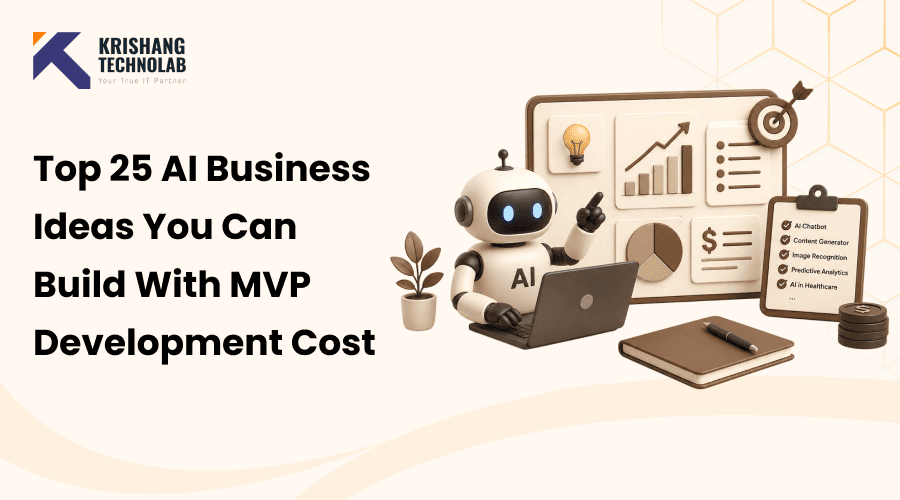
Quick Overview: Thinking about launching an AI product in 2026? This guide breaks down 25 practical AI business ideas from customer support agents to fraud detection platforms each with realistic MVP development costs, core features, required AI technologies, and monetization models to help you plan your build with confidence.
AI is no longer a nice-to-have feature; it’s the bedrock of entire new categories of business. If you have been looking for AI business ideas for 2026 or realistic AI startup ideas, the barrier to launch an AI product has never been lower. Powerful LLMs, ready-made APIs, and mature no-code infrastructure mean founders don’t need a research lab to compete, just a focused MVP that solves one real problem for one customer segment and a clear picture of AI MVP development cost before building.
Smart founders don’t build a sprawling AI platform on day one. They validate demand first, shipping a lean MVP, and only expand once real usage confirms the idea works. That’s why this guide pairs each of these AI business ideas with MVP cost estimates, so you can move from idea to build plan without guessing at your budget. It also answers how much it costs to build an AI MVP, covering the best AI business ideas to start in 2026 alongside an honest AI MVP development cost breakdown. Want to skip the research? Our team offers AI consulting services to help scope the right MVP from day one.
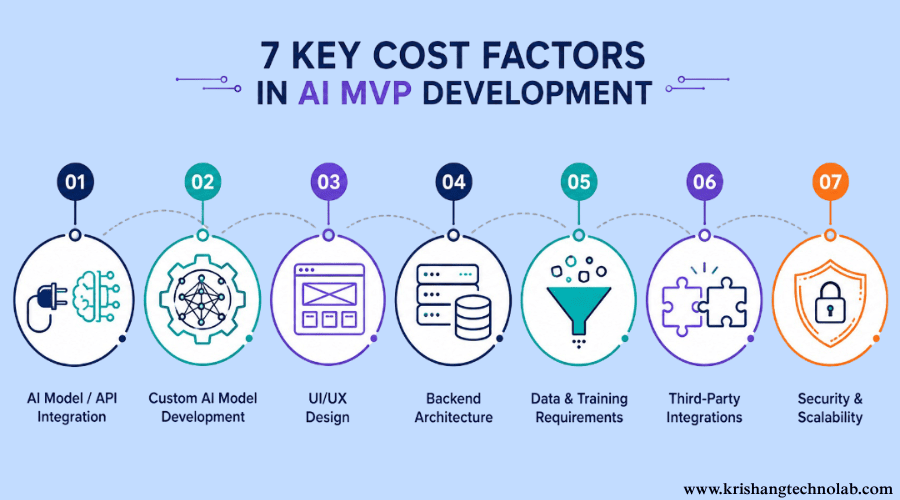
Before we dive in, here’s what actually drives AI MVP cost:
- AI model and API integration: connecting to LLMs, speech, or vision APIs
- Custom AI model development: fine-tuning or training for specialized tasks
- UI/UX design: the interface users and admins interact with
- Backend architecture: databases, APIs, authentication, cloud infrastructure
- Data and training requirements: sourcing, cleaning, structuring data
- Third-party integrations: CRMs, payments, calendars, industry tools
- Security and scalability: compliance (HIPAA, SOC 2), encryption, growth-ready infrastructure
With that in mind, here are 25 AI business ideas worth building in 2026, complete with realistic MVP cost estimates for each.
Quick Overview Table
| # | AI Business Idea | Target Users | Core MVP Features | Estimated MVP Cost |
| 1 | AI Customer Support Agent | E-commerce, SaaS, SMBs | AI chatbot, knowledge base, human handoff | $25,000–$60,000 |
| 2 | AI Sales Assistant | Sales teams, agencies | Lead qualification, CRM integration, follow-ups | $30,000–$75,000 |
| 3 | AI Content Creation Platform | Marketers, creators | Blog, social, ad copy generation | $20,000–$50,000 |
| 4 | AI Resume & Career Platform | Job seekers | Resume builder, job matching, interview prep | $20,000–$45,000 |
| 5 | AI Healthcare Assistant | Clinics, patients | Symptom guidance, appointment support, records | $40,000–$100,000+ |
| 6 | AI Legal Document Assistant | Lawyers, businesses | Document analysis, summaries, clause detection | $40,000–$100,000+ |
| 7 | AI Personal Finance Advisor | Consumers | Expense tracking, budgeting, insights | $30,000–$75,000 |
| 8 | AI E-commerce Personalization Tool | Online stores | Product recommendations, personalization | $25,000–$65,000 |
| 9 | AI Fraud Detection Platform | Fintech, e-commerce | Transaction monitoring, anomaly detection | $50,000–$150,000+ |
| 10 | AI Meeting Assistant | Businesses, remote teams | Transcription, summaries, action items | $25,000–$60,000 |
| 11 | AI Coding Assistant | Developers, startups | Code generation, debugging, documentation | $30,000–$80,000 |
| 12 | AI Cybersecurity Monitoring Tool | SMBs, enterprises | Threat detection, alerts, reporting | $50,000–$150,000+ |
| 13 | AI Recruitment Platform | Recruiters, HR teams | Candidate screening, matching, interview tools | $30,000–$75,000 |
| 14 | AI Real Estate Assistant | Agents, property companies | Property matching, lead qualification, valuation | $30,000–$80,000 |
| 15 | AI Marketing Automation Platform | Agencies, brands | Campaign generation, analytics, automation | $35,000–$90,000 |
| 16 | AI Education & Tutoring Platform | Students, schools | AI tutor, personalized learning, quizzes | $30,000–$80,000 |
| 17 | AI Document Processing Platform | Businesses | OCR, data extraction, classification | $30,000–$75,000 |
| 18 | AI Voice Agent Platform | Businesses, call centers | Voice AI, call handling, CRM integration | $40,000–$100,000+ |
| 19 | AI Supply Chain Optimization Tool | Manufacturers, logistics | Demand forecasting, inventory insights | $50,000–$150,000+ |
| 20 | AI Travel Planning Platform | Travelers, agencies | Personalized itineraries, recommendations | $20,000–$50,000 |
| 21 | AI Social Media Management Tool | Creators, brands | Content generation, scheduling, analytics | $20,000–$55,000 |
| 22 | AI Recruitment Interview Platform | HR departments | AI interviews, scoring, candidate insights | $30,000–$75,000 |
| 23 | AI Image & Video Creation Platform | Creators, marketers | Text-to-image, video generation, editing | $40,000–$120,000+ |
| 24 | AI Construction Management Tool | Contractors, builders | Cost estimation, scheduling, risk analysis | $40,000–$100,000 |
| 25 | AI Business Intelligence Platform | Startups, enterprises | Natural-language analytics, dashboards, reports | $40,000–$120,000+ |
1. AI Customer Support Agent
What is it? A chatbot that answers customers’ questions, rather than deflecting them, can pull up order status on request and clear the routine tickets automatically. If it’s out of its depth, it hands the conversation to a human agent, with the context already attached.
Who can use it? E-commerce brands, SaaS companies, and SMBs with a small support team and ever-growing ticket volume.
Core MVP Features: AI chatbot, knowledge base ingestion, ticket handoff to human agents and a basic analytics dashboard.
AI Technologies Required: Natural Language Processing, Large Language Models
Estimated Cost of MVP: $25,000–$60,000
Future Expansion: After the basics are up and running, natural next steps include voice support, multiple languages, sentiment-based escalation so frustrated customers get to a human faster, and proactive outreach for things like abandoned carts or upcoming renewals. Most teams don’t have the time to build all of that from scratch. Our AI development company team has already gone through the hard parts of chatbot, knowledge base, and handoff logic and can build on that instead of starting from scratch.
2. AI Sales Assistant
What is it? An AI agent that scores inbound leads, drafts personalized follow-ups, and logs everything to the CRM automatically.
Who can use it? Sales teams are inundated with leads they can’t follow up on. Agencies with multiple client pipelines, or early stage B2B startups where the volume of leads has outgrown their SDR headcount.
Core MVP Features: Lead scoring, two-way CRM sync, and adaptive follow-up sequences based on lead responses.
AI Technologies Required: Large Language Models, Predictive Analytics.
Estimated MVP Cost: $30,000–$75,000
Future Expansion: Call transcription with rep coaching, deal-risk forecasting, and multi-channel outreach (email, LinkedIn, SMS).
3. AI Content Creation Platform
What is it? Turns a brief or a few bullet points into a blog post, social captions, or ad copy whichever format you need.
Who can use it? Marketers stretched across too many channels, agencies handling content for several clients at once, and solo creators or small businesses that don’t have a content team to lean on.
Core MVP Features: Format-specific generation (blog, social, ads), brand voice presets, and an editing workspace for refining drafts.
AI Technologies Required: Large Language Models, Generative AI.
Estimated MVP Cost: $20,000–$50,000
Future Expansion: SEO scoring to guide what gets written, support for multiple languages, and collaboration/approval workflows once more than one person is touching the content. The writing model is really the whole product here, so it’s worth working with a team that specializes in generative AI development to get output quality right from the first release, rather than bolting it on later.
4. AI Resume & Career Platform
What is it? Reworks your resume to match a job description, suggests roles worth applying to, and runs mock interview practice.
Who can use it? Job seekers in a tough market, career coaches who want to scale their advice beyond 1:1 sessions and university career centres that serve hundreds of students at a time.
Core MVP Features: role-optimized resume builder, job matching engine, AI-led interview practice + feedback.
AI Technologies Required: Large Language Models, Natural Language Processing.
Estimated MVP Cost: $20,000–$45,000
Future Expansion: Coaching for salary negotiation when the offer arrives, a recruiter marketplace to link users with hiring teams directly, and integrations on the employer side so postings and matches sync in both directions.
5. AI Healthcare Assistant
What is it? A patient-facing assistant for symptom guidance, appointment booking, and organized health records.
Who can use it? Clinics trying to cut down on front-desk workload Telehealth providers who see a high volume of patients with chronic conditions who need more regular touchpoints than a once-a-year checkup.
Core MVP Features: Symptom triage chat, schedule an appointment, secure access to records.
AI Technologies Required: Large Language Models, Natural Language Processing and Predictive Analytics.
Estimated MVP Cost: $40,000–$100,000+
Future Expansion: Down the line, remote monitoring integration, dedicated chronic-care management programs, and partnerships with insurance providers to fold coverage questions into the same conversation.
Note: This is healthcare, so HIPAA compliance isn’t an optional plan for it to add real time and cost to the build, not just a checkbox at the end.
6. AI Legal Document Assistant
What is it? Upload a contract, and it reads through the fine print for you, flagging clauses that could bite you later and summarising the whole thing in language that doesn’t require a law degree to understand.
Who can use it? Solo lawyers who don’t have a team of associates to do first-pass reviews, law firms wanting to speed up routine contract work, and businesses signing vendor or lease agreements without in-house counsel to check them first.
Key MVP Features: Upload & Analyse Documents, Flag Risks at the Clause Level, and Provide Summaries in Simple Language.
AI Technologies Required: Large Language Models, Natural Language Processing.
Estimated MVP Cost: $40,000–$100,000+
Future Growth: There’s room to grow this well past a review tool. Contract drafting from scratch, e-signature integration built into the same flow, and jurisdiction-specific compliance checks for firms working across states or countries.
7. AI Personal Finance Advisor
What is it? An app that watches where your money actually goes, helps you build a budget around it, and nudges you when something’s off before you notice it yourself on a bank statement.
Who can use it? Pretty much anyone who’s tired of guessing where their paycheck went and people who want real visibility into spending without opening five different apps to piece it together.
Core MVP Features: Bank account linking, expense categorization, a budgeting dashboard, and insight notifications that actually say something useful.
AI Technologies Required: Machine Learning, Predictive Analytics.
Estimated MVP Cost: $30,000–$75,000
Future Expansion: Tracking and budgeting is really just the entry point. Investment recommendations make sense once someone’s spending is under control and they’re asking, “Now what do I do with what’s left over?” Debt payoff planning is its own thing worth building out properly, not just a feature bolted on. The order you pay things off in actually matters. Tax season is probably where people would pay the most for help, so some kind of optimization guidance there could end up being the more valuable addition than either of the other two.
8. AI E-commerce Personalization Tool
What is it? A plug-in that watches how each shopper browses and buys, then reshapes what they see with different recommendations, different layouts, and different offers without the store owner having to configure any of it manually.
Who can use it? Stores running on Shopify, WooCommerce, or similar platforms that want the personalization big retailers use, without building it from scratch.
Core MVP Features: A recommendation engine, on-site personalization widgets, and analytics to show what’s actually moving the needle.
AI Technologies Required: Machine Learning, Predictive Analytics.
Estimated MVP Cost: $25,000–$65,000
Future Expansion: The recommendation engine is really just the foundation. Once it’s live, the same behavioral data can drive personalized email and SMS reminding someone about the item they kept looking at but never bought. Dynamic pricing is a bigger lift but pays off for stores with real demand swings. And inventory forecasting ends up mattering most for anyone who’s been burned by selling out of a bestseller with no restock in sight.
Since this lives inside an existing storefront rather than as a standalone product, it’s worth pairing with a team that already handles ecommerce development on Shopify, WooCommerce, and Magento. One partner, no separate integration headache.
9. AI Fraud Detection Platform
What is it? A system that watches transactions as they happen and catches the ones that don’t look right before the money’s actually gone, not in a report the next morning.
Who can use it? Fintech companies, payment processors, and e-commerce platforms dealing with frequent chargebacks.
Core MVP Features: Real-time transaction monitoring, anomaly detection built on rules and models together, and an alerting dashboard someone can actually act on.
AI Technologies Required: Machine Learning, Predictive Analytics.
Estimated MVP Cost: $50,000–$150,000+
Future Expansion: Cross-platform detection to catch fraud rings operating across multiple stores or accounts, models that keep adapting as fraud patterns shift, and automation for the regulatory reporting side that nobody enjoys doing by hand.
Note: Security and compliance aren’t optional here, the regulatory environment around this space demands it. And because fraud tactics keep changing, a fixed rules engine goes stale fast. That’s why most teams working in this space lean on dedicated machine learning development services that can keep retraining the model, rather than treating it as a one-time build.
10. AI Meeting Assistant
What is it? A tool that sits in on the call, writes down what was actually said, and turns that into a summary with action items so nobody’s scrambling to remember who agreed to what by the time the next meeting rolls around.
Who can use it? Businesses and remote teams stuck in back-to-back meetings, especially ones where half the value gets lost because someone forgot to take notes.
Core MVP Features: Live transcription, AI-generated summaries, and action-item extraction that integrates with where the team already tracks tasks.
AI Technologies Required: Speech Recognition, Large Language Models.
Estimated MVP Cost: $25,000–$60,000
Future Expansion: CRM/project-management integrations, sentiment analysis, and cross-meeting analytics to spot patterns over time.
11. AI Coding Assistant
What is it? Describe what you want in plain language, and it writes the code, flags bugs as you go, and generates documentation you’d otherwise never get around to writing yourself.
Who can use it? Individual developers who want to move faster, startups without the headcount to cover every part of the stack, and engineering teams looking to cut down on the busywork around actual coding.
Core MVP Features: Code generation, inline debugging suggestions, and documentation that writes itself as the code changes.
AI Technologies Required: Large Language Models.
Estimated MVP Cost: $30,000–$80,000
Future Expansion: IDE-native plugins so it lives where developers already work, automated PR review to catch issues before a human even looks, and code-quality analytics across the whole team. Getting this right usually takes engineers who work in LLM tooling every day, not just occasionally, which is why founders in this space often hire AI developers on a dedicated basis instead of pulling from a general dev team.
12. AI Cybersecurity Monitoring Tool
What is it? A system that watches network and application activity around the clock, catches the stuff that looks like a threat, and gets the right people alerted before it turns into an actual breach.
Who can use it? SMBs and enterprises that need real security coverage but don’t have the budget or headcount to run a full in-house security operations team.
Core MVP Features: A threat detection engine, real-time alerting, and an incident reporting dashboard that security teams can actually work from.
AI Technologies Required: Machine Learning, Predictive Analytics.
Estimated MVP Cost: $50,000–$150,000+
Future Expansion: Automated incident response, compliance reporting (SOC 2, ISO 27001), and a threat-intelligence sharing network.
13. AI Recruitment Platform
What is it? A platform that sifts through resumes, figures out who’s actually a fit for the role and keeps the whole hiring pipeline organised instead of scattered across spreadsheets and inboxes.
Who can use it? Recruiters who have too many open roles at one time, staffing agencies that are placing candidates with multiple clients and HR teams at companies that are growing faster than their hiring process can support.
Core MVP Features: Resume screening, candidate to job matching, pipeline dashboard to track all from applied to hired.
AI Technologies Required: Large Language Models, Machine Learning.
Estimated MVP Cost: $30,000–$75,000
Future Expansion: Passive-candidate outreach, bias-auditing tools, and ATS integrations.
14. AI Real Estate Assistant
What is it? A tool that matches buyers or renters to properties that actually fit what they’re looking for, has a first conversation with leads to see who’s serious, and estimates what a property’s really worth without waiting on a formal appraisal.
Who can use it? Real estate agents are tired of chasing dead-end leads. Brokerages managing listings across multiple agents. Property management companies that want to lease up units quicker.
Core MVP Features: Property Matching Engine, First Filtering Pass Lead Qualification Chat, and Automated Valuation Model for Quick Price Estimates.
AI Technologies Required: Machine Learning, Predictive Analytics.
Estimated MVP Cost: $30,000–$80,000
Future Expansion: Virtual tours make sense for buyers who’d rather rule out half the listings online before booking anything in person. Mortgage pre-qualification is the natural next step once someone’s serious about a property; no reason to send them to a separate site for that. Market-trend forecasting so agents can show clients where prices are headed, not just past comps.
15. AI Marketing Automation Platform
What is it? A platform that builds out campaigns, handles the scheduling and execution across channels, and reports back on how everything’s actually performing instead of pulling numbers manually from five different dashboards.
Who can use it? Marketing agencies are running campaigns for several clients at once, and brands are managing enough channels that keeping track of it all by hand has stopped being realistic.
Core MVP Features: Campaign generation, scheduling and automation, and a performance analytics dashboard that ties it all together.
AI Technologies Required: Generative AI, predictive analytics.
Estimated MVP Cost: $35,000–$90,000
Future Expansion: Predictive budget allocation, large-scale creative A/B testing, and cross-channel attribution modeling.
16. AI Education & Tutoring Platform
What is it? Most tutoring treats every student the same, but this doesn’t. It slows down when someone’s stuck on a concept and speeds up through what they’ve already mastered, so nobody’s bored and nobody’s left behind.
Who can use it? Students who do better with one-on-one attention than in a room of thirty. Parents who want that extra support but can’t justify a private tutor’s hourly rate. Tutoring companies and schools are trying to offer personalised instruction to more students without hiring proportionally more staff.
Core MVP Features: AI tutoring chat, quizzes that shift difficulty based on how a student’s actually answering, and a dashboard for tracking progress over time.
AI Technologies Required: Large Language Models, Natural Language Processing.
Estimated MVP Cost: $30,000–$80,000
Future Expansion: Parents and teachers would probably want visibility without having to ask the student directly, so reporting dashboards make sense early. Curriculum-specific modules matter more for schools than individual families. And for younger students especially, gamified paths tend to be what actually keeps them opening the app on their own.
17. AI Document Processing Platform
What is it? Feed it a stack of invoices, forms, or receipts, and it reads them, pulls out the actual data, and sorts everything into the right category, the part of the job nobody wants to do by hand at 4pm on a Friday.
Who can use it? Finance teams buried in paperwork, insurance companies processing claims documents, logistics firms tracking shipments across dozens of forms, and healthcare admin staff who deal with more paper than they’d like to admit.
Core MVP Features: OCR ingestion, structured data extraction, and document classification.
AI Technologies Required: Computer Vision, Natural Language Processing.
Estimated MVP Cost: $30,000–$75,000
Future Expansion: Once the extraction’s solid, it’s worth adding triggers that kick off downstream workflows automatically, templates tailored to specific industries instead of one-size-fits-all extraction, and support for documents that aren’t in English, which matters a lot more than people expect once you’re working across regions.
18. AI Voice Agent Platform
What is it? A voice system that actually picks up the phone, books appointments, answers support questions, and routes calls without a caller waiting on hold for the next available human.
Who can use it? Call centers drowning in volume, service businesses that lose customers every time a call goes to voicemail, and pretty much any company where the phone still rings more than the inbox does.
Core MVP Features: Voice AI conversation flows, call routing, and CRM integration to ensure every call updates the right record automatically.
AI Technologies Required: Speech Recognition and Large Language Models.
Estimated MVP Cost: $40,000–$100,000+
Future Growth: Multilingual support for companies with customers who speak more than one language; sentiment detection to avoid a caller becoming frustrated; and outbound automation for sales calls, not just inbound. If there’s a companion mobile app in the plan too, our guide on how to build an AI-powered mobile app with a scalable API backend covers the architecture decisions worth locking in early, before the voice and app sides have to talk to each other.
19. AI Supply Chain Optimization Tool
What is it? A tool that looks at demand patterns and figures out how much inventory to actually keep on hand, enough to avoid stockouts but not so much that money’s sitting on a shelf collecting dust.
Who can use it? It ranges from manufacturers scheduling production runs to distributors controlling inventory in multiple warehouses to logistics companies trying to keep goods flowing while not over- or under-ordering.
Core MVP Features: Demand forecast models Stock level insights alert when something is about to run out or pile up.
AI Technologies Required: Machine Learning, Predictive Analytics.
Estimated MVP Cost: $50,000–$150,000+
Future Expansion: Supplier risk scoring to identify problems before a shipment doesn’t arrive, route optimization to cut down on wasted transit time, and real-time IoT sensor integration so the system knows what’s really going on in the warehouse, not what the last manual count reported.
20. AI Travel Planning Platform
What is it? Tell it your budget, your dates, and what you’re actually into, and it puts together an itinerary, not a generic top-10 list, but something built around what you’d want to do.
Who can use it? Individual travelers who’d rather skip hours of research, and boutique travel agencies wanting to offer personalized trip planning without a full-time planner behind every booking.
Core MVP capabilities: itinerary creation, personalized suggestions, and booking integration to take plans to confirmed bookings.
AI Technologies Required: Large Language Models, Predictive Analytics.
Estimated MVP Cost: $20,000–$50,000
Future Expansion: Life changes when weather or delays screw up the plan. Planning group travel with more than one set of preferences to juggle loyalty program integration so points and status actually factor into the recommendations.
21. AI Social Media Management Tool
What is it? A tool that writes the post, schedules it across platforms, and then tells you afterward what actually landed instead of guessing based on a handful of likes.
Who can use it? Creators posting more often than they can keep up with, small brands without a dedicated social hire, and social media managers juggling several accounts at once.
Core MVP Features: Content generation, scheduling that works across multiple platforms at once, plus a dashboard showing what’s actually performing versus what just feels like it is.
AI Technologies Required: Generative AI, Natural Language Processing.
Estimated MVP Cost: $20,000–$55,000
Future Expansion: Trend prediction is the one people usually want most catching a topic on the way up instead of posting about it once everyone’s already moved on. Automated replies help too, mostly so engagement doesn’t drop the moment someone steps away from their phone. Influencer collaboration tools are a smaller piece, but useful for brands that don’t want to manage those relationships in a separate spreadsheet somewhere.
22. AI Recruitment Interview Platform
What is it? Candidates record their answers on their own time, and the system scores them against the same criteria every time so two people applying for the same role actually get evaluated the same way, instead of however a tired recruiter happens to be feeling that day.
Who can use it? HR departments hiring at volume, and staffing agencies running candidates through dozens of roles a week, so sitting in on every single interview just isn’t realistic.
Core MVP Features: AI-led interview flows, automated scoring, and reports recruiters can actually act on not just a number, but something that explains why.
AI Technologies Required: Speech Recognition, Natural Language Processing, Machine Learning.
Estimated MVP Cost: $30,000–$75,000
Future Expansion: Fairness auditing matters most here; the scoring needs to hold up under scrutiny once it’s making real hiring decisions at scale, not just work well in a demo. Video assessment picks up the soft-skill signals a transcript misses entirely, which is often the thing recruiters actually care about most. And ATS integration is less exciting but probably gets used the most day-to-day, since nobody wants to check a separate tool on top of the one they already live in.
23. AI Image & Video Creation Platform
What is it? Type out what you want, and it generates the actual image or short video no stock photo search, no waiting on a designer’s turnaround time.
Who can use it? Content creators who need visuals faster than they can shoot them, marketers running campaigns across too many formats to produce manually, and e-commerce brands that need fresh product visuals constantly.
Core MVP Features: Text-to-image generation, short-form video generation, and basic editing tools to clean things up after.
AI Technologies Required: Generative AI and Computer Vision.
Estimated MVP Cost: $40,000–$120,000+
Future Expansion: Train the model to a brand’s style so the output doesn’t look generic; video-to-video editing to rework existing footage rather than starting from scratch; and animation with voiceover built in for a more finished, ready-to-post result.
24. AI Construction Management Tool
What is it? A tool that estimates what a project will actually cost, builds out the schedule around it, and flags the risks likely to blow the budget or the timeline before they do.
Who can use it? Contractors bidding on jobs, builders managing multiple sites at once, and project managers who’d rather catch a problem on paper than three weeks into the build.
Core MVP Features: A cost estimation engine, project scheduling, and a dashboard that flags risk before it turns into a delay.
AI Technologies Required: Machine Learning, Predictive Analytics.
Estimated MVP Cost: $40,000–$100,000
Future Expansion: Drone and computer-vision tracking for real site progress instead of someone’s status update, forecasting for supplier and material prices so budgets hold up against market swings, and a subcontractor marketplace to fill out a crew without starting the search from scratch every time.
25. AI Business Intelligence Platform
What is it? Ask a question in plain English, “What were our top three regions last quarter?” and it builds the dashboard on the spot, no SQL, no waiting on a data analyst to get to your request.
Who can use it? Startups that don’t have a dedicated data team yet and enterprise teams who need answers faster than their existing BI process allows.
Core MVP Features: A natural-language query interface, dashboards that generate themselves based on the question asked, and scheduled report delivery so people aren’t logging in just to check the same numbers every week.
AI Technologies Required: Large Language Models, Predictive Analytics.
Estimated MVP Cost: $40,000–$120,000+
Future Expansion: Predictive and prescriptive analytics that go beyond “what happened” into “what’s likely to happen next,” querying across multiple databases instead of just one source, and embedding this same capability into other SaaS products as a feature rather than a standalone tool. Getting the underlying models and data pipelines right is honestly the harder half of this build, often worth bringing in dedicated data science consulting before the dashboard layer is even designed.
Should You Build In-House or Hire an AI MVP Development Company?
Once you’ve picked one of these profitable AI startup ideas for entrepreneurs, the next decision is who builds it. Most non-technical founders — and even technical founders who want to move faster choose to work with an outside team rather than hiring a full in-house department from scratch. A few paths to consider:
- Hire AI developers directly on a dedicated basis if you already have product and design direction and just need engineering execution.
- Partner with an AI development company if you want a single team handling product, design, and engineering together — usually the fastest path from idea to launch.
- Bring in AI consulting services first if you’re still validating which of these ideas is worth building, so scope and architecture decisions come before any code.
- Use generative AI development or machine learning development services when your idea depends on specialized model work fine-tuning, custom prompting pipelines, or domain-specific training rather than a standard API integration.
- Hire prompt engineers specifically if your product’s value hinges on getting LLM output quality and reliability right, rather than general software engineering.
- Consider a software development outsourcing partner if you need everything from infrastructure to compliance handled under one roof, especially for regulated categories like healthcare, legal, or fintech.
Whichever route you choose, ask for a fixed-scope quote tied to the tier breakdown above (Basic, Mid-Level, or Advanced) so there’s no ambiguity about what’s included in the estimate. You can also request a free quote directly if you’d like a cost estimate for your specific idea.
Final Thoughts
These AI business ideas prove that the opportunities in 2026 aren’t about building the flashiest model; they’re about solving a specific, painful problem for a specific audience, faster and cheaper than it’s solved today. Every idea on this list can start as a narrow, focused MVP and expand from there as real usage validates the direction.
Whether you’re scoping a $20,000 basic MVP or a $150,000+ advanced platform, the same principle applies: start small, ship fast, and let paying customers tell you what to build next. And whether you build with an in-house team or hire an outside AI product development company, understanding your realistic AI MVP development cost upfront is what separates the founders who ship from the ones who stall in the planning stage.
Found this post helpful? Don't forget to share it with your network!



)