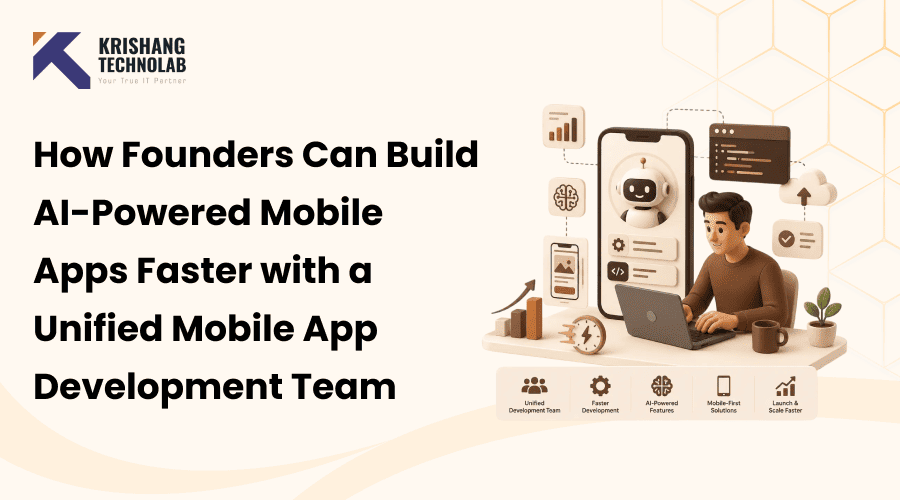
Quick Overview: Founders building AI-powered mobile apps often struggle with fragmented teams, slow handoffs, and rising costs. This guide explores why unified mobile app development teams help startups launch faster, cut expenses, and integrate AI seamlessly covering key technologies, industry use cases, and how to choose the right development partner.
AI-powered Mobile Apps are not just digital tools anymore, but are evolving into intelligent companions that learn, predict and personalize experiences in real time. Artificial intelligence is altering how users expect every app they download to act, with AI-powered recommendation engines, voice assistants, and predictive analytics. For startup founders, this is a huge opportunity but a major challenge of execution.
Building a mobile app with AI isn’t the same as building a traditional app. It needs a rare combination of skills: UI/UX design, mobile development, backend engineering, AI/ML expertise, quality assurance, and DevOps all working in sync. Most founders don’t have this talent in-house, so they end up hiring freelancers, juggling multiple vendors or piecing together a patchwork team.
That’s where a unified mobile app development team comes in. Founders no longer manage 5 different vendors or specialists each owning a piece of the puzzle. They now work with one team that owns the entire build from strategy and design to AI integration and deployment.
This article will explore why AI-powered mobile apps development is the new competitive standard, what challenges founders face when building these apps and why working with one, unified development team is one of the fastest and most cost-effective ways to get an AI-powered product to market. If you’re new to mobile app development services, or looking to scale an existing product, this guide will help you understand what’s changed and what it takes to build faster in this new AI-driven landscape.
Why AI-Powered Mobile Apps Are Becoming the New Standard
A few years ago, AI features felt like a bonus, a nice-to-have that set an app apart from competitors. Users expect it today. As consumers get used to smarter, faster, more intuitive apps, demand for AI mobile app development has gone from a nice-to-have upgrade to a must-have baseline, further accelerating.
This shift is being driven by several forces. Users now expect a customized experience. Static one-size-fits-all methodologies will never win against personalization through content, product recommendations, and interfaces tailored to individual behavior. Automation is removing the friction from all sorts of everyday activities, from filling out forms to sorting customer support tickets, before a human is even involved. AI assistants baked into apps let users get things done by talking naturally rather than through complex menus.
Apps can use predictive analytics to anticipate what the user needs next, such as an item in a shopping cart that needs replenishing or a financial risk before it occurs. Voice AI is becoming mainstream with hands-free interaction for smart homes, cars, and accessibility-driven apps. Computer vision powers scanning, visual search, and AR while recommendation engines, once Netflix and Amazon’s edge, are now standard everywhere.
The result is a wave of AI-powered applications transforming how entire industries operate:
- Healthcare: AI-driven symptom checkers, diagnostic support, and personalized treatment tracking
- Ecommerce: smart product recommendations, visual search, and dynamic pricing
- Fintech: fraud detection, robo-advisors, and predictive spending insights
- Logistics: route optimization, demand forecasting, and automated inventory management
- Education: adaptive learning paths and AI tutoring assistants
- Real Estate: AI-powered property matching, virtual tours, and price prediction models
As AI integration becomes easier and more affordable, founders who move quickly gain a real competitive edge but only if they can build and launch efficiently.
Challenges Founders Face When Building AI Apps
Building an AI-powered mobile apps sounds exciting in theory, but most founders quickly run into the same set of obstacles once development actually begins. Understanding these challenges upfront makes it easier to see why so many startups eventually turn to a unified team model.
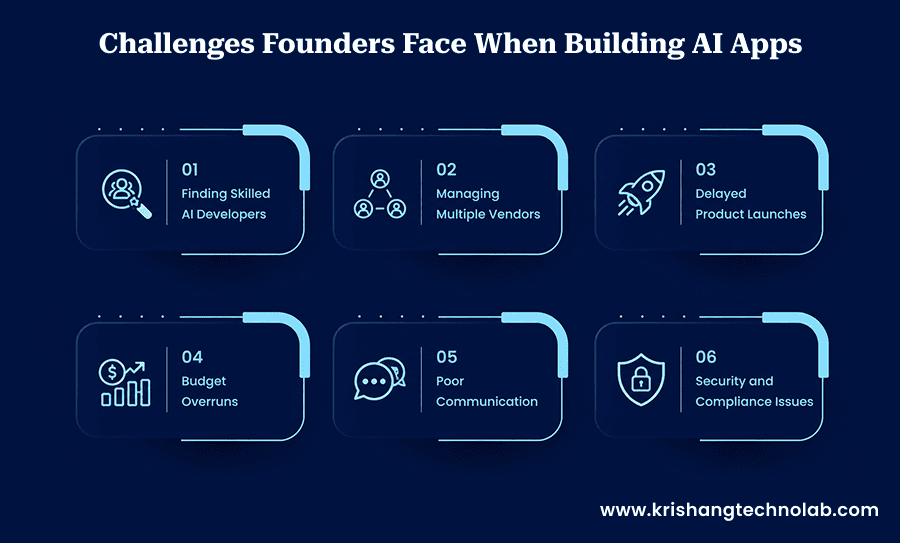
Finding Skilled AI Developers
AI talent is in short supply, and the good ones are expensive and hard to retain. Many founders spend months trying to hire an AI engineer, only to discover mid-project that the person doesn’t have real experience integrating models into a live mobile app, a very different skill from building models in a research or notebook environment.
Managing Multiple Vendors
When designers, developers, and AI specialists come from different agencies or work as independent freelancers, founders end up playing the role of project manager by default. Every decision has to be relayed across multiple parties, and even small misunderstandings can ripple into major delays.
Delayed Product Launches
Fragmented teams rarely run at the same pace. One vendor is waiting on another and finishes their work, creating bottlenecks that build throughout a project. Things that should take three months can easily drag on for six or more. Speed to market in startup app development often trumps perfection.
Budget Overruns
Miscommunication and rework are expensive. When the AI model is not seamlessly integrated with the mobile app, because the two were developed separately, it costs a lot more to fix it later than it would have cost to develop it correctly in the first place. When you add in the overhead of running multiple contracts, the costs go up fast.
Poor Communication
Without a shared understanding of the product vision, teams working in silos often build things that don’t quite fit together, a backend that doesn’t support the AI model’s requirements, or a UI that doesn’t account for AI response times. These gaps usually surface late, when they’re hardest to fix.
Security and Compliance Issues
Many AI applications use sensitive data such as health records, financial data, or personal behavioral patterns. HIPAA or GDPR compliance requirements are no laughing matter. Often, fragmented teams lack a single party responsible for security across the full stack, raising the risk that gaps fall through the cracks.
These recurring pain points are the reason why more founders are moving away from patchwork hiring and looking to an experienced AI app development company that can manage the entire build under one roof.
What Is a Unified Mobile App Development Team?
A unified mobile app development team is a single group of dedicated specialists working under one roof or one workflow to take your product from idea to launch. Founders don’t hire a designer here, a developer there, and an AI consultant somewhere else; they get one cohesive mobile app development team that owns every stage of the build.
A good unified team usually consists of:
- Business Analyst: turns your vision into clear requirements, user stories, and a realistic roadmap
- UI/UX Designer: creates intuitive, user-friendly interfaces and experience flows
- Mobile Developers: Native or Cross-App Development (iOS, Android, Flutter, and React Native)
- AI Engineers: design, train, and integrate the machine learning or generative AI features
- Backend Developers: Build the servers, APIs, and databases that power the app.
- QA Engineers: test functionality, performance, and AI model accuracy before release
- DevOps: manage infrastructure, deployment pipelines, and scalability
- Project Manager: coordinates the entire team, keeps timelines on track, and serves as your single point of contact
These roles are not separate departments but a connected unit, working from the same roadmap and communicating constantly throughout development.
Benefits of a Unified Team
- One point of communication: No more ping-ponging with different vendors or deciphering contradictory feedback for founders. Everything is through one point of contact.
- Faster timelines: Development cycles are dramatically shorter when everyone is working in parallel and aligned on priorities than when working with individual freelancers or agencies.
- Better collaboration: Designers, AI engineers and developers solve problems together in real-time, rather than locating integration issues after the handoff.
This is why more founders are ditching the freelance patchwork and going for a dedicated development team structure; it takes away the operational drag that usually slows down AI-powered products.
Why a Unified Team Builds AI Apps Faster
Speed is not just about code writing faster. It’s about eliminating the friction that tends to bog down AI-powered products. The team worked together to compress timelines at each and every stage of the build, not just the development itself.
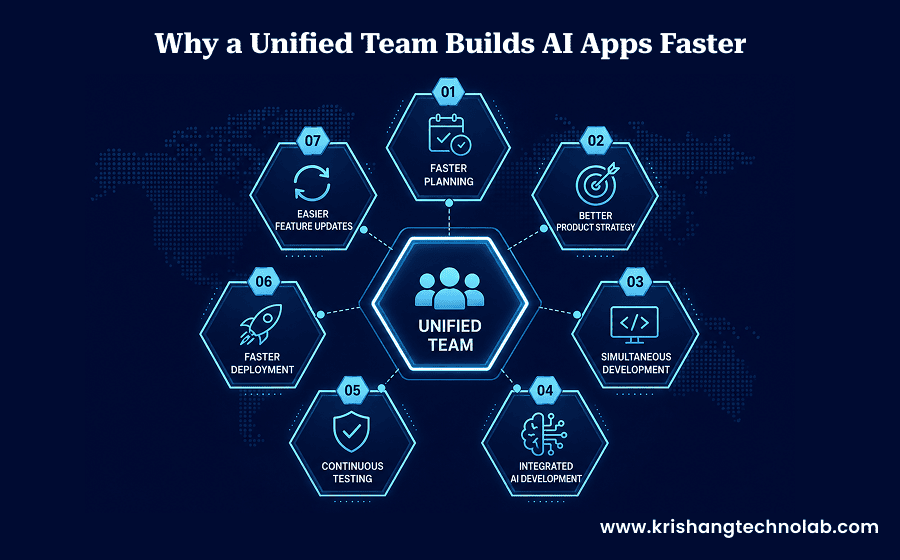
1. Faster Planning
When business analysts, designers, and AI engineers plan together from day one, there’s no back-and-forth translating requirements between separate vendors. Questions of feasibility such as whether a proposed AI feature is realistic within budget and timeline get answered immediately instead of surfacing weeks later. Founders who start from the same point can get from concept to a validated roadmap in days, rather than the weeks it can take when specs have to go through multiple external parties.
2. Better Product Strategy
A unified team doesn’t just carry out a plan; they help create it. Strategic decisions are made in full context because the same people who understand the capabilities of AI also understand the constraints of mobile, the priorities of UX, and the goals of the business. It means better trade-offs made up-front, like which AI features actually create user value and which ones just add cost and complexity.
3. Simultaneous Development
It’s not a rigid handoff design: finishes, then backend starts, then mobile starts. It’s one team’s parallel work. Designers are designing screens, backend developers are building APIs, and AI engineers are training models. This end-to-end mobile app development approach removes siloed sequential workflows and significantly reduces the overall build time.
4. Integrated AI Development
AI capabilities are not something you can bolt onto a finished app; they need to be built into the core product. The app architecture and the AI models are jointly designed by one team, so the model latency, size, and data requirements are consistent with actual mobile constraints from day one. This prevents the common scenario in which the data science team builds a model that is theoretically correct but cannot realistically be run on a mobile device.
5. Continuous Testing
Unified teams run QA in parallel, testing UI flows, backend stability, and AI model accuracy as features are developed, instead of waiting until the end of development to test everything at once. This catches bugs, integration problems, and model performance problems early, when they are much cheaper and faster to fix.
6. Faster Deployment
Deployment pipelines are built side-by-side with the product, not cobbled together at the last minute, with DevOps embedded in the same team from the start. Automated CI/CD means that the app can be moved from a build that has been tested to a live release with minimal human intervention and reduces the delays that often occur when release processes are not connected.
7. Easier Feature Updates
AI apps are not static models; they need retraining, features need to be refined, and user feedback needs to be acted upon quickly. A single team across the entire codebase and AI architecture can deploy updates much faster than a fragmented setup where every change requires re-briefing multiple vendors. That consistent agility is one of the most underappreciated advantages of working with a team that provides end-to-end AI app development services rather than one-off freelance gigs.
Together, these advantages compound. What might take six to nine months with a fragmented team can often be achieved in three to five months with a unified one, not by cutting corners but by eliminating the delays that come from disconnected teams working in isolation.
AI Technologies Used in Modern Mobile Apps
To build an AI-powered mobile apps, you need to know which technology applies to what problem. A unified development team has the expertise to weigh these options and add the right ones instead of defaulting to whatever’s trendy. Here’s a look at the core technologies that drive modern apps today.
1. Generative AI
Generative AI produces new content, text, images, code, or even audio from user prompts. This powers features in mobile apps such as AI chat assistants, content creation, personalized copywriting, and image editing. OpenAI’s GPT models, Google’s Gemini, Anthropic’s Claude, and Meta’s Llama are popular foundation models in this space. Each has strengths in reasoning ability, speed, and cost, so choosing a model is an important early decision in the development process.
2. Machine Learning
Most of the AI you see in the world today is fueled by machine learning. ML is a more general discipline. You train a model on data to recognize patterns and make predictions without having to explicitly program every possible case. It powers all kinds of things from fintech app fraud detection to content feeds just for you. Frameworks like TensorFlow still have a large following for building and deploying custom Machine Learning models, especially when apps need to run inference on-device for performance and privacy.
3. NLP (Natural Language Processing)
NLP enables applications to understand and produce human language. This is the tech behind chatbots, sentiment analysis, text summarization, and smart search. NLP is the tech behind an app that can hear a typed or spoken question from a user and answer back conversationally in a natural way, not in a stiff command.
4. Computer Vision
Computer vision allows apps to read and analyze visual data like photos, video, or camera streams. Used for document scanning, visual product search, facial recognition, augmented reality filters, and quality inspection in manufacturing applications. This technology has been particularly relevant for retail and healthcare applications where visual fidelity has a direct impact on the trust of users.
5. Recommendation Systems
Recommendation engines suggest products, content, or actions that are relevant to the user based on their behavior, purchase history, browsing patterns, and engagement data. These systems are at the core of e-commerce and media apps, increasing engagement and revenue with experiences that feel natural, not intrusive.”
6. Voice Recognition
Voice recognition turns what you say to text or commands so you can use apps without touching them. It’s the technology that powers voice assistants, accessibility features, and voice-driven navigation, which are becoming more crucial as users expect apps to work fluidly across screens, cars, and smart devices.
7. Predictive Analytics
Predictive analytics uses past data to forecast future events such as how much inventory to carry, the probability of credit risk, and how customers will change. This is particularly true for fintech, logistics, and healthcare apps, where the ability to foresee problems before they arise gives a real competitive edge.
For many of these technologies, especially on mobile, Firebase ML offers a convenient bridge providing pre-built APIs for vision, language, and prediction tasks without requiring teams to build every model from scratch.
A unified team’s job isn’t to use every technology available; it’s to identify which combination actually solves the founder’s specific product problem, then integrate it cleanly into the app’s architecture from day one.
The AI Mobile App Development Process
Every successful app follows a structured path from idea to launch. Instead of the delays of handing work between disconnected vendors, with a unified team, there is a clear, repeatable, AI-powered process for developing a mobile app, with each stage feeding directly into the next.
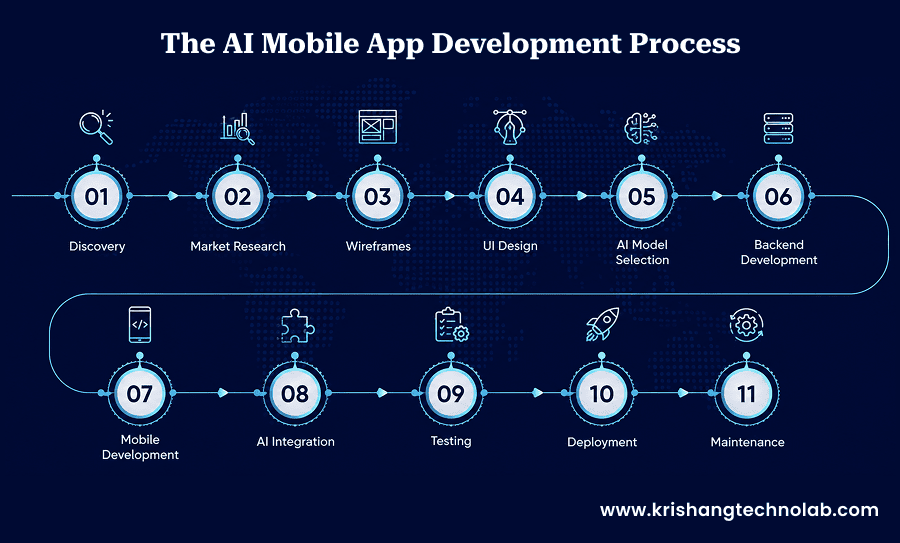
Discovery
The team works with the founder to understand the product vision, target users, core problem, and business goals. This phase lays the groundwork for all subsequent decisions.
Market Research
The team will research competitors, market trends and user expectations to validate the app idea and look for opportunities to differentiate including where AI can add real value, not just novelty.
Wireframes
Low-fidelity layouts give a concrete early sense to founders about how the product will work before any visual design is applied by sketching out the structure and user flow of the app.
UI Design
Designers deliver a polished, user-tested design that is ready for development, encompassing the entire visual experience, branding, interface elements, and interaction design.
AI Model Selection
AI engineers consider which models or frameworks are best suited for the app’s use case, including accuracy, latency, cost and whether the model is to run on-device or through a cloud API.
Backend Development
Servers, databases and APIs that will support the app’s core functionality and talk to AI models are built by developers.
Mobile Development
Mobile developers build the native or cross-platform app, developing the UI design and linking it to backend services.
AI Integration
This is where AI features come to life inside the app, connecting selected models to real app functionality be it a chatbot or recommendation engine or predictive feature and optimizing for real-world mobile performance.
Testing
QA engineers test functionality, performance, security and AI accuracy across devices and use cases, catching bugs before they reach users.
Deployment
DevOps takes care of infrastructure, monitoring and rollout to ensure a smooth launch. The app is released to the App Store and Google Play.
Maintenance
After launch, the team monitors performance, retrains AI models with new data, fixes bugs and ships updates based on user feedback.
This structured approach to custom mobile app development allows a unified team to move fast without sacrificing quality. Each step is constructed with the next step in mind, not as an independent project to be handed off to another vendor.
Why Startups Prefer a Unified Development Team Over Freelancers
If you’re an early-stage founder on a small budget, hiring freelancers often seems like the obvious first move. It’s flexible, cheap (on paper), and easy to get started with. But as the product gets more complex, especially with AI features involved, the cracks in this approach tend to show quickly.
Freelancers often work alone, with a couple of projects at a time, and no collective accountability to a larger team structure. This creates real friction: a founder might hire one freelancer for UI design, another for backend development, and another for AI integration, each with their own working style, availability, and understanding of the product. The founder’s job is to keep everyone in line, not the team’s.
| Freelancers | Unified Team |
| Communication gaps | Single contact |
| Different time zones | One workflow |
| Slower delivery | Faster launches |
| Inconsistent quality | Standardized QA |
| Difficult scaling | Easy scaling |
Cost Benefits of Working with One Development Partner
Working with a unified team also often makes better financial sense for founders watching every dollar of runway, beyond speed.
- Lower recruitment costs: It takes time and money to hire, vet, and onboard individual specialists (designers, AI engineers, QA and DevOps). This completely eliminates this need, providing founders with immediate access to a complete skill set, bypassing separate hiring cycles.
- Less management overhead: Managing multiple vendors or freelancers eats up founder time better spent on product strategy or fundraising. One team bears this burden. It is running its own internal efforts.
- Faster MVP: Founders can get a working product in front of users sooner with parallel workflows and shared context, reducing the cost of delayed market entry.
- Predictable pricing: Founders often have a better, consolidated view of the cost of developing an AI app from the get-go as opposed to juggling a variety of invoices, contracts, and hourly rates from a range of freelancers.
- Lower maintenance costs: The team that built the app already understands the architecture of the app, so post-launch updates, bug fixes and AI model retraining are quicker and less expensive than hiring a new team to maintain someone else’s code.
Read More About: How Much Does Mobile App Development Cost
Industries That Benefit Most from AI Mobile Apps
AI isn’t limited to one type of product it’s transforming mobile experiences across nearly every industry. Here’s how different industries are using it.
Healthcare
AI health apps handle symptom checking, remote diagnostics, personalized treatment plans, and medication reminders. They help free up healthcare providers and help patients get better and faster guidance that is more accurate.”
Fintech
Leading finance apps now offer fraud detection, robo-advisors, credit scoring, and personalized insights helping users decide smarter and stay safer.
Education
Adaptive learning platforms tailor lesson pace and content to each student, while AI tutors offer on-demand help outside the classroom.
Retail
AI powers product recommendations, visual search, virtual try-ons, and dynamic pricing boosting conversions while giving shoppers a more personalized experience.
Travel
AI-powered travel apps offer personalized itineraries, price predictions for flights and hotels, and chatbots for instant booking changes or support.
Real Estate
AI-powered virtual tours, property-matching, and predictive pricing help buyers and renters find listings faster while giving agents better lead insights.
Manufacturing
AI enables predictive maintenance, inspects quality through computer vision, and forecasts supply chains. Less downtime and catching defects before they become costly problems.
Logistics
In logistics, we can optimize delivery times and reduce operating costs with route optimization, demand prediction and automatic inventory tracking.
Food Delivery
Artificial intelligence tells you when to expect a delivery, suggests restaurants you might like and changes prices depending on demand. Keeping customers happy and drivers more efficient.
SaaS
AI-driven analytics, in-app chat assistants and workflow automation are increasingly becoming the key differentiators of SaaS products, enabling platforms to offer smarter, more self-sufficient tools to users.
In all of these industries the theme is clear: AI is not a bonus anymore, it is becoming the expectation. Founders building in any of these spaces have a real opportunity to stand out, but only if they can execute quickly and reliably. And that is exactly where a unified development team makes the biggest difference.
How to Choose the Right AI Mobile App Development Company
Picking the wrong partner here is expensive, not just in dollars. Before you sign anything, run the AI app development company through this checklist.
The Checklist for Choosing the Right Partner
- Experience: Anyone can say they “do AI”. What matters is whether they’ve actually shipped mobile apps and kept them running afterwards. Ask how long they’ve been building, not just how long they’ve existed.
- Portfolio: Don’t just skim the screenshots. Dig into a few projects with AI features similar to yours, and ask what actually went into building them.
- AI Expertise: This is where a lot of agencies fall short. There’s a real difference between a team that understands model selection and training versus one that just calls itself “AI-powered.” Ask pointed questions and see how specific the answers get.
- UI/UX: AI is only useful if people can actually use it. A great team knows how to mask the complexity making it feel effortless, even with a lot happening under the hood.
- Security: If your app involves health data, financial data, or any personal data, compliance is not optional. Be sure they understand HIPAA, GDPR or PCI-DSS as it applies to your particular situation, not just generally.
- Scalability: Ask what happens when your user base grows tenfold. A team that only builds for today’s traffic is setting you up for a rebuild later.
- Post-launch support: Launching is the easy part. Ask how they’ll handle bug fixes, updates, and AI model retraining once real users start using your app.
- Case Studies: Push past the highlight reel ask what went wrong on past projects and how they handled it. That tells you far more than a success story ever will.
- Agile Development: Requirements will change. Make sure they work in a way that lets you adapt without blowing up the timeline every time something shifts. The right mobile app development company treats AI as a core skill not a trend.
Future Trends in AI Mobile App Development
Things are moving fast in this space, and it’s worth knowing what’s coming next if you’re building something today.
AI Agents are outgrowing the “chatbot” label. We’re starting to see systems handle multi-step tasks on their own booking appointments, managing schedules, or resolving support conversations start to finish without human input.
Voice-first apps are picking up steam too. People are getting comfortable talking to apps instead of tapping menus especially in cars, wearables, and smart home devices.
Hyper-personalization is going a step further than the “recommended for you” section we’re all used to. The next wave adapts to how someone’s feeling and what they actually need in the moment not just what they clicked before.
Edge AI is worth watching closely. Running models on-device instead of pinging the cloud cuts lag and keeps sensitive data think healthcare or finance more private.
Multimodal AI means apps can now take in text, voice, images, and video all at once and actually make sense of them together. That opens the door to interactions that feel a lot less clunky and a lot more natural.
Autonomous workflows are changing what happens behind the scenes apps triggering and managing entire processes based on real-time data and preset rules.
On-device AI keeps gaining ground for a simple reason: people want speed, and they want their data to stay put. Less reliance on a constant internet connection helps with both.
AI copilots are now everywhere in productivity tools offering help right as you work, instead of waiting to be asked.
Founders who track these trends and partner with teams who can build them will stay ahead as user expectations rise.
Conclusion
AI is changing the possibilities of mobile apps fundamentally, and now users expect that intelligence to be built in from day one. The fastest, most reliable path for founders to launch is a unified development team that removes the complexity of managing separate vendors, closes communication gaps, and keeps every discipline in lock step. The outcome is faster delivery, better collaboration, and a product built to scale.
Ready to build your AI-powered mobile app? Partner with our unified development team and turn your vision into a launched product faster, smarter, and without the usual growing pains.
Found this post helpful? Don't forget to share it with your network!