Quick Overview: The AI development lifecycle guides projects from problem definition through data collection, model training, deployment, and continuous improvement. Unlike traditional software, AI systems depend on data quality and require ongoing monitoring since performance can drift over time. This guide covers all ten phases, common challenges, MLOps, and best practices for building reliable AI systems.
Most AI projects do not fail because the algorithm was wrong. They fail because nobody defined the problem clearly, the data was never good enough, or the model was shipped and then forgotten. A structured AI development lifecycle is what prevents these outcomes.
The AI development lifecycle is the end-to-end process organizations follow to take an AI system from an initial idea through data work, model building, deployment, and ongoing improvement. Every serious AI development engagement runs on some version of it, whether the team has written it down or not.
Their behavior is learned from data, their outputs are often probabilistic rather than fixed, and their accuracy can quietly degrade over time as the real world shifts away from the data they were trained on. A model that performed at 94% accuracy at launch can drift to 78% within a year without a single line of code changing.
That difference is why the AI software development lifecycle needs its own framework. Teams that apply a standard waterfall or even a standard agile process to AI usually discover too late that they budgeted nothing for data labeling, allocated no time for retraining, and have no way of knowing whether the model in production is still working.
In this guide you will learn what the AI lifecycle is, why it matters, the ten phases that make it up, how it compares to the traditional software development lifecycle, how MLOps supports it, the challenges teams most often run into, and a practical set of best practices and checklists you can apply to your own projects.
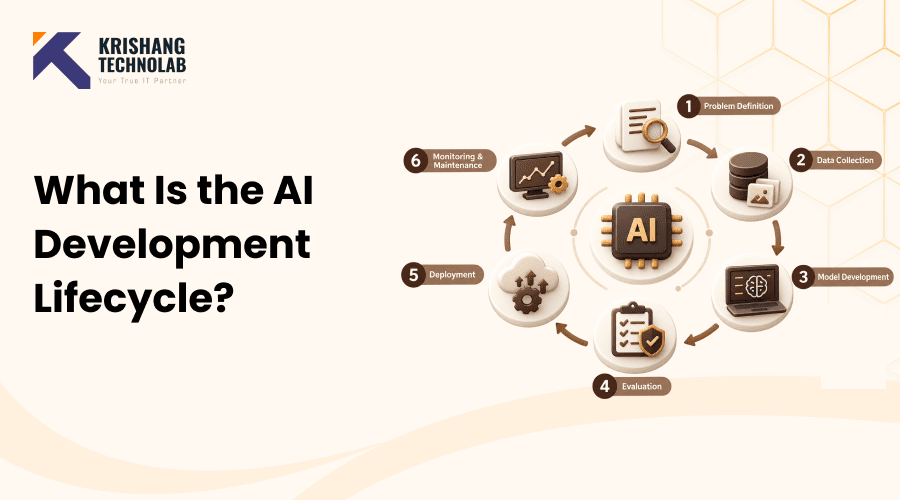
What Is the AI Development Lifecycle?
The AI development lifecycle is a disciplined, repeatable process to take an artificial intelligence project from the problem statement, through data preparation, model development and validation, to deployment, monitoring and continuous improvement.
Think of it as the operating system for an AI initiative. It answers questions like: What are we actually trying to achieve? What data do we need, and do we have it? Which modelling approach fits? How do we know the model is good enough to release? How will we know if it stops working?
Data, models, infrastructure, and monitoring work together throughout the AI lifecycle: the data sets a hard ceiling on how good the model can ever be, the model turns that data into usable predictions or outputs, the infrastructure is what makes training and running that model possible at scale, and monitoring closes the loop by showing whether the deployed system is still performing well feeding straight back into the next round of improvement rather than sitting outside the process.
The most important thing to understand about the AI project lifecycle is that it is iterative, not linear. Phases overlap and loop back. Exploratory analysis routinely sends teams back to collect more data. Evaluation results send teams back to feature engineering or model selection.
Production monitoring feeds directly into retraining, which restarts much of the cycle. Treating the lifecycle as a straight line from idea to launch is one of the most common and expensive mistakes in AI delivery.
Why Is the AI Development Lifecycle Important?
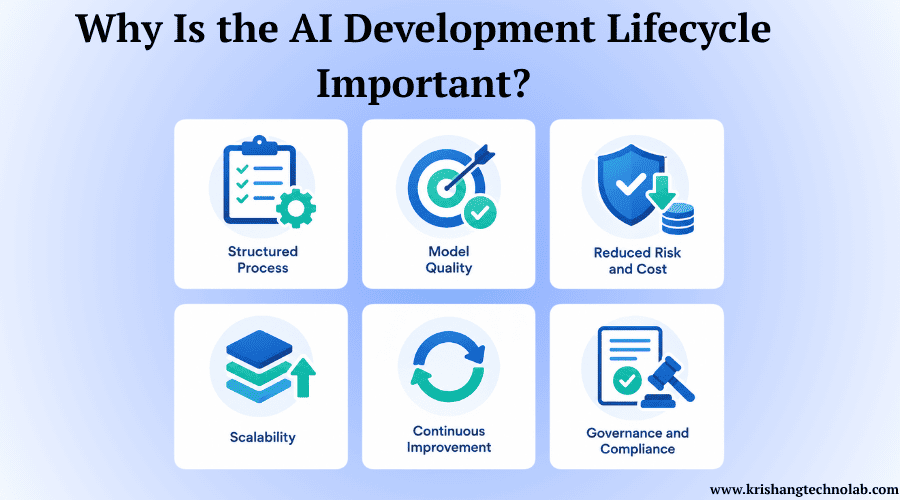
1. Creates a Structured AI Development Process
Without a lifecycle, AI work becomes unreproducible notebooks, models with no deployment path, and stakeholders in the dark. Stage gates and clear handoffs between data, ML, engineering, and business teams are created by a defined process.
2. Improves AI Model Quality
Quality comes from a disciplined process, not from individual genius. The structure of a lifecycle puts the right checks in place for data, train-valid-test splits, honest evaluation and bias analysis, catching problems before they get to production.
3. Reduces Development Risks and Costs
The biggest AI mistake is spending months developing and then finding that the use case is not feasible. Early feasibility checks and staged validation catch failures in weeks instead of quarters, and baselines prevent runaway computing costs.
4. Supports Scalability
One model can be run informally; forty cannot. A consistent lifecycle lets teams reuse pipelines, standardize deployment, and onboard new people without starting from scratch, especially when work spans an in-house group and an offshore development center.
5. Enables Continuous Model Improvement
Adding monitoring and retraining to the lifecycle means that improvement is planned work, not a reaction to complaints. Feedback from production systematically feeds the next model version.
6. Helps Address AI Governance and Compliance
What really constrains us now are regulatory expectations of transparency, fairness, and data protection. Building governance into each phase makes the audit trail and documentation compliance needs far easier than retrofitting it later.
What Are the Different Phases of the AI Development Lifecycle?
The AI development lifecycle can be split into ten phases. Each phase has its own targets, activities and outputs but teams tend to flow between phases rather than completing one before starting the next.
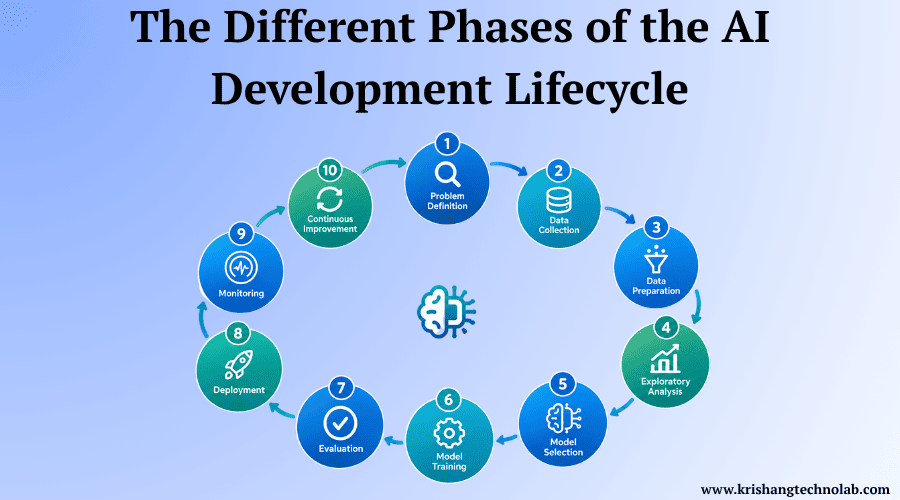
- Problem Definition and Goal Setting: clarify the business problem and success criteria
- Data Collection: identify and gather the data needed
- Data Preparation and Processing: clean, transform, and structure the data
- Exploratory Data Analysis: understand patterns, anomalies, and bias in the data
- AI Model Selection and Development: choose the approach and build a baseline
- Model Training: train and tune the model
- Model Evaluation and Validation: test performance, robustness, and fairness
- Deployment: move the model into production
- Monitoring and Maintenance: track performance and drift in production
- Continuous Improvement and Retraining: use feedback to improve the system
The sections that follow examine each phase in detail.
Phase 1 — Problem Definition and Goal Setting
Everything downstream depends on this phase, and it is the one teams most often rush.
Identify the business problem. Start with the business outcome, not the technology. “Reduce customer churn in the enterprise segment” is a problem. It’s not “implement machine learning.”
Define AI use cases. Translate the business problem into one or more specific AI tasks. Reducing churn might become predicting which accounts are at high risk of not renewing within 90 days.
Establish measurable objectives. Objectives should be measurable and time-bound. E.g., cut manual document review time by 60% in two quarters.
Define success measures. Separate model metrics (precision, recall, mean absolute error) from business metrics (cost saved, revenue retained, hours reduced). A technically excellent model can still be commercially useless if these two aspects don’t connect.
Assess technical and business feasibility. Feasibility covers data availability, compute budget, latency constraints, integration complexity, regulatory exposure, and organizational readiness to act on the model’s output. Early-stage teams in particular benefit from scoping a narrow first release, an approach covered in more depth in this guide to AI development for startups.
Define project scope. Agree explicitly on what is in and out of scope, which systems the model will integrate with, and what the first deliverable looks like.
Phase 2 — Data Collection
Once you know what the problem is, the next step is to collect the information you need to solve the problem.
Identify relevant data sources. Map all systems with a signal relevant to the problem, even if not under the team’s immediate control.
Collect structured and unstructured data. Structured data is data from databases, spreadsheets, and transactional systems. Unstructured data includes text, images, audio, video, and documents and now makes up the majority of enterprise data volume.
Evaluate data availability and quality. Assess volume, historical depth, completeness, label availability, and update frequency. A dataset of 400 examples will not support a deep learning approach regardless of how clean it is. Organizations without an internal data team often bring in data science consulting support at this stage to audit what they actually have before committing to a build.
Consider APIs, databases, sensors, documents, and third-party datasets. “If we have no internal data, we can rely on external and synthetic data, but with licensing and quality checks.”
Address data privacy and security requirements. Establish early on whether data is personal or sensitive, what legal basis you have to process it, and whether you need to anonymize, pseudonymize, or put access restrictions in place. Retrofitting privacy controls after a model is trained is painful and sometimes, impossible.
Phase 3 — Data Preparation and Processing
This phase usually takes the most time of any phase of the project, often 60 to 80 percent of the total effort.
Data cleaning involves removing corrupt records, fixing formatting inconsistencies, standardizing units and encodings, and correcting obvious errors.
Missing values are handled consciously. They are removed, filled with the mean or median, or filled with a model, or the missingness itself is used as a signal. What you do depends on why the data are missing.
Removing duplicates prevents giving undue weight to repeated records and leakage between train and test sets.
Data transformation is the process of converting data into a format that the model can use. Such as aggregation, joins, encoding categorical variables, parsing text or dates, etc.
Data labeling assigns ground-truth labels for supervised learning. This is often the most expensive and time-consuming step, and label quality directly caps model quality. Clear annotation guidelines and inter-annotator agreement checks are essential.
Feature engineering is what really creates the variables that the model learns from. Well-designed features often provide more gains than switching algorithms.
Data normalization scales numeric features to comparable ranges, which many algorithms require for stable convergence.
Data splitting is the process of dividing data into training, validation, and test sets. For time-series problems, splits must respect chronology to avoid training on the future.
Why Data Quality Matters in AI Development
Data quality and model performance have a simple and unforgiving relationship. A model learns the patterns in its training data (including errors). Mislabeled examples teach the model wrong associations. Missing values handled carelessly introduce systematic bias. Unrepresentative samples produce models that perform well in testing and fail on real users.
Critically, data quality problems cannot be fixed downstream. No hyperparameter tuning, architecture change, or ensemble method compensates for a dataset that does not contain the signal you need. Teams consistently get better returns from investing an additional two weeks in data quality than two weeks in model experimentation.
Phase 4 — Exploratory Data Analysis
Exploratory data analysis (EDA) is a systematic way of looking at a dataset before you start modeling.
Understand patterns within the dataset. Make sure you know what the data looks like, in terms of distributions, central tendencies, class balance, temporal trends, etc.
Identify anomalies and outliers. Decide if the extreme values are true rare events that need to be modeled or are errors in the data that should be thrown away.
Analyze relationships between variables. Correlation analysis and cross tabulation identify the features that have signal and those that are redundant. This also reveals target leakage, where a feature accidentally encodes the answer.
Detect potential bias. Verify that demographic groups, regions, time periods, or customer segments are proportionally represented. Any anomalies found here are far less expensive to correct than those found in the field.
Determine whether additional data is required. EDA often reveals that the current data set is not sufficient for the intended use case, which is a useful finding to make early rather than late.
Tools Used for AI Data Analysis
The exploratory analysis stack is well established and largely open source:
- Python
- Pandas
- NumPy
- Matplotlib
- Seaborn
- Jupyter Notebook
Phase 5 — AI Model Selection and Development
With a clear understanding of the data, the team selects an approach and builds an initial model.
Select the appropriate AI/ML approach. The choice follows from the problem type, data characteristics, and operational constraints rather than from what is currently fashionable.
Compare traditional machine learning and deep learning. Traditional methods such as gradient-boosted trees remain the strongest option for most structured, tabular problems. They train faster, need less data, are easier to interpret, and frequently outperform neural networks on this class of task. Deep learning is the right choice for unstructured data: images, audio, natural language, and video.
Is it generative AI or an LLM that’s the right tool? Generative models fit tasks involving open-ended text generation, summarization, extraction from unstructured documents, conversational interfaces, and content creation. They are poorly suited to problems requiring deterministic numerical output or strict auditability. Many generative AI development projects also require no training at all, relying instead on prompt engineering and retrieval-augmented generation over a foundation model. For a large share of business use cases, straightforward ChatGPT integration into an existing workflow delivers the outcome faster than building a model from scratch.
Select algorithms and architectures. Narrow to two or three candidate approaches and evaluate them empirically rather than committing to theory alone.
Establish a baseline model. Always build the simplest reasonable model first, whether that is a rule, a logistic regression, or a heuristic. The baseline sets the bar that more complex approaches must beat to justify their cost and complexity. Surprisingly often, they do not.
Common AI Model Types
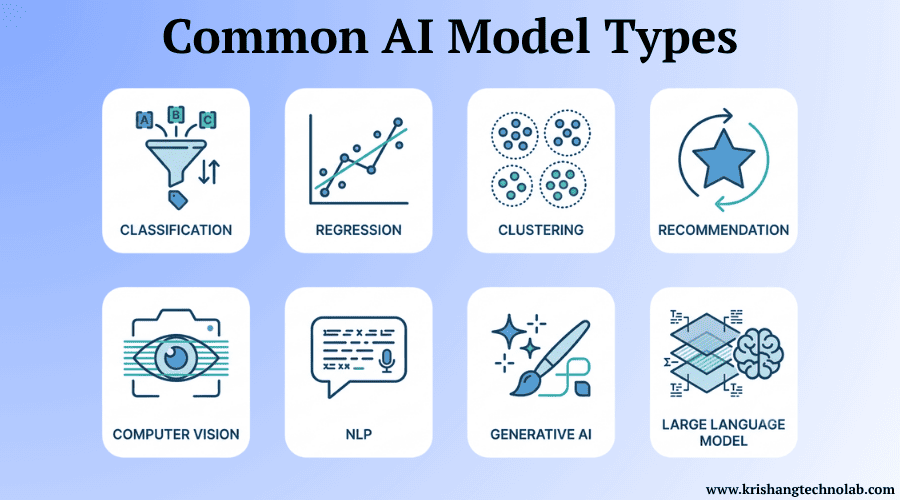
- Classification models are used to map inputs to discrete classes. It is used for spam detection, churn prediction, and medical triage.
- Regression models estimate continuous numeric values. It is used for demand forecasting, price estimation, and risk scoring.
- Clustering models identify groups of similar records without pre-defined labels. “For anomaly detection and customer segmentation.
- Recommendation models predict which item the user will interact with based on behavioral history and item similarity.
- Computer vision models are used for image and video understanding, including classification, object detection, segmentation, and quality inspection.
- NLP models understand and analyze human language for sentiment analysis, entity extraction, classification, and translation.
- Gegenerative AI models are models that can generate new content, as opposed to predicting a label. This content can be text, images, code, or audio.
- Large language models are general-purpose text models trained on very large corpora that can be adapted to many tasks by prompting or fine-tuning.
Phase 6 — Model Training
During training the model learns from the preprocessed data.
Prepare training datasets. As with the splits, you want them to be correct, leak-free, and representative. Preprocessing should be applied consistently to all sets.
Train the selected model. Run training while tracking loss curves and resource consumption, checkpointing as you go.
Tune hyperparameters. Use grid search, random search, or Bayesian optimization to systematically search learning rates, depth, regularization strength, etc., instead of manual guesswork.
Use validation data. Validation data guides tuning decisions. The test set must remain untouched until final evaluation, or the reported performance will be optimistic.
Track experiments. Log configurations, datasets, code versions, and results for every run. Without experiment tracking, teams lose the ability to reproduce their own best model. Disciplined experiment management is one of the clearest markers of mature machine learning development practice.
Address overfitting and underfitting. Overfitting shows as strong training performance with weak validation performance and is addressed through regularization, more data, simpler models, or early stopping. Underfitting means the model is too simple (not enough capacity) or the features are not enough.
Common AI Model Training Techniques
- Supervised learning trains on labeled examples where the correct output is known. It is the most common approach for prediction and classification tasks.
- Unsupervised learning finds structure in unlabeled data, used for clustering, dimensionality reduction, and anomaly detection.
- Semi-supervised learning combines a small labeled set with a large unlabeled set, useful when labeling is expensive.
- Reinforcement learning trains an agent through reward signals from interacting with an environment, applied in robotics, control systems, and model alignment.
- Transfer learning adapts a model trained on one task to a related task, dramatically reducing data and compute requirements.
- Fine-tuning further trains a pretrained model, such as an LLM, on domain-specific data to specialize its behavior.
Phase 7 — Model Evaluation and Validation
Evaluation is to determine if the model is really fit for deployment.
Test the model using unseen data. The held-out test set provides the only honest estimate of production performance. It should be used once, at the end.
Measure model performance. Use metrics appropriate to the task and the cost of different error types. Accuracy is misleading on imbalanced datasets, where predicting the majority class always can look impressive and be worthless.
Compare results against predefined KPIs. Validate against the success criteria agreed in Phase 1 including the business metric not the model metric.
Test robustness and reliability. Test performance on edge cases, noisy inputs, underrepresented segments, and adversarial examples. A model that works on average, but systematically fails for one segment of customers is not ready.
Evaluate potential bias and fairness. Break out performance by demographic, business groups as needed. Important differences can be masked by aggregate metrics.
Conduct security and performance testing where relevant. Test LLM application for inference latency, throughput under load, prompt injection resistance and leakage of sensitive training data.
Phase 8 — AI Model Deployment
Deployment moves the validated model from an experimental environment into production, where it delivers value.
Move the validated model into a production environment. This involves packaging the model with its preprocessing logic and dependencies so that inference behaves identically to training. Mismatch between training and serving preprocessing is one of the most common production bugs in machine learning.
Select the appropriate deployment architecture. These include real-time REST or gRPC APIs for interactive use, batch scoring for periodic bulk predictions, streaming inference for event-driven pipelines, and edge deployment where latency or connectivity constraints make it desirable to run on-device.
Integrate the model with applications and APIs. The model’s output must reach the system or person who will act on it in a format they can use, with sensible handling for failures and low-confidence predictions. In practice this usually means wiring the model into a custom web application or internal tool, a pattern walked through end to end in this guide to building an AI-powered web app with the MERN stack.
Establish security controls. Apply authentication, authorization, rate limiting, input validation, encryption in transit and at rest, and audit logging. Include output filtering and injection defenses in LLM-based systems.
Consider latency, scalability, and infrastructure requirements. Define acceptable response latency, request volume, autoscaling, GPU vs. CPU serving, and cost per prediction. Many of these constraints trace back to decisions made when choosing the AI tech stack, which is why serving requirements belong in the conversation early rather than at launch. Use staged rollout patterns such as shadow deployment, canary releases, or A/B tests rather than switching all traffic at once.
Phase 9 — AI Model Monitoring and Maintenance
Deployment is the beginning of the model’s operational life, not the end of the project.
Monitor model performance. Track prediction quality continuously where ground truth becomes available, and use proxy metrics where it does not.
Track data drift. Data drift is when the distribution of incoming data is different from the training data. For example, a new customer segment, product line, or geography comes into the system.
Detect model drift. Model drift (or concept drift) occurs when the relationship between the inputs and the target changes. Fraud patterns change, consumer preferences change, and a model trained on last year’s behavior is slowly incorrect.
Monitor infrastructure and latency. Monitor uptime, response times, error rates, queue depth, resource usage, and model metrics.
Identify unexpected outputs. Flagging results that may be out of expected ranges, low-confidence outputs, and generative systems responses that violate safety or quality standards.
Track operational costs. Inference costs, especially for LLM-based applications, can increase more than expected. Monitor cost per request and total spend vs. budget.
Establish alerts and incident-response procedures. Define alerting thresholds and owners and rollback path documentation. There should be a documented way to quickly disable any production model.
Phase 10 — Continuous Improvement and Model Retraining
The final stage feeds back to the start, closing the loop of the AI life cycle.
Collect production feedback. Collect ground truth, user corrections, explicit ratings, and downstream business results.
Update datasets. Add recent production data. Correct mislabeled examples. Expand coverage of poorly performing segments.
Retrain models when necessary. Retraining may be scheduled on a fixed cadence or triggered by monitoring thresholds. Automated retraining pipelines make this routine rather than disruptive.
Re-evaluate performance. Every retrained model goes through the full evaluation process before replacing the incumbent. A newer model is not automatically a better one.
Improve prompts or retrieval systems for GenAI applications. Instead, improvement for generative systems is often done by refining the prompt, upgrading the retrieval corpus, changing the chunking strategy, or adding guardrails. Teams running LLM products at scale increasingly hire prompt engineers specifically to own this loop.
Iterate based on changing business requirements. As the business evolves, the model’s objectives may need to change too, which can send the project back to Phase 1.
When Should an AI Model Be Retrained?
Retraining decisions should be driven by evidence rather than habit. The following conditions typically justify it:
- Performance degradation: monitored metrics fall below the agreed acceptable threshold
- Significant data changes: statistical drift in input distributions exceeds defined limits
- Changing user behavior: the patterns the model learned no longer reflect how people actually behave.
- New business requirements: objectives, definitions, or the cost of different errors have changed.
- New or improved training data: additional labeled data, better labels, or coverage of previously underrepresented cases becomes available
AI Development Lifecycle vs Traditional Software Development Lifecycle
AI projects and conventional software projects differ in ways that affect planning, testing, staffing, and maintenance budgets.
| Factor | Traditional Software | AI Development |
| Core dependency | Code | Code + Data + Models |
| Testing | Primarily code/function testing | Code + data + model evaluation |
| Output | Generally deterministic | Often probabilistic |
| Maintenance | Code updates | Code, data, and model updates |
| Performance | Usually stable after release | Can change as data changes |
| Lifecycle | Often more linear | Highly iterative |
The practical implications are significant. Traditional software can be specified in advance because the behavior is written by developers. AI behavior is discovered through experimentation, which makes fixed-scope, fixed-timeline contracts a poor fit.
What Is MLOps and How Does It Support the AI Development Lifecycle?
MLOps, short for machine learning operations, is the set of practices, tooling, and automation that makes machine learning systems reliable and repeatable in production. It applies DevOps principles such as version control, continuous integration, automated testing, and observability to the specific demands of data and models.
MLOps connects development and operations by removing the handoff gap where AI projects usually stall. Without it, data scientists produce models in notebooks, and engineers struggle to productionize them, with no shared tooling and no reproducibility. MLOps replaces that handoff with automated pipelines that carry a model from experiment to production and back again. It sits alongside the broader shift toward AI in software development, where automation is applied to the engineering process itself rather than only to the product.
Core MLOps capabilities include:
- Automated model training: pipelines that retrain models on a schedule or trigger without manual intervention
- Version control: tracking not only code but also datasets, features, model artifacts, and configurations
- Experiment tracking: recording every training run’s parameters, data, and results so the best model can be reproduced
- Model deployment: standardized, automated release processes with staged rollout and rollback
- Monitoring: continuous observation of model quality, drift, latency, and cost in production
- Retraining pipelines: closed-loop systems that detect degradation, retrain, validate, and promote new versions
Common Challenges in the AI Development Lifecycle
- Poor Data Quality: Bad formatting, missing values, and mislabeled data are the top cause of weak models. Fix it with better pipelines and validation, not fancier modeling.
- Insufficient or Unrepresentative Data: Most teams have less usable data than they think. Transfer learning, augmentation, and narrower scope can help.
- Data Privacy and Security: Personal and financial data come with legal limits on use and storage. Assess these upfront, not at deployment.
- Model Bias: Models trained on historical data can inherit historical unfairness. Deliberate fairness testing across groups is the fix.
- Model Performance Issues: Strong validation results can still fail in production due to leakage or metric mismatch. Shadow deployment before full release catches most of it.
- Integration With Existing Systems: Legacy systems often make integration harder than modeling. See how tointegrate AI into existing software, or start withapplication modernization if the system’s too rigid.
- Infrastructure and Computing Costs: GPU training and LLM API use can burn budget fast. Right-size models and track cost-per-prediction as a core metric.
- Model Drift: Deployed models quietly degrade as the world changes. Drift detection and a retraining plan, set up before launch, catch it early.
- Lack of AI Expertise: Few teams have ML, MLOps, and domain skills all in-house.Hire AI developers for gaps, or work with anoutsourcing partner.
- Governance and Compliance Requirements: Documentation and audit trails are now mandatory in regulated sectors. Build them as you go retrofitting later is much harder.
Best Practices for Managing the AI Development Lifecycle
The following practices consistently separate AI projects that reach production and stay there from those that stall in experimentation.
- Start with a clearly defined business problem.
- Establish measurable success criteria.
- Prioritize data quality.
- Build a reproducible development process.
- Version datasets, code, and models.
- Use appropriate evaluation metrics.
- Test models before production deployment.
- Implement monitoring from the beginning.
- Document model decisions and limitations.
- Build feedback loops.
- Plan for retraining and maintenance.
- Incorporate security, privacy, and governance throughout the lifecycle.
AI Development Lifecycle Checklist
| Stage | Key Questions |
| Problem Definition | What problem are we solving? |
| Data Collection | Do we have sufficient relevant data? |
| Data Preparation | Is the data clean and usable? |
| Model Development | Which approach fits the use case? |
| Training | Is the model learning effectively? |
| Evaluation | Does it meet defined performance criteria? |
| Deployment | Can it operate reliably in production? |
| Monitoring | Are performance and data changes tracked? |
| Maintenance | Does it require updates or retraining? |
| Improvement | What feedback can improve the system? |
How Krishang Technolab Supports the AI Development Lifecycle
Most organizations do not need help with one phase of the lifecycle. They need a partner who can hold the whole thing together, from the first feasibility conversation to the retraining pipeline running two years later.
Krishang Technolab is an AI-driven software development company with 8+ years of delivery experience, 1,000+ projects shipped, and 250+ clients across 25 countries, ranging from early-stage startups to Fortune 500 organizations. Our teams work across the full lifecycle rather than handing off a model and walking away.
Whether you are validating a first AI use case or scaling a portfolio of models already in production, you can see how we have approached similar projects or talk to our AI team about where your project currently stands.
Conclusion
The AI lifecycle runs from problem definition through data work, model building, deployment, and continuous improvement, and it’s iterative, not linear, so teams constantly loop back as evaluation, monitoring, and retraining feed into each other. What separates good outcomes from bad ones isn’t a fancier model; it’s data quality, honest evaluation, reliable deployment, and disciplined monitoring.
A model is never really “finished”; it needs ongoing care to keep producing value, which is what turns a one-off AI pilot into a lasting capability. If you want a partner who handles that full lifecycle, Krishang Technolab AI development services cover it end to end.
Found this post helpful? Don't forget to share it with your network!