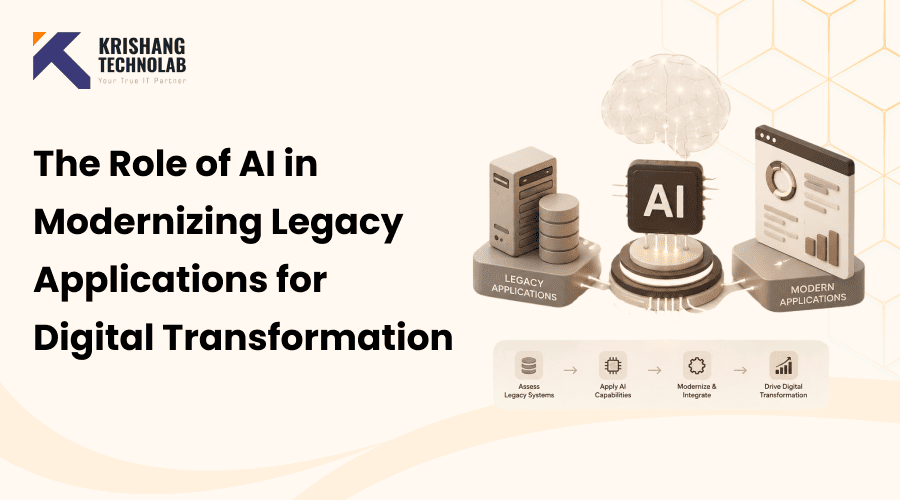
Quick Overview: AI application modernization helps transform legacy systems into scalable, secure, and future-ready applications. It uses AI for code analysis, refactoring, testing, automation, cloud migration, and data modernization to reduce technical debt, lower costs, improve performance, and accelerate digital transformation.
Few companies can afford to keep limping along on legacy systems. After all, legacy apps hold businesses back. Fortunately, AI application modernization is changing that picture. Today, teams are using artificial intelligence for legacy application modernisation. Specifically, it helps them analyse, refactor and rebuild old software in a fraction of the time it used to take.
That transformation matters because AI-enabled application modernisation cuts down on manual work. At the same time, it improves accuracy at every stage. Additionally, teams get a clearer picture of the tangled dependencies that older, manual approaches tend to miss.
As a result, more businesses are folding AI-powered application modernization into their broader AI digital transformation plans. They do this simply to stay competitive. On top of that, generative AI application modernization tools are starting to handle documentation, testing, and code conversion on their own.
This guide walks through how AI fits into application modernization. It also covers what it takes to build a solid application modernization strategy, drawing on real AI application modernization examples along the way. Beyond that, it digs into the strategies, benefits, challenges, and trends shaping where this field is headed.
Along the way, you’ll find practical steps and real-world examples from different industries. You’ll also find practices that have actually worked for other teams. So, whether you’re hands-on with the code or making the call from the business side, there’s something here for you.
What Is Legacy Application Modernization?
We modernise AI applications using smart code analysis, automation, testing and documentation. In turn, this transforms legacy software into scalable, maintainable, AI-ready applications. Specifically, it updates the architecture and performance, and it resolves outdated technology, technical debt, security risks, poor integration, and limited scalability. Ultimately, it helps companies maintain cloud services, real-time data, automation, and innovation for the long term.
What Role Does AI Play in Application Modernization?
AI in software development is reshaping application modernisation by helping teams understand and transform complex legacy systems more efficiently. It can analyse existing code, identify outdated components and hidden dependencies, and support faster code conversion, refactoring, documentation, and test generation. Beyond modernisation, AI can continuously monitor applications, detect performance issues and bottlenecks, and recommend improvements, helping teams build software that is more reliable, scalable, maintainable, and future-ready.
How AI Accelerates Legacy Application Modernization
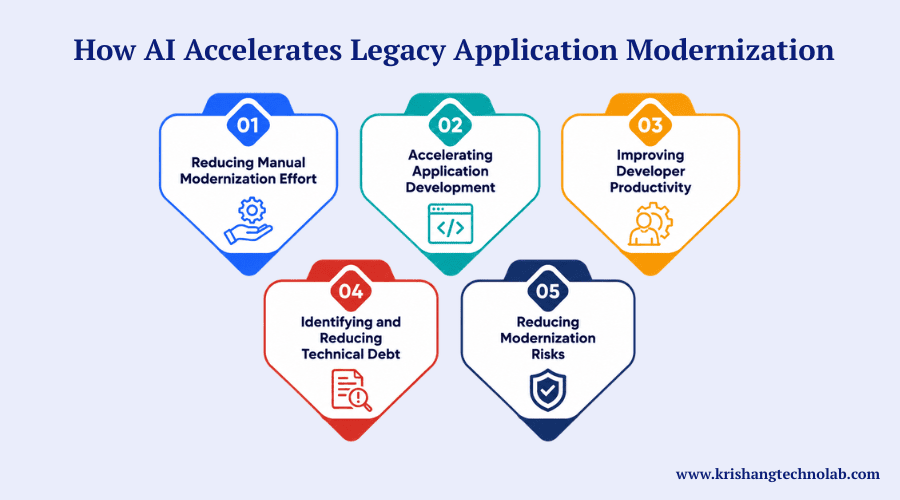
AI-powered application modernisation speeds up legacy modernisation in several ways. For example, it automates tedious tasks, digs into complex codebases, and lets teams make faster calls. Instead of relying on manual assessments and hand-written code, AI in application modernization enables teams to streamline workflows, reduce delays, and deliver more consistent results.
1. Reducing Manual Modernization Effort
AI handles the repetitive side of modernization — code analysis, documentation, testing, code conversion — freeing development teams from a lot of grunt work. That leaves specialists more room to focus on the engineering decisions, business requirements, and higher-value tasks that actually need a human in the loop — a core advantage of AI application modernization.
2. Accelerating Application Development
AI accelerates development by writing code, recommending fixes, creating test cases and helping to trace bugs. That shortens development cycles and allows teams to ship modernised applications faster, while maintaining consistency across the different phases of the project.
3. Improving Developer Productivity
AI handles legacy code reviews and routine maintenance, freeing developers to focus on architecture, innovation, and complex problem-solving that requires human expertise. Hire Dedicated AI Developers to enhance these capabilities, while AI-assisted tools provide intelligent suggestions that streamline workflows and improve overall development efficiency.
4. Identifying and Reducing Technical Debt
AI scans legacy applications to identify outdated components, duplicate code, awkward structures and future maintenance issues. Organisations that catch technical debt early can better prioritise fixes, keep applications easier to maintain, and avoid small issues becoming big modernisation roadblocks.
5. Reducing Modernization Risks
AI analyses dependencies, flags vulnerabilities, creates tests and checks application behaviour giving teams much better visibility into what’s ahead before changes actually go live. “That visibility helps prevent surprise failures and makes for a safer, more predictable AI application modernization process overall.”
Key Benefits of AI-Powered Application Modernization
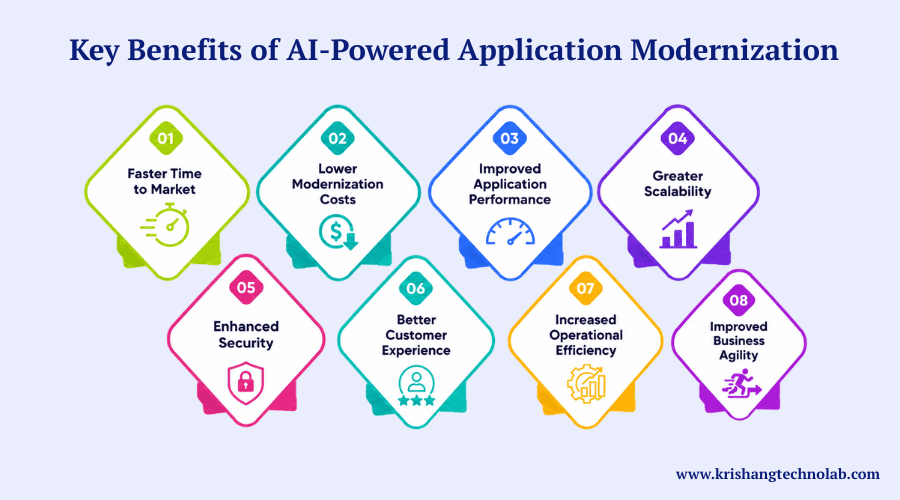
AI-driven application modernization delivers benefits that extend far beyond faster project timelines. It can improve application performance, strengthen security, and create smoother, more reliable customer experiences.
1. Faster Time to Market
By automating code analysis, conversion, testing, documentation, and deployment, AI cuts down manual effort and shortens development cycles. This enables organisations to modernise applications more quickly, get new features to market more quickly and respond more quickly if the market or customer expectations change.
2. Lower Modernization Costs
Automating the repetitive parts of engineering work — coding, testing, analysis — brings modernization costs down. Faster project execution also means fewer resources tied up for longer, and less expensive rework down the line. Budgets and development time both go further as a result.
3. Improved Application Performance
Modernised applications get better code, better architecture and continuous AI-based performance monitoring. AI is able to identify bottlenecks and inefficiencies early on, allowing teams to fix the right things without guesswork – leading to faster response times and a more reliable application overall.
4. Greater Scalability
AI-powered modernisation helps to migrate legacy applications to cloud-native architectures designed to scale with demand, and this is one of the most obvious benefits of application modernisation services based on AI. This kind of infrastructure scales automatically to changing workloads, so businesses can scale capacity without falling off performance during traffic spikes or moments of operational growth.
5. Enhanced Security
Artificial intelligence can help reinforce security in modernisation by identifying vulnerabilities, legacy components and suspicious patterns that might otherwise be missed. Better-inbuilt security controls and monitoring combined to decrease exposure, also help organisations maintain compliance with modern architectures.
6. Better Customer Experience
Modernized applications run faster, more reliably, and respond better to users in real time. AI can layer in personalization, automation, and real-time features on top of that. The result is smoother, quicker, more relevant experiences no matter which digital channel a customer is using.
7. Increased Operational Efficiency
AI modernisation streamlines workflows, automates the boring stuff, and generally makes apps more reliable. Today’s systems are easier to integrate with other business platforms and require less manual babysitting, which frees up employees and reduces delays in operations.
8. Improved Business Agility
Modern apps are based on a flexible architecture that allows them to easily add new features, plug in new technologies, or pivot in a new direction as business needs evolve. AI also speeds up development and decision-making allowing companies to innovate and react faster than their competitors.
AI-Powered Application Modernization Strategies
The right application modernisation strategy depends on application complexity, business goals, and technical requirements. Legacy application modernization services can incorporate AI to support rehosting and replatforming by analysing workloads, identifying dependencies, and suggesting suitable cloud environments. AI can also detect legacy code, recommend refactoring and architectural improvements, and help organisations decide whether to rebuild, replace, or retire applications based on usage, cost, dependencies, and business value.
How AI Helps Modernize Legacy Code
AI application modernization tools support Legacy system modernization by scanning legacy code, identifying outdated elements, and mapping application logic and dependencies. This helps teams understand technical debt risks before transformation begins. AI can then translate legacy code, automate repetitive refactoring, generate new code while preserving existing functionality, and identify vulnerabilities, duplicated logic, and inefficient structures. The result is cleaner, more secure, maintainable, and future-ready applications.
The Role of Generative AI in Legacy Application Modernization
Generative AI is transforming legacy application modernisation by helping teams analyse systems, improve code, automate documentation and testing, and simplify maintenance. Understanding generative AI can provide deeper insight into how these capabilities support modernisation, while A Generative AI Solutions Company can support these efforts and Generative AI Boosts Productivity by reducing repetitive work, improving development workflows, and enabling faster, more efficient modernisation.
AI and Cloud-Based Application Modernization
AI simplifies legacy application cloud migration by assessing workloads, mapping dependencies, evaluating infrastructure needs, and helping teams select suitable migration approaches. With Website Migration Solutions, these processes can become more structured and efficient, while containers, microservices, and serverless technologies support greater scalability and faster deployment. Post-migration, AI-driven monitoring can improve resource utilisation, detect bottlenecks, control costs, maintain performance, and automatically adjust infrastructure as workloads change.
AI, Data Modernization, and Legacy Applications
AI helps break down legacy data silos by connecting fragmented systems, modernising outdated databases, and making information easier to access, integrate, and retrieve. Data Science Advisory Services can help create a reliable data foundation for modern applications and AI initiatives.
The RAG MCP Complete Guide explains how structured, accessible, and trustworthy data can support retrieval-based AI applications. AI-powered tools can also identify duplicate or inaccurate information, improving data reliability and consistency.
How AI Enables Intelligent Applications After Modernization
Once an application is modernized, AI opens the door to smarter customer experiences — personalization, intelligent search, tailored recommendations. By analyzing customer behavior and preferences, AI surfaces content and services that are actually relevant, which boosts engagement and makes discovery easier across digital touchpoints.
Predictive analytics enables AI systems to uncover trends, forecast potential outcomes, and support smarter decisions, while intelligent automation handles repetitive processes with greater speed and consistency. Machine Learning Engineering strengthens these predictive capabilities, and ChatGPT Integration Experts can enhance virtual assistants and chatbots to deliver seamless, round-the-clock support across multiple channels.
Generative AI can create content and assist users directly, while AI agents take things further by executing tasks, managing workflows, and making decisions based on defined objectives. The AI Agent Types Explained guide highlights how different agent capabilities can automate tasks, coordinate workflows, and enable more intelligent decision-making across modernised applications, improving efficiency and responsiveness.
AI Application Modernization for Digital Transformation
AI application modernization links legacy systems to modern digital platforms, enabling much smoother integration across applications, APIs and cloud environments. It also helps to provide consistent omnichannel experiences from websites to mobile apps and everything in between, while cleaning up inefficient business processes along the way.
Modernisation makes sure that business systems are backed up by accurate and reliable data. It provides applications with real time data and faster decision making. And then there’s AI automation that takes it to the next level of efficiency and speed of response. These pieces are intended to help companies build a digital-first ecosystem for continuous improvement and long-term growth.
Step-by-Step AI-Powered Legacy Application Modernization Process
A structured process helps organisations approach legacy application modernisation in a methodical way, rather than a piecemeal way. AI helps throughout the process – assessing, planning, developing, testing, deploying and optimising – reducing risk while increasing efficiency, scalability and long-term value.
Step 1: Assess the Legacy Application Portfolio
Assess applications, technology, infrastructure, business value, maintenance costs, performance and technical debt. This assessment highlights the priorities of modernisation and the applications that should be addressed first, based on their business impact and technical condition.
Step 2: Identify AI and Modernization Opportunities
AI can transform areas such as analysis, coding, testing, documentation, monitoring, and routine business processes by reducing repetitive work and improving operational efficiency. AI Consulting Solutions focuses on identifying high-value opportunities that enhance performance, elevate customer experiences, and create new pathways for business growth.
Step 3: Analyze Application Dependencies
Map dependencies between applications, databases, APIs, infrastructure and external systems. This understanding of relationships enables teams to get ahead of migration risks, avoid disruption and safely sequence the work of modernisation.
Step 4: Define Business and Technology Goals
Set well defined objectives before you start the modernisation process. Establish measurable goals related to cost, performance, scalability, security, customer experience, development speed and adoption of AI so you can measure success down the road.
Step 5: Select the Right Modernization Strategy
Depending on the condition of the application and the business value, consider options of rehosting, replatforming, refactoring, rearchitecting, rebuilding, replacing, or retiring. Insights driven by AI may help illuminate that decision and help prioritise resources.
Step 6: Design the Target Architecture
Design a scalable architecture. This corresponds to the direction the business is headed. And throw in cloud-native services, APIs, containers, microservices, data platforms, security controls and AI capabilities to keep it flexible long-term.
Step 7: Modernize Code and Infrastructure
Modernising legacy applications involves refactoring outdated code and frameworks, upgrading infrastructure, and optimising application components with AI-based tools. Web Application Development Solutions bring these efforts together while automating repetitive tasks to accelerate development, improve quality, and maintain greater consistency.
Step 8: Integrate AI Capabilities
Embed meaningful AI capabilities (predictive analytics, intelligent automation, chat bots, recommendations, generative AI, AI agents) and make sure they are aligned with business goals, data readiness, governance and security requirements.
Step 9: Test and Validate the Modernized Application
Perform functional, performance, security, integration and user acceptance testing. AI is able to generate test cases, find bugs and analyse results. As a result, teams can ensure the application is resilient and fit for purpose before release.
Step 10: Deploy, Monitor, and Continuously Optimize
A phased application rollout makes it easier to track performance, security, costs, and user adoption at every stage. Website Maintenance Support keeps the application running smoothly after launch, while AI-driven insights highlight areas for improvement and enable continuous optimisation over time.
Challenges of Using AI for Legacy Application Modernization
Challenges of AI-driven application modernisation include poor data quality, complex dependencies, security, privacy, integration, and inaccurate AI recommendations. Skills gaps, costs and resistance to change can add to the headaches. That said, strong governance, validation, training, phased investment and experienced teams help organisations to manage these risks effectively.
How to Overcome AI Modernization Challenges
AI application modernization starts with clear business objectives and prioritising high-value applications. Through Professional Software Development Outsourcing, teams can modernise applications step by step, keeping risks under control, delivering early results, and directing development efforts toward high-priority applications that create the greatest value. Human oversight remains important throughout the process to evaluate AI recommendations and ensure final decisions align with business needs.
Strong AI needs good governance and security baked in from day one, data protection, responsible use of AI, compliance. Organisations should also monitor the AI’s performance and usage over time, to spot and resolve issues before they become bigger problems.
AI-Powered Application Modernization Best Practices
A sound modernisation strategy is focused on business value, incremental change, automation and human expertise. Upgrading applications requires data modernisation, DevSecOps and cross-functional collaboration Long-term success is defined as ongoing evaluation with meaningful metrics like cost savings, productivity, customer satisfaction, scalability and revenue impact.
AI Application Modernization vs Traditional Modernization
AI-powered modernization leans on intelligent automation, generative AI, and data-driven analysis to move faster than older approaches. By contrast, traditional modernization depends much more heavily on manual assessment, coding, testing, documentation, and decision-making at every step.
Traditional Application Modernization
Traditional modernization runs mostly on manual code review, developer expertise, testing, documentation, and infrastructure planning. As a result, teams generally need more time and more people to understand complex legacy systems, trace dependencies, transform the application, and validate the results.
AI-Powered Application Modernization
Modernisation with AI automates code analysis, translation, documentation, testing, dependency discovery and performance optimisation. Because of this, AI tools enable teams to work faster by eliminating repetitive work, identify risks sooner, and make decisions based on data — all while keeping a human in the loop at all times.
| Factor | Traditional Application Modernization | AI-Powered Application Modernization |
| Approach | Primarily manual analysis and development | AI-assisted automation and intelligent analysis |
| Speed | Longer modernization timelines | Faster transformation cycles |
| Cost | Higher manual labor and resource requirements | Lower effort through automation |
| Code Analysis | Manual code reviews and assessments | Automated code analysis and dependency discovery |
| Code Conversion | Primarily developer-driven | AI-assisted code translation and conversion |
| Documentation | Manually created or updated | AI-generated and automatically maintained |
| Testing | Manual test creation and execution | AI-assisted test generation and automation |
| Risk Detection | Depends heavily on developer expertise | AI identifies patterns, dependencies, and potential risks |
| Scalability | Requires significant manual effort | Supports scalable modernization across portfolios |
| Developer Productivity | More time spent on repetitive tasks | More focus on strategic engineering work |
| Outcomes | Modernized applications with longer delivery cycles | Faster, scalable, and more efficient modernization outcomes |
How to Measure the ROI of AI-Powered Application Modernization
We measure ROI as faster development cycles, and lower technical debt and maintenance costs. Less tech debt = less complexity in the long term, less maintenance spend Operational savings directly indicated Another piece of tangible evidence is improved application performance.
Developer productivity, customer satisfaction and time to market round out the picture. Teams can measure how many hours are saved, how often they release, how responsive the application feels, client input, and how quickly features are actually delivered. Taken together these metrics demonstrate how modernisation improved efficiency, quality and the overall customer experience.
AI-powered modernization can also open up new revenue streams — intelligent products, personalized services, automation, AI-enabled features. Comparing that incremental revenue against modernization costs gives organizations a fuller read on overall return, and regular measurement keeps future investment decisions grounded in real numbers.
How to Choose an AI Application Modernization Services Provider
For successful legacy application modernisation, choose a service provider with strong legacy technology expertise, proven AI and generative AI capabilities, cloud modernisation experience, and a solid understanding of application architecture. Hire Skilled Developers with these capabilities to handle complex transformation requirements and support modernisation across challenging technology environments.
Check for data modernization know-how, cybersecurity and compliance expertise, and an application modernization strategy that’s actually proven and repeatable. The right provider should be able to show you how they manage dependencies, protect information, reduce risk, and deliver results you can measure.
Industry-specific experience and post-modernization support matter just as much. Pick a partner who understands your business and can stick around for ongoing monitoring, optimization, and support once the application is live.
AI-Powered Legacy Modernization Use Cases
AI-powered legacy modernisation is helping organisations across every industry transform outdated applications. Specifically, it helps them run more efficiently, tighten security, improve customer experience, cut technical debt, and build a scalable foundation for future AI digital transformation work.
For instance, banking and money services see faster, safer core system updates. Meanwhile, healthcare organisations improve patient outcomes and make data more accessible. Similarly, in retail, smarter, faster platforms make shopping better for customers. Likewise, manufacturers use AI-powered automation to streamline operations. For insurers, meanwhile, intelligent automation speeds up the claims process. Additionally, telecoms upgrade systems for network management and billing. And, finally, government agencies modernise public services to increase efficiency.
This is just a sampling. Indeed, similar gains show up in virtually every sector. In every case, AI-powered application modernisation shortens timelines and makes systems more reliable.
Future of AI-Powered Application Modernization
Looking ahead, AI-powered application modernization is headed toward autonomous modernization, agentic AI for software engineering, self-optimizing applications, and AI-native architectures. Intelligent cloud operations will keep tuning infrastructure performance on their own. Meanwhile, continuous AI-assisted modernization — the next stage of AI application modernization — will let applications evolve and adapt as business needs and technology keep changing.
Why Businesses Should Start Legacy Application Modernization Now
Putting off modernisation only increases the risk and the technical debt. Meanwhile, players already taking advantage of AI are getting ahead. That alone is reason enough for businesses to get their legacy system modernisation strategy going now – the sooner they start, the better their long-term position.
Frequently Asked Questions About AI and Legacy Application Modernization
What Is AI-Powered Application Modernization?
AI-powered application modernization, also known as AI application modernization, uses artificial intelligence to analyze, transform, test, document, and optimize legacy applications, helping organizations modernize faster while cutting down on manual effort, technical debt, and risk.
How Does AI Help Modernize Legacy Applications?
AI analyses legacy code and identifies dependencies, transforms and refactors code, develops documentation, generates test cases, highlights risks and improves performance – all speeding up modernisation with greater precision and developer productivity.
Can AI Automatically Modernize Legacy Code?
Artificial intelligence can automate a lot of the modernisation work. Code analysis, translation, refactoring, test generation, etc. But full modernisation requires oversight by humans to validate business logic, architecture, security and compliance.
How Does Generative AI Support Application Modernization?
Generative artificial intelligence can help by generating code, documentation, test cases and explanations, and by helping with troubleshooting and planning, making complex modernisation work easier for development teams.
What Are the Benefits of AI Application Modernization?
The big ones: faster modernization, lower costs, better performance, greater scalability, stronger security, higher developer productivity, less technical debt, better customer experience, and more business agility.
How Much Does AI-Powered Application Modernization Cost?
Cost varies depending on complexity of the application, size of codebase, chosen modernisation strategy, infrastructure, integrations and data requirements. All of these factors should be accounted for in the assessment before establishing abudget.
How Long Does Legacy Application Modernization Take?
Timelines will be based on complexity, dependencies, tech stack, data requirements and strategy Automated analysis, coding, documentation and testing can help speed up work, but complex applications still need to be carefully planned and confirmed.
Is AI Application Modernization Better Than Traditional Modernization?
The AI-powered modernisation is typically faster and more efficient; thanks to automation and intelligent analysis. Still, the right approach depends on the application needs, business goals, and available skills.
Can Legacy Applications Be Modernized Without Replacing Them?
Yes, rehosting, replatforming, refactoring and rearchitecting are all ways to modernise without a complete replacement. It is contingent upon the condition of the application, business value and long-term goals – some of them make sense.
How Does AI Support Cloud Application Modernization?
AI supports cloud modernization by analyzing workloads, mapping dependencies, recommending migration strategies, optimizing resources, and monitoring performance — helping organizations move to the cloud while improving efficiency and reliability along the way.
Conclusion: Building an AI-Ready Foundation for Digital Transformation
AI-powered application modernization has become a strategic priority. Specifically, organizations are using it to get past the limits of legacy technology and move AI digital transformation forward. Furthermore, by working with an experienced application modernization services partner, businesses can pair artificial intelligence with modern development practices. Together, these help analyze complex systems, automate code transformation, improve testing, modernize data, and build cloud-ready applications that can actually scale.
The payoff, meanwhile, goes beyond the technical side. Specifically, organizations end up with less technical debt and lower maintenance costs. Additionally, they also get more productive developers, tighter security, better-performing applications, and stronger customer experiences. On top of that, generative AI and intelligent automation further open the door for innovation and operational efficiency.
However, none of this happens just by adopting AI tools. Rather, it requires clear objectives and the right modernisation strategy. It also requires solid data governance, real security controls, human oversight, and ongoing monitoring. Phasing the effort, meanwhile, helps minimise risk while still delivering value along the way.
Ultimately, AI application modernisation gives companies a more robust platform for building intelligent, scalable, and evolving technology. Therefore, those businesses that modernise today, with a clear strategy, will be best placed to innovate, compete, and grow as the digital environment continues to evolve.
Found this post helpful? Don't forget to share it with your network!