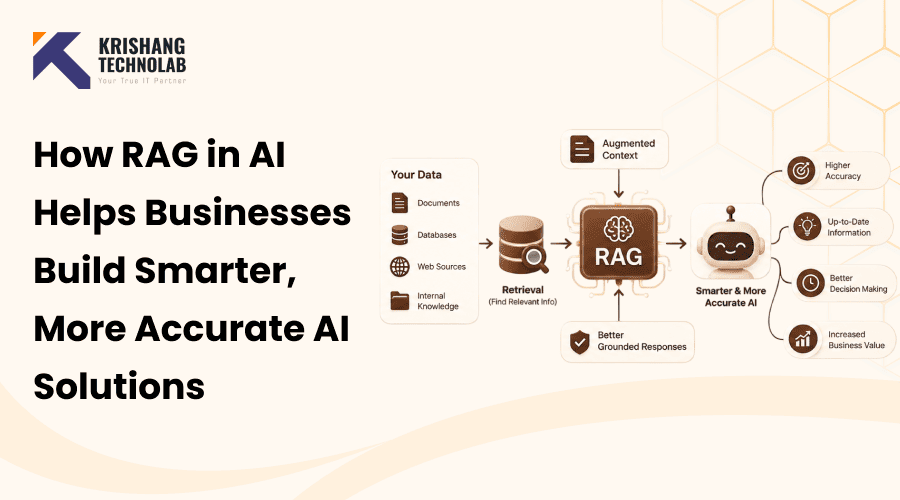
Quick Overview: RAG in AI connects large language models to your private, up-to-date business data, producing accurate, source-grounded answers. This guide explains how RAG works, its benefits, costs, use cases, and implementation steps, compares it with fine-tuning, covers challenges and ROI, and shows how to choose the right development partner.
Most businesses that experiment with generative AI hit the same wall within weeks. The demo is impressive, but the answers don’t reflect how the company actually works. The model doesn’t know your pricing policy, your product catalog, your compliance rules, or last quarter’s updates. Sometimes it fills the gap with something that sounds right but isn’t.
That is the problem RAG in AI was designed to solve. Retrieval-Augmented Generation (RAG) connects a large language model (LLM) to your own trusted data, so every answer is grounded in real, current business knowledge rather than whatever the model absorbed during training.
This guide explains what RAG is, how it works, why it matters for enterprise AI solutions, what it costs, where it delivers the strongest returns, and how to implement it step by step. Whether you plan to build in-house or work with a RAG AI development company, you’ll finish with a clear picture of what a successful project looks like.
What Is RAG in AI?
Retrieval-Augmented Generation (RAG) is a kind of AI architecture that combines two functions: text generation and information retrieval. Before the LLM writes a response, the system searches a knowledge source (documents, databases, wikis, tickets, manuals) for the most relevant information and passes it to the model as context. The model then generates a response based on that material.
How RAG differs from traditional generative AI
A standalone LLM answers from its training data alone. That data has a cutoff date, contains nothing private about your company, and can’t be easily inspected. When the model doesn’t know something, it may still produce a confident but incorrect answer.
A RAG system changes the workflow. Instead of asking the model to remember, you let it look things up first. Think of the difference between a student taking a closed-book exam and one taking an open-book exam with your company’s entire library on the desk.
Why businesses are adopting RAG
RAG technology has become a default pattern for business AI for practical reasons:
- It uses your existing documents and data without retraining a model.
- The way to improve knowledge is to change the source content, not the model.
- Answers may be cited for users to check.
- Access controls can limit what each user is able to retrieve.
For organizations investing in generative AI development services, RAG is often the first architecture that moves a project from “interesting prototype” to “trusted tool.”
How Does RAG in AI Work?
At a high level, a RAG pipeline follows a simple flow:
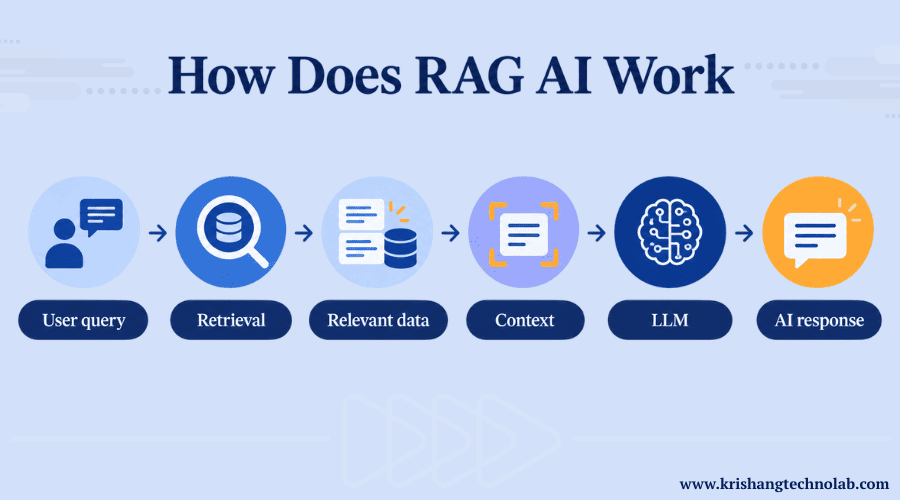
Behind that flow are four core stages.
Data ingestion and document processing
Everything starts with your knowledge. The system collects content from PDFs, web pages, internal wikis, CRM records, support tickets, contracts, product databases, and more. This content is cleaned, converted to text, enriched with metadata (source, date, department, access level), and split into smaller passages called chunks.
Chunking matters more than most teams expect. Chunks that are too large dilute relevance; chunks that are too small lose context. Good document processing is one of the biggest drivers of overall quality.
Embeddings and vector databases
Each chunk is converted into an embedding, a numerical representation of its meaning. Then you save the embeddings in a vector database, so you can search by meaning instead of exact keywords. A search for “time off for new parents” can find a policy called “Parental Leave Guidelines” even if the words don’t match exactly.
Information retrieval and semantic search
When a user asks a question, the system converts it into an embedding and runs a semantic search to find the closest matching chunks. Many enterprise systems combine this with keyword search (hybrid search) and add a reranker to reorder results by true relevance. Metadata filters can narrow results by department, region, document type, or permission level.
Context augmentation and AI generation
The best-matching passages are inserted into the prompt along with the user’s question and instructions such as “answer only from the provided sources and cite them.” The LLM then generates a response grounded in that context. If the knowledge base doesn’t contain the answer, a well-designed system says so instead of guessing.
Why Businesses Need RAG in AI
General-purpose LLMs are remarkable, but they have structural limits that matter in a business setting:
- Limited or outdated knowledge. Models are trained up to a point in time. Your pricing, policies, and products change constantly.
- No access to proprietary information. A public model has never seen your internal playbooks, contracts, or customer history.
- Weak traceability. It’s hard to know where a standalone model got an answer, which is a problem in regulated or high-stakes work.
RAG lets companies connect AI with internal knowledge while keeping that knowledge under their control. Employees and customers get faster access to relevant business information, and the organization gets AI that reflects its own reality. This is why enterprise RAG AI solutions have become a cornerstone of modern enterprise AI strategy, particularly for AI knowledge management and private data AI use cases.
Key Benefits of RAG AI for Businesses
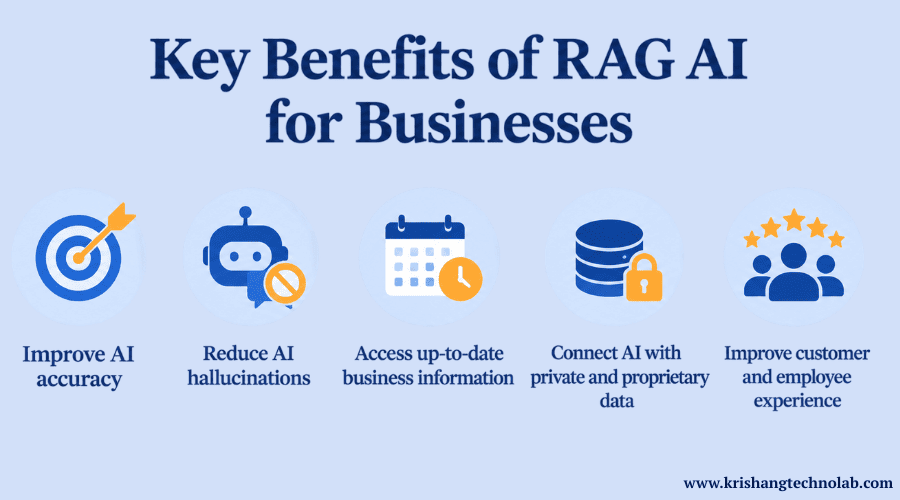
Improve AI accuracy
The model’s answers will be more accurate and specific to your organization with the right source material. Instead of generic advice, you get answers that reference your actual policies, specs, and procedures. Accuracy still depends on retrieval quality, which is why evaluation (covered later) is essential.
Reduce AI hallucinations
Hallucinations, plausible-sounding but false statements, are among the biggest barriers to business adoption. RAG reduces them by grounding responses in retrieved evidence and allowing the system to cite sources or decline to answer. It doesn’t eliminate hallucinations entirely, but it makes them far easier to prevent, detect, and audit.
Access up-to-date business information
Because knowledge lives in a searchable index rather than inside model weights, updating the AI is as simple as updating the documents. New product launch? Revised compliance rule? Re-index the content and the system reflects it, often within minutes. This is the foundation of real-time or near-real-time data retrieval.
Connect AI with private and proprietary data
RAG lets you query confidential information without exposing it to train a public model. With the right architecture and permission-aware retrieval, encryption, and private deployment options, you can build secure AI on business data that respects access rules and data residency requirements.
Improve customer and employee experience
Customers get fast, accurate answers through AI-powered customer service. Employees stop digging through shared drives and get answers in seconds. Both groups benefit from consistent responses that reflect approved information.
How Much Does RAG in AI Cost?
RAG AI cost varies widely, and anyone who quotes a single number without knowing your scope should be treated with caution. A focused proof of concept over a few thousand documents is a very different project from an enterprise-wide platform spanning dozens of systems, languages, and compliance regimes. The sections below explain what drives cost so you can budget realistically and compare proposals fairly.
Factors that affect RAG implementation cost
- LLM and API usage: Most ongoing cost comes from tokens processed per query. Model choice and context length matter greatly.
- Embedding models: Charged per volume of text embedded, both at ingestion and when queries are processed.
- Vector database: Managed services bill by storage, compute, and query volume; self-hosted options shift cost to infrastructure and engineering time.
- Cloud infrastructure: Hosting, orchestration, queues, logging, and, for private deployments, GPU capacity.
- Data volume and complexity: More documents, more formats, and more sources mean more processing and more storage.
- Data processing: Cleaning scanned PDFs, tables, and inconsistent content can require more effort than teams anticipate.
- Integration and development: The biggest one-time cost is often integration with your CRM, helpdesk, intranet, identity provider, and other systems.
- Security and compliance: Scope for regulated industries with controls over access, audit logs, data masking, and certifications.
- Monitoring and maintenance: Post-launch activities include evaluation, prompt tuning, re-indexing, model upgrades, and so on.
Integrations and data preparation dominate one-off build costs. Usage volume and maintenance dominate recurring costs. Ask for itemized estimates that break out the two.
How to reduce RAG implementation costs
- Choose the right LLM. Save premium models for complex queries and use smaller cheaper models for routine queries.
- Optimize retrieval. Better chunking, reranking, and filtering mean fewer and more relevant passages are sent to the model.
- Reduce unnecessary token usage. You can trim prompts, limit retrieved context, and cap response length as needed.
- Use caching. Cache common questions and embeddings so you don’t pay repeatedly for the same work.
- Select an appropriate vector database. Pick the tool that matches your scale; don’t just grab the largest one.
- Start with an MVP. Prove value on one use case and one data source before expanding. Our guide on AI development for startups walks through an MVP-first path from idea to production.
Cost-effective RAG is rarely about the cheapest components. It’s about not paying for context and capability you don’t need.
RAG AI Use Cases for Businesses
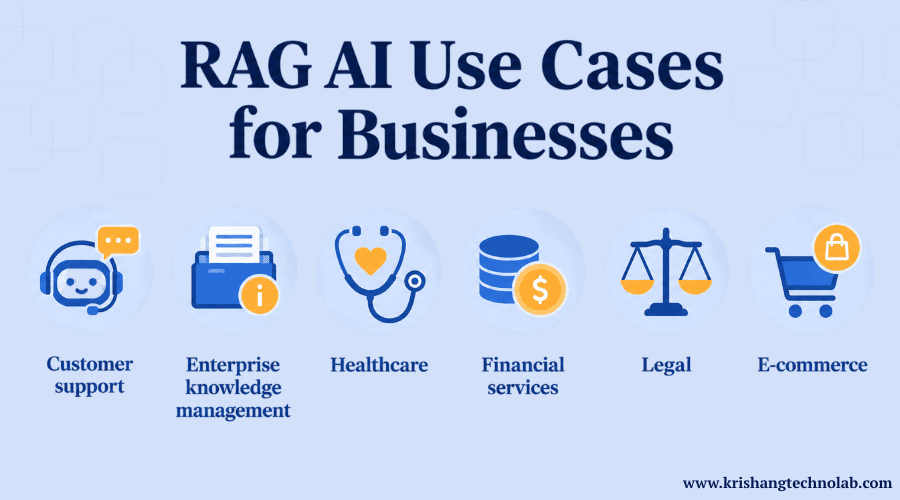
Customer support
RAG AI for customer support is often the fastest route to measurable value. A knowledge-base chatbot can answer product, billing, and troubleshooting questions using your approved documentation, handle automated FAQ responses, and hand off to human agents with the relevant context attached. Because answers are grounded in your content, they stay consistent with policy. RAG AI chatbot development typically includes helpdesk integration, escalation logic, and analytics on unanswered questions, which in turn reveal gaps in your documentation. For a closer look at automation beyond chat, read our guide toAI agents for customer support.
Enterprise knowledge management
Most organizations have valuable knowledge scattered across drives, wikis, chat threads, and inboxes. RAG AI knowledge base development turns that sprawl into a single conversational interface. Employees can ask natural-language questions such as “What’s our process for vendor onboarding in Germany?” and get back a response with links to the source documents respecting each person’s rights of access.
Healthcare
RAG is being used by healthcare organizations to pull up clinical guidelines, internal protocols, research literature, and administrative documentation. It can help staff to find relevant information faster and reduce the amount of documentation. There’s too much at stake to settle for anything less than strong governance, oversight by humans, privacy protections, and compliance with regulations such as HIPAA, where applicable. Professionals should use RAG as an aid but not a replacement for clinical judgment.
Financial services
Banks, insurers, and investment firms use RAG for policy and procedure lookup, regulatory research, internal audit support, and client-service knowledge. Traceable sources and audit logs are especially valuable here, since teams need to show where an answer came from.
Legal
Legal teams use RAG to search contracts, clauses, case files, and internal precedents, and to summarize large document sets. Citation to source passages is critical, and outputs should always be reviewed by qualified professionals.
E-commerce
RAG is used by online retailers for product information, specifications, availability and policies, allowing assistants to answer complex questions, compare products and tailor recommendations based on catalog data and shopper context. These assistants work best when they sit on a well-built eCommerce development foundation, so catalog, pricing, and order data stay in sync.
Across every one of these examples, the pattern is the same: RAG AI solutions for business work best where accurate answers depend on specific, changing, and often private information.
Key Components of an Enterprise RAG System
A production-grade enterprise RAG architecture is not just a model and a database.
- LLM: The engine that creates from hosted APIs to privately deployed models, the choices are varied.
- Embedding model: Converts text into vectors. Quality here strongly influences retrieval relevance.
- Vector database: Stores embeddings and supports fast similarity search at scale.
- Retriever: The logic that finds candidate passages, often combining semantic and keyword search.
- Reranker: Reorders retrieved results so the most relevant passages reach the model.
- Knowledge base: The system curates and governs the source of content.
- Document Management: Content parsing, cleaning, and structuring, including tables and scanned files.
- Chunking: Breaking content into meaningful retrievable pieces.
- Prompt engineering: Formatted, appropriately cautious instructions that keep answers grounded.
- Evaluation and monitoring: Ongoing measurement of retrieval quality, answer accuracy, latency, cost, and user feedback.
Weakness in any one component limits the whole system, which is why experienced teams invest as heavily in data preparation and evaluation as they do in model selection.
How to Implement RAG AI in Your Business
Whether you’re building internally or engaging RAG AI implementation services, the path looks broadly similar. If you’re building in-house and need extra capacity, you canhire AI developers to extend your team.
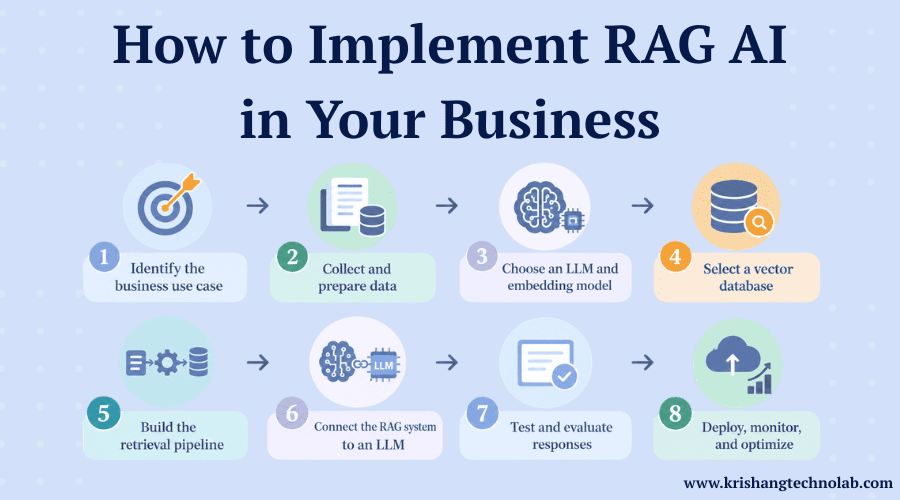
Step 1: Identify the business use case
Start with a specific problem and a measurable goal: reduce support ticket volume, cut time spent searching policies, speed up onboarding. Define success metrics before writing any code.
Step 2: Collect and prepare data
Inventory your sources, clean out outdated or duplicate content, resolve conflicts between documents, and add metadata. Determine the source owners and how they are to be maintained. This step often sets the ceiling for the project. Teams without in-house data expertise often bring in data science consulting to audit sources and clean the data.
Step 3: Choose an LLM and embedding model
Balance quality, speed, cost, language support, and data-privacy requirements. Some organizations use hosted APIs; others need private or on-premises deployment. If you’re starting with OpenAI models,ChatGPT integration services can shorten the path to a working connection.
Step 4: Select a vector database
Consider scale, filtering capabilities, hybrid search support, security features, hosting model, and how well it fits your existing infrastructure.
Step 5: Build the retrieval pipeline
Implement ingestion, chunking, embedding, indexing, hybrid search, reranking, and metadata filtering. Test retrieval quality on its own before connecting it to the model.
Step 6: Connect the RAG system to an LLM
Design prompts that instruct the model to answer from the retrieved context, cite sources, and admit uncertainty. Add guardrails for off-topic or sensitive requests. This is also where RAG AI integration services come in, linking the system to your helpdesk, CRM, intranet, Slack or Teams, and single sign-on. Larger rollouts typically sit inside broader enterprise software development programs, and if the systems you’re connecting are outdated, it helps to understand how AI can modernize legacy applications first.
Step 7: Test and evaluate responses
Build an evaluation set of real questions with known good answers. Measure retrieval relevance, answer correctness, groundedness, and refusal behavior. Include subject-matter experts in the review.
Step 8: Deploy, monitor, and optimize
Roll out to a limited group first. Track usage, unanswered questions, user feedback, latency, and cost. Use what you learn to refine chunking, prompts, and content. A RAG system is a living product, not a one-time project.
Challenges of Implementing RAG AI
RAG is powerful but not plug-and-play. Typical problems are:
- Data quality: Poor answers are caused by outdated, conflicting, or poorly formatted docs. Retrieval can only be as good as the content behind it.
- Incorrect retrieval and poor chunking: If the right passage isn’t retrieved, even the best model can’t answer correctly.
- Residual hallucinations: Grounding reduces but does not completely eliminate them, especially when the retrieved context is ambiguous.
- Data security and privacy: Sensitive information needs permission aware retrieval, encryption, and audit trails.
- Scalability and latency: And as you scale to more documents and users, you’ll need efficient indexing and caching to keep those snappy response times.
- Cost management: Token usage can skyrocket without monitoring and optimization.
- Evaluation: Without systematic testing, quality problems stay invisible until users lose trust.
Most of these are solvable with the right architecture and process. They are also the main reason organizations seek out a RAG AI consulting services partner before committing to a full build. If you’re weighing strategy against execution, our guide to AI consulting vs. AI development can help you decide.
Best Practices for Building an Effective RAG AI Solution
- Use high-quality business data. Curate before you index. Remove duplicates, archive stale content, and assign owners.
- Optimize chunk size. Test different sizes and overlaps against real questions; document structure should guide your approach.
- Select the right embedding model. Evaluate on your own content and languages, not only public benchmarks.
- Use hybrid search where appropriate. Combining semantic and keyword search helps with product codes, names, and exact terms.
- Add reranking. It’s one of the most reliable ways to improve relevance.
- Apply metadata filtering. Narrow searches by department, date, region, or document type.
- Secure sensitive information. Enforce access controls at retrieval time, not just at the interface.
- Continuously evaluate retrieval quality. Treat your evaluation set as a living asset.
- Monitor costs and performance. Track tokens, latency, and answer quality together.
How RAG Delivers ROI for Businesses
The return on a RAG investment typically shows up in several places:
- Reduced customer-support workload. Self-service answers can deflect routine questions so agents focus on complex cases.
- Improved employee productivity. Less time searching means more time on actual work.
- Less time spent searching documents. Knowledge workers often spend a significant part of their day looking for information; faster retrieval compounds across teams.
- Better access to organizational knowledge. Expertise stops living only in a few people’s heads.
- Fewer information-related errors. If the sources are consistent, that will mitigate errors due to outdated or misremembered guidance.
- Scalable AI-powered services. The same foundation can be used to support new use cases and departments once built.
To measure ROI honestly, establish baselines before launch: average handling time, ticket deflection rate, time-to-answer, onboarding duration and error rates. Then compare with post-launch results. Compare these gains to the total cost of ownership, including the RAG AI cost factors we discussed above.
The Future of RAG in AI
RAG continues to evolve quickly. Several directions are worth watching:
- Agentic RAG. AI agents decide what to retrieve, run multi-step searches, call tools, and verify results rather than performing a single lookup.
- Graph RAG. Knowledge graphs capture relationships between entities, improving answers to questions that span many documents.
- Multimodal RAG. Retrieval extends beyond text to images, diagrams, audio, and video.
- Adaptive RAG. Systems adjust their retrieval strategy based on the complexity of each question.
- RAG-powered AI agents. Agents that act, not just answer, using retrieved knowledge to complete workflows.
- Enterprise AI knowledge systems. Unified layers that make organizational knowledge available to every AI application.
The common thread is that retrieval is becoming a core capability of enterprise AI solutions rather than an add-on.
Choosing the Right RAG Partner
To build a trustworthy system, you need data engineering, search, security, and LLM application design experience. In case you decide to outsource this activity, search for a RAG AI development company that can demonstrate:
- Ability, End to End: From discovery and RAG AI consulting services to custom RAG AI development, deployment, and ongoing support.
- Integration depth: Experience connecting RAG to your existing systems, not just standing up a standalone demo.
- Evaluation discipline: A clear method for measuring accuracy, groundedness, and cost.
- Security and compliance expertise: This is especially true in healthcare, finance, and legal environments.
- Transparent Pricing: Line-item estimates detailing build, infrastructure, and usage costs
- Broader AI breadth: Strong generative AI development services experience so RAG fits into a broader AI roadmap.
The right RAG AI development services partner will provide more than a chatbot. They’ll help you pick the right use case, prepare your data, build a measurable system, and plan for the long haul. Before making your choice, check out the relevant case studies and see how each provider handles your industry.
Conclusion
RAG in AI makes generative AI genuinely useful for business by grounding it in the information that actually matters to your organization. It improves accuracy, reduces hallucinations, keeps responses current, and lets you put private and frequently updated data to work without retraining a model. It supports use cases from customer support to enterprise knowledge management, healthcare, finance, legal, and e-commerce.
Success isn’t automatic, though. Cost, security, data quality and implementation strategy all warrant attention from the outset. Start with a defined use case, prepare your data carefully, and measure results rigorously and then scale from there.
If you’re ready to move from experimentation to production, a team offering enterprise RAG AI solutions and RAG AI implementation services can help you scope the right first project, estimate RAG AI cost accurately, and build an AI system your people and customers can trust. Ready to scope your project? Talk to our AI experts.
Found this post helpful? Don't forget to share it with your network!