
Quick Overview: Discover how agile software development helps teams build better products through iterative delivery and continuous feedback. This guide covers the Agile methodology, Manifesto, Scrum, and Waterfall comparison, plus benefits, challenges, best practices, tools, metrics, and how to choose the right Agile development partner for your project.
Software rarely turns out the way anyone first imagines it. Requirements shift, markets move, users surprise you, and a plan written in January can look naive by April. Agile software development exists precisely because of this reality. Instead of trying to predict everything up front, it gives teams a way to build in small steps, learn from real feedback, and adjust course before small problems become expensive ones.
Today, agile development is the default way of working for a large share of modern software engineering teams, from early-stage startups to global enterprises. It has reshaped how products are planned, built, tested, and released, and it differs sharply from the traditional, sequential approaches that dominated the industry for decades.
This guide walks through everything you need to know. You will learn what Agile is, how the Agile methodology works in practice, what the Agile Manifesto says, how Scrum fits in, how Agile compares with Waterfall, where it shines, where it struggles, and how to choose the right partner if you decide to outsource software development. By the end, you should be able to judge whether Agile is the right fit for your next project and how to get the most from it.
What Is Agile Software Development?
Agile software development is an iterative and incremental approach to software development where requirements and solutions evolve through collaboration between cross-functional teams and the customer. The word “agile” is a pointer to the goal: to be able to respond quickly and rationally to change.
It is helpful to think of Agile as a mindset supported by a set of practices, rather than a single fixed process. The Agile methodology for software prioritizes working software, collaboration, and responsiveness over rigid plans and heavy paperwork. Different teams express that mindset in different ways, which is why the umbrella includes frameworks such as Scrum, Kanban, and Extreme Programming. In the broader field, agile system development is simply this philosophy applied to the full life of a system, from first idea to long-term maintenance.
How Does Agile Software Development Work?
The Agile team has a high-level view of what the product is and a prioritized list of features they want to deliver. Instead of building everything at once, the team picks a small set of the most valuable items and works on them for a short, fixed period, usually one to four weeks. At the end of that period, the team has a working increment of the product that stakeholders can see, test, and comment on.
That feedback goes straight back into planning. Priorities may change, new ideas may appear, and some planned features may be dropped entirely. The cost of changing direction is low because each cycle is short. That’s the essence of how agile development processes differ from the older approaches: learning is part of the workflow, not deferred until a big release.
In practice, a typical cycle will involve planning, building, testing, reviewing, and reflecting. Teams meet regularly, keep the work visible on a shared board, and talk to each other daily. The Agile software model rewards transparency and punishes silos. That is also why many businesses choose to hire software developers who already work in Agile teams: they can join the daily rhythm quickly, communicate openly, and start delivering working increments sooner.
What Is the Agile Software Development Methodology?
It is tempting to treat Agile as just another project-management technique, a calendar of meetings, and a board of sticky notes. In reality, the Agile software development methodology is a broader approach to how teams think about requirements, quality, risk, and customers. It changes who makes decisions, how often work is validated, and what “done” actually means.
Under this approach, the product is never really “finished” in a single moment. It grows continuously, guided by evidence from real users. That is why an agile development model suits products whose needs are unclear at the start, or that must keep evolving after launch.
Key Characteristics of Agile Development
While each framework adds its own details, the Agile development methodology shares several consistent characteristics:
- Iterative development: Work is done in repeated short cycles. Each pass refines the product, improving design, code, and usability based on what was learned previously.
- Incremental releases: Instead of one large delivery, the product is released in usable pieces. Customers see value early and often.
- Customer collaboration: Stakeholders and users are part of the process rather than distant approvers. Their input shapes priorities throughout the project.
- Continuous feedback: Reviews, demos, user testing, and analytics supply a steady stream of information that guides decisions.
- Adaptability: Changing requirements are expected and welcomed, not treated as failures of planning.
- Cross-functional teams: Developers, testers, designers, and product people work together, so handoffs shrink and ownership grows.
Together, these traits explain why the agile software development model has become so popular. It aligns the way teams work with the uncertain nature of building software.
The Agile Manifesto and Its Principles
Agile did not appear overnight. Many of its ideas existed in lightweight methods during the 1990s, but the movement gained a shared identity in 2001, when seventeen practitioners met in Utah and wrote the Manifesto for Agile Software Development. It is short, deliberately simple, and still the philosophical foundation of everything Agile today.
Four Values of the Agile Manifesto
The manifesto for agile software development is built around four value statements. Each compares two things and says that, while both matter, the first deserves more weight:
- Individuals and interactions over processes and tools.
- Working software over comprehensive documentation.
- Customer collaboration over contract negotiation.
- Responding to change over following a plan.
Notice the phrasing. The manifesto does not say processes, documentation, contracts, and plans are worthless. It says that when tradeoffs arise, people, working software, collaboration, and adaptability should win. Many teams misread this and abandon documentation or planning entirely, which usually causes trouble later.
Read More About: Software Development Ideas for Entrepreneurs and Small Businesses
12 Principles of Agile Software Development
Behind the four values sit twelve principles that make them practical. In plain language, they say the following:
- Satisfy the customer through early and continuous delivery of valuable software.
- Welcome changing requirements, even late in development.
- Deliver working software frequently, from a couple of weeks to a couple of months, favouring shorter timescales.
- Business people and developers have to work together every day during the project.
- Build projects around motivated individuals. Give them the environment and support they need; trust them to get the job done.
- The best and most effective way to convey information is through face-to-face conversation.
- Working software is the primary measure of progress.
- Agail sustainable development by ILE processes, with sponsors, developers and users capable of maintaining a constant pace indefinitely.
- Continuous attention to good design and technical excellence enhances agility.
- Siplicity, the art of maximising the amount of work not done, is a must.
- The best architectures, requirements, and designs emerge from self-organising teams.
- At regular intervals, the team reflects on how to become more effective, then tunes and adjusts its behavior accordingly.
These principles are what separate genuine agile software development from “agile in name only”. A team that does daily stand-ups but ignores technical quality, sustainable pace, or customer involvement is just using the vocabulary without the substance. When you evaluate a software development firm, ask how it applies these principles in day-to-day work, not just whether it uses Agile terms.
How Does the Agile Software Development Process Work?
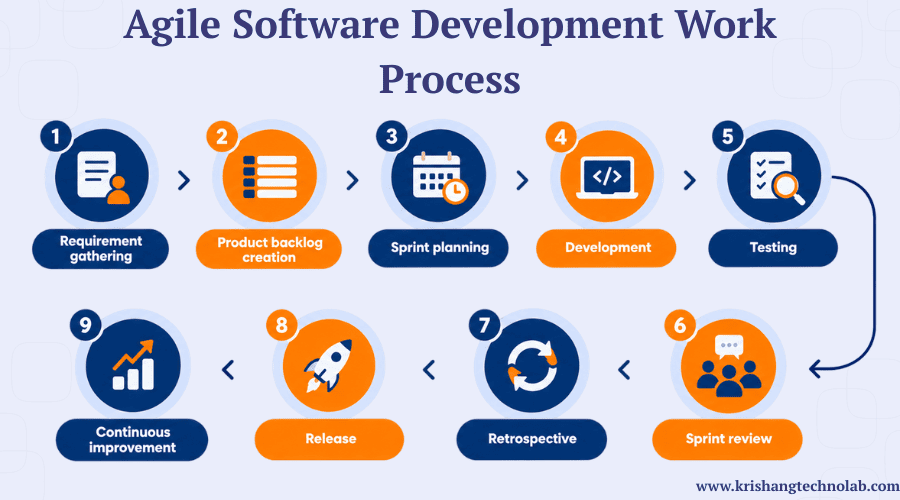
The agile software development process is often described as a loop rather than a line. Although every organization adapts it, most teams follow a recognizable rhythm. Here is a typical flow, from the first idea to continuous improvement.
1. Requirement gathering
Team and stakeholders talk about objectives, users and constraints. Instead of creating a giant specification, they capture needs in lightweight items like user stories, for example: “As a returning customer, I want to save my payment details so I can check out faster.”
2. Product backlog creation
All desired work goes into a single, ordered list called the product backlog. The product owner prioritizes it based on value, risk, and effort. The backlog is a living document that changes constantly.
3. Sprint planning
At the start of each iteration, often called a sprint, the team selects the highest-priority items it can realistically complete. Together they define a sprint goal and break the work into tasks.
4. Development
Engineers and designers build the selected features, usually working in small increments and merging code often. Daily check-ins keep everyone aligned and surface blockers quickly.
5. Testing
In Agile, testing is not a late phase. It happens continuously alongside development through unit tests, integration tests, code reviews, and exploratory testing. Many teams automate as much of this as possible.
6. Sprint review
At the end of the sprint, the team demonstrates what it built to stakeholders. This is a working session, not a formal presentation, and the feedback gathered here directly influences the backlog.
7. Retrospective
The team then looks inward. What went well? and What slowed us down? What will we change next sprint? Retrospectives are the engine of continuous improvement.
8. Release
Completed work is released to users, either at the end of each sprint or whenever it is ready. Teams with mature automation may release many times per day.
9. Continuous improvement
Data from real usage, support requests, and team reflection feeds into the next planning session, and the cycle begins again.
This cycle is the practical core of agile software engineering. Its power comes less from any single step than from how tightly the steps are connected and how quickly feedback travels through them. That is why many companies work with an experienced software development partner: a good one already runs this loop well, so your project gets working increments and useful feedback from the first sprint. For teams practicing agile system development at scale, the same loop simply runs across multiple teams, with extra coordination.
Agile Software Development Lifecycle
The agile software development lifecycle (or simply Agile SDLC) differs from traditional lifecycles in one important way: the phases are not divided into long, sequential stages. Instead, all planning, design, development, testing, and deployment occur within each short iteration.
A common way to describe the agile development lifecycle uses six broad phases:
- Concept and inception: define the vision, scope, and initial team.
- Iteration planning: shape the backlog and plan the first sprints.
- Construction: build, test, and integrate working features.
- Release: deploy the increment to users.
- Production and support: monitor performance and fix issues.
- Retirement: sunset the product when it is no longer valuable.
People tend to categorize SDLC methodologies by how they approach change. Sequential models of the waterfall type assume a stable plan. Iterative and incremental models such as the Agile software development model assume that the plan will change and are designed accordingly.
What Is Scrum Development?
If Agile is the philosophy, Scrum is the most widely used way to put it into practice. Scrum development is a lightweight framework that organizes work into fixed-length sprints and defines a small set of roles, events, and artifacts. Surveys of Agile practitioners have consistently shown Scrum to be the most commonly used Agile approach, which is why the terms “Scrum” and “Agile” are so often confused.
Scrum software development is intentionally simple to describe but challenging to master. It offers just enough structure to keep teams focused while leaving the technical details to the people doing the work. The agile scrum framework is also easy to adapt, which is part of the reason it has spread well beyond software into marketing, operations, and product design.
How Scrum Works
Scrum is built from a handful of roles, artifacts, and events.
Roles
- Product Owner: represents the customer and stakeholders, owns the product backlog, and decides what the team should build first.
- Scrum Master: a servant-leader who coaches the team, removes obstacles, and protects the Scrum process.
- Developers: the cross-functional professionals, including engineers, testers, and designers, who build the product increment.
Artifacts
- Product Backlog: the ordered list of everything that might be needed in the product.
- Sprint Backlog: the items chosen for the current sprint plus the plan for delivering them.
- Increment: the usable, potentially releasable result of the sprint.
Events
- Sprint: a time-boxed iteration, typically two weeks, during which a usable increment is created.
- Sprint Planning: where the team decides what it can deliver and how.
- Daily Scrum: a brief daily meeting, usually fifteen minutes, to sync on progress and blockers.
- Sprint Review: an inspection of the increment with stakeholders, producing feedback for the backlog.
- Sprint Retrospective: a team discussion focused on improving how the team works.
The predictable rhythm of these events creates a steady cadence. Stakeholders know when they can expect to see progress, and the team knows when it can expect to receive feedback.
Agile Software Development With Scrum
Using Agile software development with Scrum gives teams a concrete starting point. Agile supplies the values and principles; Scrum supplies the roles, meetings, and rules of engagement. A team can adopt Scrum without fully understanding Agile, but the results are usually shallow. Conversely, a team can be agile without using Scrum at all, relying on Kanban or another approach instead.
So, the answer to the question “is Scrum the same as Agile?” is a no. Scrum is a framework in the family of Agile approaches. Understanding the relationship between Scrum and agile development enables organizations to make a conscious choice and not just follow the herd with Scrum.
What Is the Waterfall Development Method?
The Waterfall development method is a linear, sequential approach in which each phase must be completed before the next begins. A typical Waterfall model in software engineering moves through requirements, system design, implementation, testing, deployment, and maintenance, with little or no going back. The name comes from the way progress flows downward from one stage to the next.
Waterfall has real strengths. It produces thorough documentation, sets clear milestones, and works well when requirements are stable and well understood, such as in some hardware-integrated or compliance-heavy projects. Its weakness is rigidity. If a requirement is wrong or the market shifts midway, the cost of correcting it can be enormous because testing and user feedback arrive so late.
Agile vs. Waterfall Development
No discussion of Agile is complete without comparing it to the approach it largely replaced. Many teams still encounter Waterfall, especially in regulated industries or fixed-scope government contracts, so the distinction matters.The table below summarizes the major differences between the two approaches.
| Factor | Agile | Waterfall |
| Development | Iterative | Sequential |
| Requirements | Flexible, evolve over time | Usually fixed up front |
| Testing | Continuous throughout | Later stages |
| Customer feedback | Frequent | Limited |
| Releases | Frequent, incremental | Usually final-stage |
| Change management | Easier | More difficult |
The contrast between the agile development model and Waterfall is less about which is better in the abstract and more about which fits the context. If you can define the full scope in advance and expect little change, Waterfall can work. If you expect learning, change, and discovery, which is the norm for most digital products, the Agile software development model is usually the safer choice. Some organizations even blend the two, using a hybrid approach where high-level planning is fixed but delivery is iterative.
Benefits of Agile Software Development
The popularity of Agile is not accidental. It can be hard to beat the benefits of doing it well with traditional methods.
- Faster time to market: Teams deliver working increments early; therefore, customers can get a usable version of the product long before the full vision is complete.
- Better adaptability: Absorbing changing requirements into the backlog without derailing the project.
- Continuous customer feedback: Regular reviews ensure the product stays aligned to real needs, decreasing the likelihood of building something nobody wants.
- Improved product quality: Ongoing testing and regular integration catch defects while they are still cheap to fix.
- Reduced development risk: Small iterations mean small bets. If an idea fails, the team finds out within weeks, not years.
- Better team collaboration: Advantages: daily communication, shared ownership increases morale, transparency, and trust.
- Continuous improvement: Retrospectives are an opportunity for the team to improve their process with every sprint.
- Earlier identification of issues: Design and business issues come up early, when it is much cheaper to change direction.
Over time, these gains of agile development multiply. Teams that stick with the approach tend to become faster, more predictable, and more confident in their delivery.
Challenges and Limitations of Agile Development
Agile is powerful but not magic, and it would be misleading to present it as a universally perfect one. “Being upfront about the limitations helps teams adopt it more successfully.”
- Scope changes: Flexibility is a strength, but constant change can make it hard to know when the product is really finished.
- Strong communication is required: This means talking about it openly and often. Struggling teams can be misaligned or scattered.
- Difficult for inexperienced teams: Self-organization and discipline are skills that develop over time. Often a coach is beneficial for new teams.
- Less predictable long-term scope: Plans change, so it’s harder to promise features, budgets, and dates far in advance.
- Active stakeholder participation is essential: Product owners and stakeholders aren’t available, feedback loops are broken, and quality suffers.
- Risk of scope creep: Without a well-managed backlog and clear goals for the sprint, new requests can pile up and stretch timelines.
- Documentation may be overlooked: The manifesto’s preference for working software is sometimes misinterpreted as a license to cut documentation, which causes onboarding and maintenance headaches.
Good leadership, disciplined backlog management, and a team that understands the rationale for the practices can manage most of these issues. The Agile methodology in development works best when it is taken up sensibly, rather than mechanically.
Different Agile Methodologies and Frameworks
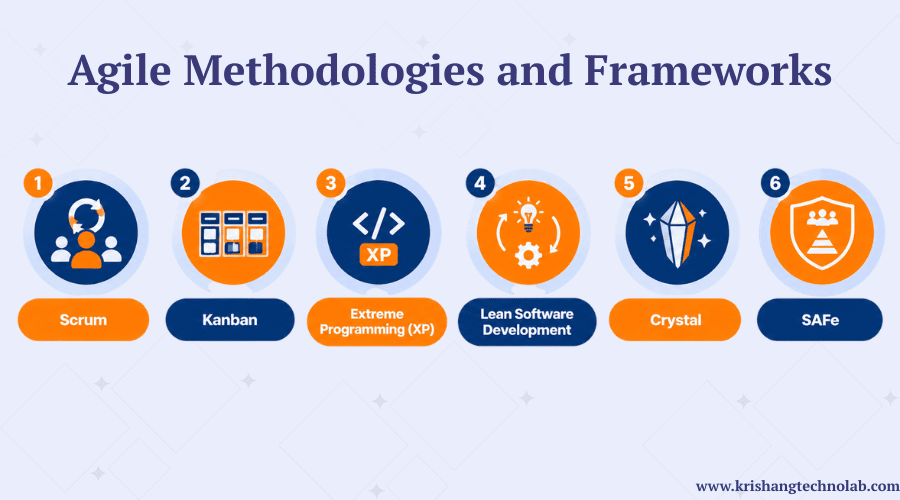
Agile is an umbrella, and several frameworks sit underneath it. Understanding them helps you pick the right fit, much as comparing SDLC methodologies helps you choose between sequential and iterative models.
Scrum
The most famous framework is Scrum. The defined roles and fixed sprints and regular events are good for teams working on products where requirements are changing. Scrum development is particularly effective when a team can focus on a single product and has an active product owner.
Kanban
Kanban is about visualizing work on a board and limiting work in progress. No sprints, fixed or otherwise. Work flows continuously from to-do to done. It works well for support, maintenance and operations teams with unpredictable incoming work.
Extreme Programming (XP)
XP emphasizes engineering discipline: pair programming, test-driven development, continuous integration, and frequent small releases. Many Scrum teams borrow XP practices to strengthen code quality.
Lean Software Development
Inspired by lean manufacturing, this approach aims to eliminate waste, amplify learning, decide as late as responsible, and deliver fast. It provides a useful lens for any team trying to cut unnecessary work.
Crystal
Crystal is a family of lightweight methods that scale according to team size and project criticality. It puts heavy emphasis on communication and people over rigid process.
SAFe
The Scaled Agile Framework helps large organizations coordinate many Agile teams around shared goals. It adds planning layers and roles for portfolio, program, and team levels. It is popular in enterprises, though some practitioners find it heavier than other options.
When Should You Use Agile Software Development?
Agile is especially valuable when uncertainty is high and learning matters. Consider it when:
- Requirements are likely to change as the market, users, or business strategy evolves.
- You are building a new product and need to validate ideas before investing heavily.
- You are developing a SaaS product that will keep evolving after launch.
- You are creating mobile or web applications where user feedback and quick releases drive success.
- You are building an MVP and need to reach users quickly with a focused feature set.
- The product is complex, and breaking it into small increments reduces risk.
- The product is customer-driven, with frequent input from real users shaping the roadmap.
Many businesses that lack in-house expertise turn to custom agile software development from an experienced partner. Whether through agile application development services or broader agile product development services, an external team can bring both capacity and process maturity. Agile software development services of this kind are especially useful when you want working software quickly without building a full engineering organization first.
Different Types of Agile Software Development Projects
The principles stay the same across projects, but the emphasis shifts depending on what you are building.
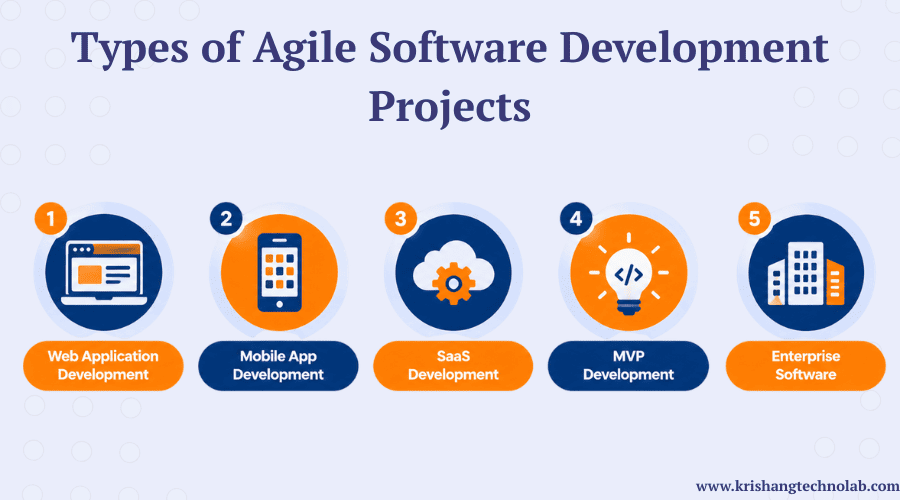
Agile for Web Application Development
Web apps love short release cycles and constant refinement. Teams can ship a core feature and observe how users behave with it to iterate on design and performance. Agile web design services tend to combine frontend, backend, QA, and DevOps skills into one cross-functional team so features move from idea to production without long handoffs.
Agile for Mobile App Development
Mobile products must survive app-store-review cycles, must run on a range of devices, and must satisfy the expectations of demanding users. Sprints also enable teams to test on real devices early, get beta feedback, and improve the experience before wider release. The Agile mobile app development services also involve continuous testing on various platforms to keep up the quality with the addition of new features.
Agile for SaaS Development
SaaS products are never really done. Because subscriptions are about ongoing value, roadmaps need to respond to churn data, customer requests, and competitors. Agile SaaS development is a natural fit, enabling frequent releases, feature flags, and data-driven prioritization. For example, read how a USA SaaS company scaled its engineering team with an offshore dedicated team.
Agile for MVP Development
An MVP exists to test assumptions as cheaply as possible. Agile MVP development is about maintaining a small scope, shipping the smallest version with value, and then relying on real-world feedback to determine what to build next. This protects budgets and shortens the path to product-market fit. This approach is usually combined with dedicated developers that help startups scale faster. Many startups now add intelligent features early on.
Agile for Enterprise Software
Big companies have legacy systems and compliance rules and many stakeholders. Enterprise agile development services focus on responsibly scaling agile without losing the speed and feedback that make agile valuable, through clear governance, architecture planning, and coordination between teams.
Which Agile Software Development Services Do Businesses Use
If you do not have the in-house capacity to run Agile projects, a development partner can fill the gap. A good Agile development partner does much more than write code. It delivers process, transparency, and accountability that keeps projects in line with business goals. Here are the main categories of services you might encounter
Custom Agile Software Development
Custom Agile Development Services are designing and building software based on your particular needs, in iterative sprints with your input at every stage. You see features working on a regular basis, can change priorities and still control scope and budget. This model is great if off-the-shelf products don’t fit your workflows, or if software is core to your competitive advantage.
Agile Software Development Consulting
Agile software development consulting helps organizations improve their way of working, whether they are just starting or are struggling. An Agile consulting services can include assessments, coaching, backlog & roadmap workshops, tooling & metrics guidance. Agile development consulting is especially helpful when you have good engineers but inconsistent delivery.
Scrum Development Services
Scrum development services provide experienced practitioners who can properly run Scrum from facilitation to execution of sprints. A Scrum software development services can be provided by a full team or by a few specialists (for example, a Scrum Master or product owner) who will work in your organization.
Agile Transformation Services
Agile transformation services help organizations to adopt Agile ways of working. This is outside of engineering; it’s about leadership, planning, budgeting, and culture. Successful transformation is incremental, outcome-driven, and training and coaching-driven, not mandated through some prescriptive rollout. For a related look at modernization, see how AI is modernizing legacy applications for digital transformation.
Dedicated Agile Development Teams
A dedicated, agile development team who works exclusively on your product as an extension of your organization. Often companies will want to hire an dedicated agile development team if they need long-term capacity and continuity. Need particular skills? You can hire agile software developers individually, such as backend engineers, mobile developers, or QA specialists and plug them into your current workflow. As the team grows, it helps to know how to scale your development team with dedicated developers without losing quality or communication.
How to Choose an Agile Software Development Company
Selecting the right agile software development company is one of the most important decisions in any outsourced project. Look beyond price and evaluate the following:
- Technical expertise. Confirm the team has proven strength in the languages, frameworks, and architectures your product requires.
- Agile experience. Ask how long they have worked in Agile and how they handle change, estimation, and prioritization.
- Scrum expertise. Check for trained Scrum Masters and product owners, and ask how they run sprint events.
- Development methodology. Understand how Agile practices, such as CI/CD and code reviews, fit into their daily work.
- Communication process. Look for clear cadences, shared tools, and time-zone overlap, plus honest reporting when things go wrong.
- QA and testing capabilities. Strong test automation and manual testing practices protect quality as the product evolves.
- Technology expertise. Ensure they can support the wider stack, including cloud, data, and integrations.
- Portfolio and case studies. Ask for examples of work similar to your project and, if possible, speak to past clients.
- Security practices. Review how they handle access control, data protection, and compliance requirements.
- Post-launch support. Software needs maintenance, so clarify what support and improvement options exist after release.
A reliable agile software development agency will welcome these questions. If you are evaluating mobile partners in particular, this guide to choosing the right mobile app development company goes deeper. The best agile development company for you is the one that behaves as a genuine partner: transparent about risks, proactive with ideas, and comfortable with your involvement throughout the project.
Agile Software Development Best Practices
Whether you work with an external team or your own, these practices consistently separate strong Agile teams from average ones:
- Keep the product backlog prioritized. A clear, ordered backlog ensures the team is always working on the most valuable thing.
- Define clear sprint goals. A single, meaningful goal gives each sprint focus and purpose.
- Maintain continuous communication. Short daily syncs, open channels, and quick decisions prevent small misunderstandings from growing.
- Involve stakeholders. Regular demos and honest conversations keep expectations realistic.
- Automate testing. Automated tests protect quality and make frequent releases safe.
- Integrate CI/CD. Continuous integration and delivery pipelines reduce manual effort and make releases routine rather than stressful.
- Track meaningful metrics. Measure outcomes that guide decisions, not numbers that merely look impressive.
- Conduct regular retrospectives. Make them honest, and follow through on the actions agreed.
- Release frequently. Small releases lower risk and speed up learning.
- Continuously improve. Treat the process itself as a product that evolves.
These habits reinforce one another. Together, they make the agile software development methodology far more effective than any single ceremony or tool.
Agile Software Development Metrics
Metrics help teams see whether their agile development processes are working. They should inform conversations, not become targets to game.
- Velocity: the amount of work a team completes per sprint, useful for forecasting but not for comparing teams.
- Sprint burndown: remaining work in a sprint over time, showing whether the team is on track.
- Release burndown: progress toward a larger release across multiple sprints.
- Lead time: the time from a request being made to its delivery.
- Cycle time: the time from work starting to work finishing.
- Deployment frequency: how often the team releases to production.
- Defect rate: the number and severity of bugs found, a signal of quality.
- Customer satisfaction: direct feedback through surveys, ratings, or support trends.
Strong Scrum development teams combine delivery metrics with quality and customer measures, so they never optimize speed at the expense of value.
Conclusion
Agile software development has succeeded because it mirrors the reality of how software is really made: by learning, collaboration, and continuous adjustment. This iterative and flexible way of working allows teams to deliver value faster, reduce risk, and meet real user needs.
Scrum is one of the most popular Agile frameworks, but it’s just one choice. There’s a place for Kanban, XP, Lean, and others. And Agile isn’t right for every project. Tight regulatory sequencing, a fixed scope, or little room for feedback may be better served by a more structured approach or a thoughtful hybrid.
In the end, the right methodology is the one that works for your needs, your team, your product, and your business goals. If you are in the midst of weighing your options or looking for an experienced partner, our team can help you move from idea to working product with confidence, providing agile software development services from custom agile software development to dedicated teams. Get in touch to discuss your project and find the approach that fits.
Found this post helpful? Don't forget to share it with your network!