Quick Overview: Artificial intelligence is transforming business at an unprecedented pace, making it essential for CEOs to understand the latest trends shaping enterprise AI. This blog highlights 10 critical AI statistics for 2026, covering adoption, ROI, investments, productivity, security, skills, and leadership insights to help executives make informed strategic decisions.
Artificial intelligence is no longer an emerging technology, it’s a boardroom priority. By 2026, CEOs will be making decisions about investing billions of dollars in AI based on its potential to improve productivity, reduce operational costs, create new revenue streams and transform customer experiences.
But the excitement is more complex than the reality. AI adoption is accelerating, but many organizations still struggle to achieve measurable returns. Pilot projects go wrong, governance issues increase and skills shortages continue to hamper progress. Selecting the right AI development partner early on is often what separates the companies that scale successfully from those stuck running endless pilots.
The bottom line for business leaders: Understand the numbers behind AI adoption. Here are the statistics behind each one, sourced from the original research, showing where companies are succeeding, where they are failing, and what CEOs should be focusing on to stay competitive.
1. AI Adoption Has Reached Mainstream Enterprise Scale
AI has moved beyond experimental technology to broad adoption across business. Most organizations are using AI in one way or another in their operations, but very few have achieved the more complex levels of maturity.
Key AI Adoption Statistics
- By Q1 2026, 72 percent of enterprises will have one or more AI workloads in production, up from 55 percent in 2024 and just 20 percent in 2020.
- By 2026, 91% of companies will use AI in some capacity, up from 78% in 2024.
- 83% of companies with more than 5,000 employees have deployed AI, compared with only 42% of firms employing between 50 and 499 workers.
- Only 28% of enterprises describe their AI implementation as mature.
CEOs need to know: AI adoption is no longer a competitive advantage in itself. It’s becoming a business requirement. The real differentiator is not if a company is using AI, but how well it is scaling and how well it is integrating it into its core business operations. Companies still tinkering may be falling behind competitors embedding AI into their products, workflows, and customer experiences. This is where working with an experienced AI consulting team can be invaluable to identifying the right starting use cases rather than spreading effort across too many disconnected pilots.
2. Most CEOs Still Struggle to Prove AI ROI
One of the biggest challenges executives face is to prove measurable results from AI investments. Spend is increasing, but many organizations still are not producing meaningful financial outcomes.
Key CEO ROI Statistics
- Just 12% of CEOs report that they have achieved both revenue growth and cost reductions from AI initiatives.
- 56% of CEOs say they’ve received nothing measurable from AI investments.
- Companies that use AI broadly in their products and customer experience tend to have profit margins about 4 percentage points higher.
What It Means for C-Suite Leaders Investment in AI still lags far behind measurable returns. “Many companies are throwing money at AI but few are seeing revenue growth and cost savings. CEOs need to focus AI efforts on solving particular business problems and set clear performance measures right at the start. The secret to success is to treat AI as a business transformation initiative, not as a technology upgrade. A structured data science consulting engagement can help you quantify the benefits before you commit a budget.
3. Most AI Pilots Never Scale
One of the most surprising revelations of 2026 is how many AI projects never leave the pilot phase. Many organizations pilot, but few go to enterprise scale.
Key AI Pilot Failure Statistics
- 95% of generative AI projects never go beyond the experimentation phase.
- 88% of organizations are deploying AI in at least one function, but only 23% are scaling agentic AI solutions.
- Less than 10% of companies scale AI agents to deliver tangible business value
- Over 40% of agentic AI projects will be cancelled by 2027.
CEO takeaways The high failure rate of AI pilots shows that execution is everything. Many organizations start AI projects without a goal, without executive buy-in, or without a plan to scale. CEOs should focus on identifying high-impact use cases and making sure successful pilots have a path to enterprise-wide deployment. And the key difference between a pilot that gets shelved and a pilot that is actually built to scale from day one is a capable machine learning development team. Companies that go beyond experimentation will be much better positioned to capture long-term value from AI investments.
4. AI Agents Are Becoming a Strategic Priority
AI agents are evolving rapidly from simple chatbots into self-contained systems that can execute complex tasks, make decisions, and run workflows. This changes enterprise software and operations.
Key AI Agent Statistics
- 97% of executives say their firm used AI agents in the past year
- 52% of workers are already using AI agents in their daily work.
- By the end of 2026, 40% of enterprise applications will be developed using task-specific AI agents, up from less than 5% in 2025.
What It Means for CEOs AI agents are becoming a core element of the enterprise. As they develop from basic assistant systems to autonomous task performers, companies will see increased productivity, less manual work, and better customer experience. Many of these agentic workflows are now built on top of generative AI development or through direct ChatGPT integration, giving teams a faster path from concept to working agent. CEOs should start planning for an agent-enabled future by investing in governance, infrastructure, and workforce readiness.
5. Global AI Spending Continues to Explode
The investment in AI is still extraordinary. Global companies are throwing record budgets at AI software, infrastructure, talent, and research.
Key AI Spending Statistics
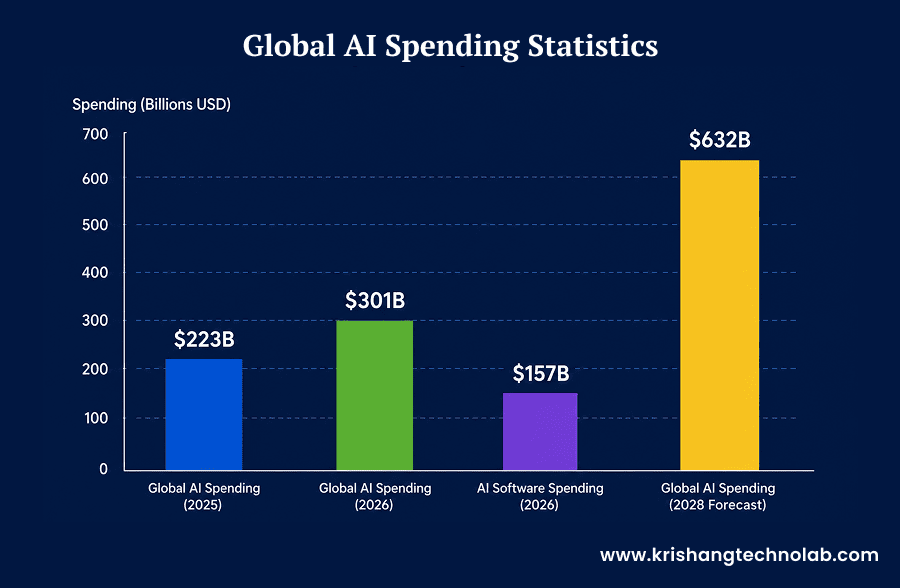
- IDC: AI spend to hit $301B in 2026 from $223B in 2025
- That includes $157 billion of spending in 2026 on AI software
- Global AI spending is expected to hit $632 billion by 2028.
- Corporations spent $581.7 billion on artificial intelligence in 2025, a 130% increase over the previous year.
- Private AI investments hit $344.7 billion
- U.S. private AI investment was $285.9 billion versus China’s $12.4 billion.
What CEOs Need To Know The rapid pace of global AI investment demonstrates that organizations worldwide see it as a strategic priority. If you delay investment, you’ll find yourself up against companies that have better AI, better operations, and shorter innovation cycles. Not every AI investment will pay off. But markets are changing fast, and to stay competitive, long-term commitment to AI development is more important than ever and best done with the right AI development partner rather than a series of internal experiments.
6. AI Creates a Massive Productivity Gap
One of the top business trends in 2026 is the “AI productivity gap”. The employees who successfully use AI outperform those that do not by a wide margin.
Key Productivity AI Statistics
- AI superusers are 5x more productive than slow adopters.
- Super-users save about 9 hours per week, roughly 4.5 times more than laggards.
- AI super-users are 3 times more likely to receive raises and promotions.
- 92% of executives are actively cultivating an AI-elite workforce.
- 60% of organisations plan workforce reductions among employees who fail to adapt
- 77% of executives say AI refusers won’t be considered for promotion opportunities
What This Means for CEOs AI is creating a growing productivity gap across organisations. Employees who can leverage AI effectively are completing work more quickly, delivering improved results and advancing their careers faster. CEOs should see training in AI as a strategic investment and ensure employees have the tools and education they need to thrive. Creating an AI-ready workforce will be critical to harnessing the productivity benefits and maintaining organisational performance, a theme we explore more in our AI in Healthcare guide, which considers how one highly regulated, talent-starved industry is closing this very same gap.
7. Governance and Security Risks Are Increasing
As organizations race to adopt AI, security and governance are moving to the top of executives’ priority lists. The use of AI without regulation is full of risks from data leakage to compliance violations.
Key Security AI Statistics
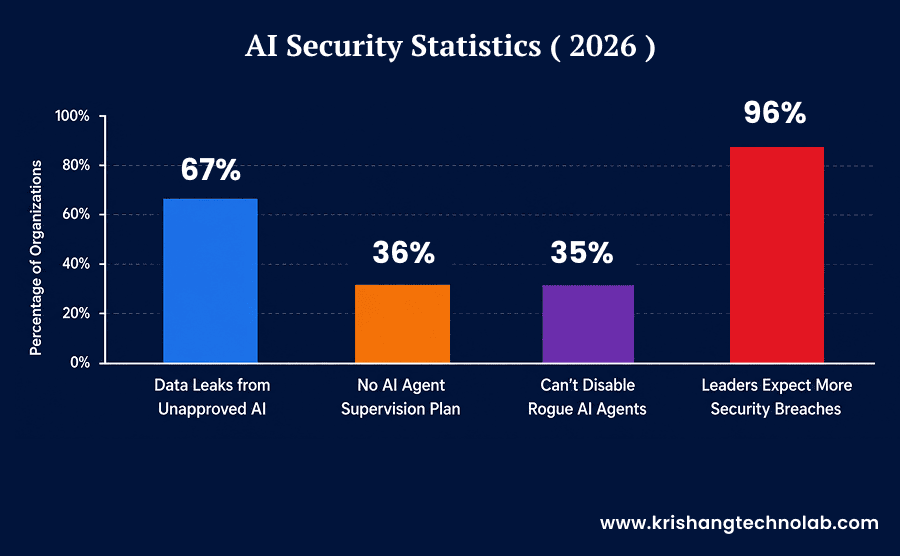
- 67% of executives say their company has had a data leak or breach caused by unauthorized AI tools
- No formal plans for AI agent oversight exist in 36% of organizations.
- 35% can’t disable a rogue AI agent immediately if needed
- 96% of business leaders believe generative AI increases likelihood of security breaches.
The Implications for CEOs With the growth of AI adoption, governance and security risks are becoming top business concerns. Data leaks, ill-managed AI systems, and unauthorized AI use can cause organizations financial, legal, and reputational harm. CEOs must set clear AI policies, establish oversight, and ensure security teams are involved in AI deployment decisions from the earliest stages of custom software development, rather than being added later. Effective governance will be a key factor for the long-term success of AI.
8. The AI Skills Gap Remains the Biggest Obstacle
Technology is moving too fast for the workforce’s skills. That means many organizations find it hard to attract employees who have the skills to successfully deploy and manage AI.
Key Skills AI Statistics
- The number one barrier to AI integration is the deficit of a skilled workforce.
- Skills shortages could cost the world economy as much as $5.5 trillion by 2026.
- Only 13% of workers have reached a threshold of agentic AI skills.
- 82% of organizations have AI training programs.
- 59% of organizations still report significant AI skills gaps despite training efforts
What it means for chief executives The AI skills gap is still an issue and is one of the biggest barriers to successful implementation. Among those organizations that do provide training, many don’t have the expertise to effectively implement and administer AI. Instead of just internal upskilling, many CEOs are closing this gap faster, opting to go the route of hiring AI developers or hiring prompt engineers straight away. To get the most value from AI investments, organizations will need to close the skills gap by hiring, training, or a combination of the two.
9. AI Adoption Varies Dramatically by Industry
Different sectors are at different speeds. Differing levels of AI adoption are being driven by regulation, infrastructure needs and business use cases.
Key Industry AI Statistics
- 41% of financial services & insurance organizations operate AI agents in production
- 63% of doctors say they have used AI tools in healthcare.
- Regulatory and infrastructure constraints continue to lag government agencies and manufacturers behind many industries.
- The manufacturing, logistics, and defence industries are the leading adopters of robotics and autonomous systems.
Implications for CEOs There isn’t one formula for success as AI adoption varies widely by industry. CEOs should benchmark their AI progress against direct competitors, and focus on use cases that align with industry-specific challenges and opportunities, be that a fintech platform handling sensitive transactions, or a healthcare provider managing patient data. Leaders can see how their peers are using AI to find ways to make their organizations more efficient, improve customer experiences or create new revenue streams.
10. CEOs Are Taking Direct Ownership of AI Strategy
One of the big changes in 2026 is that AI is now a CEO responsibility. AI strategy is no longer the sole responsibility of CIOs, CTOs or innovation teams.
Key CEO Leadership AI Statistics
- 72% of CEOs say they are the main decision maker for AI strategy, about double the previous year
- Globally, 90% of CEOs expect to increase their AI investments in 2026.
- 94% to continue investing in AI despite unclear near-term ROI
- 50% of CEOs say their job security is directly linked to AI success
- 73% report feeling stressed or anxious about AI strategy decisions
- 64% are concerned about losing their job if their org’s AI transformation fails
What This Means for CEOs AI is a CEO-level responsibility, not a tech department initiative. Investors, boards, employees and customers are increasingly demanding that leadership teams have a clear AI strategy and vision for the future. CEOs need to walk the tightrope of balancing innovation, managing risk and making sure that AI investments are aligned with long-term business objectives, which is why more leadership teams are bringing in dedicated AI consulting support instead of relying solely on internal teams stretched across competing priorities.
Final Thoughts
Two competing realities define the AI landscape in 2026. Adoption is speeding up, investment is surging, and productivity gains are undeniable on the one hand. But the majority of organizations continue to wrestle with ROI, failed pilots, governance, and talent shortages.
The statistics show a clear pattern: in the AI age, the winners won’t necessarily be the companies that spend the most money on AI. They will be the companies that can scale AI, build workforce capabilities, establish strong governance, and link AI initiatives to measurable business outcomes successfully.
For CEOs, the question is no longer whether AI matters. The question is whether your organization can turn AI investment into sustainable competitive advantage before your competitors do. If you’re evaluating where to start, our team can request a free quote and walk through which AI use cases are most likely to deliver measurable value for your specific business.
Source: MIT Sloan Management Review, Gartner, DataCamp
Found this post helpful? Don't forget to share it with your network!