Quick Overview: Choosing the best AI development company requires evaluating expertise, security, and scalability. This guide helps you hire AI developers, compare AI development services, and find the right custom AI development partner.
Growing businesses can no longer afford to ignore artificial intelligence. Every industry is rushing to adopt AI-powered solutions. But success is not determined by the technology itself. Your choice of an AI partner does. Choosing the Best AI Development Company is essential to building AI solutions that align with your business goals and deliver meaningful results.
Many companies believe that any good coder can build a working AI solution. The reality is that building AI requires deep expertise, ethical judgement and deep domain knowledge. Picking the right AI development company can make or break your project.
There are plenty of vendors in the market who claim to be AI experts. Some are real innovators. Others just throw the “AI” label on generic software services. That makes it important to separate real capability from marketing hype.
This guide walks you through every step of that. Learn how to define your needs, assess vendors and avoid costly errors. No matter if you’re running a startup or an enterprise, this roadmap will guide you to the best Artificial Intelligence Development Company for your goals.
By the end, you’ll know what really differentiates a true AI development partner from a run-of-the-mill vendor. Now, let’s learn how to choose, with confidence and knowledge.
Why Choosing the Right AI Development Company is Critical for Business Success
The stakes of this decision are higher than most businesses realize. Choosing the wrong AI software development services can blow your budget and delay your roadmap. Worse, it can come up with solutions that don’t scale or that break compliance rules.
In contrast, the right AI development partner can speed up growth. Moreover, they bring technical expertise, industry insights, and ongoing Generative AI consulting services that keep your roadmap realistic. Your business gets a competitive edge instead of an expensive experiment.
“Therefore this decision needs to be researched very well before it is signed in haste. The following sections break the process down into manageable steps.”
Understand Your AI Development Needs Before You Search
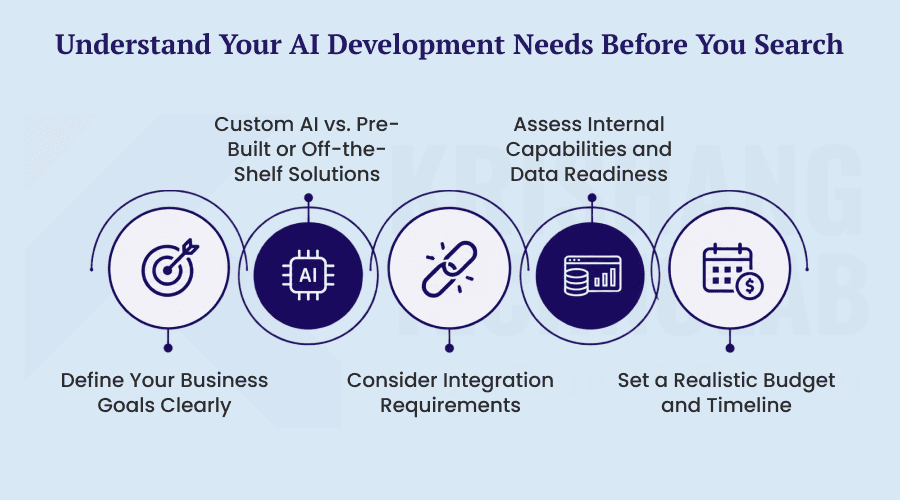
Before contacting any vendor, clarify what you actually need. This single step prevents wasted meetings and mismatched proposals. Whether you’re evaluating a large firm or a specialized AI Development Agency, having this clarity means you can weed out companies that don’t fit much more quickly.
1. Define Your Business Goals Clearly
First, figure out what problem you want the AI to fix for you. Is it for automating customer support, demand prediction or personalised marketing? AI development spans many use cases, and vague goals lead to vague proposals.
Measurable outcomes you anticipate. Shorten support response time by 20%. This clarity will help any ai software development company to scope your project precisely.
2. Custom AI vs. Pre-Built or Off-the-Shelf Solutions
Then you need to decide whether you need custom AI development or an existing solution. Off-the-shelf tools are quicker and cheaper to deploy. But they seldom fit your exact business processes.Custom solutions are more costly up front, but they deliver a far better fit long term.
A trusted Generative AI Development Services will guide you honestly toward the right option for your business. If you’d rather test the waters before committing to a full build, starting with AI MVP development is often the smarter first move — it validates the concept on a smaller budget before you scale into something more custom. They should never try to sell you a custom build when something simpler would meet your needs.
3. Consider Integration Requirements
Your new AI solution must be compatible with your existing systems. Think about your CRM, ERP, or internal databases early on in the process. Otherwise integration problems can derail your project after it launches.
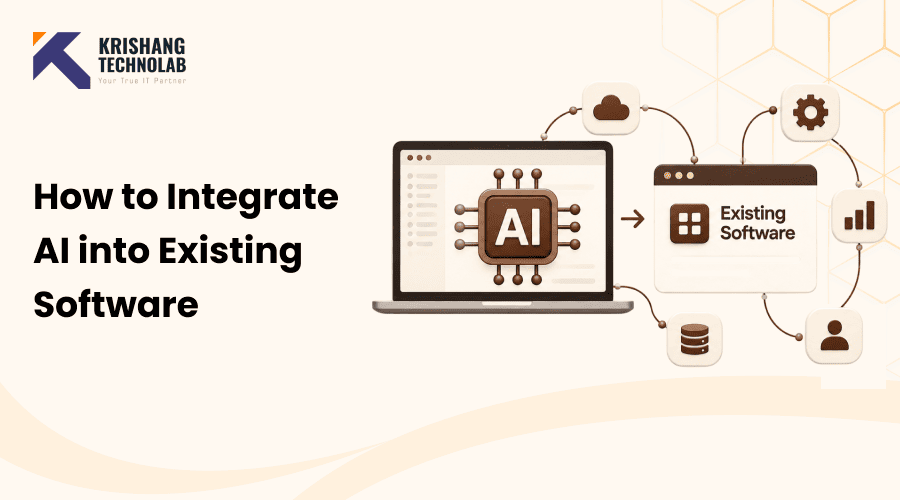
Ask potential partners how they work with legacy software; providers offering dedicated ChatGPT development services typically have proven integration frameworks already in place. As a result, the uncertainty around both risk and timeline is reduced.
4. Assess Internal Capabilities and Data Readiness
Data quality is very important for AI models — messy or incomplete data will hold back even the best-built solution. So, take stock of whether your business has clean, structured, and sufficient data before you start. If it’s not there yet, that’s not a dealbreaker; it just means a data science consulting engagement should come first, so your data is actually ready to train on by the time development begins.
Also consider your internal team’s technical capacity. Some businesses need a fully managed partner. Others only need targeted support alongside an in-house team.
5. Set a Realistic Budget and Timeline
Finally, set a realistic budget range before you begin to evaluate vendors. The cost of developing AI varies with complexity and scale. So a budget allows you to compare apples to apples.
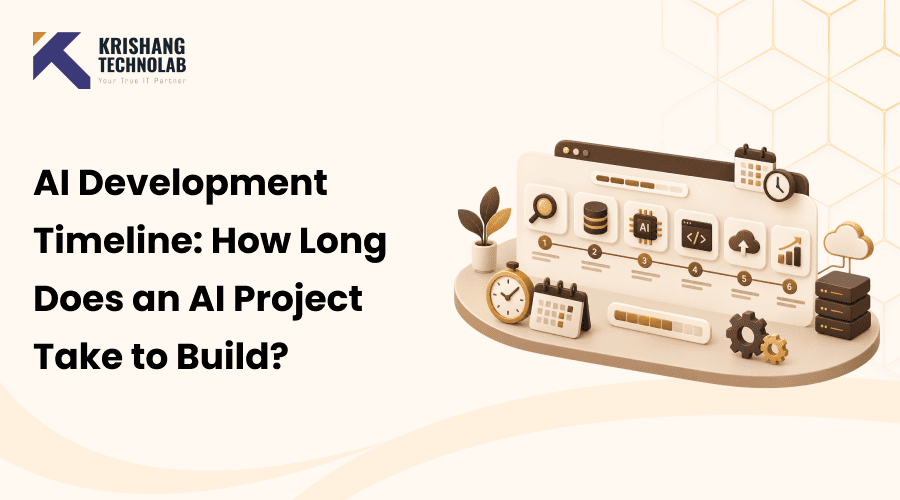
Set a timeline too, but be flexible. AI projects that are rushed tend to skip important testing stages. A reasonable time frame preserves quality and your investment.
Key Qualities to Look for in an AI Development Company
Not all vendors deliver the results. A good partner is a mix of proven technical knowledge, industry experience, straightforward communication, and a strong approach to data security. Look past the flash and the hype of their sales pitch and dig deeper into case studies, scalability planning and ethical AI standards to find a real partner for long-term development.
1. Relevant Industry and Technical Expertise
Industry experience is very important in AI projects. A company with knowledge of healthcare workflows will build better healthcare AI. Fintech experience also builds more compliant financial solutions.
Request examples of work relevant to your industry — browsing a company’s portfolio of past work is often the fastest way to see how quickly a team understands challenges like yours.
2. Technical Mastery in ML, NLP, Computer Vision, and Cloud AI
Beyond industry knowledge, technical depth is non-negotiable. Look for proven machine learning development expertise alongside natural language processing and computer vision. Additionally, cloud AI infrastructure skills matter for scalable deployment.
Use your evaluation calls to ask specific technical questions, and don’t hesitate to Hire Artificial Intelligence Developers directly if you want to vet individual skill sets rather than an entire agency. The best experts explain things clearly, without excessive jargon. That transparency really shows you know your stuff.
3. Proven Results Through Case Studies with Measurable Impact
Case studies illustrate how a company performs in real situations. Ask for examples with real business value, not just technical descriptions — outcomes like revenue growth or cost savings tell you far more than a list of technologies used. If you’re a founder, it’s also worth understanding what AI development for startups typically looks like, so you know what “real impact” should look like at your stage.
A reputable AI development company will be happy to provide references. If a vendor doesn’t get specific, that’s a red flag.
4. Data Security and Compliance Standards
Artificial intelligence systems often work with sensitive data about businesses and customers. Thus, data security should be the highest evaluation criterion. Ask about how the company secures data when developing and deploying.
Compliance regimes such as HIPAA and GDPR are essential. If your business is in regulated industries, specifically ask to confirm experience in compliance. It protects against legal and reputational risk.
5. Integration Capabilities with Existing Systems
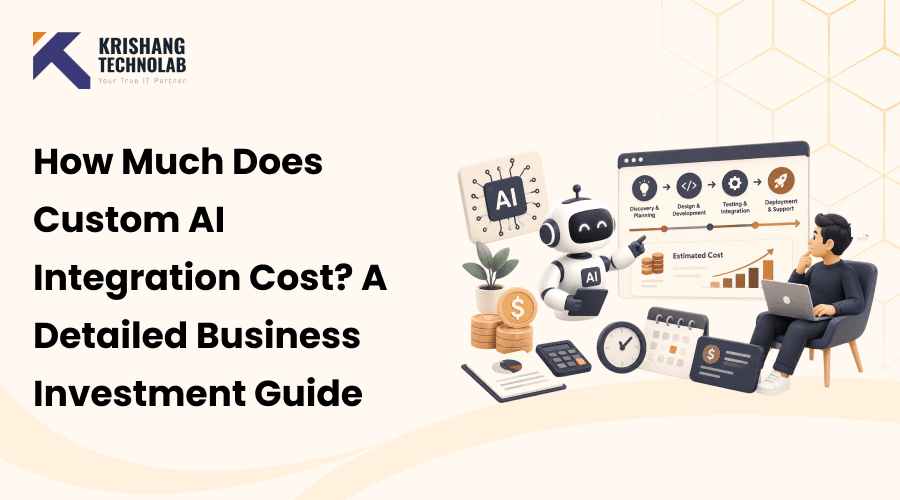
As mentioned earlier, integration determines real-world usability. When evaluating a vendor, ask how they handle compatibility with your existing systems — and if budget is a concern, this breakdown of custom AI integration cost is worth a read before you get quotes. Beyond cost, look for good signs like solid technical documentation and a clear grasp of API work.
Ask also about procedures to test integration stability. Reliable AI development companies test integrations well before launch.
6. Scalability and Future-Readiness
Your AI solution must scale with your business. So, scalability planning has to start from day one. This guide to building the right AI tech stack for startups is a helpful reference for architecture decisions that hold up as demand grows.
“Being ready for the future means also being ready for new AI advancements.” The best AI development company builds systems meant to be improved over time, not just for launch day.
7. Transparent, Consistent Communication
“While technical skill is important, the quality of communication often is a better predictor of the success of a project than technical skill alone.” Look for partners that provide frequent updates and candid feedback. Good communication cuts down on confusion and helps keep things moving.
Notice how quickly they respond and how well they listen in the first conversations. Such behavior tends to last for the duration of the engagement.
8. Ethical AI Practices
Ethics in AI development is becoming more and more important. Ask how the company deals with bias, fairness and transparency in its models. Responsible AI building takes care of your brand image in the long term.
An ethical company will document its testing procedures. It’s about accountability not technical delivery.
9. A Multidisciplinary Team
Finally, strong AI projects need a variety of expertise — data scientists, engineers, UX designers, and industry consultants. It’s also worth asking whether you can hire prompt engineers, since getting the most out of large language models has become its own skill. Together, this combination produces solutions that are both technically sound and genuinely usable.
A multidisciplinary team also responds better to unexpected challenges. This can provide your project with more perspectives on problem solving.
How to Evaluate and Compare AI Development Companies
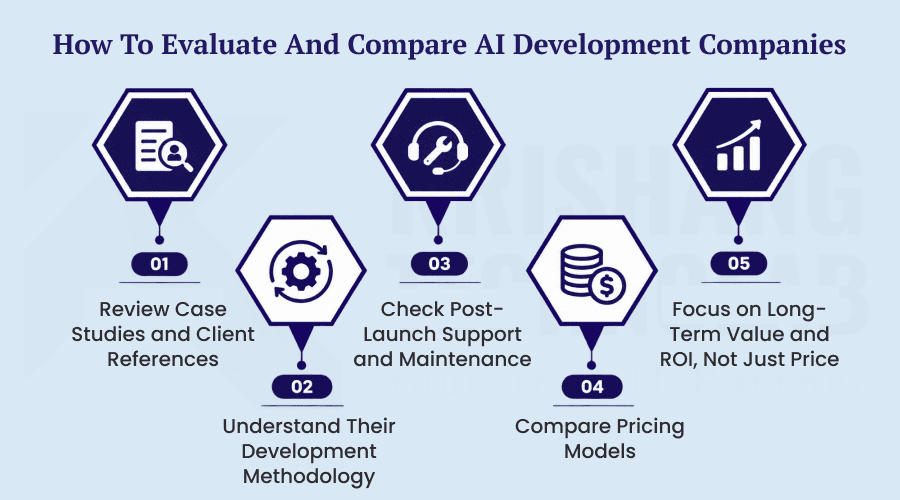
Vendor shortlisting is only half the job. To properly compare them you should check client references, development methodology and pricing models side by side. Select a partner that fits your project scope and goals and balances the initial investment with support after launch and the long-term return on investment. Whether you’re comparing agencies or a full-scale AI Solutions Company, the same evaluation criteria apply.
1. Review Case Studies and Client References
Always ask for case studies related to your goals. Then, ask for real client references whenever possible. Often in a direct conversation you learn things that a shiny portfolio doesn’t teach you.
Ask references about communication, timelines and support after launch. These details are as important as the technical outcomes.
2. Understand Their Development Methodology
The methodology of development will make your project go smoother. Ask if the company has Agile or Scrum or DevOps practices. Often these frameworks offer flexibility and iterative feedback.
A systematic approach also improves the transparency of AI development process. Always be aware of where your project stands.
3. Check Post-Launch Support and Maintenance
Many projects don’t fail in development, they fail after launch. So, ask them detailed questions about the ongoing support and maintenance. Data changes with time, and therefore AI models need to be monitored and re-trained.
Please confirm what support packages are included and what other charges are for the support packages. This will allow you to avoid any unpleasant surprises later.
4. Compare Pricing Models
AI development companies use different pricing models. Common models are fixed price, time and materials and retainer agreements. Each choice is appropriate for different types of projects and different levels of risk tolerance.
Flat-rate pricing is good for well-defined projects. Time and materials is appropriate for work that is evolving or exploratory. Compare these models to your project’s level of confidence.
5. Focus on Long-Term Value and ROI, Not Just Price
Find a few good prices. Instead, measure long term value and expected return on investment. A cheaper vendor can end up costing you more if the solution doesn’t scale.
Estimate potential ROI from efficiencies, revenue growth, or cost savings. “That leads to smarter, more sustainable decisions.”
Common Mistakes to Avoid When Choosing an AI Development Company
Even experienced companies make mistakes when choosing vendors that they could have avoided. You can save yourself a lot of time and money if you can see these traps coming.
The biggest mistake people make is to go purely by price. The low prices are often a sign of limited expertise, or hidden fees. Likewise, overlooking data security during the evaluation creates a serious long-term risk.
Another frequent error is to ignore scalability checks. Businesses often only want solutions built for the needs of today. And so as their business grows they are faced with costly rebuilds.
Many projects also are derailed by poor communication fit. If a vendor doesn’t respond early on, expect the same later. Finally, failing to think about plans for post-launch support leaves businesses stranded when problems arise.
Why a Long-Term AI Development Partner Beats a Short-Term Vendor
Most businesses want to begin by selecting one project vendor. But having a long-term AI development partner pays off in the long run. They know your business context like no one else, having worked with it again and again.
| Factor | Short-Term Vendor | Long-Term AI Development Partner |
| Business Understanding | Limited, project-specific | Deep and evolving |
| Support After Launch | Often minimal | Ongoing and proactive |
| Cost Efficiency Over Time | Higher due to repeated onboarding | Lower through continuity |
| Innovation Alignment | Reactive | Strategic and forward-looking |
As the table shows, long term partnerships are often more effective than one off engagements. Businesses get consistency, trust and accumulated technical knowledge. This is why many enterprises now put partnership potential front and center when choosing vendors.
Steps to Follow to Develop and Deploy Your AI Solution
Understanding the development process helps you evaluate proposals more accurately. Most reputable AI development companies follow a similar structured approach.
First, your team works with your stakeholders to define the problem well. They then collect and process the data needed for training. Data quality impacts model performance.
After that, developers choose the right frameworks and tools for the solution. Model training follows — and for teams exploring more autonomous systems, this primer on what AI agent development actually involves is a useful next read. This usually goes through several iterations and testing cycles. Once results meet performance benchmarks, deployment begins in a controlled environment.
Finally, ongoing monitoring helps ensure the model continues to perform well over time. Business conditions change all the time. So you have to make adjustments. The last step weeds out vendors who fall off post-launch and finds reliable partners.
Final Thoughts
Choosing the best AI development company is a decision that shapes the future of your business. The right partner has the technical expertise and a real understanding of what you are trying to achieve. A bad choice can waste resources and delay meaningful progress, though.
This guide will take you through important steps to help you make this decision with confidence. “You need to define your business goals and technical specification, first.” Then you need to vet potential partners on their expertise, security, scalability and communication.
Always remember that price should never be your only consideration. Look for long term value, proven results and the ability to offer ongoing support. A good AI development partner is going to feel more like a strategic partner, not a vendor.
AI is transforming industries and your choice of development partner is more crucial than ever. Do your homework and ask a lot of questions. This careful approach will ultimately allow your business to unlock the full capabilities of AI.
Whether you need custom AI development or specialised technical expertise, there’s a company for you. Use this guide as your road map to that confident, educated decision.
Frequently Asked Questions
How do I choose the best AI development partner for my business?
Evaluate AI development services on technical depth, industry background, communication style, and delivery process. Check certifications, review completed projects, and read client references. Test compatibility with a small pilot project before signing a larger contract.
What should I look for in an AI software development company?
Prioritize AI software development providers with demonstrated experience, transparent pricing, robust data security, and a collaborative culture. Look for scalable architecture, ethical standards, and post-launch support built into the engagement model, not an afterthought.
How much does it cost to hire an AI development agency?
AI development pricing depends on project scope, complexity, data needs, and team size, ranging from a few thousand dollars to six-figure enterprise budgets. Request itemized proposals to compare vendors fairly and avoid hidden fees.
What questions should I ask a generative AI development company before hiring?
Ask generative AI vendors about prior projects, team composition, data handling, and turnaround times. Cover testing procedures, integration experience, and post-launch maintenance plans. Clear answers reveal how organized and transparent the partnership truly is.
How do I evaluate an AI solutions company’s portfolio?
Assess an AI solutions provider’s portfolio for industry relevance, measurable outcomes, and technical diversity. Read testimonials for specifics, not generic praise. A strong portfolio shows consistent quality across many projects, not just polished showcase pieces.
How do I know if a machine learning development company is experienced?
Verify AI talent through years in business, customer retention, and relevant certifications. Ask them to explain complex concepts simply — true experts avoid excess jargon. Confidence discussing past challenges and lessons learned signals genuine expertise.
Should I hire an AI app development company or build an in-house team?
AI outsourcing suits tight budgets, short timelines, or one-off projects. In-house teams fit businesses needing long-term iteration, oversight, and institutional knowledge. Many companies blend both, building capacity while bringing in outside specialists for niche skills.
What are the red flags when choosing a custom AI development company?
Watch for vague proposals, reluctance to share references, and unclear pricing when selecting an AI provider. Poor early communication, no defined testing process, and missing post-launch support are major red flags that worsen after signing.
Found this post helpful? Don't forget to share it with your network!