

Quick Overview: Knowing how to manage dedicated development team growth is key to scaling without losing quality or communication. This guide covers when to scale, how to structure larger teams, and best practices to manage dedicated development team performance as your project grows.
Growing a software product is exciting. It’s harder to grow the team behind it. As a software development agency, we regularly work with founders and CTOs who reach a point where their in-house developers are stretched thin, deadlines slip, and new features pile up in the backlog. This is usually the moment companies start to explore how to manage dedicated development team instead of hiring every role in-house.
Having a dedicated development team means full-time developers working only on your project, without the cost and delay of traditional hiring. If done correctly, this model enables you to scale quickly, control quality and keep your roadmap on track. Poorly done, it leads to miscommunication, missed deadlines and wasted budget.
This blog takes you step-by-step through how to manage dedicated development team, from understanding the model to hiring the right people to running day-to-day operations that actually work.
What Is a Dedicated Development Team?
A dedicated development team is a team of full-time developers hired from a software development agency or IT outsourcing company and working on a single client’s project. They’re an extension of your in-house team, working to your processes and goals, while the agency looks after their recruitment, payroll and HR. Many companies that hire dedicated developers find that this setup relieves them of the administrative burden of having to build a tech department from scratch.
This is not freelancing or outsourcing one-off projects. When companies hire dedicated developers, they get long-term commitment, consistent output and engineers develop an in-depth knowledge of the product. This is why more businesses now choose to manage dedicated development team rather than build every function internally.
Dedicated Team vs. In-House Team
| Factor | Dedicated Development Team | In-House Team |
| Hiring Time | Days to a couple of weeks | Weeks to several months |
| Setup Cost | Bundled into monthly rate | Salary, benefits, equipment, office space |
| Talent Pool | Global, agency-vetted | Limited to local market |
| Flexibility | Scale up or down easily | Harder to adjust quickly |
| Management | Shared with the outsourcing partner | Fully on the company |
Building an in-house team can take a long time. Posting a job, interviewing and onboarding a single developer can take weeks or even months. A dedicated development team, on the other hand, can often start within days, since the partner agency has already screened its talent pool.
Dedicated Team vs. Staff Augmentation vs. Project Outsourcing
| Model | What It Means | Best Fit | Control Level |
| Dedicated Team | Full-time developers working only on your project, long-term | Ongoing, evolving products | High |
| Staff Augmentation | Adding specific skills to your existing in-house team, usually short-term | Filling a temporary skill gap | Medium |
| Project Outsourcing | Handing off an entire project to an agency and reviewing the final result | Well-defined, one-off projects | Low |
If control and flexibility are your primary concerns, then learning how to manage dedicated development team is usually a better long-term investment than staff augmentation or fixed-price outsourcing.
Also Read About: How Should You Choose Between a Dedicated Development Team and Outsourcing for Your Project?
Why Companies Scale With Dedicated Developers
This hiring model is not just a trend that is being demanded, but it is supported by real numbers. According to Verified Market Research, the global IT staff augmentation market was valued at almost $300 billion a few years ago and is expected to exceed $850 billion by the early 2030s, with a compound annual growth rate of over 13%. This growth is indicative of the number of companies moving away from slow, traditional hiring.
Another data point worth noting is that industry research shows nearly three out of four enterprises today utilize staff augmentation or dedicated hiring models to solve talent shortages, and the average time to fill a specialized technical role via traditional hiring can extend beyond 80 days. For companies that need to deliver features fast, that lag is simply too expensive. And this is precisely the reason why so many founders decide to hire dedicated developers, rather than waiting months to fill just one single role, whether it’s a full stack developer or a specialist in a narrower stack.

Faster Hiring and Onboarding
Companies can avoid the slowest stages of recruitment, sourcing, screening and technical testing by using a proven partner to hire dedicated developers. Most agencies can onboard a ready team within one to two weeks, which is a fraction of the time it takes to fill a role through a standard job posting.
Cost-Effective Scaling
An in-house hire includes the cost of salary, benefits, equipment, office space, and training. Typically, all of this is rolled up into a dedicated developer hourly or monthly rate, which makes budgeting much easier for growing companies that work with a software development outsourcing partner.
Access to Global Tech Talent
Local hiring restricts a company to the talent available in one city or country. Choosing to hire remote developers opens access to a much larger, often more affordable, pool of experienced engineers across regions, including teams that specifically hire dedicated developers in India or spread across other established outsourcing hubs.
Flexibility to Scale Up or Down
Product needs change quickly. A dedicated team model allows a business to add developers during high-demand phases and scale back once a feature ships, without the legal and financial complexity of layoffs. Some companies combine this with an offshore development center to keep costs predictable, while headcount flexes with demand.
How to Manage Dedicated Development Team Effectively
This is where many companies struggle to achieve the desired results. The easy bit is hiring the team. What really matters for the success of the partnership is knowing how to properly manage dedicated development team. This is how it appears when applied in a real-world scenario.
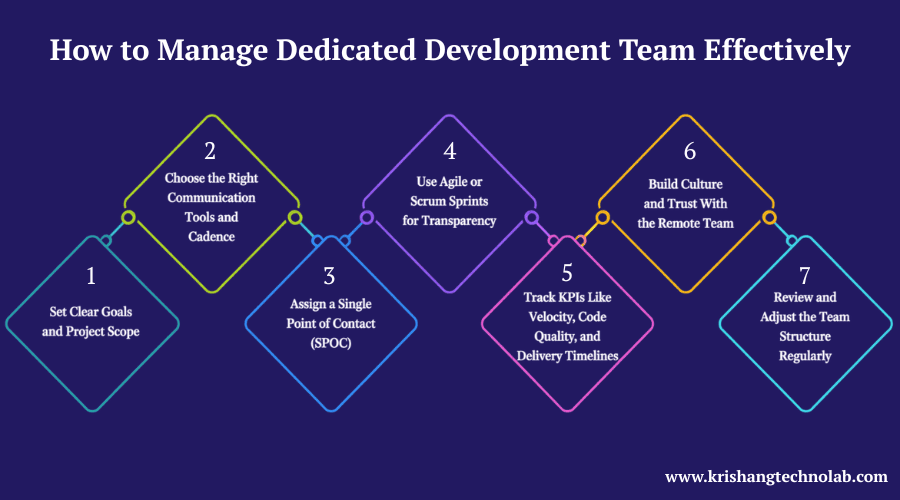
Set Clear Goals and Project Scope
Document what success looks like, features, deadlines, and priorities before the team begins. Remote teams underperform because of vague goals. Write down the concrete outcomes you expect from each sprint, not just an overall product vision, and share these with the team before the start of day one. A written scope also provides both sides a point of reference as priorities shift mid-project, and this happens more often than most teams anticipate.
Choose the Right Communication Tools and Cadence
Daily standups, weekly syncs and async updates ensure everyone stays aligned, even when working across different time zones. Select two or three essential tools rather than spreading discussions over five different apps; this simple step avoids the majority of miscommunication. Pick a time for daily check-ins that’s regular and when your team can also make it. Use written updates for things that don’t need to be discussed in real-time, so that the context of the conversation is always there when you need it in between meetings.
Assign a Single Point of Contact (SPOC)
One person on each side should be designated as the communicator. This avoids confusion from conflicting instructions and scattered messages. When developers are given instructions from many stakeholders at the same time, it is hard to know what is a priority and deadlines are missed. A single point of contact filters requests, resolves conflicts before they reach the team, and gives leadership one reliable source of truth on progress, blockers, and what is actually being built each week.
Use Agile or Scrum Sprints for Transparency
With two-week sprints and well-defined deliverables, it’s simple to monitor progress and realign priorities without throwing off the entire roadmap. Each sprint should end with a demo or review so stakeholders are able to see working progress, not just status updates. It also helps catch scope creep early, because any new request has to wait for the next sprint planning session, rather than derailing the current work.
Track KPIs Like Velocity, Code Quality, and Delivery Timelines
The numbers don’t lie. By routinely reporting sprint velocity and bug rates, you can see whether the team is performing, not just whether they’re busy. Track the number of story points you finish in each sprint, how often your code passes review on the first try and how close your actual delivery dates are to your initial estimates. These metrics convert vague impressions like “the team seems fine” into data-driven decisions.
Build Culture and Trust With the Remote Team
Involve dedicated developers in product conversations, not merely in task listings. Teams that feel connected to the company produce better, more thoughtful work. Involve them in planning calls, explain the rationale behind roadmap choices and celebrate achievements together beyond just within the organization. Developers who grasp the broader context produce superior code, and identify issues sooner, as they are constructing with a specific aim in mind rather than merely resolving tasks.
Also Read About: How to manage a remote dedicated development team efficiently?
Review and Adjust the Team Structure Regularly
As the product expands, the team composition should also expand. Review roles, and headcount each quarter. A team assembled for an MVP won’t meet the demands of a product that’s scaling six months later, so consider team structure a continuous decision rather than a one-off setup. Regular reviews also uncover skill gaps early on, preventing them from becoming missed deadlines or last-minute rushed hiring decisions.
Companies that use these practices to manage dedicated development team experience fewer delays, higher code quality and generally a much smoother scaling process.
How to Hire a Dedicated Development Team
Once the basics of how to manage dedicated development team are clear, the next step is finding the right partner to build one with.
Define Your Tech Stack and Roles Needed
Before reaching out to any agency, list the exact skills needed: frontend, backend, mobile, DevOps, QA and the seniority level required for each role. At this stage many businesses are looking to hire software developers across several disciplines at once rather than filling one role at a time.
Evaluate Software Development Agencies
Search for an IT outsourcing company or software development agency with a proven portfolio, verified client reviews and experience in relevant services. A partner who has previously addressed issues similar to yours will help you avoid wasting time and effort on rework in the future.
Interview and Vet Developers
It is worth interviewing the candidates directly to confirm technical skill and communication fit before the team joins the project, even if the agency has already screened them.
Also Read About: How to hire a dedicated development team?
Sign the Contract and Onboard
Once a company settles on hiring dedicated developers, a structured onboarding plan and access to tools, documentation, and a clear first sprint set the tone for how smoothly the whole engagement will go. Some partners also support this process through a global capability center model for larger, longer-term assignments.
Common Challenges When Managing a Dedicated Team (and How to Solve Them)
Even a well-structured dedicated development team will have some friction along the way. Most of these issues are recurring, and each one can be easily resolved when identified early.
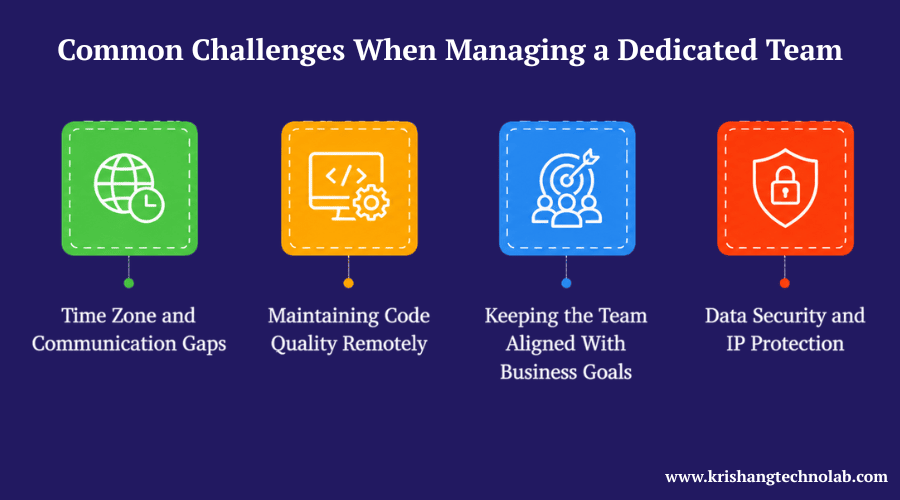
Time Zone and Communication Gaps
Even overlap two to three working hours a day for live discussions, and then rely on written documentation for everything else.
Maintaining Code Quality Remotely
Automate code reviews, CI/CD pipelines, and coding standards from day 1 to ensure quality is not left entirely to manual checks.
Keeping the Team Aligned With Business Goals
Share the business context along with the work details. Teams that understand why a feature is important build it better.
Data Security and IP Protection
Ensure that an NDA and a clear IP ownership agreement are in place before the team begins, and implement controls on access to reduce exposure to sensitive systems.
Tools to Manage Dedicated Development Team
The right remote team management tools make the difference between chaos and a smooth workflow:
- Project management: Jira, Asana, or ClickUp to track sprints and tasks.
- Communication: Slack or Microsoft Teams for daily updates, Zoom for face-to-face syncs.
- Code collaboration: GitHub or GitLab for version control and code review.
- Time and productivity tracking: Simple time-tracking tools to keep budgets and hours transparent.
Choosing the Right Partner to Scale Your Team
Not every agency delivers the same experience. If you are considering a partner to hire a dedicated development team, it is helpful to look at their flexibility of engagement, the industries they have worked in and their transparency about the hiring and vetting process. Reviewing a partner’s past projects is often a faster way to judge fit than a sales call alone.
Krishang Technolab works with scaling businesses seeking dedicated developers without the burden of traditional recruiting, from full-stack to mobile app developers, matched to the roadmap instead of a generic job description. For companies looking to scale a development team this year, either locally or with options to hire dedicated developers in the US, it’s easier to manage a dedicated development team when the engagement model is built around how they already work rather than a rigid template. Krishang Technolab organizes these engagements for that flexibility.
Conclusion
Scaling a product does not mean slowing down delivery or overloading an in-house team. Businesses can have a dedicated development team that acts like an extension of their own without the time and cost of traditional hiring, with clear goals, the right communication cadence, and consistent KPI tracking. For companies ready to take the next step, this is a good place to build out a dedicated development team matched to the exact tech stack and roadmap a project needs.
Frequently Asked Questions
What does it mean to manage dedicated development team?
It means overseeing a group of full-time, outsourced developers who work only on your project; setting goals, running sprints, tracking KPIs and keeping communication clear across time zones.
How much does it cost to hire a dedicated development team?
Cost depends on developer seniority, location and tech stack. Most agencies charge a monthly rate per developer for salary, benefits and management, which is normally less than the total cost of a comparable in-house hire.
What is the difference between a dedicated team and staff augmentation?
In the long run, a dedicated team works only on your project, whereas staff augmentation brings particular skills to your existing team for a shorter time, usually to cover an immediate gap.
How do you communicate effectively with a remote dedicated team?
Mix daily standups, weekly syncs and async tools with one point of contact on each side to avoid mixed messages.
How long does it take to onboard a dedicated development team?
Most agencies can onboard a ready team within one to two weeks, compared to months for traditional in-house hiring.
Is hiring a dedicated development team cheaper than in-house hiring?
Yes, most of the time. Companies save on recruiting, benefits, equipment and office space and they get full-time committed developers.
How can a software development agency help scale a team faster?
An experienced software development agency has a pre-vetted talent pool, so companies can skip the slowest parts of hiring and get started building with a dedicated development team in days rather than months. Krishang Technolab works on this very model across different tech stacks and geographies.
Found this post helpful? Don't forget to share it with your network!