Quick Overview: This guide explains the MVP development process step by step, covering idea validation, market research, feature prioritization using MoSCoW, agile development sprints, usability testing, and post-launch iteration, giving startup founders a clear, actionable roadmap from first idea to successful product launch.
Every product you use today started out as a rough idea on someone’s notepad. Airbnb originated with an air mattress that was installed in a living room. Dropbox launched with a two-minute explained video, and that was it. Buffer was a simple landing page before any code was written for the actual product. What do all three share? They built just enough to learn, validate and grow, going through the MVP development process.
If you have a product idea right now and you are wondering where to start, you are at the right place. In this guide you will learn the entire MVP development process step by step from an idea to your first real users in plain language, without the jargon.
Whether you’re a first-time founder, product manager, or a non-technical entrepreneur, this is the most practical guide you’ll find on how to build a minimum viable product in 2026. If you’re still thinking over what technologies to use to bring your product idea to life, then taking a look at a custom software development approach can help you map your requirements before you commit to a stack.
What Is an MVP (Minimum Viable Product)? A Clear Definition
An MVP (Minimum Viable Product) is the simplest version of your product designed to effectively address a primary issue for a specific group of users while generating meaningful feedback.
The term was popularized by Eric Ries in The Lean Startup (2011) and is still the foundation of modern product development today.
MVP definition in simple terms: An MVP is not just an incomplete product. It is a fully working product with a deliberately limited scope.
An MVP isn’t about building something perfect. The goal is to find out as quickly as possible if your idea solves a real problem before spending months and thousands of dollars on full development.
It’s important to understand the connection between an MVP and custom software development here: custom-built software allows you to tailor the features you need for your early users, without the limitations of off-the-shelf tools that may not match your use case. Teams that bypass this foundation often find themselves rebuilding from scratch and that’s exactly the kind of expensive rework that professional software development outsourcing partners are trained to help you avoid from day one.
Key characteristics of a true MVP:
- Solves one specific problem, not ten
- Works reliably for early adopters
- Collects usable feedback from real users
- Can be built and launched within weeks, not years
Why Building an MVP Is the Smartest Move for Startups in 2026
The data is difficult to refute.
According to a study from McKinsey and the University of Oxford, IT projects that do not have a validation phase are 45% over budget, 7% over schedule and deliver 56% less value than expected.
Meanwhile, CB Insights reports that 35% of startups fail because they have no market need for what they built. That’s why an MVP is built to eliminate this risk by testing demand before you build the full product.
So, here’s why smart founders will be looking at the MVP approach in 2026:
- Reduces financial risk: For weeks, not months, you validate not build something nobody wants.
- Speeds up time-to-market: A lean scope gets you in front of users faster, which means faster feedback loops.
- Attracts early investment: Investors want to see traction and validated learning, not slides. An MVP gives you both.
- Shapes a better product: Real user behavior teaches you more than any brainstorm session. The MVP makes you listen.
- Enables AI-assisted development: To make an MVP that works, a founder will only need a few weeks instead of months by 2026, thanks to AI writing tools and no-code platforms. For an extra speed boost, they can also work with AI developers who know this area inside and out. This cuts the time it takes to build by a lot while still giving them full power over the product roadmap.
MVP vs Prototype vs Proof of Concept: What Is the Difference?
These three terms get confused constantly. Here is a clear breakdown:
| Term | Purpose | Audience | Functional? |
| Proof of Concept (POC) | Test technical feasibility | Internal team | Partially |
| Prototype | Test design and flow | Stakeholders / testers | No (mockup) |
| MVP | Validate market demand | Real users | Yes |
A prototype is a visual mock-up that looks like the product but doesn’t work. A POC is a test to see if a technology can be built. An MVP is a product that works and is released to real users to test out business assumptions.
It’s like this: You draw the house (prototype), check if the foundation works (POC), then build the most basic livable version (MVP).
Read More About: The Complete MVP Development Guide for Startups in 2026
The Complete Step-by-Step MVP Development Process
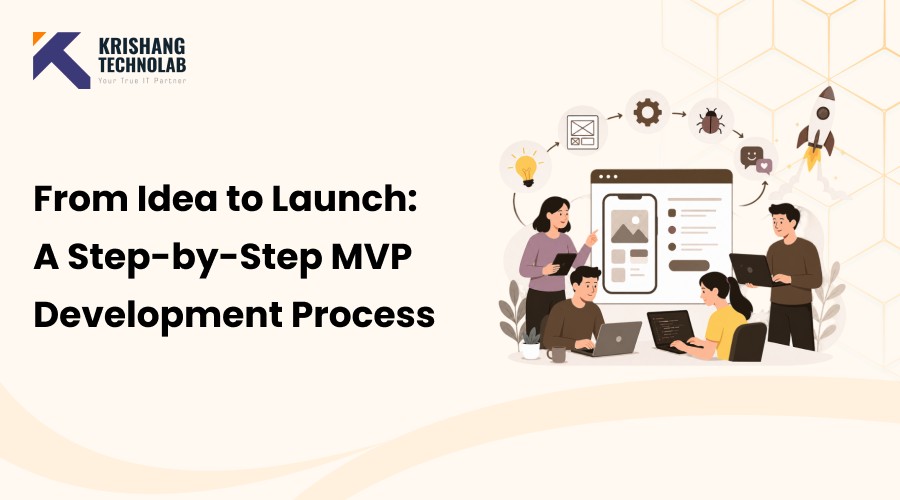
Here’s the complete MVP Development Process that outlines the journey from the initial spark of an idea to delivering a live product to real users.
Step 1: Identify the Problem Worth Solving (Idea Validation)
Before writing a single line of code or designing a single screen, you need to answer one question with ruthless clarity:
“What specific problem am I solving, and for whom?”
Most failed startups do not fail because of bad execution. They fail because they solved a problem nobody actually had or built a solution for people who were not willing to pay for it.
How to validate your idea before building:
- Talk to 20–30 potential users in your target audience (customer discovery interviews).
- Use the Jobs-to-be-Done framework to ask, “What job are people hiring this product to do?”
- Observe existing workarounds: if people are using spreadsheets, WhatsApp, or sticky notes to solve a problem, there is a product opportunity
- Check forums like Reddit, Quora, and G2 reviews for recurring complaints in your target niche
Before finalizing your problem statement, it also helps to look at how UI/UX design decisions shape whether users immediately understand your product’s value. A well-designed first interaction can validate your idea faster than any survey.
Step 2: Conduct Market Research and Competitive Analysis
Understanding your market is not optional. It determines whether your MVP has a fighting chance.
What to research:
- Market size: Is it large enough to build a business? Total addressable market (TAM)
- Competitors: Who else is solving this problem? How do you do? Where do they go wrong?
- User behavior trends: Is this problem getting bigger or smaller?
- Pricing landscape: How much are users currently paying for similar solutions?
Tools to use:
- Google Trends (spot rising vs declining demand)
- SEMrush or Ahrefs (keyword demand signals)
- G2, Capterra, App Store reviews (read what users hate about competitor products)
- Statista, IBISWorld (market size data)
The competitive analysis insight most founders miss: Don’t look at what the competition is doing. See what their users are complaining about. That’s your shot. If your research confirms that search visibility is key to reaching your target audience, launching your MVP with an expert SEO plan from the outset puts you ahead of your competition who treat search as an afterthought.
Step 3: Define Your Target Audience and User Personas
You can’t build your MVP Development Process for “everyone and anyone”. The more specific your target user, the more acute your decisions on the product.
User persona is a semi-fictional profile of your ideal early adopter based on real research.
A strong user persona should encompass:
- Demographics (age, job title, industry)
- Goals and motivations
- Frustrations and pain points
- Current tools/solutions they use
- How they prefer to discover and evaluate new tools
Step 4: Map the User Journey and Core Use Cases
Before you prioritize features, chart the end-to-end journey your user goes through to solve their problem with your product.
A user journey map answers the following questions: What does the user need to do, and in what order, from first landing on your product to achieving their goal?
Example — a simple invoicing MVP user journey:
- User signs up
- User creates a client profile
- User generates an invoice
- User sends invoice via email
- User marks invoice as paid
When designing these flows, bringing in a Figma design specialist early can save weeks of back-and-forth by producing high-fidelity user journey maps that developers can build from directly.
This MVP Development Process safeguards against scope creep, the primary cause of delays and budget overruns in MVPs.
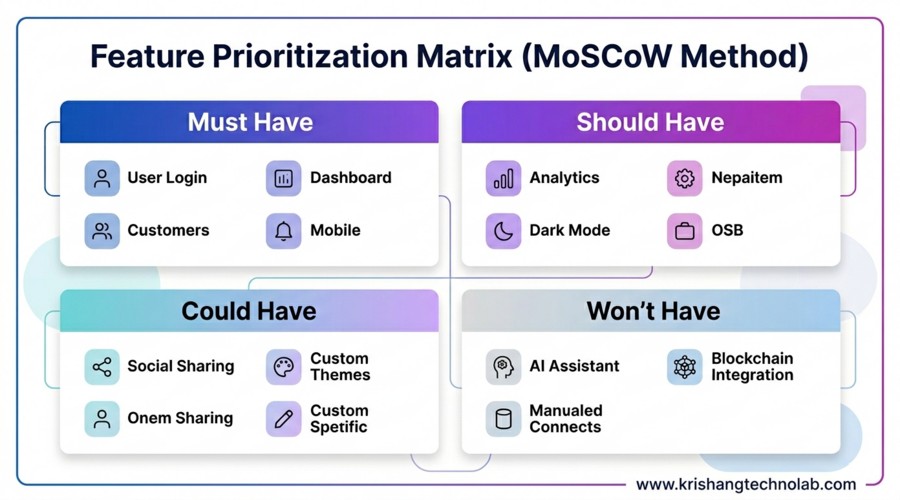
Step 5: Prioritize Features Using the MoSCoW Method
Once you have your user journey, jot down all the features you could build. Then, mercilessly prioritize using the MoSCoW method:
| Priority | Label | Meaning |
| Must Have | Core | MVP cannot function without this |
| Should Have | Important | Valuable but not launch-blocking |
| Could Have | Nice-to-have | Add in v2 if users ask |
| Won’t Have | Out of scope | Not in this iteration |
Rule of thumb: your MVP should only contain the Must Haves. If a feature does not directly serve the core use case you mapped in Step 4, it goes into Should Have or less.
A short feature list is not a flaw, it is a strategy. Every feature you don’t build now is developer time you can spend learning from real users instead. If you’re not sure what features should be on your Must Have list, a structured AI consulting session can help you apply data driven frameworks to prioritize features based on user behavior patterns and not gut feel.
Step 6: Choose the Right Tech Stack or No-Code MVP Tools
Don’t pick your tech stack for technical elegance but for how fast to market.
For non-technical founders, no-code/low-code MVP tools:
- Bubble: Full web app builder with database and logic
- Webflow: Beautiful, functional websites and landing page MVPs
- Glide: Turn a Google Sheet into a mobile app in hours
- Softr: Build web apps from Airtable data
- Make (formerly Integromat): Automate workflows between tools without code.
For technical founders, lean tech stack choices in 2026:
- Frontend: React, Next.js development, or Vue.js; Next.js has become the go-to choice for MVPs that need both fast performance and SEO-friendly server-side rendering out of the box.
- Backend: Node.js, Python/FastAPI, or Supabase (BaaS) pairing a no-code frontend with a Node.js backend gives you the flexibility to grow the product after initial validation without rewriting everything.
- Database: PostgreSQL, Firebase, or Supabase
- Hosting: Vercel, Railway, or Render (fast and affordable)
- Auth: Clerk or Auth0 (do not build auth from scratch)
If you are unsure which stack fits your product category, our guide on how to choose the right tech stack for mobile apps walks through the full decision framework for Android, iOS, React Native, and Flutter and the same logic applies when choosing between web frameworks for your MVP.
Key principle: Use proven technology your team already knows. An MVP Development Process is not the place to experiment with a new language or framework. Optimize for shipping fast.
Step 7: Build a Wireframe or Clickable Prototype
Build low fidelity wireframes of your core screens before you build. This MVP Development Process finds design and flow problems before they are costly code problems.
Tools for wireframing and prototyping:
- Figma: Industry standard for UI/UX prototyping
- Balsamiq: Quick, sketch-style wireframes
- Whimsical: Fast flowcharts and wireframes
- Marvel or InVision: Clickable prototypes without code
A clickable prototype lets you test your user flow with real people before a single line of code is written. Show it to 5–10 members of your target audience and watch them use it. Where they get confused, you redesign for free. If prototyping is not in your skill set, you can hire a UI/UX designer who specializes in conversion-focused wireframes. Getting this right before development starts is one of the highest-ROI investments you can make in the MVP Development Process.
This step alone can save weeks of development time.
Step 8: Develop the MVP Using Agile Methodology
Prototype and lean feature list validation begins development. MVP development is best done in Agile fashion (2-week sprint cycles).
How agile MVP development works:
- Break core must-have features into small, shippable bits.
- Work in 2-week sprints; each sprint delivers working software.
- Review and demo at the end of every sprint.
- Adjust scope and priorities based on what you learn
- For startups that don’t have an internal engineering team, creating an offshore development center is one of the most cost-effective ways to do agile sprints with experienced developers at a fraction of the cost of local hiring.
Development best practices for MVPs:
- Build mobile-first most users will interact on their phone. For products with a strong mobile use case, a dedicated React Native development team can build a single codebase that runs natively on both iOS and Android, cutting your MVP development timeline almost in half.
- Do not over-engineer the backend and use managed services to move faster.
- Write just enough tests to catch critical bugs, not 100% code coverage.
- Use feature flags to deploy code without releasing it; it lets you test with select users.
Realistic MVP Timeline:
- No-code MVP: 2-6 weeks
- Simple web app MVP: (with developer) 6-12 weeks
- Complex mobile app MVP: 10-16 weekseeks
Step 9: Test for Bugs, Usability, and Performance
Before the launch your MVP should pass three layers of testing:
- Functional Testing: Is the core functionality working as expected? Is the sign-up flow functional? Can users complete the primary action successfully?
- Usability Testing: Are real users able to use the product themselves? Have five people from your target audience do a task and watch them do it without any prompting. Find out where the users are stuck and fix that.
- Performance Testing: Does the app load in less than 3 seconds? Does it break under moderate load? Use tools like Lighthouse (Google) to audit performance. Performance issues at the MVP stage often trace back to architectural decisions if your team is stretched thin, website maintenance and QA support can catch and resolve issues before they affect your early adopter experience.
Bug triage rule for MVPs: Please address any bug that obstructs the core use case promptly. Everything else goes on a backlog for post-launch.
Step 10: Launch to Early Adopters and Collect Feedback
Your MVP is ready. Now the real learning begins.
How to get your first 100 users:
- Product Hunt – worldwide community of early adopters seeking new products
- Reddit communities – Find the subreddits where your target user hangs out and add real value
- Hacker News “Show HN” – Tech crowd, good for dev tools and B2B products
- LinkedIn – Professional & B2B Products
- Your own network – The most underrated launch channel
- Cold outreach – Email campaigns to reach out to potential users found during your research phase
Targeted pay-per-click advertising is one of the fastest ways to get your MVP in front of the right users on day one, especially when you have a defined persona and a specific problem you are solving.g.
How to collect actionable feedback post-launch:
- In-app surveys with tools like Typeform or Tally
- User interviews (aim for 3–5 per week in the first month)
- Session recordings with Hotjar or Microsoft Clarity to watch real user behavior
- NPS (Net Promoter Score) surveys after 7–14 days of usage
How to Measure MVP Development Process — Key Metrics to Track
Vanity metrics (sign-ups, page views) feel good but tell you nothing about if your MVP is actually working. Instead, track these:
| Metric | What It Tells You |
| Day 1 / Day 7 Retention | Are users finding immediate value? |
| Activation Rate | Are users completing the core action? |
| Time-to-Value (TTV) | How fast do users experience the “aha moment”? |
| Churn Rate | How many users leave and why? |
| NPS Score | Would users recommend this to others? |
| Customer Acquisition Cost (CAC) | How much does it cost to get one user? |
Choose a North Star Metric, the single metric that best captures whether users are getting value. For a productivity app it could be “tasks completed per week.” And a marketplace, it might be “transactions per month that were successful.”
For B2B MVPs, integrating your product with a CRM right out of the gate makes it so much easier to track user behavior and conversion metrics. HubSpot development is particularly relevant for startups that need a CRM and marketing automation that work in tandem with their product.
The Build-Measure-Learn Loop Explained (Lean Startup Model)
Eric Ries developed the central feedback cycle of the lean startup methodology, the Build-Measure-Learn (BML) loop.
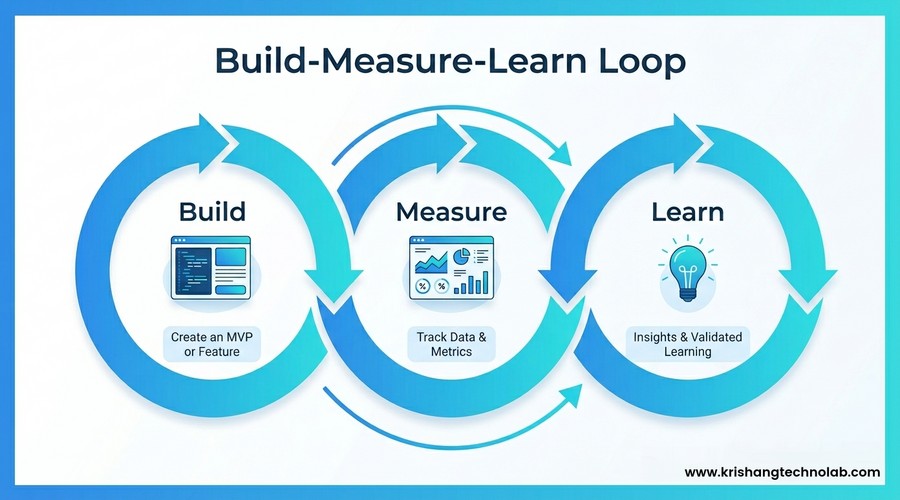
The goal is to finish one full lap as quickly as possible. The faster you loop, the faster you will learn what is and isn’t working.
Most startups that fail take 12–18 months to complete their first loop because they try to perfect the product before going to market. Lean is to launch fast, measure honestly, learn fast, and then improve.
When to Pivot, Iterate, or Scale After MVP Launch
After your first launch cycle, you face three paths:
Iterate
You have strong retention signals; users love the core concept, but specific features need improvement. Keep the same direction; improve the product. This is the most common outcome.
Pivot
Users are not retained. Interviews reveal the core assumption was wrong. Change a fundamental element: the audience, the problem you solve, the business model, or the channel. A pivot is not failure; it is informed redirection. Slack pivoted from a gaming company. Instagram transitioned from being a location check-in app.
Scale
Retention is strong. Users are referring to others organically. Unit economics work. Now is the time to invest in growth, hiring, and expanding features. Scaling before product-market fit is one of the most expensive mistakes in startup history. When you do reach the scaling phase, having a full-stack development team ready to expand your product’s feature set quickly without rebuilding your foundation is what separates startups that scale smoothly from those that accumulate technical debt.
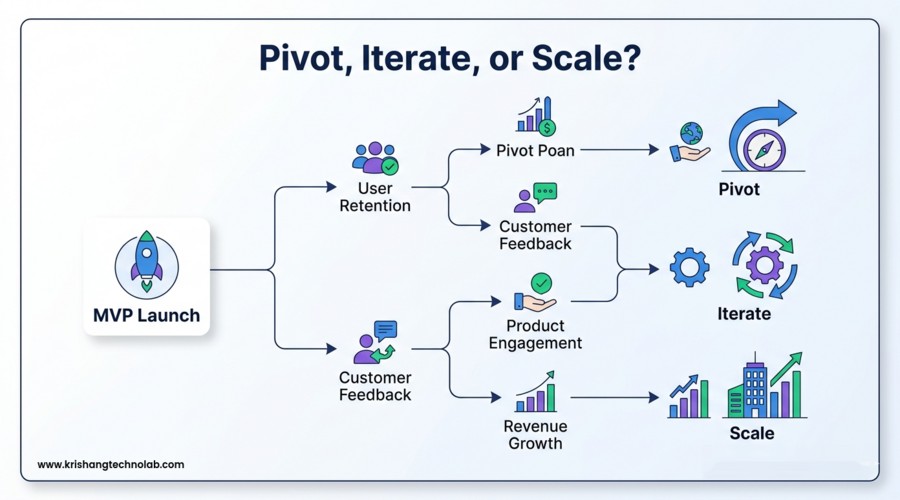
How to know which path to take:
- Retention below 20% at day 30 → investigate pivoting
- Retention above 40% at day 30 + organic referrals → signals readiness to scale
- Mixed signals → iterate and retest
How to Achieve Product-Market Fit After MVP Launch
Product-market fit (PMF) is when your product meets a sound market need.
Marc Andreessen, who coined the term, defines it as: “being in a good market with a product that can satisfy that market.”
Sean Ellis of GrowthHackers offers a practical PMF test: survey your users and ask “How would you feel if you could no longer use this product?” If 40% or more answer “Very disappointed,” you have product-market fit.
Signs you are approaching product-market fit:
- Users are telling friends without being asked
- Churn rate is dropping month over month
- Support tickets decrease as users figure out the product naturally
- Revenue or engagement is growing faster than your marketing spend
Product-market fit is not a moment. It is a direction you head towards through disciplined listening and iteration.
Common MVP Development Mistakes (And How to Avoid Them)
Mistake 1: Building too many features
The biggest killer of MVPs. Every extra feature is extra time, money, and complexity. If it is not in your core user journey, cut it.
Mistake 2: Skipping user research
Building based on assumptions is how you end up with a polished product nobody uses. Talk to real users first, always.
Mistake 3: Waiting too long to launch
Perfectionism is the enemy of learning. One way to avoid this trap is to build your MVP on a platform that is fast to deploy and easy to iterate. Webflow development is a popular choice for content-heavy or SaaS marketing MVPs because design changes take hours, not sprint cycles.
Mistake 4: Measuring vanity metrics
Downloads, sign-ups, and social media followers do not tell you if your product works. Track activation, retention, and engagement.
Mistake 5: Not talking to users after launch
Launching is not the end; it marks the beginning of the journey. Post-launch interviews are as important as pre-launch research.
Mistake 6: Trying to build everything in-house
Many MVP teams grind to a halt because they insist on hiring full-time staff for every role. As we covered in our breakdown of IT staff augmentation, bringing in specialist developers on a flexible, project basis is a far smarter approach for early-stage products. It gives you senior-level expertise exactly when you need it, without locking you into permanent overheads before you have validated your idea.
Mistake 7: Confusing an MVP with a beta
A beta is an almost-complete product you test for bugs. An MVP is a deliberately minimal product you test for market fit. These are very different things.
Real-World MVP Examples That Became Billion-Dollar Products
Dropbox (2007)
Before building anything, Drew Houston made a 3-minute demo video showing what the product would do. Overnight signups went from 5,000 to 75,000. The entire MVP was a video with no code, no product, just a validated idea. The lesson here applies directly to how you present your own MVP. Investing in website branding and visual identity before you launch helps create the kind of first impression that turns early visitors into believers, not bouncers.
Airbnb (2008)
The founders rented out air mattresses in their own apartment to see if people would actually pay to sleep in someone else’s home. Their “MVP” was a basic website with photos of their own living room.
Buffer (2011)
Joel Gascoigne set up a two-page website. Page 1 described the product. Page 2 said, “You caught us before we’re ready.” Enter your email to be notified.” The email list validated demand before a single feature was built.
Zappos (1999)
Nick Swinmurn took photos of shoes at local stores, posted them online, and manually bought the shoes at full price when someone ordered to test whether people would buy shoes online before building any inventory system.
The common thread: All four validated the core assumption with minimum cost before building the full product.
How Much Does It Cost to Build an MVP in 2026?
MVP development cost varies widely based on complexity, team, and approach:
| MVP Type | Estimated Cost | Timeline |
| No-code MVP | $500 – $1500/month | 2–6 weeks |
| Simple web app | $5,000 – $20,000 | 6–10 weeks |
| Mobile app MVP | $10,000 – $50,000 | 10–16 weeks |
| Complex platform MVP | $25,000 – $150,000+ | 16–24 weeks |
Software development outsourcing offers a structured way to engage a dedicated team with defined milestones and costs, but without the overhead of full-time hiring. For startups needing to keep costs predictable but without sacrificing quality,
Cost-saving strategies:
- Use no-code tools like Bubble, Glide, or Webflow to delay coding costs
- Use managed backend services (Supabase, Firebase) to cut backend development time
- Limit scope ruthlessly; every extra feature adds proportional cost
One approach that many founders miss out on is leveraging a white-label tech stack partner, who can provide you with a ready-made technical infrastructure across multiple technologies, essentially giving you a senior engineering team without the recruitment cost and allowing you to focus your budget on the product decisions that actually matter for validation.
How Long Does MVP Development Take? A Realistic Timeline
Here is a realistic week-by-week breakdown for a simple web app MVP:
| Phase | Duration |
| Problem validation + user interviews | Week 1–2 |
| Market research + competitive analysis | Week 2–3 |
| User personas + journey mapping | Week 3 |
| Feature prioritization + scope definition | Week 3–4 |
| Wireframing + prototype | Week 4–5 |
| MVP development (agile sprints) | Week 5–12 |
| Testing + bug fixes | Week 12–13 |
| Soft launch to early adopters | Week 13–14 |
| Feedback collection + iteration | Week 14+ (ongoing) |
Total: 12–16 weeks for a functional, tested, launched web app MVP Development Process with a small team.
Final Thoughts — Start Small, Learn Fast, Build Smart
The biggest mistake most wannabe founders make is to wait until they have the perfect product to launch. The second biggest is building for months without talking to a single user.
The MVP development process exists to protect you from both mistakes.
Start with a real problem. Talk to real people. Build only what is necessary to validate your core assumption. MVP Development Process Launch to a small group. Measure ruthlessly. Learn. Improve. Repeat.
The products that change the world are not the ones that launch perfectly. They are the ones that launched, learned, and kept getting better one iteration at a time. If you are ready to move from idea to execution and want an experienced team to guide the technical decisions, Krishang Technolab’s mobile and web development team has helped founders across industries turn early-stage ideas into production-ready products without the guesswork.
Go build the smallest version of your best idea. Today.
Found this post helpful? Don't forget to share it with your network!



)