Quick Overview: Building a startup MVP without a plan wastes time and money. This MVP development timeline breaks the process into clear phases, costs, and deliverables, helping founders create a realistic MVP roadmap for startups, prioritize features, and launch faster with confidence and measurable results.
The exciting part is building a startup. However, many founders make the same early mistake. They either dive straight into development without a plan, or they spend months perfecting features nobody asked for. Both these routes are a waste of time and money.
A clear MVP development timeline solves this problem. It breaks the whole process into stages, sets realistic expectations and helps you launch faster without compromising on quality. This blog takes you through the complete MVP roadmap, the MVP development process, and the factors that determine how long your project will actually take.
If you’re new to startup MVP development or looking to improve your MVP planning process, this blog provides a simple, practical step-by-step framework that you can start applying right away.
Why Every Startup Needs a Clear MVP Development Timeline
An MVP (minimum viable product) is the most basic version of a product that includes only the essential features needed to validate an idea. In MVP development for startups, it addresses a genuine need for real users. It is not supposed to impress everyone. They helps you test an idea rather quickly. It also lets you learn from actual users before you invest more time and money into it.
A clear MVP development timeline keeps your team on track. Without one, projects can drift. Deadlines slip as a result. And costs are climbing too. Meanwhile, teams also add features users may not need. So a timeline helps your team make better decisions. Each step should focus on a single question: Will this help us launch sooner and gain insights faster?
What Is an MVP Development Timeline?
An MVP development timeline is a plan that defines every stage of your product development, from the first idea to the launch. It lays out a timeline for each phase, such as research, design, development and testing.
Think of it as a project map, with dates. It keeps your team aligned. It helps you, the founder, see progress as well. Without a timeline, it is easy for the launch date to slip away from you.
MVP Roadmap vs. MVP Development Timeline: What’s the Difference?
This is one of the most common questions founders ask and the answer is simple. Your strategy is the MVP roadmap. It says what you’re building, why you’re building it, and what order you’re building it in. Your MVP development timeline is your roadmap. It tells you when each part of that strategy is actually going to happen.
The roadmap answers the “what and why” in short and the timeline answers the “when”. You need both of them. No matter how good your plan is, it’s useless without a deadline. A timeline without a roadmap leads to fast execution of the wrong features. These two together form the backbone of a successful MVP development roadmap.
MVP Development Timeline at a Glance
Below is a quick summary table of the full MVP development process, including timeline, core focus and key deliverables for each phase in one place.
| Phase | Timeline | Core Focus | Key Deliverables |
| Idea Validation and Market Research | 1 – 2 Weeks | User interviews and competitor research. | User personas, competitor analysis. |
| Defining MVP Goals and Requirements | 1 Week | Set KPIs and success metrics. | Product Requirement Document (PRD). |
| Feature Prioritization and MVP Planning | 1 – 2 Weeks | Rank features using MoSCoW. | Prioritized feature backlog, roadmap. |
| UI/UX Design and Prototyping | 2 – 4 Weeks | Build wireframes and prototypes. | Clickable prototype, style guide. |
| MVP Development and Coding | 4 – 12 Weeks | Build core product features. | Functional beta build, source code. |
| Testing and Quality Assurance | 1 – 3 Weeks | Run functional and bug testing. | Bug reports, stable candidate build. |
| MVP Launch and Deployment | 1 Week | Deploy and go live. | Live product URL or app listing. |
| Post-Launch Iteration and Improvement | Ongoing | Collect feedback and analytics. | Feedback log, next-sprint feature list. |
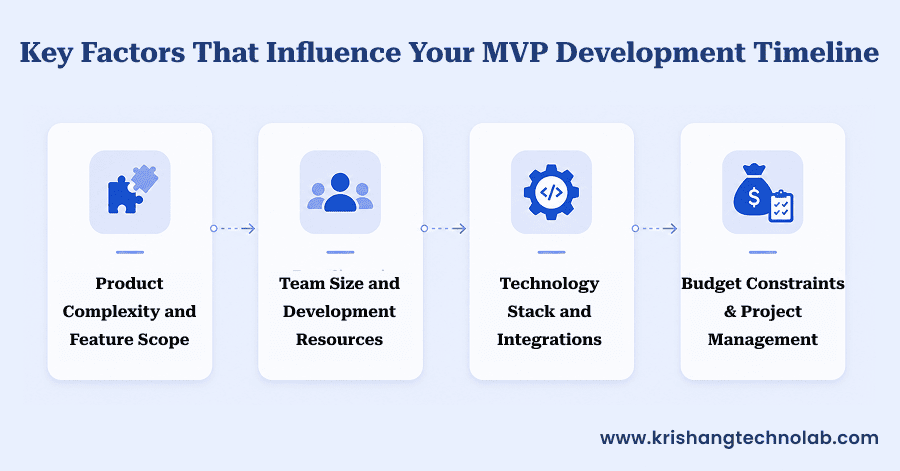
Key Factors That Influence Your MVP Development Timeline
Startups don’t all move at the same speed. There are many elements that impact project duration. You can start day one knowing the timeline and setting clear goals.
Product Complexity and Feature Scope
The more features you have, the more time it takes to build. You can launch a simple landing page tool in a few weeks. A product with user accounts, payments, and live data takes longer. So it’s important to get the key features first. This allows you to validate your idea faster.
Team Size and Development Resources
Your team is impacting the timeline. More control with in-house teams. But they’re more expensive. Freelancers are faster and have more freedom. Still, their support may vary. A dedicated MVP development company usually has talented people and a clear process. This is why many startups choose to hire a dedicated development team, so work can go faster and execution stays consistent.
Technology Stack and Integrations
The tools you use will affect speed. Build a simple MVP in days with no-code platforms. The use of rapid application development tools can also save time. Tailored products take longer. Their control is a bit better, though. Payment tools and APIs can be more work. Also, security checks could take longer.
Budget Constraints and Project Management
Your budget affects every part of the project. The budget gets bigger as the team gets bigger. It also supports more work at the same time. This usually means quicker delivery. A smaller budget could slow progress. One at a time may be necessary to complete tasks. Good project management keeps the MVP development process on track. It also helps prevent small delays from turning into bigger problems.
The Complete MVP Development Roadmap: Step-by-Step Timeline
Here’s a realistic breakdown of each stage of the MVP development process. It also includes predicted timelines for planning. These numbers are project-specific. But they’re still a useful starting point.
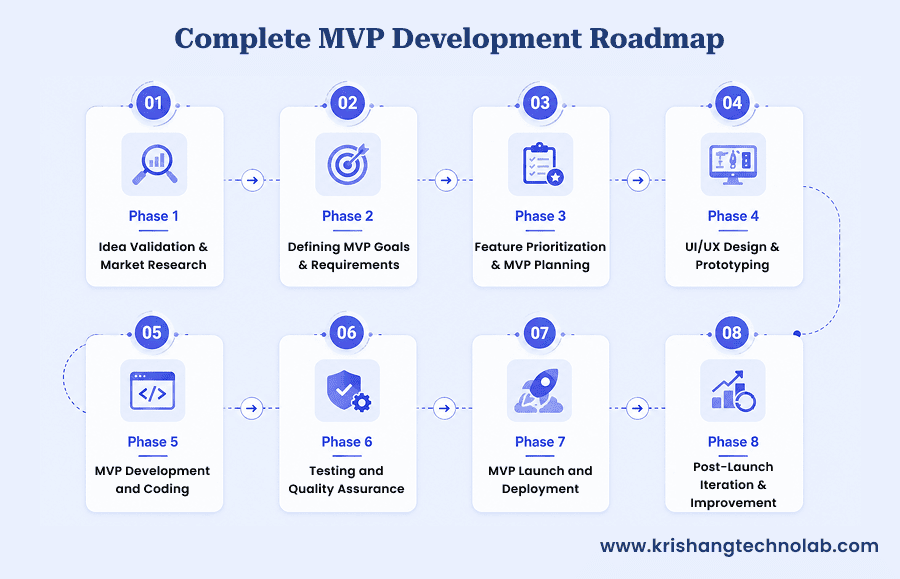
Phase 1: Idea Validation and Market Research (1 – 2 Weeks)
Validate your idea before you write the code. First, speak to potential customers. Next, look at your competition. Then confirm that the problem is real. Also, validate that people will pay for a solution. This step is often omitted. But it is crucial. If you don’t, you risk building the wrong product. That’s the biggest mistake in minimum viable product development.
Also Read About: Why should you validate your startup idea before building an MVP?
Phase 2: Defining MVP Goals and Requirements (1 Week)
Set clear goals once you validate your idea. In layman’s terms, find the success criteria of your MVP. Then establish clear and measurable goals. For instance, a main action can be a user achieving a certain goal or subscribing to the service. Then, describe the main needs that your product should fulfill. This helps make sure your team stays aligned and works toward the same goal. So there is no confusion before development starts. All of this is essential to build an MVP successfully.
Phase 3: Feature Prioritization and MVP Planning (1 – 2 Weeks)
Your first release shouldn’t have every feature. Thus, use extreme caution while setting priorities. Use a simple framework such as MoSCoW. It has everything, from must-have, should-have, could-have and won’t-have. You could also use rice scoring. These methods help you prioritize features based on impact and effort. And so you make better decisions. This step also saves time in later development. That is the essence of the MVP planning process.
Phase 4: UI/UX Design and Prototyping (2 – 4 Weeks)
Now design what your product will look and feel like. Start with wireframes. Then create a clickable prototype. At this point, one key idea is understood. A prototype isn’t an MVP. A prototype is a visual model for feedback. An MVP, however, is a functional product that real users can actually use. After that, you should test the prototype with a small group of users to gather feedback. This helps you recover faster. This approach prevents costly changes in the future.
Phase 5: MVP Development and Coding (4 – 12 Weeks)
It is the longest phase. Here is where you build your core product. Most teams use Agile MVP development. The work is organized into short, focused sprints. Each sprint is one to two weeks long. This produces periodic status updates. It also helps in faster bug fixing. It also provides flexibility in case there is a change in priorities. But the timeline is still dependent on complexity and team size.
Also Read About: Why is AI MVP development important for startups?
Phase 6: Testing and Quality Assurance (1 – 3 Weeks)
Before launch, testing is required. Functional testing must be done first. This testing ensures that every feature works as expected. Then you’ll do some usability tests. This phase makes sure that the product is user-friendly. Also do performance testing. That shows it can handle real traffic. If you don’t conduct tests, you will encounter problems at launch. Such issues can cause user frustration.
Phase 7: MVP Launch and Deployment (1 Week)
After testing, you are ready to launch. The first step is to set up hosting for your product. Next, set up monitoring tools. Then get ready with your release plan. Many startups begin with a soft launch. They initially release to a select group of people. Such an approach lowers risk. It also helps identify and fix issues at an early stage. This is the beginning of your MVP launch strategy in the real market.
Phase 8: Post-Launch Iteration and Improvement (Ongoing)
The day of launch isn’t the end. But it’s the beginning of learning. First, collect user feedback. And then track analytics. Also observe user behavior. It’s a function of feedback and iteration. This process in turn affects future features. Most products are enhanced many times. They eventually achieved product – market fit.
Realistic MVP Development Timeline Examples
Every project is unique. But these general ranges are useful for founders to plan their MVP project timeline.
| Complexity Tier | Timeline | Example Products | Typical Team Setup |
| Simple MVP | 6 – 8 Weeks | Landing page tools, basic directories, internal tools | No-code builder or solo developer |
| Medium MVP | 3 – 4 Months | SaaS dashboards, marketplaces, subscription platforms | Small agile team or freelance squad |
| Complex MVP | 5 – 6+ Months | AI products, fintech apps, healthcare platforms | Dedicated MVP development company with compliance support |
Simple MVP Timeline (6 – 8 Weeks)
This phase is about simple products. For example, landing page validation tools, basic directories or internal tools. These products have limited features. They don’t have complex integrations either.
Medium Complexity MVP Timeline (3 – 4 Months)
This range suits more advanced products. For example, SaaS dashboards, two-sided marketplaces and subscription platforms. These require user accounts and billing. They also include a few integrations. Thus, this range is common for an MVP roadmap for SaaS startups.
Complex MVP Timeline (5 – 6+ Months)
This statement is true for sophisticated products. For example, AI features, fintech apps or health care systems. It takes longer for these projects. They are often required to be checked for compliance. It also requires security reviews. They also need thorough testing before launch.
Also Read About: What is the difference between MVP and full product development?
How Long Does MVP Development Take? Cost and Timeline Together
The question “how long does MVP development take” often comes with another question. That question is price. They are therefore intimately linked. More time also usually means a bigger budget.
No-code MVPs are the quickest way. And these are the lowest cost. They are also good for simple validating projects. Hiring freelancers offers more flexibility. The cost is moderate. But timelines can be a bit less predictable.
Usually, it costs more to get started with an MVP software development agency or an MVP development services provider. It does mitigate risk, though. These teams have repeatable processes. So they are able to deliver on time more often.
Most control is with in-house teams. But there are also ongoing costs of salaries and management. Besides, the MVP development cost for a startup may increase if the hiring process takes longer than expected.
If you are thinking of outside help, check your experience carefully. Search for MVP development experts or SaaS MVP development companies with proven work. Ask about past projects. Ask for realistic time frames, too. Don’t believe the sales pitch.
Common Mistakes That Delay MVP Development
There are mistakes that will keep happening again and again, even when you have a good plan. Knowing them in advance helps you avoid the same traps.
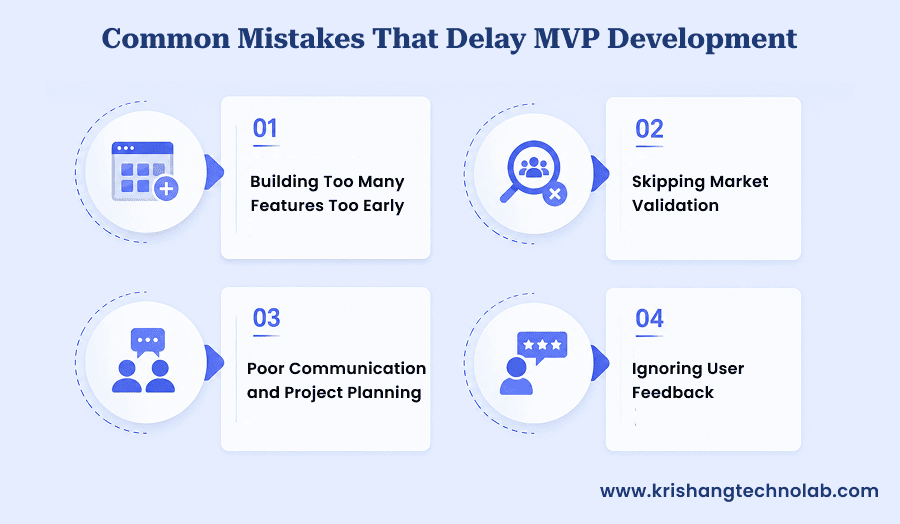
Building Too Many Features Too Early
Feature creep is the number one timeline killer. Every “just one more feature” request adds development time and then testing time. Stay on your priority list and save the extras for future releases.
Skipping Market Validation
Some founders dive straight into building because they’re excited about their idea. If you don’t validate your product, you could spend months building something that doesn’t even solve a problem.
Poor Communication and Project Planning
Vague requirements cause confusion. Expect delays, rework and frustration on both sides if your development team doesn’t truly understand what you want.
Ignoring User Feedback
Once your MVP goes live, feedback is invaluable. Founders who ignore early user signals tend to build the wrong second version and waste the time they saved by launching fast in the first place.
How to Accelerate Your MVP Development Timeline Without Sacrificing Quality
If you need to go faster, use these tricks. They are a time saver. But don’t lower the quality of the product.
Focus on Core Features Only
Solve one problem very well. Do this before adding anything else. Your MVP will be simple. It’s easier to build, too. Additionally, it is easier to test. Users get it faster, too.
Use Agile Development Methodologies
The lean startup methodology includes agile sprints. They break work down into small chunks. Thus, work is easier to deal with. They also identify early problems. Also, you can adapt before you lose too much time.
Leverage Existing Tools and APIs
You don’t have to create everything from scratch. The tools for payment, login and messaging, for example, are already there. Therefore, you can use ready-made solutions. This also saves weeks of work. And it accelerates development.
Partner With an Experienced MVP Development Team
Teams with experience move faster. They know how to build MVPs. So they avoid the common pitfalls. They also adhere to proven processes. If you need it fast, partner with custom MVP development experts or an MVP consulting services company. Such partnerships can therefore shorten your timeline significantly.
Creating an Effective MVP Roadmap for Long-Term Growth
A strong MVP is just the beginning. So founders who think beyond launch day build stronger early-stage growth through custom software development, ensuring their product can scale, adapt, and evolve with user needs.
Define Product Vision and Milestones
Connect your MVP goals to your long-term vision. Also set simple goals for the next three, six and twelve months. As a result, your team always knows the next step.
Prioritize Features Based on User Feedback
Use real data to drive your product road map. So, focus on what users are asking for the most. Also look at common problems and complaints. In addition, use this feedback to plan your next updates.
Plan for Scaling After Validation
Once your MVP has found product-market fit, prepare to scale. Upgrade your tech stack, for example. Also, if needed, hire dedicated developers. And expand to new markets. So your system is ready to scale.
Conclusion: Build Smarter With a Realistic MVP Development Timeline
The key to a successful launch is realistic planning. An MVP roadmap and a detailed product development timeline help you build the right product. They also help you go at the right pace. It saves you time and money.
Every phase matters. It is important to validate the product early. And iterating post-launch is also important. It seems faster at first, so it is tempting to skip steps. However, such shortcuts often lead to increased workload in the future. The first thing is good planning. Then go faster when you know where you are going.
If you’re ready to go from idea to working product, start mapping out your MVP roadmap today. Consider reaching out to a team at an experienced MVP app development company for expert support. They can help you build, test, and launch with confidence.
Frequently Asked Questions
What is an MVP roadmap?
An MVP roadmap is a plan of strategy. It tells you what features to build and why they’re important. It also tells you the order of development. Therefore, the focus is on the overall vision of your startup roadmap, rather than specific dates.
How do you build an MVP roadmap?
First, you validate your idea. Then you define your core purposes. Next, you rank features by impact. Then you map major milestones from research to launch. So, this is the basis of your MVP development roadmap step-by-step.
What is the difference between an MVP roadmap and an MVP development timeline?
The roadmap is what you’re building and why. The timeline will tell you when each part happens. In essence, the roadmap is strategic. The timeline, on the other hand, is the implementation schedule that brings the plan to life.
How long should an MVP development timeline be?
Most MVPs take between six weeks and six months. Simple products build quicker. But complex products take longer. These can be compliance needs, integrations or advanced features.
What are the stages of MVP development?
The main steps of the MVP development process are idea validation. Then you set goals and priorities for features. Next is design and prototyping. And then there is development and testing. Then you move on to launch and post-launch iteration.
How do you estimate MVP development time?
First, break the project into phases. Then allocate times to each phase. Also consider feature scope, team size and the technology choices. After that, you can get a more accurate estimate. Finally, include buffer time for testing and delays.
What comes after MVP launch?
You collect user feedback after launch. The use data is then examined. Then you build new features based on the insights. This stage thus pushes you towards product-market fit and further refinements.
Why is an MVP roadmap important for startups?
An MVP roadmap keeps the team focused on priorities. It also saves unused development time. And it helps to communicate a clear plan to investors and partners. This allows improved decision-making for the team.
Found this post helpful? Don't forget to share it with your network!