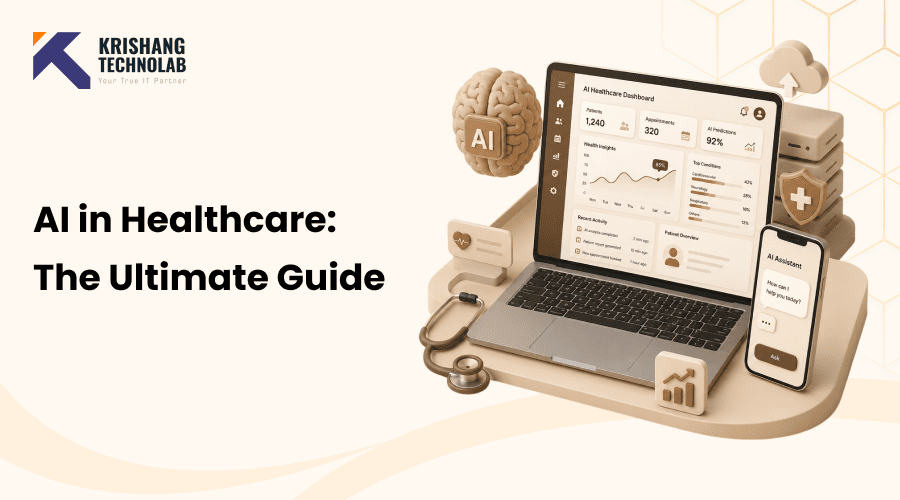
Quick Overview: AI in Healthcare is reshaping how hospitals diagnose, treat, and manage patients every day. This guide explores AI in Healthcare applications, from medical imaging to predictive analytics, while covering real benefits, ethical challenges, and where this fast-growing technology is headed next.
Hospitals today look the same from the outside, but a lot has changed behind the scenes. Modern systems can now flag early indicators of sepsis for clinicians, automatically triage medical scans before a radiologist reviews them, and generate draft clinical notes in real time as a doctor speaks with a patient. None of these developments happened by accident. It was the result of years of focused AI in healthcare development, done by teams who understood the technology and the exacting standards that medicine demands.
The change is coming quickly. Health AI adoption among physicians increased 78% in 2024, with 66% using it, and the global market is heading to hundreds of billions within a decade, driven largely by the rising investment in AI development in healthcare among hospitals, startups, and research labs alike.
In this blog we’ll look at what AI healthcare is, how it originated, where it’s being used, and what’s next.
What Is AI in Healthcare?
‘AI in healthcare’ refers to the application of computer systems that can analyse medical data, identify patterns and support decisions that would typically require a trained human. These systems are not meant to replace clinicians but rather to serve more like a rapid, very thorough assistant that doesn’t tire and can scan thousands of images or records in the time it takes a person to review one.
Also Read About: What is AI-Powered Software Development?
AI vs Machine Learning vs Deep Learning
The three terms are interchangeable, but they are not the same.
- Artificial Intelligence (AI) is an all-encompassing term to describe any system that can mimic human-like reasoning or decision-making.
- Machine learning (ML) is a part of AI in which the system learns regularities from data instead of being given precise rules. A machine learning model trained on thousands of mammograms, for example, learns what cancer tends to look like, and this is a core outcome of machine learning development.
- Deep learning is a more sophisticated subtype of machine learning that utilises layered neural networks, loosely inspired by the human brain, to tackle particularly complex tasks, such as reading medical images or understanding natural language in clinical notes.
Think of it like nested circles: AI is the outer ring, machine learning sits inside it, and deep learning sits inside that.
How AI “Learns” from Medical Data
At its simplest, an AI model is trained on huge amounts of historical medical data – scans, lab results, patient histories – where the right outcome has already been tagged. Over time the system recalibrates itself so that it is capable of finding the same patterns in new, unlabelled data. This is why data quality matters so much in healthcare AI: a model is only as good as the examples it learned from.
Evolution of AI in Healthcare
AI in healthcare was not a sudden event. It has evolved through a number of phases, each one characterized by the technology and data available at the time, from the inflexible early software to the data-hungry, self-improving models of today.
Early Rule-Based Systems
The first healthcare AI was not intelligent as we know it today. They were the if-then-else expert systems hardwired in the 1970s and 80s, encoding a doctor’s logic directly into software. They worked on narrow problems but ran aground quickly outside their rules.
Rise of Machine Learning with EHRs
The move to Electronic Health Records (EHRs) in the 2000s and 2010s created something that rule-based systems never had: vast amounts of structured patient data. The explosion of data allowed machine learning models to start to find patterns across millions of records, rather than relying on hand-coded rules.
Modern Era: Deep Learning + Generative AI
Deep learning and, more recently, generative AI define the current wave. Generative AI systems today are capable of producing clinical notes, condensing complex patient histories into summaries, and engaging in human-like conversations with patients. That’s one of the fastest-growing segments in the field of generative AI for business; the generative AI in the healthcare market alone is projected to be worth USD 4.7 billion in 2026.
Key Milestones in Adoption:
- 1970s – 80s: Rule-based expert systems (e.g., MYCIN)
- 2000s – 2010s: Widespread EHR adoption creates structured data at scale
- 2015 – 2020: Deep learning breakthroughs in medical imaging
- 2023 – 2026: Generative AI moves into clinical documentation, billing, and patient-facing chat tools
Key Applications of AI in Healthcare
AI is now almost everywhere in patient care, reading scans and writing clinical notes. Here’s a look at the areas where it’s having the biggest and most measurable impact.
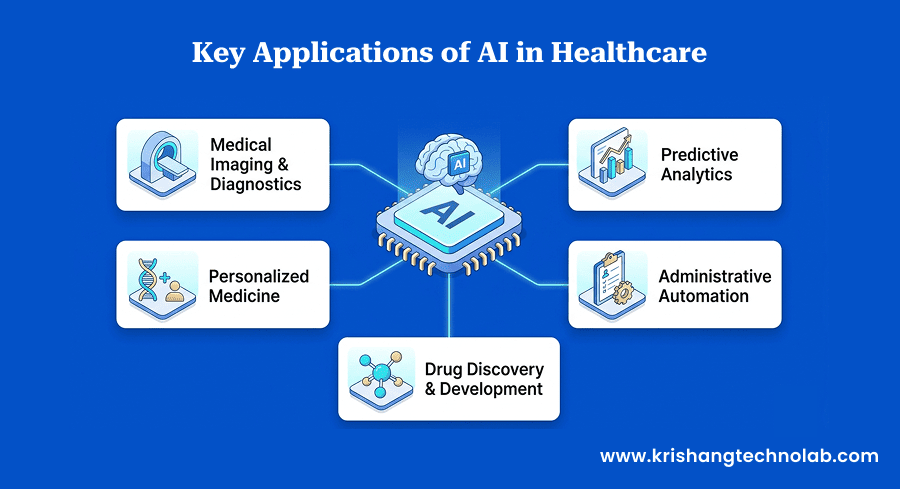
Medical Imaging & Diagnostics
This is where AI in medical imaging has made some of its more measurable progress. AI models trained on radiology images can now identify strokes, brain tumours and breast cancers. Often they are as accurate as those of trained specialists. In some cases, they’re even quicker.
By May 2025, the FDA had approved or cleared around 1,250 AI- or ML-enabled medical devices. In fact, radiology is the largest segment of these approvals.
- Radiology (X-rays, CT scans, MRIs): AI helps emphasize the most urgent scans. That means the most critical cases get to a radiologist ahead of sitting in a queue.
- Faster and more accurate detection of diseases: A commonly cited study on mammograms found AI was able to evaluate scans with 99% accuracy. This, in turn, helps speed up the diagnosis of breast cancer.
- AI-assisted pathology: Pattern recognition in tissue samples leads pathologists to detect abnormalities, often missed in the rush of time.
Predictive Analytics
Predictive analytics in healthcare is based on past patient data. It helps to predict what may happen next. This also enables better care planning.
- Disease risk prediction: Lifestyle, genetics and medical history models. They identify patients who are at risk of diabetes, heart disease or cancer. This process usually happens before symptoms develop. So doctors can step in early.
- Hospital readmission forecasting: Predictive models can help hospitals identify patients who are likely to be readmitted within 30 days of discharge. This also helps with early follow-up care. This process, in turn, may help reduce the risk of readmission.
- Patient deterioration alerts in ICUs: Models fed with continuous monitoring data. These models detect patient deterioration several hours earlier than routine checks typically would. That way, medical teams can react more quickly.
Personalized Medicine
Every patient responds differently to treatment. AI helps to shift medicine away from the standard protocols. It supports the development of care plans for each patient. It also increases treatment accuracy.
- Treatment plans based on genetics and lifestyle: AI models combine genetic markers with lifestyle data. They recommend individualized treatments. Also, it helps the doctors choose better options.
- Precision oncology: AI is used more widely in cancer treatment. It matches tumor genetics with therapies most likely to work. This in turn reduces trial and error in treatment.
- Drug response prediction: AI predicts a patient’s response to a drug. This helps to prevent treatment that is ineffective or potentially harmful. But it also helps to make safer prescribing decisions.
Drug Discovery & Development
AI in drug discovery is changing a slow and costly part of healthcare.
- AI for molecule screening: AI models can do a virtual screening of millions of combinations of molecules online rather than testing the compounds in the lab one by one. So it is easy for researchers to find good candidates. They can also try the best options first. This approach is increasingly supported by AI software development, which enables more powerful and scalable modeling systems.
- Reducing drug development timelines: Drug discovery can take many years. AI, though, can find the best candidates much faster. So research teams can get new treatments to patients sooner.
- Cost savings in pharma R&D: As an example, platforms like BioNeMo and Chemistry42 are currently operational and being used in practice. They save drug companies time and money. They also support early-stage research. This means that companies can accelerate development. They can help get patients treatments sooner.
Virtual Health Assistants & Chatbots
AI chatbots in healthcare are now a common first point of contact for patients.
- Symptom checkers: Patients tell of symptoms in chat then the system provides guidance. It may be a sign of urgent care. It might mean a routine appointment. They also point to self-care.
- Patient engagement tools: Automated reminders help keep patients on track. For example, they remind people to take medication. They also remind them of follow-up care and appointments. Consequently, fewer treatments are missed.
- Mental health support bots: AI tools that talk and support. They are a judgment-free first step. They also make it easier for people to access support. This approach is helpful where there are not enough therapists.
Administrative Automation
AI in healthcare administration handles an important part of healthcare work.
- Medical billing and coding: AI tools help with coding diagnosis and procedures. It saves manual work for the staff. This process saves time for staff. And here, more than 37% of healthcare professionals want AI to assist them.
- Appointment scheduling: Smart tools reduce missed appointments. They guess who might not make it. Then they send reminders early.
- EHR data management: Staff can find records quickly with AI tools. In some cases they can cut the search time by more than 50%. AI helps doctors write reports as well. They can reduce the time spent charting by 40 – 45%.
Benefits of AI in Healthcare
Advantages of AI in healthcare go beyond convenience. They enhance clinical outcomes. It saves costs as well. They save time for medical teams as well, especially when supported by a generative AI development company that builds domain-specific healthcare solutions.
- Improved accuracy in diagnosis: AI models train on large imaging data. They find few problems. Doctors can easily overlook these issues when they are fatigued or rushed.
- Faster decision-making: Doctors don’t have to go through all scans or lab results one by one. Instead, AI flags urgent cases first. And so, doctors move more quickly.
- Reduced healthcare costs: Studies show large savings. AI can reduce costs by $200–$400 billion annually. And it is via greater efficiency that these savings come.
- Better patient outcomes: Earlier detection means better results. It also helps to have treatment tailored. Together they improve survival and reduce complications.
- Increased efficiency for medical staff: AI reduces paperwork and admin work. As a result, physicians can dedicate more time to direct patient care. And the quality of care improves, too. The ROI for AI in healthcare is about $3.20 for every $1 spent. Most benefits are apparent within 14 months.
Challenges and Limitations of AI in Healthcare
Despite its potential, AI in healthcare is not a panacea. There are still real barriers. They include data, trust, rules and bias. As a result, adoption is still slow in many hospitals and clinics across the world.
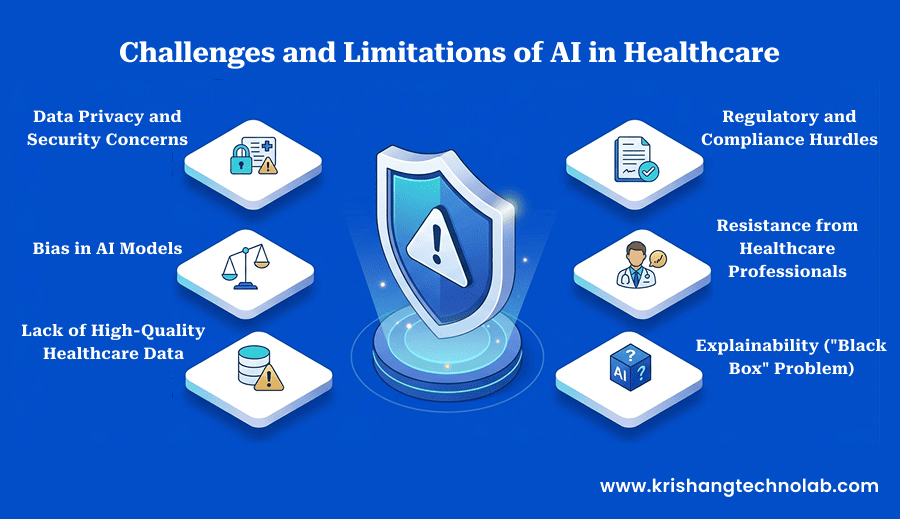
Data Privacy and Security Concerns
AI in healthcare data privacy is still a major concern. The cost of healthcare data breaches is now $7.42 million per incident. On top of this, it takes companies about 279 days to detect and contain a breach. That’s longer than any other industry.
Bias in AI Models
AI models are biased. The model exhibits superior performance when the training data focuses more on certain groups. Such biases can lead to performance degradation for under-represented groups. Studies of healthcare AI often cite this risk.
Lack of High-Quality Healthcare Data
AI needs good data to work well. Healthcare data, however, is often fragmented. It also lacks consistency in format. Moreover, stringent privacy rules restrict the sharing of data. Therefore, obtaining high-quality, well-curated training data is challenging.
Regulatory and Compliance Hurdles
The rules are rapidly evolving. They also vary by region. The EU AI Act, for example, considers medical AI to be high-risk and therefore subject to strict documentation and supervision. The HTI-2 rules and state privacy laws in the U.S. add additional complexity. That makes it harder to work across borders.
Resistance from Healthcare Professionals
Adoption is slow for valid reasons. The caution of many clinicians. Surveys show 77% of healthcare organizations report weak AI tool maturity as a barrier. Another 47% say cost is a concern. Also, 40% cite regulatory uncertainty.
Explainability (“Black Box” Problem)
Many deep learning models can’t provide clear explanations for their decisions. They behave like a “black box”. Such behavior is dangerous in healthcare. A wrong decision can impact patient health. Therefore, lack of transparency continues to be a serious problem.
Ethical Concerns in AI Healthcare
But beyond technical constraints, AI poses more profound questions. They are fairness, accountability and confidence. These problems are as important as accuracy in the care of patients. So they need to steer how AI is used.
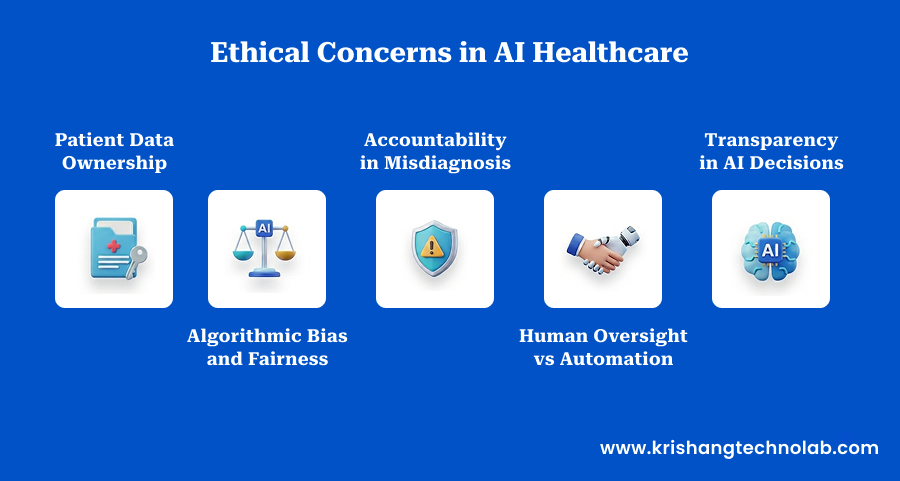
Patient Data Ownership
Who actually controls the data used to train AI models, the patient, the hospital, or the device manufacturer? In reality, many healthcare systems still lack a definitive answer.
Algorithmic Bias and Fairness
Bias is not just technical. It’s also a matter of fairness. Can we trust a model trained largely on one group to make decisions about another? The question is still open.
Accountability in Misdiagnosis
A misdiagnosis can be a result of AI. When such an event happens, it is not clear who is to blame. Maybe it’s the hospital. It may be the vendor. Or it could be the clinician who applied the tool.
Human Oversight vs Automation
One thing all systems of healthcare agree on. AI should assist doctors, not replace them. But as AI becomes better, the line becomes more blurred. It is more difficult to separate support from decisions.
Transparency in AI Decisions
Doctors and patients should have a basic understanding of AI decisions. They should see results, not only that. They should also know how the result was obtained. It builds trust and safety.
Real-World Examples of AI in Healthcare
The theory is one thing, but real deployments tell the clearest story. Here are examples of how AI is already operating inside hospitals, research labs and even consumer devices you might have in your pocket.
- AI radiology tools used in hospitals: Enterprise-level AI is now used in many hospital networks and helps prioritise urgent scans, so radiologists see the most critical cases first.
- Large-scale clinical AI projects (successes and challenges): Several widely cited examples in healthcare AI involve large clinical initiatives that performed well in research environments but faced challenges when deployed in real-world medical practice. These cases are still useful to point out the gap in lab performance and clinical deployment.
- AI in eye disease detection: AI labs working with eye hospitals have shown AI models can identify more than 50 eye diseases from retinal scans with accuracy comparable to leading specialists.
- AI-powered wearable devices: Consumer wearable devices now use AI to continuously monitor heart rhythms, oxygen levels, and activity patterns, flagging irregularities for follow-up before they become emergencies.
Role of AI in Hospitals of the Future
The hospital of tomorrow will not be entirely unique on the outside. But internally, AI will change how it operates. It will help in the care, tracking of patients and assist surgeons. Most of this work will be done quietly, in the background.
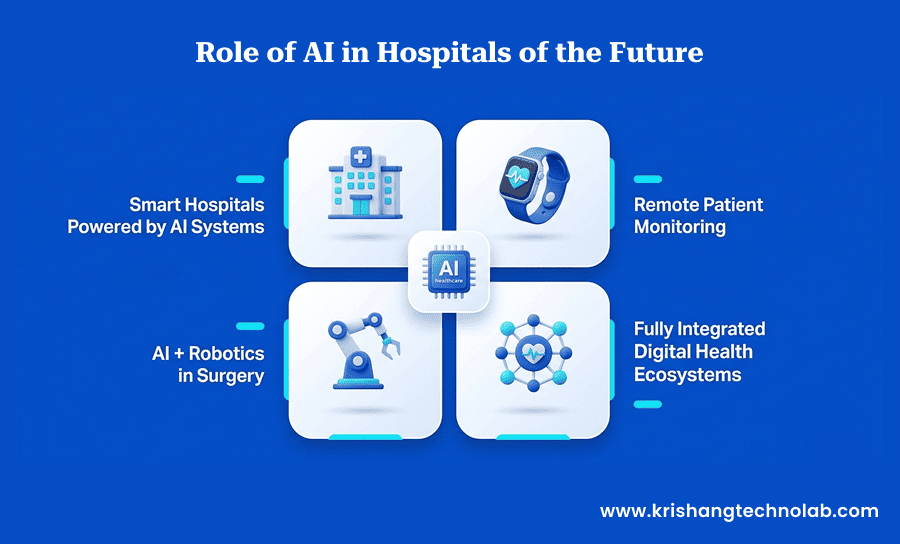
Smart Hospitals Powered by AI Systems
Hospitals are now using AI systems in their command centers. They also employ smart wards. Data from multiple departments feeds these systems. Then they provide one perspective of patient flow and risk. That means staff can respond quicker.
Remote Patient Monitoring
AI in remote patient monitoring is growing fast. It’s one of the fastest-growing areas in health technology. AI platforms consume data from wearables and devices in real-time. They start to notice early signs of health deterioration. This information is very useful for patients with heart, lung and brain problems treated at home.
AI + Robotics in Surgery
AI also aids robot-assisted surgery. It helps with planning and accuracy. It could create $40 billion in value annually by 2026. That makes it one of the most valuable uses of AI in healthcare.
Fully Integrated Digital Health Ecosystems
Full system connectivity is the ultimate goal. Imaging, EHRs, wearables, and admin tools will all connect. AI will combine them into one workflow. This will result in improved system integration. It will also decrease the lag of unconnected tools.
Future Trends in AI Healthcare
The next phase of healthcare AI is less about proving that the technology works and more about scaling it responsibly. And this is what the field can expect in the next few years, along with the rise of types of AI agents that will increasingly power healthcare workflows in different forms.
Generative AI in Clinical Documentation
Generative AI in healthcare is already transforming the writing of clinical notes. Institutions that have deployed AI scribes to listen to patient visits and automatically draft documentation have achieved a 40-45% reduction in charting time.
AI + Genomics Integration
The pairing of AI with genomic sequencing means treatments that are not only specific to a diagnosis but also specific to that patient’s genetic makeup.
Digital Twins of Patients
Some health systems are experimenting with “digital twins”, virtual models of a patient based on their data, to run simulations of how they would react to various treatments before trying them in the real world.
Fully Personalized Preventive Healthcare
In the future, AI systems will help shift healthcare from reactive treatment to proactive prevention by identifying risk years before symptoms occur.
Expansion of Telemedicine + AI
The expansion of AI in telemedicine is coinciding with the creation of virtual care platforms. It’s not some niche trend, either, with major health systems already deploying AI-assisted virtual physicians and nurses in thousands of hospital rooms, driven further by advances in AI agent development.
The Role of Developers in Enabling AI Adoption in Healthcare
AI in healthcare is much more than a clinical decision; it is first and foremost an engineering problem. That’s why so many hospitals and health-tech startups partner with an artificial intelligence software development company, rather than trying to build everything from scratch internally. Most don’t have the in-house expertise to build these systems on their own.
How Engineering Teams Support Clinical Transformation
Developers convert clinical requirements into functional systems, ensuring the integration of tools into existing EHR platforms rather than creating another standalone application for clinicians to manage. This phase is where organizations usually look to hire AI developers with particular experience in regulated, data-sensitive environments. General software experience doesn’t always map to the compliance and safety standards healthcare demands.
Building Scalable and Compliant Systems
The implementation of AI in healthcare requires systems built for HIPAA, GDPR, and emerging frameworks like the EU AI Act from day one, not retrofitted after deployment. Here, engineering teams that know the ins and outs of regulated environments are key, as failing to comply can completely stop a deployment. In many health systems, they partner with a specific generative AI development company for tools like clinical documentation assistants where the underlying language models need to be carefully tuned to prevent clinical errors.
Also Read About: How Much Does It Cost to Hire an AI Consultant?
Continuous Support and Iteration
As patient populations and clinical practice change, AI models degrade, a phenomenon often referred to as model drift. A tool isn’t reliable just at the pilot stage but years after launch when ongoing monitoring, retraining and support from technical teams are in place. For this reason, it’s often more practical to hire dedicated developers for long-term maintenance rather than relying on a one-time project team that disappears after launch.
Conclusion
AI in healthcare has moved well past the experimental stage. It already reads scans, flags at-risk patients, drafts clinical notes and helps discover new drugs, quietly and at scale. The benefits are tangible: diagnoses are quicker, costs are reduced and time is given back to overworked clinical staff. But challenges like data privacy, bias and regulatory uncertainty mean this technology must be implemented carefully, not rushed. The future of healthcare is not about AI replacing doctors, but about AI collaborating with doctors. For those organizations that are ready to take that step, the right place to start is a conversation with an experienced AI development company that understands both the technology and the regulatory weight that healthcare carries.
Frequently Asked Questions
What is AI in healthcare?
AI in healthcare is the application of computer systems. These are deep learning and machine learning. They look at medical data. They also help in diagnosis. It also forecast patient risk. It also automates some clinical tasks in hospitals.
How is AI used in healthcare?
AI is used in many fields. For instance, it enables medical imaging and predictive analytics. It is also helpful when planning personalized treatments. It also supports drug discovery. They also power virtual healthcare assistants. And finally, it helps with billing and scheduling efforts.
Why is AI important in healthcare?
AI solves critical healthcare problems. It cuts rising costs. It also helps with staff shortages. They also work with huge amounts of medical data. They help clinicians make better decisions. The patients also have better results.
How to Implement AI in Healthcare?
Implementation requires teamwork to be successful. Clinical staff and engineers have to work together. Systems also need to use compliant data infrastructure. AI tools need to fit within existing EHR systems. Post-deployment, teams have to monitor performance. This alleviates model drift.
What are the challenges of implementing AI in healthcare?
The barriers are obvious. Risks to data privacy are among these. They also are subject to algorithmic bias. There is also a deficiency of high-quality clinical data. Rules are not clear. Moreover, some healthcare workers still do not fully trust AI tools.
Found this post helpful? Don't forget to share it with your network!