
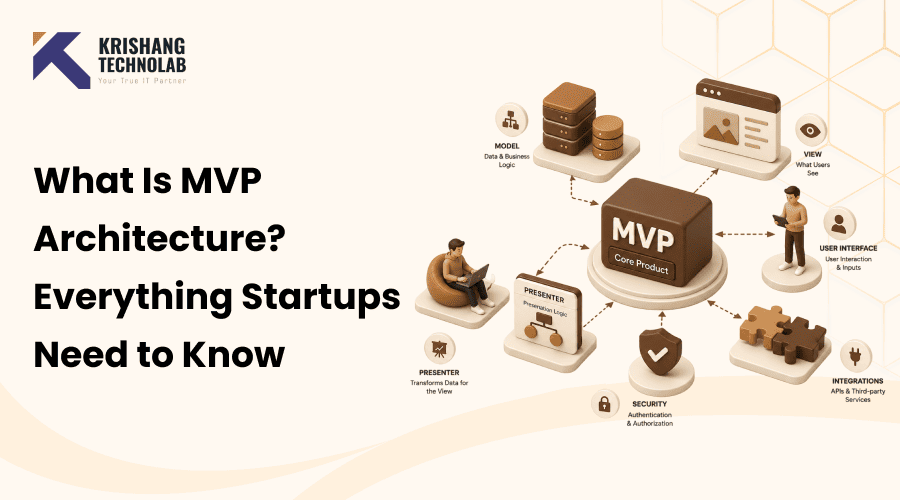
Quick Overview: MVP Architecture provides the technical foundation for building a Minimum Viable Product that is fast, scalable, and cost-effective. It helps startups validate ideas with essential features, simplify maintenance, improve testing, and support future growth. This guide explains its components, benefits, best practices, technology choices, common mistakes, and why it is essential for successful product development.
Long-term business success often begins with identifying a market gap and developing a solution that meets customer expectations. However, the rapid development alone will not turn that idea into a scalable digital service. A well-designed MVP Architecture offers the technological base to test ideas, reduce development risks and accelerate long-term growth. It is a strategic and technical decision that will have an impact on the speed of development, scalability, product quality, support and user experience. Before starting development, many startups invest in MVP development services to validate their product idea while building a scalable technical foundation.
Moreover, a good MVP Software Architecture helps development teams to structure application components, define roles and build scalable systems that can adapt to changing business needs. It accelerates start-ups in validating their product by focusing on the must-have features. It lets you focus on fast development but with no compromise on performance, maintainability or future scalability.
Furthermore, with evolving customer expectations, companies are required to release updates faster and add features more efficiently. A scalable MVP Architecture allows continuous improvement. It reduces technical debt, increases collaboration, and makes long-term maintenance easier, especially when supported by experienced MVP development services for startups.
In this guide, you’ll learn about MVP Architecture, why it’s important, when to use it in startups, how it works, its key components, best practices, mistakes, and future trends. You will learn how Cost-Effective Development Teams set the foundation for building scalable, high performing and successful digital products.
What Is MVP Architecture?
In simple terms, each successful startup starts with an idea, but to create a scalable product you need a solid MVP Architecture. As a result, it helps startups to validate ideas, reduce risks, accelerate development and enable long term growth. Moreover, it also offers a scalable, secure, and maintainable architecture that enhances performance, collaboration, and future growth. Additionally, learn what MVP Architecture is, why it’s important, when to use it in startups, how it works, its key components, best practices, common pitfalls to avoid and future trends. You’ll also discover how to find the Right Development Budget that helps you convert your ideas into successful digital goods. A reliable startup software development company can help define an architecture that supports future growth from day one.
Why MVP Architecture Matters for Startups
Above all, MVP Architecture is important for Startups because it allows faster product validation and minimises development risks, costs and technical debt. As a result, it helps businesses launch faster, collect feedback from actual users, scale up easily, simplify maintenance and respond to shifting market demands. Software system design provides a secure, modular and manageable basis for collaboration, third-party integrations, cloud scalability and future feature expansion. The scalable application design and the strong Software system design provide startups with the benefits of building reliable products, gaining the trust of investors, optimising their resources, accelerating their development cycle and establishing a solid foundation for sustainable, long-term business growth. For this reason, businesses often work with a custom software development company to create an MVP that balances speed, scalability, and long-term maintainability.
When Should Startups Choose MVP Architecture?
Ideally, MVP Architecture should be adopted in the early stage of product planning to build a scalable basis before starting development. Software system design helps startups to cut costs, avoid technical debt, validate ideas and accelerate product development. The Software system design is particularly well-suited for start-ups entering highly competitive markets with limited budgets, or for developing innovative products that require ongoing customer feedback and rapid iterations. And it is scalable, tech-integrated and future upgradeable. Additionally, if your startup has limited resources, choosing MVP development services can significantly reduce development risks and time to market. Minimum Viable Product architecture can help startups to improve collaboration, get investment and make sustainable future-ready digital products.
How MVP Architecture Works
Essentially, a successful Minimum Viable Product demands an Application Design Framework that strikes a balance between speed, scalability, and long-term growth. Strong Application Design Framework – Describes the relationship between application levels, data, and features. Software Design Strategy – Modular, Secure and Extensible base. It provides a good technical base to make development smooth and collaboration easy, application performance better and new features can be added without breaking existing functionality.
Core Components of MVP Architecture
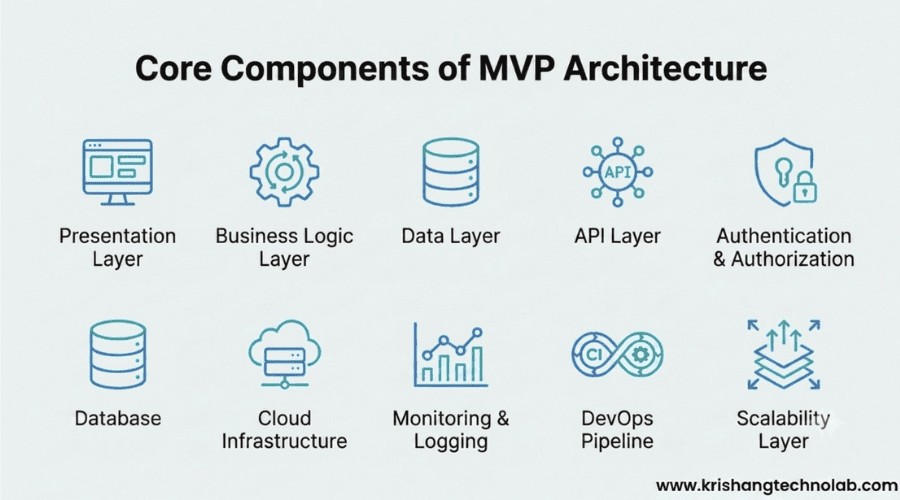
At its core, each and every successful MVP Architecture is composed of multiple interconnected components that together build a scalable, maintainable, and reliable application. Understanding these components enables startups to develop products that are easy to scale and deliver great performance. Partnering with a trusted MVP development company in Israel helps startups implement these architectural components efficiently while reducing development risks. In a well-designed Modular Application Design, each component has a single responsibility and has no unnecessary dependencies.
1. Presentation Layer in MVP Architecture
First, the Presentations layer is the part of the MVP Architecture which can be directly interacted by the users. This covers mobile apps, web interfaces, dashboards and user experience elements. The layer is kept simple with a professional MVP Software Architecture that displays information and collects user input instead of complex business logic. The more intuitive presentation layer will increase the customer satisfaction and will make easier to change the interface in the future. A responsive user interface built by experienced React development services or frontend developers improves the overall user experience.
2. Business Logic Layer in MVP Architecture
Next, the business logic layer acts as the brain of the MVP Architecture. It processes user requests, applies business rules, validates data, and decides the application’s response. In Modular Application Design, decoupling business logic keeps the application behaviour consistent and simplifies the development of future features. Businesses working with an experienced MVP development company in Canada can implement a robust business logic layer that supports scalable applications and evolving business requirements. This layer allows startups to change business processes without modifying the user interface or database.
3. Data Layer in MVP Architecture
Similarly, data storage is the heart of every digital product. In MVP Architecture, the data layer manages databases, repositories, caching, and data persistence. A Modern Software Architecture ensures that information is stored, retrieved, updated, and secured efficiently. While specialised services handle database operations, experienced hire front end developers ensure that this data is presented through responsive, high-performing user interfaces, delivering a seamless experience while improving application performance, security, and long-term maintainability.
4. API Layer in MVP Architecture
In addition, APIs are heavily used by modern applications to send and receive information from external services. APIs converse with payment gateways, authentication providers, SMS platforms, mapping services, AI tools, cloud services and so much more. The Modular MVP Architecture ensures that the API Integrations and Application Infrastructure remain loosely connected to external systems.
5. Authentication and Authorization in MVP Architecture
Equally important, user security must be built in from day one. Authentication is used to verify the identity of a user where as authorisation is used to control access to the various resources.An efficient Application Design Framework will have secure login mechanisms, role-based permissions and encrypted communication. With a safe Software Design Strategy, all security precautions are centralised and easily manageable.
6. Database Layer in MVP Architecture
Likewise, the database stores application information including user profiles, transactions, settings, analytics, and operational data. A scalable Application Design Framework chooses the right database based on business needs, while Software Design Strategy optimises indexing, query speed, and data consistency for long-term expansion.
7. Cloud Infrastructure for MVP Architecture
Additionally, Cloud infrastructure gives startups the flexibility and scalability they need. Companies run their MVP Architecture on cloud platforms that will automatically allocate resources as traffic increases, rather than buying expensive hardware. Cloud-native Modular Application Design supports containerisation, load balancing, backup and disaster recovery.
8. Monitoring and Logging in MVP Architecture
Meanwhile, continuous monitoring helps companies to spot problems before consumers see them. A mature MVP Architecture includes centralized logging, performance monitoring, error tracking, and system health reporting. Likewise, MVP Software Architecture enables developers to diagnose problems efficiently while improving application reliability.
9. DevOps Pipeline for MVP Architecture
Furthermore, coding is not the end of development. Modern MVP Architecture includes automated testing, continuous integration, continuous deployment, version control and automation of infrastructure. An organised Agile MVP Architecture will allow for consistent deployments to development, testing and production environments.
10. Scalability Layer in MVP Architecture
Finally, perhaps the most important component of MVP Architecture is scalability planning. Startups exponentially scale user traffic, transactions, integrations and data volumes. A future-ready Modular Software Architecture is based on horizontal scaling, modular services, optimised databases, and cloud-based infrastructure. This enables businesses to scale up without rebuilding their applications.
Key Principles of MVP Software Architecture
To build on this, Fintech MVP Development requires a strong architectural foundation that supports rapid iteration, security, and future scalability. Every startup has different business goals, but the most successful products share a consistent set of architectural principles. Application Design Framework complies with these principles, allowing businesses to build efficient, scalable, and easy-to-maintain applications with the flexibility to evolve as the product grows. By applying these principles during fintech MVP development, startups create a technical foundation that adapts to changing business requirements instead of becoming a constraint, enabling faster innovation and long-term success.
Keep It Simple
First and foremost, the first principle of Application Design Framework is to be simple. Don’t add any extra complexity, each part should solve a specific problem. Lean Application Design Framework helps startups to test ideas faster and cut down development time and maintenance cost.
Design for Scalability
At the same time, although an MVP begins with limited functionality, it should never limit future growth. Scalable Future-Ready Architecture helps us to plan for user growth, feature additions and business requirement expansions. The High-Performance Architecture is scalable by nature to avoid costly architectural rework later.
Separate Responsibilities
Likewise, the Modular Software Architecture is good as it separates the presentation, the business logic and the data management into independent layers. This separation leads to better testing, debugging, collaboration and long-term maintainability, while making the overall Modular Software Architecture more resilient to change.
Benefits of MVP Architecture
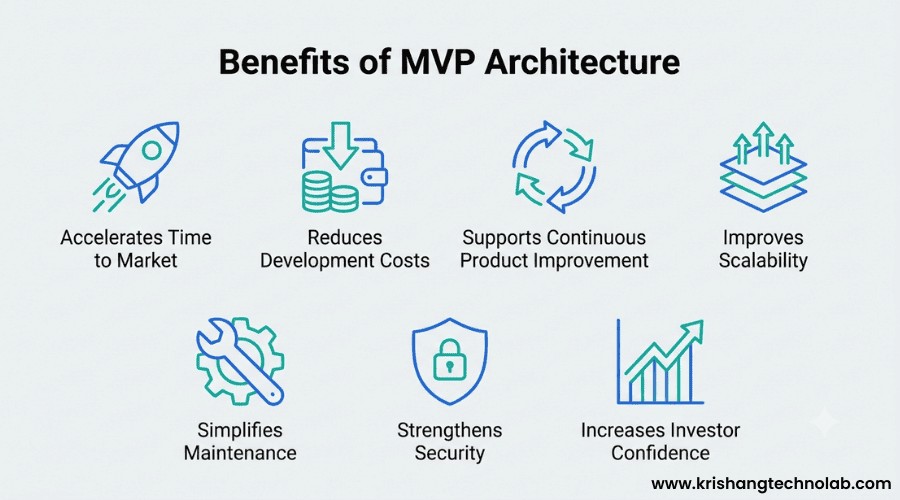
As a result, developing a digital product isn’t simply about getting to market quickly, but designing a solution that can grow with shifting customer expectations and business objectives. That’s where MVP Architecture delivers real, lasting value. A Product Engineering Foundation allows startups to go faster, minimise risks, and create a solid technical foundation without making the first product too complicated.
Many founders achieve these goals by partnering with a trusted startup MVP development company in Australia, ensuring their product is built for rapid validation and long-term scalability. Together with a scalable Minimum Viable Product Architecture, it allows companies to test ideas and at the same time keep the application flexible enough for future innovations.
1. Accelerates Time to Market
For example, speed is one of the most significant competitive advantages for companies. A well thought out MVP Architecture directs development efforts to the features that solve the customers’ core problem, enabling teams to launch sooner. Developers can design something that works, gather feedback, and iterate rapidly rather than spending months on non-essential features.
Lean MVP Software Architecture gets rid of bottlenecks in development and reduces code down to bite size pieces. It also enables multiple developers to work on the same project simultaneously which accelerates productivity and shortens time to release.
2. Reduces Development Costs
In addition, startups often have limited finances, therefore resource management is crucial. The MVP Architecture enables businesses to validate market demand before developing unnecessary features, helping optimize the MVP development cost while ensuring every hour spent on development creates measurable business value. A reliable SaaS MVP development company helps startups create scalable, maintainable, and cost-efficient MVPs that are easier to enhance as user demand grows. A well-structured Modular Software Architecture also helps to cut down costs by encouraging reusable code, reducing maintenance, and preventing costly architectural changes in later stages of the project.
Furthermore, a well-structured Modular Software Architecture also helps to cut down costs. It encourages reusable code, less maintenance, and prevents costly architectural changes in later stages of the project.
3. Supports Continuous Product Improvement
Furthermore, there’s no startup that ships a perfect product. Customer feedback frequently uncovers new opportunities, missing features, and usability improvements. With Flexible MVP Architecture you can do these changes in a simpler way, without affecting the whole application.
Modular Software Architecture separates the business logic from the user interfaces and data management and allows different modules to be updated separately. The software can be broken into pieces where changing one piece does not impact the rest of the system.
4. Improves Scalability
Eventually, many businesses experience gradual or rapid growth after they get market traction. Without a scalable MVP Architecture, scaling the user traffic might result in performance problems, downtime, and increased operational costs.
The future-ready Modular Software Architecture addresses the scalability issue with cloud deployment, optimised databases, efficient APIs, caching mechanisms and modular services. A business can scale its infrastructure as demand increases without redeploying the application.
5. Simplifies Maintenance
Likewise, applications need continual maintenance throughout their entire span. Building a product on a well defined MVP Architecture helps in fixing bugs, updating features, enhancing the performance and patching security vulnerabilities. A clean Modular Software Architecture also makes the codebase more readable for developers, meaning that bringing on new team members and keeping the codebase maintained is a much more efficient process.
6. Strengthens Security
Most importantly, security should never be considered optional. A good MVP Architecture has authentication, authorisation, encryption, secure APIs and handling of data all built-in from the start. MVP Software Architecture also provides you with centralised security controls that make it easy to track vulnerabilities, update applications and meet industry standards as your application evolves.
7. Increases Investor Confidence
Consequently, investors look at the business opportunity of a startup as well as its technical foundation. A scalable MVP Architecture means that the company is ready for long-term growth, not just a prototype launch. A strong MVP Software Architecture gives investors confidence that scaling, maintenance and adding new features later on will not face huge technical challenges.
MVP Architecture vs Traditional Software Architecture
By comparison, although both architectural approaches aim to build reliable software, their objectives differ considerably. The differences allow startups to select the strategy that best matches their business goals, their resources and their expected growth.
| Aspect | MVP Architecture | Traditional Software Architecture |
| Primary Goal | Validate product ideas quickly | Build a complete production-ready system |
| Development Speed | Fast and iterative | Longer planning and development cycles |
| Initial Investment | Lower | Higher |
| Feature Scope | Essential features only | Comprehensive functionality |
| Scalability | Planned from the beginning but expanded gradually | Often designed for full-scale deployment |
| Customer Feedback | Collected early and continuously | Usually received after major development milestones |
| Risk Level | Lower business and financial risk | Higher upfront investment and uncertainty |
| Maintenance | Modular and iterative | May require larger updates depending on complexity |
On the one hand, for the startups, the MVP Architecture is most often the best as it can be developed fast and can be sustainable for the long term. Instead of spending a lot of money before they know what their customers need, they can test the idea of their business. And develop upon a solid MVP Software Architecture that has room for future growth.
On the other hand, for organisations traditional software architecture still fits well with steady requirements and predictable workflows. The flexibility and adaptability of MVP Architecture are more useful for startups, especially in the initial stage of product development.
How to Design an Effective MVP Architecture
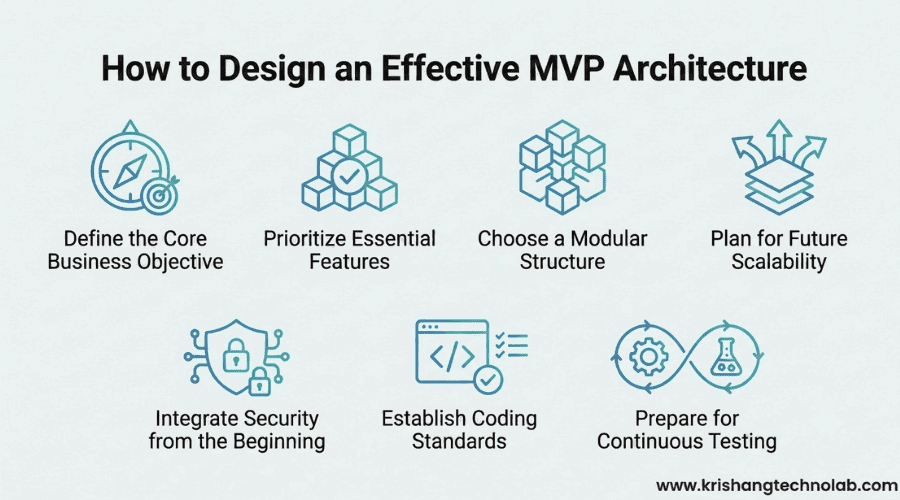
Before you begin, good MVP Architecture is built long before the development process. This requires detailed planning, technical skills and a clear understanding of business objectives. Here the goal isn’t to get to market quickly but to build a product that could be scaled efficiently with the company.
1. Define the Core Business Objective
First, every successful MVP Architecture begins with identifying the primary problem the product solves. The startup should not be building a lot of features. The value proposition should be clear and there should be a customer need.
2. Prioritize Essential Features
Next, every successful MVP Architecture begins with identifying the primary problem the product solves. The startup should not be building a lot of features. The customer need must be clear and the value proposition must be clear.
3. Choose a Modular Structure
After that, a modular MVP Software Architecture separates different application responsibilities into different components. Every component has a clear role and that means developers can improve certain parts of the application without messing up the whole system. This greatly improves the efficiency of long term maintenance and future updates.
4. Plan for Future Scalability
Meanwhile, even if the initial product is for a small audience, every MVP Architecture should expect growth in the future. The application has scalable infrastructure, flexible databases and well-designed APIs that allow it to scale without any major architectural changes.
5. Integrate Security from the Beginning
At the same time, security is not an afterthought and needs to be built into the MVP Software Architecture at every level. From the outset, you need to build in authentication, authorisation, encrypted communications and secure data storage.
6. Establish Coding Standards
Likewise, coding standards help development teams work together. The quality of the project as it grows is guaranteed by the structured parts of the MVP Software Architecture such as naming conventions, documentation, version control and code reviews.
7. Prepare for Continuous Testing
Finally, testing should be integrated throughout the development lifecycle. Automated testing, integration testing and performance testing help to ensure that every improvement made to the MVP Architecture maintains system reliability.
Read About: How Long Does MVP Development Take?
Choosing the Right Tech Stack for MVP Architecture
When choosing technologies, Technology selection plays a crucial role in the success of any MVP Architecture. The right tech stack should align with your business goals, scalability requirements, development expertise, budget, and long-term vision. Many startups also evaluate the cost to hire dedicated developers in India when planning their MVP, as it helps them optimise development costs while accessing experienced talent to build a scalable and high-performing product.
1. Frontend Technologies
For the frontend, some of the modern JavaScript frameworks like React, Angular, and Vue help in building interactive and responsive user experiences. Startups can leverage AngularJS development services to create scalable, high-performance web applications with a strong frontend foundation. Flutter app development services provide scalable MVP Software Architecture for mobile applications and make it easier to build cross-platform applications for startups.
2. Backend Technologies
On the backend, in MVP Architecture, you may choose backend frameworks such as Node.js, .NET, Java Spring Boot, Python Django, or Laravel. The right choice depends on your project’s complexity, performance requirements, scalability goals, and your team’s expertise. Partnering with a dedicated development team that provides professional Django development services and Laravel development services enables startups to build a secure, scalable backend, accelerate product development, and simplify long-term maintenance.
3. Database Selection
Similarly, good for structured data are PostgreSQL and MySQL and for flexible, fast changing datasets NoSQL solutions like MongoDB are good. Also, the right selection of the database has the potential to improve the MVP Architecture and MVP Software Architecture through better performance and scalability.
4. Cloud Platforms
Additionally, cloud providers offer managed services for infrastructure, storage, databases, monitoring and security to make it easier to deploy and scale. Cloud-native deployment enables startups to scale resources according to user demand without a hefty investment in infrastructure.
5. DevOps and Automation
Furthermore, continuous Integration and Continuous Deployment (CI/CD), containerisation and infrastructure automation accelerate and improve the consistency of release. These allow for improvement of the architecture of the MVP Software by minimising the manual errors in deployment and allowing for quick iterations.
Best Practices for MVP Software Architecture
To achieve this, building a successful MVP Software Architecture requires more than selecting the right technologies. The best outcomes are obtained by a good software architecture and consistent engineering practices that drive reliability, maintainability, and continuous improvement. Startups increasingly combine AI development services with MVP architecture to automate workflows and accelerate product innovation.
Keep the Architecture Simple
Build only those features that solve the core business problem. Don’t add unnecessary complexity. Simper architecture is easier to build, maintain and improve increasing the cost and reducing technical debt.
Design with Scalability in Mind
Grow your business, scale your architecture to more users, data and features. A scalable foundation means less re-development in the future, and consistent application performance.
Separate Concerns Clearly
Divide the application into presentation, business logic and data layers This is nice because it is easier to maintain, easier to test, and it allows developers to update individual components without breaking the entire system.
Write Clean, Maintainable Code
Code should be modularised in accordance with standard methods, including proper naming conventions and reuse. Good code organization makes code easy to read, easy to maintain, and easy to change by developers over the product’s life.
Document Architectural Decisions
Document everything, project, architecture, workflows, technical decisions. Keep documentation clear. Properly documented systems enable the developers to get up to speed on the application quickly and allow future development.
Automate Testing Wherever Possible
Automate unit, integration and regression testing to catch issues early. Continuous testing enhances software quality, lowers deployment risks, and speeds up future releases.
Monitor Application Performance
The development teams are continuously monitoring the performance of the application for identifying areas that need improvement and to ensure that the system can support the increasing number of users and keep the application up and running smoothly.
Protect Sensitive Data
Secure authentication, authorisation, data encryption and API security from the get-go. Security is embedded in the development process to protect sensitive information, to mitigate potential threats and slowly build trust with users.
Review the Architecture Regularly
Change your MVP architecture as your business needs and technology evolve. Periodically the architecture is reviewed for scalability, cost effectiveness and to ensure alignment to the enterprise goals.
Treat the MVP as the Foundation
View your MVP as the starting point of a growing product rather than the finished solution. Well planned MVP Software Architecture helps in easy addition of features, optimal scaling and future growth of the business.
Common MVP Architecture Mistakes Startups Should Avoid
Even the best startup idea can flounder if the underlying MVP Architecture is not well planned. Many founders think about launching fast. Often ignoring architectural decisions leads to increased maintenance cost, increased development time, scalability issues down the line. By learning from these common mistakes, startups can build a more robust MVP Software Architecture that can help them to not only validate their product quickly but also grow their business in the long run.
Overengineering the Product
Many startups spend a great deal of time and money developing feature-rich applications before testing the waters to determine if there is any real demand in the market. This often results in longer development cycles, increased costs, and features of little value to end users. An effective MVP Architecture helps teams focus on solving the core customer problem with only the core features needed for validation. Once you get the user feedback confirming product-market fit, you can add more capabilities with an MVP Software Architecture that is scalable enough for the application to grow without breaking its existing foundation.
Ignoring Scalability
Some startups assume they can redesign their application after achieving growth. Unfortunately, rebuilding a product often costs significantly more than designing a scalable MVP Architecture from the beginning. MVP Software Architecture is modularised with services, the deployment to the cloud, optimised databases and flexible APIs to accommodate future users without major structural changes.
Choosing the Wrong Technology Stack
Another common mistake is to choose technology simply because it is popular, not because it is right for the project, which can create headaches down the road for development. Scalability, performance and maintenance requirements are different for each startup. The best MVP architecture would be a balance of technology choices, business goals, available expertise and expected growth. We intentionally select the MVP Software Architecture to guarantee that the application runs effectively throughout its life cycle.
Mixing Business Logic with User Interface
Developers who tightly couple application logic with the user interface make future updates more difficult and time-consuming. Professional MVP Software Architecture separates the presentation, business rules, and data management into separate layers. MVP Architecture simplifies management while making testing and maintenance easier.
Neglecting Security
Security should never be postponed until after launch. Startups are at high risk of financial loss and reputational damage due to weak authentication, unprotected APIs or poor data management. How to Build Security into MVP Architecture from the Ground Up to Secure Customer Information and Build Trust. Proactive security includes secure development, proper access controls, continuous risk assessment and continuous monitoring of the application during its entire lifecycle.
Poor Documentation
Many startups don’t see the value of documentation in early development. The well documented MVP Architecture allows new developers to quickly understand the application, decreases onboarding time and enhances collaboration across technical teams. Also, detailed MVP Software Architecture documentation will ensure long-term maintenance and future feature expansion.
Ignoring Testing
Many teams skip testing to speed up development, but this decision can lead to expensive problems down the road. Reliable MVP Architecture involves automated testing, integration testing and performance testing all through the software development life cycle. This guarantees the MVP Software Architecture is stable while adding new features.
Failing to Collect User Feedback
The purpose of an MVP is validation. Launching an application without tracking the user behaviour or collecting the customer feedback is a defeat of the purpose of MVP Architecture. Successful startups continuously review user interactions and update their product strategy and MVP Software Architecture based on real insights.
Real-World Startup Example
Consider a startup building an online healthcare appointment platform. Instead of building everything from scratch with basic features such as registration of users, search for doctors, appointment booking, and schedule management, the team develops an MVP Architecture. The modular MVP Software Architecture decouples the frontend, backend, database, authentication and APIs enabling a quicker launch and simpler maintenance. With more user input, the app introduced features such as online purchases, video consultations, reminders, and digital prescriptions without modifying the program. After launching the product, digital marketing services for startups help attract early users, increase brand visibility, and gather valuable customer feedback for continuous improvement. This example explains how MVP Architecture and MVP Software Architecture enable scalability, continuous improvement, lower development costs, and allow the product to be successful in the long term.
Future of MVP Architecture
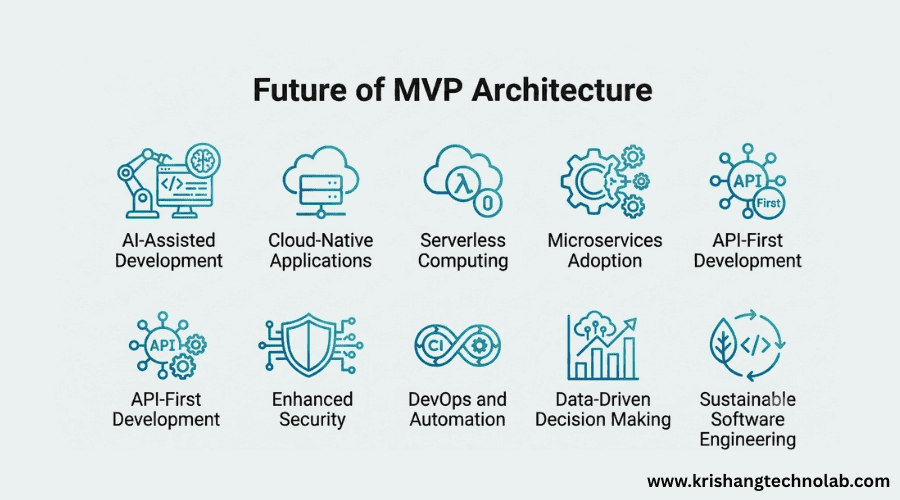
As software development evolves rapidly, emerging technologies, changing customer expectations, and smarter development practices will shape the future of MVP architecture. Understanding how to build an MVP has become more important than ever, as startups that adopt these trends early are better positioned to innovate, scale efficiently, and gain a competitive advantage. AI-powered coding assistants and AI software development services are transforming how startups build, test, and scale modern applications, enabling faster development cycles and more reliable MVP delivery.
AI-Assisted Development
AI is revolutionising software engineering by accelerating the processes of coding, testing, documentation and debugging. In the future MVP Architecture will use more AI-powered development tools to increase productivity and software quality.
Cloud-Native Applications
Cloud Computing will continue to shape MVP Software Architecture. A flexible operating environment that promotes corporate growth, simplifies application management, and allows development teams to deliver innovations more effectively.
Serverless Computing
Serverless platforms charge startups only for the computing resources that are actually used. This allows for a low cost MVP Architecture especially when validating the product first when there is uncertainty on user demand.
Microservices Adoption
Although many startups begin with a modular monolithic application, growing products often transition toward microservices. The future for MVP software architecture is more about using independently deployable services to increase scalability and flexibility in development.
API-First Development
Today’s digital ecosystems rely heavily on integrations. The API-first approach to the MVP Architecture design will be compatible with third-party platforms, mobile apps, cloud services and future business partners.
Enhanced Security
Cybersecurity requirements continue to increase. Future MVP software architecture will emphasise zero-trust security models, better authentication, automatic threat detection and greater regulatory compliance.
DevOps and Automation
Automation will remain central to modern MVP Architecture. By leveraging modern software delivery approaches, development teams can introduce improvements more frequently, lessen the risk inherent with deployments, and make sure they’re working with a stable, high quality application that continues to evolve.
Data-Driven Decision Making
Analytics will play an even greater role in shaping product development. Future MVPs will have a software architecture that includes advanced monitoring, user behaviour analytics, predictive analytics and performance optimisation tools to help make informed business decisions.
Sustainable Software Engineering
Future MVP Architecture will also focus on resource optimisation, energy-efficient infrastructure, and sustainable cloud computing practices without compromising application performance as organisations focus on operational efficiency.These trends can ensure that the Startups’ MVP Software Architecture is flexible enough to thrive in a more competitive digital world.
Conclusion
MVP Architecture is the basis for any successful startup to validate ideas, reduce risks, control development costs and support long-term growth. It makes the applications scalable, secure, maintainable and future-ready with modular design and system organization. It helps the startups to improve collaboration, reduce technical debt and adapt quickly to the changing market demands. Instead of viewing an MVP as a quick fix, companies need to see it as the launching pad for sustainable growth. It is the foundation for innovation and sustainable competitive advantage. Building a scalable MVP is much easier when partnering with an experienced MVP development company that understands startup growth challenges.
Found this post helpful? Don't forget to share it with your network!