Quick Overview: Discover Vibe Coding for MVP Development, including AI MVP development costs, timelines, tools, processes, benefits, risks, and how to build an MVP with AI while maintaining quality, security, and scalability.
The first two questions founders ask when they’re considering vibe coding for their MVP development are: What will it cost and how long will it take? Both answers depend on what scope, complexity, and AI development stack the team chooses. Vibe coding in 2026 looks very different from the early hype cycle, since teams now treat it as a serious production method rather than a shortcut.
Vibe coding for MVP development isn’t coding by hand, it’s guiding AI using everyday language. Instead of writing every function manually, a founder or developer writes what the function should do. AI produces the implementation, a human reviews, improves and ships it. This shift has transformed AI MVP development from a slow and expensive process to something leaner and faster.
In the old way of doing things, making an MVP took months and a whole tech team. With AI-assisted MVP development, that time frame gets a lot shorter. But speed does not necessarily mean success. Cost and timeline depend on feature scope, third-party integrations, security needs, and level of human oversight the project needs.
This guide outlines real cost ranges, realistic timelines, and what drives them both. It also covers the AI tools, risks, and budgeting steps founders need before starting an AI-powered development project. By the end, you will know exactly what vibe coding for MVP development actually costs and how long it realistically takes.
What Is Vibe Coding for MVP Development?
Vibe coding for MVP development is a workflow in which developers guide artificial intelligence systems in plain language instead of typing out every line of code. The creator is now an engineer and reviewer, and AI does most of the mechanical implementation work. Unlike simple autocomplete tools, this involves continuous dialogue, so iteration cycles that once took days now take hours. Founders exploring MVP development for startups increasingly treat this approach as the default starting point rather than a fallback.
How Vibe Coding Works
In practice, a founder describes a feature like a payment flow or a way for users to log in, and AI writes the first code for it. After, the developer makes sure it’s correct and safe, and chooses the tech stack, data model, and safety standards. AI speeds up work, but it doesn’t take the place of engineering judgement. Reviewing generated code closely is exactly why many teams pair internal skills with outside AI development services for the security-critical pieces.
Why Startups Are Using AI to Build MVPs Faster
Startups face real pressure to validate ideas quickly, and hiring senior engineering talent remains expensive and slow. Many early-stage teams now rely on AI-powered development to close that gap. Since market conditions shift fast, vibe coding for MVP development shortens the build window and delivers real user feedback sooner. This same pressure is quietly Vibe Coding Changing Startup Team Structures, since a single generalist can now cover work that once needed three specialists.
Vibe Coding vs Traditional MVP Development
Vibe coding for MVP development stands apart from traditional builds in three ways: speed, team size, and cost. A traditional team spends three to six months writing every line by hand. An AI-assisted team gets there in weeks by working through prompts instead. Budgets drop, and founders start hearing from real users much sooner. The gap between Traditional MVP Development vs AI-Assisted MVP Development shows up most clearly once you compare team size and iteration speed side by side.
| Factor | Traditional MVP Development | Vibe Coding for MVP Development |
| Development approach | Manual coding | Natural language and AI-assisted coding |
| Typical timeline | 3 to 6 months | 3 to 10 weeks |
| Team size | 3 to 6 engineers | 1 to 3 technical generalists |
| Typical cost | $80,000 to $200,000+ | $15,000 to $60,000 |
| Iteration speed | Weeks per cycle | Days per cycle |
| Human oversight | Required throughout | Required at every critical decision point |
| Code ownership clarity | Fully authored and understood | Partially generated, needs deliberate review |
Traditional MVP development services still wins on predictability and long-term code clarity. However, AI-assisted MVP development wins clearly on speed and validation-stage cost. Most early-stage founders prioritize speed, since the goal is learning, not perfection. That single distinction, Traditional MVP Development vs. AI-Assisted MVP Development, drives most of the vendor selection conversations early-stage teams have when choosing an MVP development company.
How Much Does It Cost to Build an MVP With Vibe Coding?
Vibe coding MVP cost depends on product type, number of features and integration complexity. But once the scope is well defined at the beginning, most AI-assisted MVP development projects are within predictable ranges. Knowing these ranges early helps founders to budget accordingly before they commit to development. Many founders get their first realistic number from an AI development company during an early scoping call.
Average Vibe Coding MVP Development Cost
Most AI-assisted MVP builds come in the $15,000 to $60,000 range and consist of core workflows, authentication and a couple of integrations. Complex products with AI features or compliance needs can easily run over $80,000. Compared to the traditional development process, MVP Development with AI cuts implementation hours and, thus, directly cuts the total labour costs. A closer look at the AI MVP development cost breakdown shows exactly where those hours go.
Vibe Coding MVP Cost by Product Type
Costs shift significantly depending on what you are building. Cost climbs alongside feature count and integration complexity. Simple SaaS tools are less expensive than marketplaces or AI-powered products. This is a table of typical ranges of costs for a vibe coding MVP by category, and the corresponding time frames. A dedicated SaaS MVP development partner usually prices these tighter than a generalist shop.
| MVP Type | Estimated Cost | Typical Timeline |
| Simple SaaS MVP | $15,000 to $30,000 | 4 to 6 weeks |
| Web App MVP | $20,000 to $40,000 | 5 to 8 weeks |
| Mobile App MVP | $25,000 to $50,000 | 6 to 10 weeks |
| Marketplace MVP | $30,000 to $60,000 | 7 to 10 weeks |
| AI MVP | $35,000 to $80,000 | 8 to 12 weeks |
What Factors Affect Vibe Coding MVP Cost
Several variables push vibe coding MVP cost up or down during development. Feature count matters most, since every addition adds prompt cycles and review hours. Integrations, UI complexity, backend architecture and security needs also add to the cost. Still, ruthlessly scoping is the quickest way to keep your AI-Powered MVP Development budget under control.
- Feature count and product complexity
- UI and UX design requirements
- Third-party API integrations
- Backend architecture and database needs
- AI or API usage costs
- Security and compliance requirements
- Developer expertise and review time
Feature count is still the biggest driver. Every additional feature adds prompt cycles, testing time, and review hours. Consequently, ruthless scoping is the fastest way to control cost. This is also where MVP development agencies earn their fee, since experienced teams catch scope bloat before it reaches a sprint.
How Long Does It Take to Build an MVP With Vibe Coding?
Vibe coding MVP timeline is very dependent on complexity. Simple products can go faster than multi-sided platforms. Workflow-based products can be rolled out quickly as single-core products. But creating and testing AI-based tools takes time. Founders who’d rather skip the guesswork often hire MVP developers directly to scope this timeline accurately from day one. It helps managers be more realistic about when their companies will go live. A full MVP development timeline breakdown makes these ranges easier to plan around.
Vibe Coding MVP Timeline by Complexity
Typically a simple MVP will be built in four to six weeks. A SaaS tool with medium complexity and integrations will take seven to ten weeks. Complex builds, like those with AI or compliance, can take anywhere from ten to fourteen weeks. Traditional MVPs with similar scope and features can take 2-3 times longer to build.
What Can Make Vibe Coding Take Longer
Some problems make the vibe coding MVP timeline go out well beyond initial estimates, even with AI help. The biggest offenders are still poorly defined requirements, scope creep and complex integrations. Knowing these risks in advance will help founders to prevent delays in AI-assisted MVP development.
- Poorly defined requirements before development starts
- Scope creep during the build
- Complex third-party integrations
- AI-generated code that requires significant rework
- Extended testing and debugging cycles
- Security and compliance reviews
- Slow founder feedback on early builds
Poorly defined requirements cause the most delay. Vague prompts produce vague code, and vague code requires more revision. Therefore, clear specifications at the start save weeks later. This is one of the most common Vibe Coding Risks founders underestimate going into their first sprint. For a deeper comparison, see this guide on vibe coding vs traditional coding.
How the Vibe Coding MVP Development Process Works
A disciplined process separates successful AI-assisted MVP development from rushed, unstable builds. Teams that have clear steps ship faster, and avoid costly rework. Here are the 6 steps of how mature teams vibe code to go from idea to MVP to launch, and how best MVPs are built in practice rather than in theory.
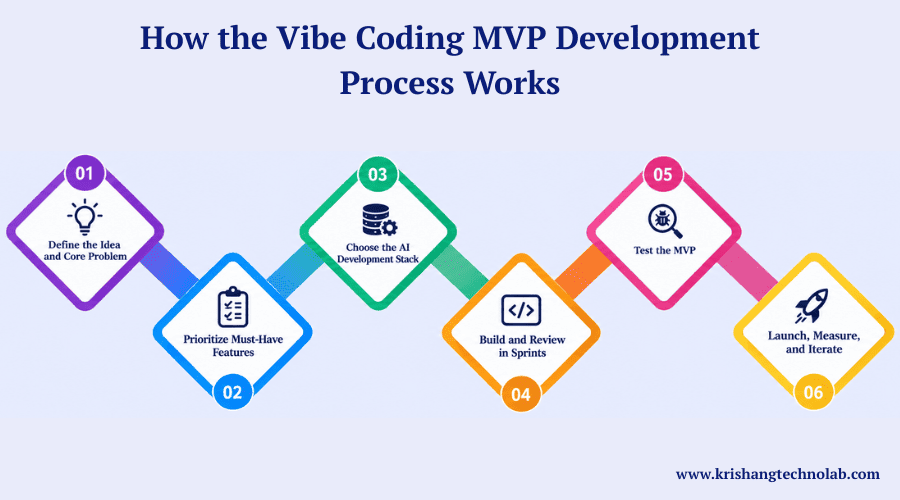
1. Define the Idea and Core Problem
Every build starts with a clearly defined problem statement. The team identifies who the user is, what pain point they face, and what success looks like. Without this clarity, AI-generated output tends to miss the mark entirely.
2. Prioritize Must-Have Features
Teams sort features into three groups: must-have, nice-to-have, and not now. Because scope discipline drives both cost and timeline, this step matters more than any technical decision. Limiting must-haves to three or five features keeps the build focused, especially for AI MVP development for startups working with limited runway.
3. Choose the AI Development Stack
The right AI development stack depends on product type. Build SaaS application using React and Node.js and power it using AI coding assistants. For the AI-driven features, there could be a Python base with model interaction for an AI MVP development project. Choosing the stack early also shapes how Vibe Coding Teams are structured, since fewer specialists are needed once the tooling is settled.
4. Build and Review in Sprints
Work is done in brief spurts, a week or two of intense work. AI writes logic or screens for a developer to review before it gets folded into the main code base. The quality is still there. The rhythm keeps the vibe coding for MVP development fast without losing the reliability of the code. Teams following a proven MVP development process rarely skip this checkpoint.
5. Test the MVP
“Even with AI-generated code, testing is still a must.” Automated tests can quickly identify functional bugs, while manual review can find security and logic issues that AI tools may completely miss. Skipping this step leaves the product at real risk once users interact with the product.
6. Launch, Measure, and Iterate
After launch, the team tracks activation, retention, and direct user feedback closely. These metrics guide the next round of feature decisions and validate whether the core assumption of the MVP is indeed true.
Which AI Tools Are Used for Vibe Coding an MVP?
Several kinds of AI tools supporting a modern vibe coding workflow. The most common AI coding assistants write functions and catch errors right inside the editor. AI-powered app builders enable non-technical founders to prototype quickly. Dedicated tools do a good job of testing, debugging and backend API development. Teams that need this stack managed end to end often bring in AI development services rather than assembling it piecemeal.
- AI coding assistants for in-editor code generation
- AI-powered app builders for rapid prototyping
- AI tools for UI design and wireframing
- AI tools for automated testing and debugging
- AI tools for backend and API development
AI coding assistants remain the most widely used category. They sit inside the development environment and generate functions, tests, and fixes as the developer works. Meanwhile, AI agents are beginning to handle multi-step tasks with less manual prompting. A rundown of the best vibe coding tools on the market makes this stack decision faster.
Benefits of Vibe Coding for MVP Development
There are a number of obvious pros of vibe coding vs traditional builds for MVP development partners. The most obvious is speed, since AI generated code reduces implementation time significantly across most Vibe Coding Teams today.
Then there is the low cost of development. Reduced engineering hours in the build reduces overall budget requirements. What used to require five or six engineers can now be handled by smaller teams. This shift is a direct example of Vibe Coding Changing Startup Team Structures across the industry, not just a one-off efficiency gain.
Prototyping faster means founders can see working software in days, not weeks. Which means you get feedback from users faster, which is the whole point of building an MVP in the first place. And non-technical founders benefit too, as natural language prompts lower the barrier to direct involvement in product decisions. Many of these founders eventually bring in a mobile app MVP development partner once the core web product validates.
Risks and Limitations of Vibe Coding
AI-assisted MVP development has obvious benefits but real risks. The quality of the code varies. Security issues can be overlooked by peer review. Technical debt also compounds faster than most founders realise. So, vibe coding for MVP development demands still requires a human to review each important decision. Understanding Vibe Coding Risks upfront is far cheaper than discovering them after launch.
- Inconsistent AI-generated code quality
- Security vulnerabilities in generated implementations
- Technical debt that accumulates faster than expected
- Scalability gaps not handled automatically by AI
- Reduced architectural oversight without deliberate review
Security needs special attention. Payment integrations, authentication systems, need a human to review it who knows what common AI-generated vulnerabilities look like. Academic research on insecure AI code shows nearly half of generated snippets carry exploitable bugs. This is why most MVP development companies now build in a mandatory security pass.
If you miss this step, you’ll pay for it later, especially as your product grows beyond the MVP stage. Comparing the two paths side by side, Traditional MVP Development vs AI-Assisted MVP Development, usually settles which review process a team commits to. It’s the same discipline experienced software development companies apply to any codebase, regardless of who or what wrote it.
How to Reduce Vibe Coding MVP Development Costs
Controlling vibe coding MVP cost comes down to five practical habits. Each habit directly reduces development hours without sacrificing product quality. Disciplined founders take these steps systematically to keep AI-assisted MVP development cost-effective while still delivering a workable, testable product on time. A seasoned MVP development agency applies most of these by default.
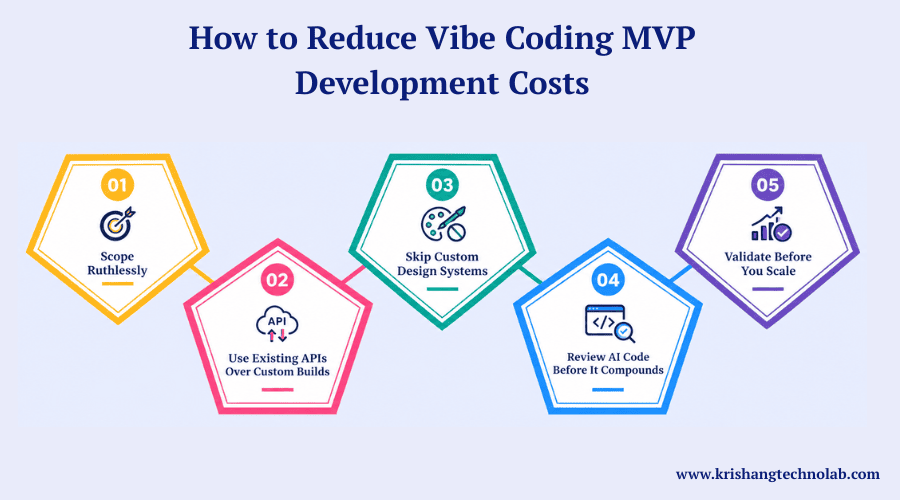
1. Scope Ruthlessly
Limit the build to three to five must-have features only. Every extra feature adds prompt cycles, review time, and cost. Ruthless scoping remains the single most effective way to control overall project cost during the AI MVP development process.
2. Use Existing APIs Over Custom Builds
Don’t build your own custom logic; use existing tools like Stripe or SendGrid. Off-the-shelf integrations will always be cheaper and more reliable than AI-generated integrations. This reduces the time for testing, since these tools can handle edge cases safely.
3. Skip Custom Design Systems
Build on existing component libraries such as Tailwind or shadcn. Custom design polish post validation not on MVP. These savings can add up quickly because early adopters care more about how things work than how they look.
4. Review AI Code Before It Compounds
Sprints are short and focused and catch problems early. Skip the review step, and AI-generated code quietly builds technical debt that costs far more to unwind down the line. If you review each component as it ships, small problems don’t become expensive rewrites down the line. This discipline is what separates reliable vibe coding developers from teams chasing speed alone.
5. Validate Before You Scale
Launch to a small group first, rather than the whole market. Spending on infrastructure or polish before demand is proven remains the single biggest avoidable cost in AI MVP development. Validation protects your budget early.
When Should You Use Vibe Coding for Your MVP?
Vibe coding for MVP development is perfect for SaaS products, internal tools, marketplaces, and early stage AI products. These categories are benefited from fast iteration and low validation stage cost. But for heavy compliance requirements or complex real-time infrastructure, it often takes more work in the trenches than the standard AI-assisted development would. Founders weighing this decision often bring in an MVP development agency for a second opinion, or explore MVP partnerships with a technical co-founder instead.
How to Calculate Your Vibe Coding MVP Budget
A simple formula helps founders estimate total spend before starting. Total MVP cost equals development, AI or API costs, design, infrastructure, testing, and deployment combined. Development is usually the biggest piece, so having this formula in place during early planning helps to avoid budget surprises down the road. Some teams run this exercise directly with an AI consulting services provider before writing a single prompt.
Vibe Coding MVP Cost and Timeline: Example Scenarios
Real numbers provide a context to anchor these ranges. Here are examples of typical project types and typical outcomes.
A simple SaaS MVP with a single core workflow and basic authentication will cost between 15,000-25,000 and take about 4-6 weeks to build. A typical AI-powered model integration MVP costs $40,000 to $70,000 over eight to twelve weeks. Most MVP development agencies quote within these bands once the feature list is locked.
Marketplaces MVP with 2 user types and payment processing will typically cost $30,000 – $55,000 for 7-10 weeks. A mobile app MVP with a backend API generally falls between $25,000 and $45,000 across six to nine weeks. Teams comparing quotes should also read a guide on how to build an MVP before signing a statement of work.
How to Choose the Right Approach for Your MVP
The right approach depends on several variables working together. Your choice will depend on budget, deadline, complexity and technical know-how available. Security and scale are also important especially for fin-tech products. Early thinking about your post-MVP roadmap helps avoid a rushed foundation coming back to hurt future growth and scaling efforts. Reviewing the best tech stack for MVP development guide alongside your roadmap keeps this decision grounded. Most teams still benchmark against a traditional software development company before committing to a fully AI-driven build, especially when the incumbent is an established MVP development company with a track record.
Conclusion: Is Vibe Coding a Cost-Effective Way to Build an MVP?
Vibe coding for MVP development genuinely changes the cost and timeline equation for early-stage founders. Projects that once took six months and $150,000 now often ship in weeks for a fraction of that budget. Vibe coding in 2026 has moved well past the experimental phase into something founders plan around with real numbers.
However, the savings come from faster implementation and iteration, not from skipping engineering judgment. Scope, complexity, integrations and security review still play a major role in the outcome. This is exactly the tension behind Traditional MVP Development vs. AI-Assisted MVP Development, and it rarely resolves in favor of pure speed alone.
Founders who succeed with this approach see AI as a partner, not a replacement for technical thinking. They scope mercilessly, review generated code thoroughly and validate before putting any more skin in the game. Reading up on how to validate a startup idea before development starts remains one of the highest-leverage steps in this entire process.
For most SaaS, marketplace and early AI products, vibe coding for MVP development is the faster and cheaper path to real user feedback. Traditional development still makes sense for complex, compliance-heavy or highly specialised builds. The choice between the two begins with a clear assessment of your budget, timeline and product complexity. Whether founders explore MVP partnerships, hire AI developers directly, or keep everything in-house, best MVPs are built on disciplined scope rather than raw tooling.
Frequently Asked Questions
How much does it cost to build an MVP with vibe coding?
The cost of creating an MVP (minimum viable product) for vibe coding typically ranges from $15,000 to $60,000 for most projects. At the low end you have simple SaaS tools, and at the high end, AI-powered products with model integration can easily cost over $80,000, depending on the scope and complexity.
How long does it take to build an MVP using AI?
AI-assisted MVP development usually takes four to twelve weeks. Simple products ship in 4-6 weeks.Complex builds with compliance or AI features can extend the timelines to 12-14 weeks total.
Is vibe coding cheaper than hiring a development agency?
Yes, vibe coding is usually fifty to seventy percent cheaper for MVP development than a traditional development agency. Much of that cost reduction is due to less engineering hours and faster iteration cycles over similar project scopes.
What is the average cost of an MVP in 2026?
MVP Development Cost 2026 The average cost of MVP development can range from $15,000 to $100,000 depending on the approach you choose. The low end is AI-driven builds, the high end is traditional custom development for similar features.
Can non-technical founders build an MVP with AI tools?
Absolutely. AI-driven development can dramatically lower the technical barrier for non-technical founders. A technical reviewer still earns their keep here, handling architecture calls, security review, and making sure the AI-generated code actually holds up once real users show up.
How much does an AI MVP development project cost?
AI MVP development projects involving model integration or training typically run $35,000 to $80,000. Where a project sits on that spectrum depends on the complexity of the data pipeline, how much you’re going to use the API, and the AI development stack you choose.
What factors increase MVP development timeline the most?
The most increases in MVP development timeline are due to poorly defined requirements and scope creep. Vibe coding MVP timeline estimates also often get pushed out from initial projections by complex 3rd party integrations, security reviews, and slow founder feedback cycles.
Do I still need a developer if I use vibe coding?
Yes, even with an AI-assisted MVP, you still require a developer. They review the code that’s generated, select the architecture, establish security standards and identify issues that automated AI tools frequently miss in the implementation.
Which AI tools are best for building an MVP fast?
AI coding assistants, app builders, and backend generation tools together form the fastest AI development stack. The right balance depends on the type of product (SaaS tool, mobile app or AI-powered platform).
Is an AI-generated MVP secure enough for production?
Ensure that your code is secure before you deploy it to production. When you build your MVP with the help of AI, security is not part of the package. You need to ensure that people’s login methods, payment methods, and data management are all secure.
Found this post helpful? Don't forget to share it with your network!