Quick Overview: Scaling a SaaS engineering team doesn’t have to mean months of local hiring delays and rising costs. This guide walks through how one US SaaS company overcame its talent gap by choosing to hire Indian developers for SaaS companies, covering the hiring process, collaboration strategies, challenges, costs, and measurable results achieved.
Every fast-growing SaaS company eventually hits the same wall: the roadmap is moving faster than the engineering team can keep up with. New features, customer requests, security work, and infrastructure upgrades pile up while the local hiring pipeline crawls along at its own pace. For many US SaaS companies, the limiting factor isn’t ambition or budget; it’s simply not being able to find and hire enough qualified engineers fast enough. This is exactly why so many businesses now hire Indian developers for SaaS companies looking to close that gap quickly.
This is where Indian developers for SaaS companies have become a go-to solution. India’s technology workforce is one of the largest and most experienced in the world, and a growing number of US SaaS businesses are tapping into it to scale their engineering teams without the multi-month hiring cycles and high costs of building everything domestically.
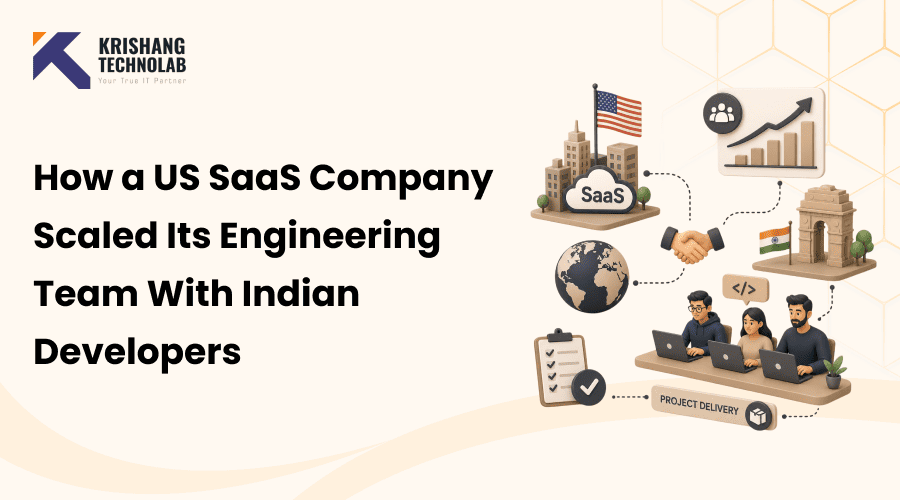
This article walks through how scaling engineering teams with Indian developers actually works in practice using the journey of a US SaaS company as a throughline from the initial hiring challenge to team-building strategy to the results achieved once the India-based engineering team was up and running.
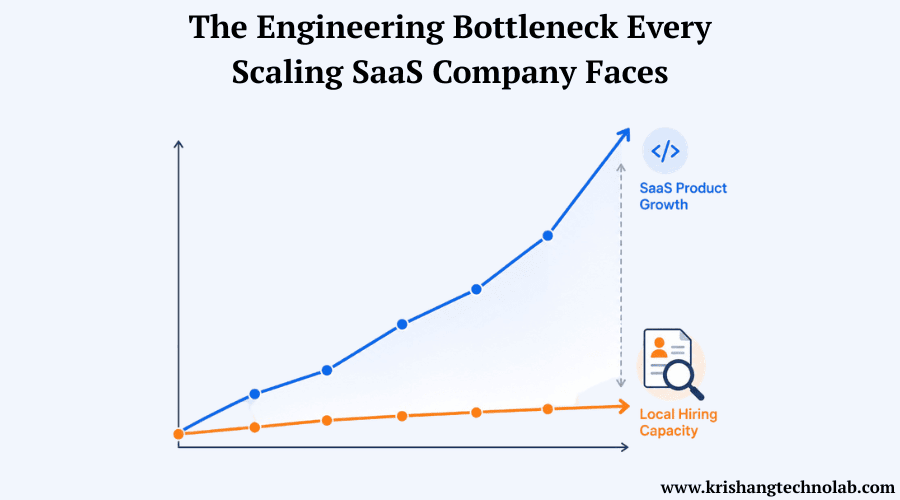
The Engineering Scaling Challenge for US SaaS Companies
As SaaS products mature, the amount of engineering work required to support them grows nonlinearly. New modules, integrations, mobile apps, and infrastructure needs stack on top of the original product, and the backlog grows faster than most teams can clear it.
At the same time, US companies hiring Indian developers has become more common precisely because domestic hiring has grown harder. Experienced software engineers, particularly those with SaaS-specific backend, cloud, and DevOps expertise, are in short supply relative to demand, which drives up compensation and lengthens the recruitment process. A single senior engineering hire in the US can take three to six months from job posting to start date, and that’s assuming the search doesn’t stall entirely.
Add rising salaries, benefits costs, and recruiting overhead, and it becomes clear why traditional local hiring alone often isn’t enough to keep pace with a scaling SaaS business. Something has to change in the hiring strategy itself, not just the intensity of the search. Many companies reach this point exactly when they start exploring how to scale a development team with dedicated developers instead of relying solely on in-house recruitment.
Why the Company Considered Developers From India
Facing a widening gap between product ambitions and available engineering capacity, the company began looking at ways to access a much larger, ready-to-work talent pool. This is a familiar turning point; it’s often the moment when leadership starts asking why Hire Indian developers for SaaS companies in the first place.
62% of US businesses currently outsource IT services to India, demonstrating how commonplace offshore engineering has become for companies seeking to scale effectively.
A few factors made the decision straightforward:
- A large pool of skilled technical talent: India produces a substantial number of computer science and engineering graduates each year, many of whom go on to build deep experience in modern SaaS technologies.
- Relevant SaaS experience: The Indian tech talent is often sourced from global product companies, service providers, and startups that copy the technical stack of the Western SaaS companies.
- Quicker team development: Hiring an Indian software development team can cut down your hiring time significantly as opposed to hiring locally.
- Flexible team structures: Companies can hire individual contributors, put together small squads, or stand up fully dedicated teams, based on need.
- Cost advantages: In India, the compensation benchmarks allow companies to hire experienced engineers at a fraction of the fully loaded cost of an equivalent US hire, without necessarily sacrificing skill level.
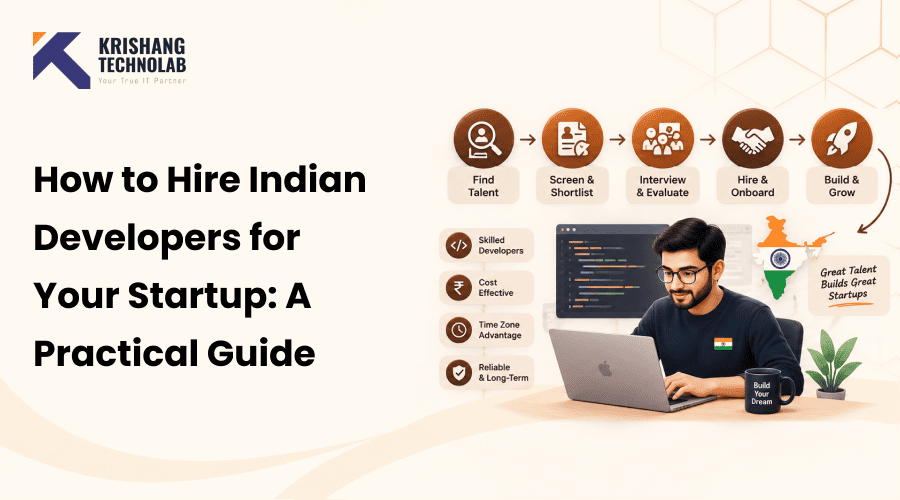
For a deeper look at how this decision typically plays out, Hire Dedicated Developers for Startups breaks down how early-stage and growth-stage companies weigh talent access against cost and control.
How the US SaaS Company Built Its Indian Engineering Team
Defining the Required Roles
Before hiring began, the company mapped out exactly what roles it needed to fill:
- Backend developers to handle core application logic and APIs
- Frontend developers to build and maintain the user-facing product
- Full-stack developers to bridge gaps across the stack
- QA engineers to own testing and release quality
- DevOps engineers to manage infrastructure, deployment, and reliability
- Engineering leadership to coordinate the India-based team and align it with the US roadmap
Having this structure in place before recruiting started made it far easier to hire with intention rather than filling seats reactively.
Finding the Right Indian Developers
Technical skill alone wasn’t the only criterion. The company evaluated candidates for:
- Technical expertise matched to the specific stack in use
- SaaS experience, particularly with multi-tenant architectures, subscription billing, and cloud-native design
- Communication skills, since day-to-day collaboration would happen primarily over written and video channels
- Time-zone compatibility, to ensure enough overlap with the US team
- Cultural alignment, so the India-based engineers could integrate naturally into existing team norms and communication styles
This combination of not just “Can they code?” but “Can they collaborate effectively across a distributed team?” turned out to be one of the more important filters in the hiring process. Companies going through this evaluation for the first time often lean on a structured resource like How to Hire Dedicated Developers to Avoiding the Common Missteps of Screening for Technical Skill Alone.
Building an Offshore Development Team in India
With role definitions and hiring criteria in place, the company had to decide how to structure the relationship. Broadly, there were three paths: direct hiring through a local entity, working with a staffing agency, or partnering with a firm to build a dedicated development team. Each comes with different trade-offs in cost, control, and speed, and the right answer generally depends on how permanent and how large the team is expected to become. Some companies instead set up a full offshore development centre in India, which provides them with more direct oversight than a staffing arrangement while still avoiding the overhead of a wholly owned entity.
Once the structure was chosen, the company focused on:
- Establishing clear communication processes from day one
- Setting up shared project management and collaboration tools so both sides worked from the same source of truth
- Clearly defining responsibilities between the US and Indian teams to avoid duplicated or dropped work
- Creating overlapping working hours so real-time collaboration was possible for at least a few hours each day
This foundational work is often what separates software development outsourcing engagements that succeed long-term from arrangements that stall out after a few months.
The Benefits of Hiring Indian Developers for SaaS Companies
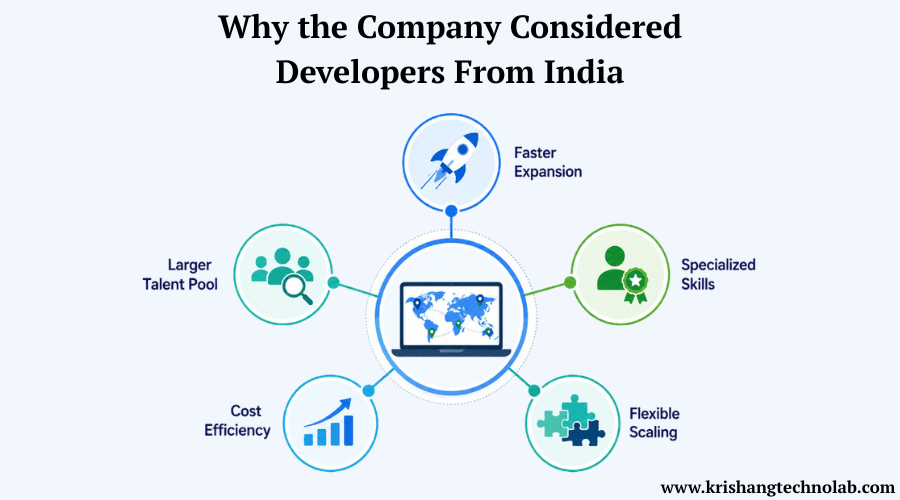
Once the team was up and running, it became clear that there are some advantages to Hire Indian developers for SaaS companies:
- Faster team growth: Local recruiting could help recruit new engineers on board in weeks instead of months and allow the company to move more rapidly on roadmap items.
- Access to specialized skills: The company was able to find developers with the specific expertise required in cloud infrastructure, machine learning development, DevOps automation, and mobile development skills that had been hard to locate domestically at the pace required.
- Cost efficiency: This increased the company’s overall headcount without increasing total engineering spending by optimizing where to spend the engineering budget.
- Larger talent pool: India’s technology workforce enabled the company to draw from a far deeper pool of candidates than the local market could provide.
- Flexible scaling: The team can ramp up and down according to product needs, not fixed headcount regardless of demand.
How the Teams Collaborated Across the US and India
Making a distributed team of remote developers in India function well day-to-day required deliberate process design, including:
- Daily standups scheduled during the overlap window
- Sprint planning sessions that included both US and India-based engineers
- Shared project management systems (issue trackers, documentation wikis, and roadmaps) so nothing lived only in one team’s inbox
- Consistent code review practices to maintain quality across contributors regardless of location
- Active time-zone management, including rotating meeting times to distribute the burden fairly
- Ongoing efforts to maintain a single, unified engineering culture rather than two separate ones
Challenges of Working With an Indian Development Team — and How They Were Solved
No cross-border engineering setup is frictionless. The company encountered and dealt with a variety of typical problems:
- Time-zone differences: Solved by dedicated overlapping working hours and asynchronous documentation for everything else.
- Communication: Covered by clear standards for written documentation and communication channels for different types of updates (urgent vs. non-urgent and technical vs. status).
- Quality control: code reviews, automated tests, and common engineering standards expected of all contributors.
- Cultural Differences: These can be overcome by spending time on relationship building, two-way open feedback, and making sure the India-based team sees the company strategy and not just the task lists.
- Security and Data Privacy: All of our team members, no matter where they are located, have strict control of access, compliance reviews, and secure development practices.
The Results: How the SaaS Company Scaled
While exact numbers will vary from company to company, this is the kind of engineering scaling with Indian developers that typically shows up in a few measurable ways:
- A significant increase in the number of engineers added within a defined period
- A team build-out timeline measured in weeks rather than the months typical of local-only hiring
- Improved development velocity, with more sprints shipped and a shorter cycle time on feature delivery
- More frequent product releases as backlog pressure eased
- Meaningful engineering cost savings compared to an equivalent fully US-based build-out
- Reduced average time-to-hire per engineering role
- Downstream customer and product growth, as faster shipping translated into faster response to market demand
For companies considering this approach, tracking these same metrics—headcount growth, hiring speed, velocity, release cadence, and cost—is a useful way to measure whether an India-based team is delivering on the expected value. Reviewing current agency and outsourcing profitability statistics can also help set realistic benchmarks before the engagement begins.
Direct Hiring vs. Outsourcing SaaS Development to India
| Factor | US-Based Hiring | Indian Development Team |
| Talent pool | Limited by local market size and competition | Access to one of the world’s largest tech talent pools |
| Hiring speed | Often 3–6 months per role | Frequently weeks, especially through agencies or dedicated teams |
| Cost | Higher salaries and fully loaded employment costs | Generally lower cost for comparable experience levels |
| Scalability | Constrained by local supply and budget cycles | Easier to scale up or down based on product needs |
| Technical expertise | Strong, but harder to source at scale quickly | Deep bench across SaaS, cloud, AI, and DevOps skill sets |
| Time-zone considerations | Full overlap with US business hours | Requires planning for overlap, typically a few hours per day |
How Much Does It Cost to Hire Indian Developers?
The cost of hiring dedicated developers in india for US companies is determined by a number of factors:
- Developer experience and specialization: More experienced engineers with niche skills (e.g., specialized cloud platforms or artificial intelligence systems) are more expensive than generalist developers.
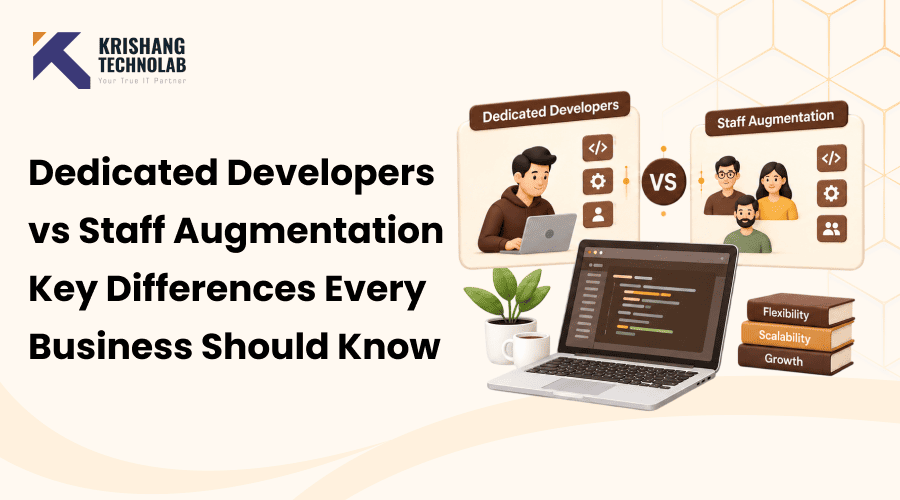
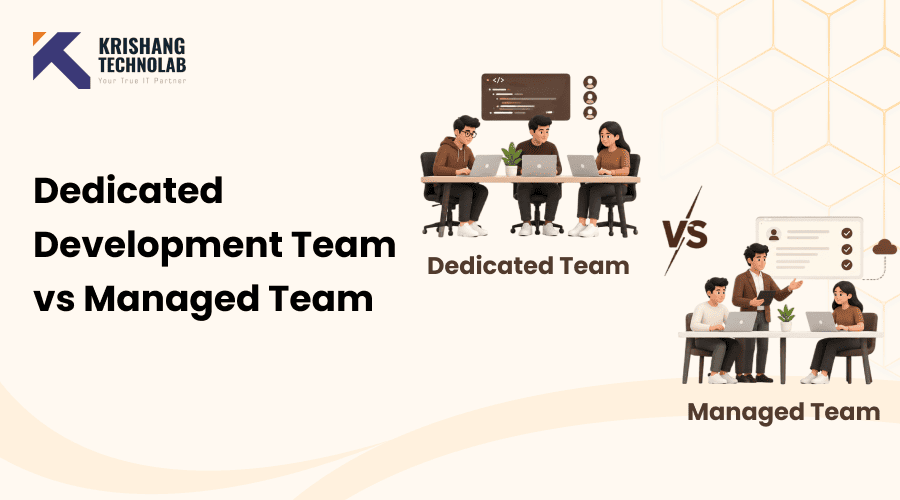
- Models of full-time vs. dedicated teams: direct full-time hires, staff-augmentation arrangements, and fully managed dedicated teams all have different levels of overhead included and cost structures.
- Infrastructure and management costs: equipment, tooling, and local management or agency fees can add to the base compensation cost.
- Comparison with US engineering hiring costs: even accounting for these additional costs, hiring through India frequently remains meaningfully less expensive than an equivalent US-based hire, particularly at the senior level.
Because these variables shift by role, seniority, and engagement model, most companies find it worthwhile to build a detailed cost comparison specific to their own hiring plan rather than relying on general averages alone. If broader outsourcing is also on the table, it’s worth understanding white label agency vs. outsourcing models, since the cost structure and division of responsibility differ meaningfully between the two.
When Should a USA SaaS Company Consider Hiring Developers From India?
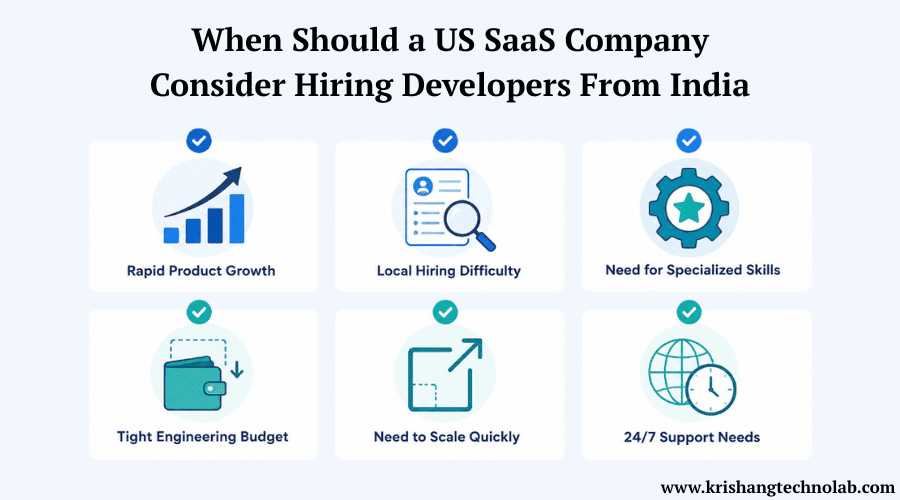
This approach tends to make the most sense in specific situations, including:
- Rapid product growth that’s outpacing current engineering capacity
- Persistent difficulty hiring qualified engineers locally
- A need for specialized technical skills that are scarce or expensive domestically
- Tight engineering budgets that require getting more output per dollar
- A need to expand development capacity quickly, without waiting out a long hiring cycle
- 24/7 development or support requirements, where time-zone differences can actually become an advantage rather than a drawback
Companies weighing a more permanent, larger-scale presence rather than a single team should also look at building a global capability center, which extends the same model beyond engineering into broader business functions.
Best Practices for Building a Successful India Engineering Team
Companies that get the most out of an Hire Indian developers for SaaS companies tend to follow a similar playbook:
- Hire for skills and cultural fit, not just technical ability, but communication style and collaboration mindset.
- Start with a clearly defined team structure so roles, reporting lines, and responsibilities are unambiguous from day one.
- Establish communication expectations early, including response times, documentation standards, and meeting cadence.
- Invest in onboarding so new engineers understand not just the codebase but also the product context and company goals.
- Maintain consistent engineering standards across every team member, regardless of location.
- Give Indian developers ownership of meaningful projects, rather than restricting them to peripheral tasks.
- Build long-term relationships instead of treating the team as a temporary resource; retention and institutional knowledge matter just as much offshore as they do domestically.
For teams already managing a dedicated engineering group, How to Scale Your Development Team With Dedicated Developers goes deeper into the day-to-day management practices that keep a growing team aligned.
Working With a Partner Like Krishang Technolab
Not every SaaS company wants to run the sourcing, vetting, and team-building process entirely on its own and that’s where a partner with an established presence in India can shorten the path considerably. Krishang Technolab is one such AI-driven software and app development company, based in Ahmedabad, India, with more than 8 years of experience serving SaaS and enterprise clients across the US, UK, and other markets.
Rather than starting from scratch, companies can hire dedicated developers who already have experience with common SaaS stacks, including backend frameworks like Node.js and Python, and frontend technologies such as React and Next.js. For companies that want a fully managed engagement rather than individual hires, Krishang Technolab’s offshore development center model provides an established team, infrastructure, and management layer from day one, which removes much of the setup work described earlier in this article.
This kind of partnership can be especially useful for teams that don’t yet have the internal processes to manage a distributed workforce a dedicated partner brings established communication routines, project management practices, and quality standards that would otherwise take months to build from scratch in-house.
Conclusion
Hire Indian developers for SaaS companies offer a proven way to fill the growing gap between product aspiration and engineering capacity for US SaaS companies, providing access to a deep talent pool, faster hiring, specialized technical skills, and significant cost efficiency.
The companies that succeed with this model don’t treat their India-based engineers as a stopgap but as a true extension of the team. They invest their money in transparent communication, fair processes, and long-term relationships, rather than simply seeing the arrangement as transactional.
For SaaS founders and CTOs who are considering this option, the pragmatic takeaway is simple: begin with a clear team structure, hire intentionally for both skill and collaboration fit, and build the communication mechanisms that make a distributed team work before scaling headcount. Get that foundation right, and an engineering team based in India can be one of the most effective levers to scale a SaaS business.
If you’re ready to explore what this could look like for your own product, you can request a free consultation to talk through your specific engineering roadmap.
Found this post helpful? Don't forget to share it with your network!